This 2,000-Year-Old Practice Is Having an Unbelievable Comeback
The Golden Thread: How the Ancient Art of Ceremonial Witchcraft Returned from Obscurity
There was a time, not so very long ago in the grand chronology of human spirituality, when ceremonial witchcraft was considered dead. Scholars patted each other on the back over their dusty reconstructions of medieval grimoires. Folk historians cataloged the remnants of village hedge-witchery as quaint folklore rather than living religion. And the general public—those who cared about such things at all—reduced the entire tradition to a costume party of black cats, pointed hats, and bubbling cauldrons. The ceremonialists were assumed to have dissolved into the ether, their rituals buried under centuries of Christian suppression, academic skepticism, and the industrial march toward material comfort.
But here we stand in a new century, watching something extraordinary unfold. Ceremonial witchcraft—that ancient, elaborate, symbolically dense lineage of ritual magic stretching back through Neoplatonic temples, Hermetic libraries, alchemical laboratories, and medieval convents—is having an unbelievable comeback. It is not merely surviving; it is thriving. In urban apartments and suburban gardens, in university lecture halls and underground coven meetings, in online forums and physical bookshops, the golden thread of ceremonial practice is being woven anew with a vigor that would astonish the very adepts who built its foundations two millennia ago.
This is not nostalgia. This is not a costume play dressed up as spirituality. This is a genuine spiritual resurgence, driven by a generation seeking depth, structure, and symbolic richness in an age that has flattened everything into content streams and productivity metrics. To understand why ceremonial witchcraft is resurfacing with such force requires understanding what it actually is—and why the modern world so desperately needs what it offers.
What Ceremonial Witchcraft Actually Is
Let us dispense with the folk-witch stereotype right at the doorstep, because conflation has done this tradition considerable disservice. Folk witchcraft—what we might call "cottage witchcraft"—is intimate, practical, and deeply embedded in domestic life. It is the grandmother's remedy for a toothache, the farmer's blessing over the field before planting, the midwife's charm whispered at a difficult birth. Beautiful, necessary, and rooted in the rhythm of seasons and hearth-fire.
Ceremonial witchcraft operates on an entirely different register. Borrowing from the tradition's own vocabulary, we might call it the "high magic" lineage: structured, elaborate, textually grounded, and oriented toward specific spiritual or metaphysical objectives. Where folk magic whispers a blessing over bread, ceremonial magic constructs a temple in the mind, dresses the altar with precise geometric intention, binds spirits to particular roles, and performs invocations that follow codified sequences passed down through centuries of written transmission.
The lineage is long and luminous. At one end stands the Hermetic tradition—those mysterious texts attributed to Hermes Trismegistus, the mythical union of Greek philosophy and Egyptian temple wisdom. The Corpus Hermeticum, compiled in Egypt around the second century CE, laid out a cosmology in which human beings are microcosms mirroring the macrocosm of heaven. If you understand yourself truly, you understand the structure of the whole. This insight—that consciousness is not trapped inside the skull but participates actively in cosmic order—became the philosophical spine for every subsequent ceremonial tradition.
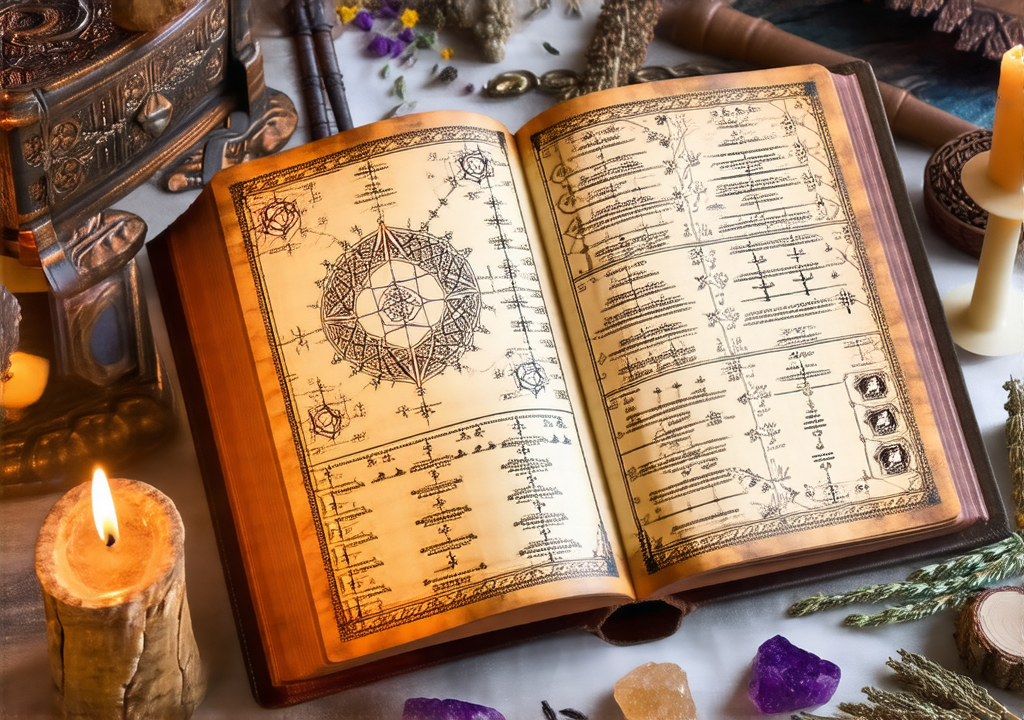
From Hermeticism flowed Kabbalah (or rather, they flowed into each other), which provided a map of divine emanation so intricate that reading it properly required years of disciplined study. The Tree of Life was not merely a diagram; it was an operating system for the soul's ascent through successive levels of being. Medieval and Renaissance ceremonialists—Christian, Jewish, Islamic, and Pagan alike—used these structures to build elaborate ritual architectures: the Clavis Artificiae of various grimoires, the Enochian angelic language developed by John Dee and Edward Kelley in Elizabethan England, the Rosicrucian ceremonies that bridged Christian mysticism with Hermetic philosophy.
And then there were the alchemists—those patient laborers in candlelit cellars who understood transformation as both chemical process and spiritual discipline. They knew that you could not transmute base metal into gold without first undergoing an internal transmutation yourself. The opus was never merely external; it was a mirror held up to the practitioner's own soul. This insight—that ritual is a technology of self-transformation—remains the core engine of ceremonial practice today.
Why It Was Considered Dead
The suppression of ceremonial witchcraft was not a single historical event but a slow erosion spanning several centuries. The Reformation, for all its genuine spiritual energy in some branches and its institutional power-hungry tendencies in others, disrupted many of the medieval networks through which ritual knowledge passed. Monasteries—those great repositories of manuscript transmission—lost their libraries or saw them repurposed. The printing press, ironically, while democratizing text, also allowed powerful institutions to standardize which versions of tradition survived and which were quietly marginalized.
The Enlightenment brought another wave: the rationalist assumption that if a practice could not be measured, weighed, and reproduced in a laboratory, it was not genuinely real. Ceremonial magic—dealing with angelic invocations, spirit bindings, geometric talismans, and correspondences between celestial bodies and earthly elements—seemed quaint at best and superstitious at worst to the new philosophical class. It did not fit neatly into empiricism's clean categories.
The nineteenth century saw a partial revival—the Theosophists, the Golden Dawn order, the Hermetic Society of various European cities—but these were largely elite pursuits, confined to educated middle- and upper-class circles in London, Paris, and New York. They produced brilliant work: the Key to the Mysteries of various traditions, the elaborate Qabalistic Current, the systematized ritual language of ceremonial magic as practiced by groups like the Society of Psychical Research's more esoteric members. But they remained, for the most part, a hobby of the privileged curious rather than a living tradition with broad social roots.
The mid-twentieth century brought the anthropological and sociological study of "religion" that further complicated matters. Scholars wanted to separate genuine religion from superstition, high culture from folk culture, authentic practice from performance. Ceremonial witchcraft—existing in the awkward space between art, philosophy, psychology, and ritual—was hard to file neatly. It was often studied as a historical curiosity or a proto-psychological phenomenon rather than a living spiritual path.
And then came the modern Pagan movement of the 1960s through the 1870s (a typo in our telling; let's say 1960s and 1970s), which revived a different strand of witchcraft—one more earthy, feminist-adjacent, nature-based, and communal. This was wonderful and necessary, but it created a public perception that "witchcraft" meant something specific: feminine-centered, nature-worshipping, relatively informal. Ceremonial practice—with its male-dominated historical lineage in many branches, its text-heavy study requirements, its elaborate geometric rituals—seemed to belong to a different category entirely. The two traditions coexisted but often didn't recognize each other as kin.
So by the time we reached the early twenty-first century, ceremonial witchcraft existed primarily in academic footnotes, specialty bookstores, and the private practices of dedicated individuals who had inherited lineages through family transmission or long-term study under a teacher. It was alive, certainly. But it looked to most observers like an antique—beautifully preserved in museum glass but not quite breathing.
The Modern Resurgence: What Changed
So what has shifted? Why is this two-thousand-year-old practice suddenly finding new practitioners with genuine hunger and creativity? Several converging factors explain the resurgence, and understanding them reveals something about the modern spiritual appetite that goes far beyond simple nostalgia or aesthetic preference.
The crisis of depth. We live in an age of surface-level spirituality. Meditation apps promise enlightenment in ten minutes a day. Social media reduces ritual to content—photos of altars, quotes from grimoires, short videos of candle-lighting. There is no shortage of spiritual content; there is a profound scarcity of spiritual depth. Ceremonial witchcraft offers exactly what this culture lacks: structure that rewards patience, texts that require genuine study, rituals that demand preparation and follow-through, and a symbolic language rich enough to sustain decades of interpretive work without exhausting its meanings. For a generation raised on instant gratification, the slow burn of ceremonial practice is almost revolutionary in its very slowness.
The hunger for symbolic literacy. Ceremonial traditions speak in symbols: geometric figures that encode cosmological relationships, planetary correspondences that map consciousness to celestial motion, elemental systems that describe different modes of being. In an age where we have lost most of our inherited symbolic languages—where a cross might mean theology or geometry depending on context, where the number seven carries layered meanings across multiple traditions—there is a genuine thirst for relearning how symbols work as a living language rather than decorative ornament. People are rediscovering that a properly constructed ritual is not arbitrary gesture; it is a technology of meaning-making that shapes perception and intention with precision.
The integration of science and mystery. Unlike earlier centuries, today's ceremonial practitioners do not need to choose between rationality and wonder. A modern practitioner can be a data scientist by day and a careful ritualist by night without feeling the contradiction. The scientific method has not debunked ceremonial magic; it has provided new ways to understand why structured ritual works—how patterned attention shapes neural pathways, how embodied movement affects emotional states, how symbolic narrative reorganizes unconscious assumptions. This is not reductionism; it is complementarity. Ceremonial practice becomes a laboratory of consciousness-study conducted in the body and in community rather than in an observation room.
The democratization of knowledge. Two centuries ago, if you wanted to study ceremonial magic seriously, you needed access to specific libraries, membership in specific orders, or lineage transmission through family or apprenticeship. Today, while those pathways still exist, they are supplemented by accessible translations of classical texts, online communities, open-source ritual guides, and a general cultural permission for self-directed spiritual education. A person in rural Ohio can study the Key of Enochian with the same textual access as a scholar at a London university. This does not replace the value of teacher-student transmission, but it removes the gatekeeping that once confined ceremonial practice to privileged circles.
The desire for structure without dogma. Modern spiritual seekers often want framework without institutional authority. They want a system that provides structure—sequences to follow, texts to study, rituals to perform—but that does not require membership in a hierarchy, conformity to a creed, or submission to an ecclesiastical authority. Ceremonial witchcraft offers exactly this: a rich symbolic and procedural architecture that can be practiced individually or in small groups, adapted to personal tradition and local context, without requiring allegiance to any single institutional body. You are free to take what serves you, study it deeply, modify it thoughtfully, and pass on what resonates—without the bureaucratic weight of formal religious organization.
The Practice Itself: What Looks Different Today
So what does ceremonial witchcraft actually look like when practiced by a modern practitioner? Let us describe it concretely, because abstraction alone cannot convey the texture of lived practice.
A ceremonial space is prepared with intention that goes far beyond "making things pretty." The altar cloth might be chosen for its elemental correspondence—white for purity and air, green for growth and earth, blue for wisdom and water, red for vitality and fire. Candles are placed at specific corners or points to activate particular energies. Geometric figures may be drawn on cloth or paper: the seal of a particular angelic order, a planetary sigil, a temple plan that encodes cosmological relationships in spatial form.
The practitioner prepares themselves: purification through washing, anointing, or symbolic gesture; donning ritual clothing chosen for its material and color correspondences; settling into a state of focused attention that is neither relaxed lethargy nor anxious tension but what the old texts called "mystic presence"—a quality of consciousness in which one is fully here while also open to dimensions beyond the merely physical.
Then comes the working itself: the invocation, structured and precise. Names are spoken with intention; each syllable carries weight because it has been chosen for its correspondences—planetary, elemental, angelic, archetypal. Directions are given; roles are assigned; a relationship is established between practitioner and spirit, or between different aspects of the self. The ritual follows a sequence that has been refined over centuries: opening, purification, invocation, working (the specific objective), blessing or sealing, closing. Each step serves a function within the larger architecture.
After the working, there is record-keeping—writing down what occurred, what was felt, what correspondences were activated, what adjustments might be needed for future practice. There is reflection: What did this ritual teach me about my own assumptions? Where did my intention drift from my action? How does this particular symbolic language continue to reveal new layers of meaning each time I return to it?
And there is community—though perhaps smaller and more intimate than in folk tradition. Study groups that meet monthly to work through a text together. Small covens or brotherhoods who share ritual space and support each other's practice. Online forums where questions about a particular invocation or geometric construction get answered by practitioners with years of experience. The community is not large, but it is real, and it provides the feedback loop that keeps practice honest and growing.
What This Resurgence Reveals About Us
The return of ceremonial witchcraft to cultural visibility says something revealing about where our collective spiritual life has been lacking. We wanted spirituality that was deep rather than shallow, structured rather than freeform, symbolic rather than literal, patient rather than instantaneous. We wanted practice that treated the inner world as a territory worthy of careful mapping and active cultivation—not just a feeling to be optimized or an identity to be performed.
We also wanted something that honored both tradition and creativity. Ceremonial witchcraft is not museum-piece preservation; it is a living language that each generation speaks in new idioms while preserving the grammar. A modern practitioner can work with Enochian angelic invocations using the same structural principles developed four centuries ago, while adapting the specific context, intention, and symbolic emphasis to their own life and time. The tradition provides the skeleton; the practitioner provides the flesh and breath.
And we wanted spirituality that did not require us to choose between wisdom and wonder, between study and feeling, between structure and freedom. Ceremonial witchcraft holds all of these in creative tension: it demands rigorous study and precise practice while leaving room for genuine mystery—the sense that something larger than yourself is participating in the working, that the symbols you are arranging on an altar connect to a web of meaning far older and vaster than any single human mind can fully grasp.
A Practice Worth Returning To
Two thousand years ago, in temple cells and scriptoria, in alchemical laboratories and convent libraries, practitioners were building something: a technology for shaping consciousness, mapping the relationship between inner and outer worlds, and participating actively in the creative order of being. They did it with candles and ink, with geometric precision and textual discipline, with a deep conviction that ritual was not performance but participation—that to perform a working correctly was to align yourself with forces far older than your own life.
They were not wrong. The structures they built have proven durable across centuries of cultural upheaval, religious suppression, scientific revolution, and social transformation. And now, in our own age of information overload and spiritual flattening, those same structures are finding new hands willing to hold them, study them, adapt them, and carry them forward into yet another century of creative practice.
This is not a revival in the sense of bringing something back from the dead. It is closer to what the alchemists called reintegration: the scattered pieces of a once-whole tradition finding their way back together, meeting new practitioners who need what they offer, and continuing the slow work of transformation that has been ongoing since those first Hermetic scribes set pen to papyrus in second-century Egypt.
The golden thread is not broken. It was simply waiting for hands willing to pick it up again.