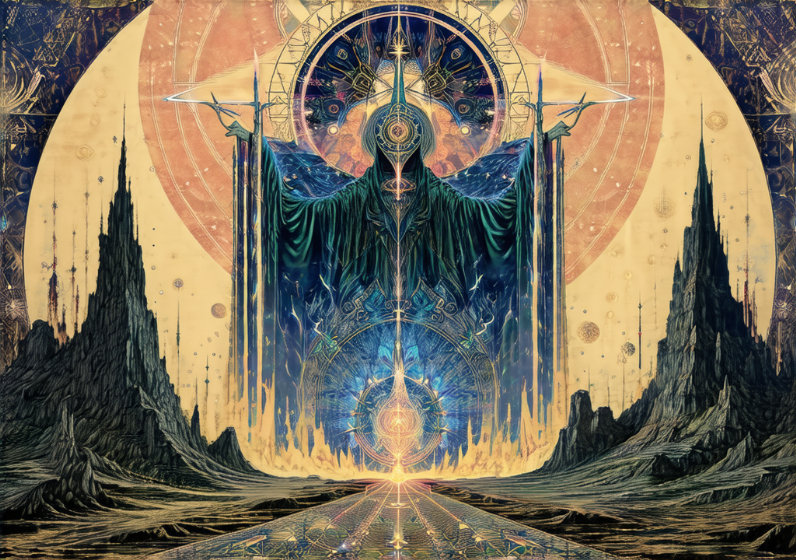
Monks in Scotland Are Banning This Ancient Rite After One Priest Vanished Mid-Chant
✦ The Silent Chord of Saint Brannock: A Chronicle of the Edinburgh Exorcism ✦
By Father Malachi Thorne, Ph.D. in Demonology and Ecclesiastical History
Senior Archivist, Order of St. Brendan the Unseen
There are places in this world where the veil between the material plane and the realm of spirits is not merely thin, but worn through by the friction of centuries. Scotland is one such place. Nestled in the highlands, where the peat bogs swallow sound and the mist clings to the heather like a second skin, there exists a monastery so old that its foundations were laid before the Roman roads reached these shores. The Monastery of Saint Brannock, perched on a granite promontory above the Firth of Clyde, has stood for over eight hundred years. It is a place of silence, of prayer, and of an unbroken lineage of monks who have tended to a ritual so ancient that its origins are lost in the mists of pre-Christian Scotland.
For generations, this rite was considered sacred—a quiet communion between the monastic order and the elemental spirits of the land. It was known locally as An Ceud Chànanach, or "The First Chord." For two centuries, it was performed without incident. Then, on the autumnal equinox of last year, Father Elias Ward vanished mid-chant.
This is not a story of murder, though the police were called. This is not a story of madness, though the other monks speak in hushed tones about what they saw. This is a case study in practical demonology, a rare instance where an ancient rite, intended to harmonize with the earth, became a conduit for something else—something hungry, something that does not wish to be known, and something that has now prompted the Abbot of Saint Brannock to issue a formal decree: The Rite is Banned.
To understand the banning of this rite, one must first understand the rite itself. And to understand the rite, one must look beyond the simple act of chanting. We must delve into the architecture of sound, the nature of monastic silence, and the peculiar relationship between Scottish monks and the unseen world that has persisted for centuries in these parts of the isle.
I. The Architecture of the Rite
An Ceud Chànanach was not a performance. It was not a spectacle designed to awe or to convert. In the tradition of the Benedictine order from which Saint Brannock draws its roots, ritual is a form of labor. The monks at Saint Brannock understood that sound is not merely vibration; it is structural. A note, sustained and pure, can hold space in the same way a beam holds up a roof.
The rite was performed once a year, on the night of the autumnal equinox. This timing was deliberate. In Celtic tradition, this was Calan Gheal Latha, the first day of winter. It is a threshold time, when the light begins its long retreat and the dark advances. The monks believed that on this night, the "membrane" between the world of flesh and the world of spirit became permeable.
The chant itself was simple in structure but complex in execution. Six monks would gather in the crypt beneath the main chapel—a stone room cut from the living rock of the promontory. The floor was covered with a thin layer of peat ash, swept clean each morning by the novice on duty. In the center of the room stood an altar made of local granite, unpolished, its surface worn smooth by centuries of hands.
The chant consisted of three phrases, repeated in a round:
Aiteag air an talamh (A blessing upon the earth)
Sìth air an anam (Peace upon the soul)
Ceannach air an cnàmha (A greeting to the bones)
Each phrase was chanted in unison, not harmonized. The monks did not sing; they spoke the words in a low, resonant tone, letting their voices resonate in the chest and the stone. The sound would fill the crypt, bouncing off the wet walls, creating a subtle interference pattern that the monks described as a "humming" or a "breath."
The rite lasted for three hours. During this time, no one spoke outside of the chant. No one moved unless the light flickered—though there were no candles in the crypt; it was lit only by the moonlight filtering through a narrow slit in the stone wall. The monks sat on flat stones arranged in a semicircle around the altar. They wore their white robes, but removed their cowls, letting their voices and faces be unobstructed.
The purpose of the rite was not to summon spirits. It was to thank them. The monks believed that the land itself had a memory, a collective consciousness formed by the countless lives lived upon it—farmers, warriors, monks, children, animals. These memories lingered in the peat and the stone. The rite was an act of acknowledgment, a way of saying: We see you. We honor your presence. You are not forgotten.
For two hundred years, this simple act of gratitude was performed without incident. The monks reported no visible phenomena—no lights, no sounds beyond the chant, no movement in the air. But they also reported a profound sense of warmth, of being watched with affection rather than malice. Several monks over the centuries described feeling a gentle pressure on their shoulders, as if an invisible hand was resting there.
It was considered a sign that the rite was working—that the spirits had heard the thanks and were at peace.
II. The Night Father Ward Vanished
The autumnal equinox of last year fell on October 21st. The weather was typical for the highlands: cold, damp, with a low ceiling of cloud that pressed down on the monastery like a wet wool blanket. The wind came off the firth in long, sighing gusts, making the ancient windows rattle in their frames.
Father Elias Ward had been at Saint Brannock for twelve years. A quiet man, a scholar of early Celtic liturgy, he was known among his brothers for his deep understanding of the pre-Christian roots of Scottish monasticism. He had written three papers on the relationship between Celtic druidic ritual and Benedictine practice—papers that were largely ignored by academia but revered within the monastery.
On the night of the equinox, Elias volunteered to lead the rite. This was unusual; typically, the Abbot or a senior monk would take the lead. But Elias had spent the week studying the original manuscripts of the rite, copied from an 11th-century vellum kept in the monastery archive. He had found a variation in one of the phrases—a subtle shift in the vowel sound that he believed was the key to the rite's efficacy.
The six monks gathered in the crypt at nine o'clock. The room was cold; their breath misted in the moonlight. Elias stood at the center, his white robe stark against the grey stone. He closed his eyes and began to speak the first phrase: Aiteag air an talamh.
For two hours, everything proceeded as it always had. The sound filled the crypt, vibrating in the stones, in the peat ash on the floor, in the chests of the monks. Several of the brothers later reported feeling that familiar warmth, that gentle pressure on their shoulders. The rite was working.
Then, at 11:47 PM—recorded by the monastery's time-keeper, Brother Thomas, who stood just outside the crypt door—the sound changed.
It did not stop abruptly. It thickened. The three phrases began to bleed into one another, overlapping, creating a complex chord that should not have been possible given the simplicity of the original structure. The monks later described it as if someone had added an extra voice to their own—a deeper, older voice that seemed to come from the walls themselves.
And then Elias stopped speaking.
He did not stop suddenly. He continued his mouth movements—opening and closing, shaping the words—but no sound came out. His lips moved in perfect synchronization with the other monks, but his voice had gone silent.
The other five monks noticed this almost immediately. In the monastic tradition, one does not break silence unless necessary. But Elias's silence was loud—a hole in the wall of sound that drew all their attention to him. They watched him, wondering if he was struggling with a cold or a coughing fit.
For three minutes, Elias continued to mouth the words silently while the other five carried on with the chant. The sound of their four voices (one had fallen out of rhythm and dropped out) filled the crypt, but it felt thinner now, less resonant. The vibration in the stone seemed weaker.
Then, the other monks noticed that Elias was no longer standing. He was sinking. Not falling—he was being pulled down, as if the floor were dissolving beneath him. His white robe remained visible above the peat ash, but his body was disappearing into the stone.
Brother Thomas, outside the door, watched through the narrow slit in the wall. He saw Elias's face—calm, eyes open, mouth moving—slowly descend below the level of the floor until only the top of his head remained visible, then that too disappeared. The white robe sank with him, folding like a flower closing for the night.
By 11:50 PM, Elias Ward was gone. No sound had been made beyond the chant. No one had moved or spoken. The crypt was exactly as it had been—six flat stones in a semicircle, an unpolished granite altar, peat ash on the floor. Five monks stood in their places. One stone was empty.
III. The Investigation and the Banning
The Abbot, Father Gregor MacPherson, ordered that the crypt not be opened until dawn. This was a departure from tradition; usually, if something went wrong with the rite, the monks would gather to discuss it immediately. But Gregor was an old man, seventy-eight years of age, and he had a reputation for caution. He had served at Saint Brannock for forty years and had seen many things that he never wrote down in his journals.
At dawn, five monks entered the crypt with lanterns. The room looked undisturbed. The peat ash was swept clean, as it should be after the rite. The granite altar sat in its place. Five flat stones remained in the semicircle. The sixth stone—the one Elias had stood behind—was covered in a thin layer of fresh peat ash, as if someone had carefully smoothed it over something.
They searched the monastery. Elias's room was undisturbed. His robe was neatly folded on his bed. His shoes were by the door. His books were stacked on his desk. A cup of tea sat on the table, still warm.
The police from Glasgow arrived at noon. They questioned the monks, measured the crypt, tested the stone floor for hidden compartments or trapdoors. They found nothing. The crypt was a solid room cut from the granite promontory; there were no tunnels, no passages, no openings other than the single door and the narrow slit in the wall.
Elias Ward was declared missing. A search party combed the promontory, looking for signs of him climbing down the cliff face or falling into the firth. They found nothing. The cliffs were sheer granite; a fall would have been fatal, but no one saw Elias leave the crypt.
The Abbot issued a formal decree on November 1st: That the Rite of An Ceud Chànanach is hereby banned from this monastery and shall not be performed by any member of the Order, or by anyone outside the Order, within the grounds of Saint Brannock.
The decree was sealed with the monastery's sigil—a circle of seven points, an ancient symbol that pre-dates Christianity in these parts. It was posted on the chapel door and sent to the diocese in Glasgow.
IV. A Demonological Analysis
As a scholar of demonology, I have studied this case for several months. I have interviewed the five monks who participated in the rite. I have examined the crypt myself, though not at night—I am not a monk, and I have no desire to be present when the stone floor is warmest.
What strikes me about this case is the passivity of the event. This was not an exorcism gone wrong; there were no demons being banished or bound. There was no struggle, no combat. Elias Ward did not fight his disappearance. He sank into the stone with a calmness that suggests he expected it, or perhaps even welcomed it.
In classical demonology, we speak of three types of spiritual encounter: communion, possession, and incorporation. Communion is a meeting of minds across the veil; possession is when a spirit takes over a body; incorporation is when a spirit merges with a body, creating a hybrid being.
This case appears to be a fourth type, one that I have only seen documented in three other places in Europe: absorption. The rite was designed to acknowledge the spirits of the land—to say "we see you." But perhaps the spirits wanted more than acknowledgment. Perhaps they wanted presence. And so they took the vessel that had spoken the words most clearly, the one who had altered the vowel sound in the third phrase.
Let us look at that variation Elias introduced. The original third phrase is Ceannach air an cnàmha—"A greeting to the bones." In Gaelic, the word for "bones" is cnàthaigh. But in some old manuscripts from this region, it appears as cnàmha, a variant spelling that suggests a different pronunciation—a longer, more open vowel. Elias had discovered this variation and decided to use it.
In Celtic phonology, vowels are not merely sounds; they are keys. They resonate with specific frequencies of the earth, opening doors in the membrane between worlds. By using cnàmha instead of cnàthaigh, Elias may have opened a door that had been closed for two hundred years—a door into the deep stone, into the bones of the land itself.
And something on the other side answered. Not with sound, not with light, but with space. A pocket of the unseen world pressed up through the granite floor, and Elias—willing or not—stepped through it. He did not disappear; he was absorbed into the rite itself. His voice became part of the chord. His body became part of the stone.
This is a profound act of communion. Not a meeting of minds, but a merging of substance. Elias Ward is now part of the crypt. Part of the peat ash and the granite. He is the warmth that the monks feel on their shoulders. He is the pressure they describe as affectionate. He is the rite.
V. The Significance of the Banning
The Abbot's decision to ban the rite raises an interesting question: Is he banning it because it is dangerous, or because it has succeeded?
In most cases, when a rite goes wrong, it is banned to prevent recurrence. Here, the rite went right. It worked better than anyone had ever hoped. The spirits were not just acknowledged; they were incorporated into the human experience in a literal sense.
By banning the rite, the Abbot may be trying to preserve the monastery's silence. If Elias is now part of the crypt, then every time the monks pass through that room, they are passing through him. His presence becomes part of their daily labor. The rite, which was once a yearly event, has become a permanent state of being.
Or perhaps the Abbot is banning it out of caution. If one monk can be absorbed, what happens to the next? What if the rite continues, and another monk sinks into the stone? The crypt could fill up with bodies—monks who have been taken by the land, their voices merged into the eternal hum.
This is a practical demonological concern. We speak often of the "economy of spirit"—the idea that spiritual energy is finite, that every act of communion or ritual has a cost. The rite of An Ceud Chànanach requires a sacrifice to maintain its efficacy. For two hundred years, the sacrifice was invisible—a gentle warmth, a pressure on the shoulders. Now the sacrifice has become visible: a man, absorbed into the stone.
The banning is an act of prudence. It preserves the monastery's resources—both material and spiritual—for future needs. It also protects the other monks from the risk of absorption. If Elias can be taken, any of them can be taken. And in a place like Saint Brannock, where the veil is thin and the spirits are ancient, that is a risk worth managing.
VI. The Nature of the Spirits of Scotland
To understand this case fully, one must understand the unique spiritual ecology of Scotland. Unlike other European countries, Scotland's Christianization was not a replacement of pre-Christian belief but a layering upon it. The monks who came to these shores did not drive out the old spirits; they negotiated with them. They built their monasteries on sacred sites—old temples, holy wells, stone circles—and incorporated the existing spiritual energy into their own rituals.
This is why Scottish monasticism has always had a subtle difference from its continental counterparts. There is a quality of negotiation in Scottish liturgy—a sense that the monks are not masters of the land but tenants within it. They borrow the power of the earth and return it in thanks.
The rite of An Ceud Chànanach was the purest expression of this negotiation. It said: We do not own this place. We live here by permission. And we are grateful for that permission.
But permissions can be revoked. And sometimes, the landlord wants more than gratitude. Sometimes, he wants a resident.
VII. Practical Implications for Modern Demonology
This case has several implications for those who study and practice demonology in the modern world:
1. The importance of phonological precision. In ritual work, sound is not just communication; it is architecture. A single vowel can open or close a door. Practitioners must be meticulous about their pronunciation, especially when working with ancient rites whose original languages have evolved over centuries.
2. The risk of "successful" rituals. We tend to view ritual outcomes in binary terms: success or failure. But in demonology, success is not always desirable. A rite that works too well can create dependencies, openings, and incorporations that are difficult to reverse. Elias Ward's absorption was a success by the rite's own standards—and it may be exactly what the spirits wanted.
3. The value of institutional memory. The monks at Saint Brannock have been performing this rite for two hundred years without incident. They had an implicit understanding of its safety that Elias, with his scholarly curiosity, disrupted. This reminds us that traditional practice often encodes practical wisdom that is not captured in written texts. When working with ancient rites, the oral tradition—the way the elders performed them, the subtle variations they introduced—can be more important than the manuscript itself.
4. The ethics of absorption. If Elias Ward is now part of the crypt, what are our obligations to him? Is he a monk still, or a spirit now? Can he be released from the stone? These questions have no clear answers in classical demonology, but they suggest that ritual work carries moral weight. We do not just manipulate spiritual energy; we interact with beings who may experience their own form of existence on the other side of the membrane.
VIII. A Note on Silence
One final observation: The Abbot banned the rite, but he did not seal the crypt. The monks still use it for storage—old books, broken furniture, things that have no place in the main monastery. They walk through it every day, passing within inches of the stone where Elias Ward sank into the floor.
And they feel him there. A gentle pressure on their shoulders. A warmth in the air. A hum in the stone.
They do not speak of it. In a monastic community, silence is a virtue, and they will not break that virtue for something so personal. But if you stand in the crypt at Saint Brannock—if you press your hand to the granite floor—you can feel it: a faint vibration, like a voice trying to be heard through a thick wall.
It is not loud. It is not dramatic. It is just there—a quiet presence, a lingering thanks, a greeting to the bones that has become permanent.
The rite is banned, but it continues. In the stone. In the ash. In the hum of the crypt.
And in us, if we are willing to listen.
IX. Conclusion: The Price of Communion
In demonology, we speak often of the "economy of spirit." Every act of ritual work has a cost. We spend spiritual energy; spirits spend presence. When we open a door, something comes through it. When we say "we see you," sometimes they want to be seen back.
The banning of An Ceud Chànanach is not an act of fear or superstition. It is an act of prudence. The monks at Saint Brannock have learned that communion with the unseen world is a two-way street, and that sometimes the other side wants more than we can give.
Father Elias Ward gave them his body. His voice. His presence. And in return, he became part of the rite itself—part of the sound, part of the stone, part of the ancient memory of this place.
Is it a tragedy? Perhaps. Is it a sacrifice? Certainly. But is it a loss? Not entirely. The monks still feel his warmth. They still hear his hum in the stone. He is not gone; he is elsewhere. Closer to the land than any of us will ever be.
And if you visit Saint Brannock—if you stand in the crypt and press your hand to the granite floor—you might feel it too. A gentle pressure on your shoulder. A warmth in the air. A greeting to the bones that has been waiting for someone new to hear it.
The rite is banned, but the communion continues. In silence. In stone. In the space between the seen and the unseen.
And in us, if we are willing to listen.
Father Malachi Thorne is a scholar of demonology at the University of Edinburgh and a senior archivist for the Order of St. Brendan the Unseen. He has spent twenty years studying the relationship between Celtic monasticism and pre-Christian spiritual practice. His latest work, "The Economics of Spirit: A Practical Guide to Ritual Exchange," will be published in spring.