Between the Lines of Folk Wisdom (You've Been Doing It Wrong)
Between the Lines of Folk Wisdom: You've Been Doing It Wrong 🕯️
By Thalia Vesper, Keeper of the Thresholds
There is a peculiar arrogance in the modern practitioner. We read books, we join forums, we buy crystals by the pound, and we speak to spirits with the confidence of those who have merely memorized a script. We believe that because we understand the theory of witchcraft, we possess the practice. We believe that because we can define "sympathetic magic," we know how to make it work. But folk wisdom does not live in definitions. It lives in the friction between intention and reality, in the smell of damp earth, in the precise angle at which a candle flame leans toward an open window, in the quiet shame of a spell that worked but felt like nothing happened.
To be an authority on ceremonial witchcraft is not to stand above folk wisdom, looking down with scholarly pity. It is to dive beneath it, into the murky, beautiful, inconsistent waters where true power resides. And what we find there often contradicts everything we've been taught in workshops and online communities. You have been doing it wrong—not because you lack knowledge, but because you are treating living tradition as a dead text.
Let us begin with the most fundamental error: the confusion between ritual and reverence. In ceremonial witchcraft, ritual is often treated as a mechanism—a set of instructions to be executed in sequence to produce a desired outcome. Light this candle, speak these words, cut this herb at this angle. The ritual becomes a machine, and we become its operators. But folk wisdom knows that ritual is not a tool; it is a relationship. When your grandmother made a tea for the dead, she did not measure the leaves with a scale. She remembered how her own mother had done it. She touched the pot before heating it. She whispered to the water as if it could listen, because in folk tradition, water always can. The ritual was not about chemical composition or energetic resonance; it was about attending. And attending is something we have largely forgotten how to do.
Consider the practice of divination. We have turned tarot, runes, and scrying into systems of interpretation so rigid that they become almost mathematical. We create spreads with seven positions, each with a fixed meaning. We consult books to decode cards. This is not wrong in itself—structure has its place—but it flattens the mystery. Folk diviners did not need spreads because they were already immersed in the web of meanings that the symbols represent. A card showing a tower was not "sudden change" in the abstract; it was that tower, the one on the hill above the village where the miller's daughter jumped after her lover left her. The symbol was local, personal, and alive. When we divorce symbols from their living context, we turn them into icons in a user interface—functional, but soulless. You have been doing it wrong because you are reading about the magic rather than reading from it.
Now let us speak of herbs. This is where modern ceremonial practice diverges most dramatically from folk wisdom. We create tinctures and essential oil blends based on "correspondences" tables—rose for love, sage for cleansing, lavender for calm. These correspondences are not wrong; they are inherited knowledge, refined over centuries. But folk herbalism was never about correspondence in the abstract. It was about specificity. A healer in a village would know that this particular plant, growing on the north side of the churchyard in shade, worked better than the same species growing elsewhere. She knew which part to use—root, leaf, flower—and at what time of day to gather it. She knew whether to dry it in sunlight or shade, whether to crush it with a mortar or tear it by hand. The knowledge was embodied, not tabulated. When you buy a pre-made "love potion" blend from an online shop, you are buying the idea of love magic, not the practice. You have been doing it wrong because you've outsourced the relationship between yourself and the plant material.
There is also the matter of time. Ceremonial witchcraft has adopted the structure of the liturgical year—sabbats, new moons, full moons—as its primary temporal framework. This is useful for community gathering and shared rhythm. But folk wisdom operates on a different calendar entirely. It follows the life cycles of local plants and animals. It marks time by harvest, by the first frost, by the return of specific birds, by the angle of shadows at solstice as it falls here, in this particular place, not in some generic hemisphere. A farmer-witch knows that you should cut willow before the sap rises, but she also knows that if the spring comes late and the buds are still tight, you wait another week. She is listening to her landscape. We, with our universal moon calendar, often cast spells at times when local conditions contradict or complicate our intentions. You have been doing it wrong because you've adopted a global template for what should be a local practice.
Let us not forget the role of the body in folk magic. In ceremonial practice, we often treat the practitioner as a mind first—a consciousness directing energy through will and visualization. The body is secondary, a vessel to be positioned correctly. But folk wisdom understands that you are your body. Your hands have done this task ten thousand times; they remember what your mind forgets. Your feet know the path to the spring. Your breath carries the smell of the forest floor into every room you enter. When a folk healer lays her palm on an ailing child, she is not "channeling energy." She is using the full apparatus of her lived body—its warmth, its pressure, its particular history with this family—to mediate healing. We have intellectualized the physical and thereby diminished it. You have been doing it wrong because you've made your body a tool rather than a participant.
And what of spirits? In ceremonial witchcraft, we tend to be cautious around spirits. We build protective circles, we bind them with specific words, we treat them as entities separate from ourselves that must be managed. This is not bad practice—caution has saved many practitioners from harm—but it creates a distance that folk wisdom does not have. In folk tradition, spirits are neighbors. They live in the walls, in the wells, in the old oaks. You greet them when you pass their domain. You leave them offerings without expecting anything specific in return. You say thank you to the fire even when you're just boiling water. The relationship is one of mutual courtesy, not transactional exchange. We have made spirits into clients or employees—entities we summon for services. Folk wisdom treats them as citizens of a shared world. You have been doing it wrong because you've turned neighborly relations into business arrangements.
There is also the question of secrecy and sharing. Ceremonial witchcraft, particularly in its modern Western form, often treats knowledge as something to be earned through initiation or purchased through books. There's an implicit hierarchy: those who know are above those who don't. Folk wisdom has a more complex relationship with knowledge. It is shared freely among family and community, but it is also guarded from outsiders—sometimes out of respect for its source, sometimes out of simple practicality (if everyone knows the remedy, the neighbors will come to you and then go elsewhere). Knowledge in folk tradition is not a commodity; it's a trust. When you post your complete ritual on social media, you are not sharing wisdom; you're advertising. And when you charge for initiations that folk healers would have given their grandchildren freely, you've turned inheritance into product. You have been doing it wrong because you've treated living knowledge as intellectual property.
Let us also examine the role of failure. In ceremonial practice, we tend to frame magic in terms of success and failure—a spell "worked" or "didn't work." This binary is inherited from a very modern, very Western way of thinking about cause and effect. Folk wisdom understands that magic often works in ways you cannot measure or even notice. The tea for the dead may not produce a vision; it simply honors the relationship between the living and the departed, which has its own kind of work done. The protection charm on your door may never be tested because no one comes to break in—and still, it has maintained the boundary that made that peace possible. We measure magic by visible outcomes; folk wisdom measures it by sustained attention over time. You have been doing it wrong because you've demanded receipts from a practice that operates on faith and continuity.
There is something else: the relationship with place. Ceremonial witchcraft often treats space as neutral—a room, a garden, a field—onto which we project our intentions. Folk wisdom knows that place has its own will. A crossroads is not just a symbolic point of transition; it's where three roads meet and each carries its own traffic of footfall, weather, and history. A well is not just water; it's the accumulated memory of every hand that has drawn from it. When you perform magic in a space, you are negotiating with that space's existing story. Folk practitioners learn to read these stories before they begin. We often skip this step and assume our intention overrides local reality. You have been doing it wrong because you've treated your home or garden as a blank canvas rather than a collaborator.
Let us also speak of the hands. In folk tradition, much magic is done with bare hands—kneading dough, stirring pots, arranging flowers, mending fences. The hand is a primary tool, more fundamental than any wand or crystal. This is not because hands are magically superior; it's because they are intimate. They touch. They press. They feel temperature and texture. A witch who works only with tools at arm's length has created a buffer between herself and the material world. Folk magic requires you to be in contact—to get your hands dirty, to feel the stick of dried herbs under your nails, to know by touch whether the clay is ready for shaping. You have been doing it wrong because you've sanitized the practice into something that could be performed without a body.
And what of language? We speak incantations in Old English or Latin to add "mystique" and distance from the mundane. Folk wisdom speaks in the local tongue, in the language of the household. You don't need to say lux perpetua when you light a candle; you can say, "Light for the evening, keep it safe." The specificity of your own words carries more weight than the prestige of borrowed tongues. This doesn't mean we should abandon old languages—there is power in them—but we should not treat them as substitutes for our own voice. When you speak a word you've never used before, you are performing magic. When you speak a word your grandmother spoke to you while washing dishes, you are continuing it. You have been doing it wrong because you've prioritized the exotic over the familiar.
Let us also consider the role of repetition. Ceremonial practice often treats each ritual as a unique event—a one-time performance with special significance. Folk wisdom understands that magic lives in repetition. The daily washing, the weekly sweeping, the seasonal turning—these are where power accumulates. A spell done once is a gesture; a practice done for years becomes a habit, and a habit becomes a part of you. We have made each ritual feel like a premiere when folk tradition treats it as a verse in an ongoing song. You have been doing it wrong because you've treated continuity as monotony rather than as the very mechanism by which small attentions become large transformations.
There is also the question of community. Modern ceremonial witchcraft can be deeply individualistic—you find your path, you do your work, you keep your secrets. Folk magic was almost always communal. Healers worked in pairs or families. Recipes were shared at market days. Knowledge was tested and refined by many hands over generations. This doesn't mean we must all belong to a coven or share every detail—but it does mean that wisdom grows when it is passed hand-to-hand, not downloaded from a screen. You have been doing it wrong because you've treated folk wisdom as a product to be consumed rather than a practice to be continued.
Let us also speak of silence. In ceremonial ritual, we fill space with words—invocations, invocations, more invocations. We are afraid that if we stop speaking, the magic will stop working. Folk wisdom knows that much of what matters happens in the pauses—the moment between lighting the candle and beginning to speak, the time after the final word when you simply stand and feel the room settle into its new state. Silence is not empty; it's where the work integrates. You have been doing it wrong because you've treated silence as a gap to be filled rather than as part of the ritual itself.
And finally: the question of why we do this at all. In ceremonial witchcraft, we often answer this with high concepts—service to the universe, alignment with cosmic order, personal empowerment. These are not wrong. But folk wisdom asks a simpler and more honest question: who needs this? Not "what energy am I projecting" but "whose life will be made a little easier, a little warmer, a little more coherent?" The tea for the dead is not about honoring ancestors in some abstract sense; it's about making sure your grandmother knows you still remember her. The protection charm on the door is not about creating an energetic shield; it's about waking up to a house that feels safe because someone cared enough to mark its threshold. You have been doing it wrong because you've elevated the practice so high that you've lost sight of the people and places it was originally for.
None of this means we should abandon ceremonial structure, scholarly knowledge, or intentional design. These are valuable tools. But they become hollow when they replace relationship, attention, and embodied presence. Folk wisdom is not primitive; it is primed—shaped by use, refined by failure, warmed by generations of hands that did not need to explain why the tea worked because they had drunk it every day since birth.
To do it right—to truly practice rather than merely perform—you must be willing to be less efficient, more specific, more local, more physical, and more honest about what you know and don't know. You must be willing to let a ritual fail in ways you cannot explain. You must be willing to say "I don't know" instead of consulting a correspondence table. You must be willing to touch the clay with your bare hands even though it will stain your fingers. You must be willing to listen to your garden rather than force it into a symbolic template.
This is not a regression. It is a deepening. Folk wisdom does not compete with ceremonial knowledge; it grounds it. Without the rooted, embodied, local, and relational practice that folk tradition represents, our ceremonies become beautiful but brittle—elegant structures without soil to grow in. With it, they become alive.
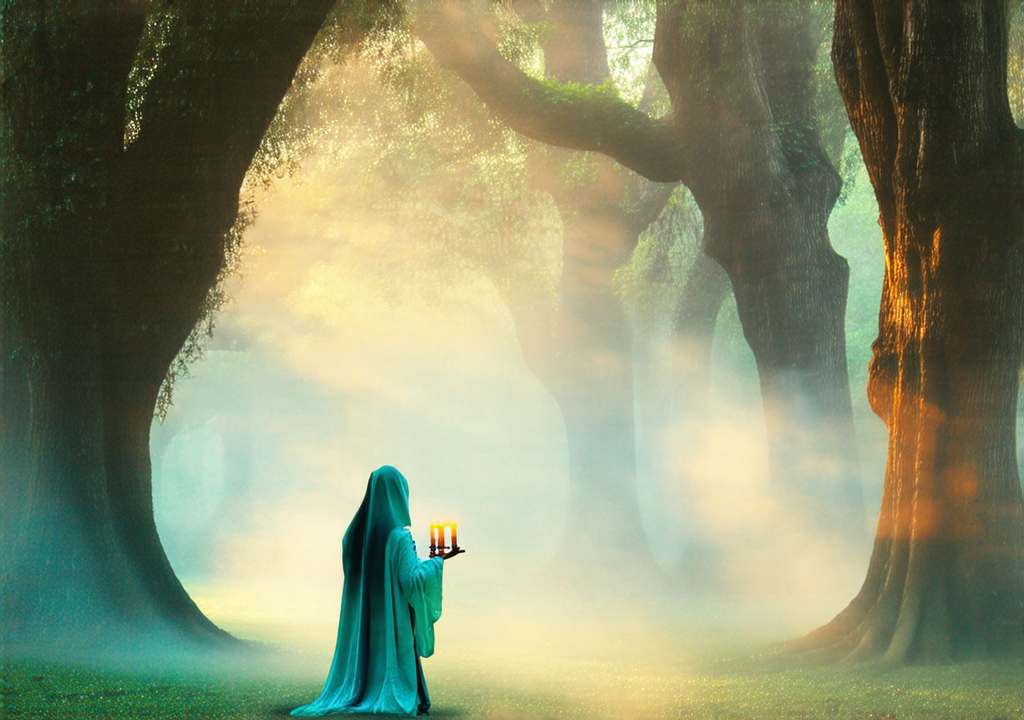
So tonight, when you light your candle, do more than recite the words from your grimoire. Feel the wick between your fingers. Smell the wax as it melts. Notice how the flame moves with the air current from your open window. Say "good evening" to the light, because it is a living thing in this room and you are its neighbor. This small shift—this move from performance to attendance—is where folk wisdom lives. It has been there all along, in the lines between your instructions, waiting for you to stop reading and start doing.
You have been doing it wrong not because you lack knowledge, but because you have forgotten that knowledge is not practice. And now, if you are willing, you can remember. 🌿