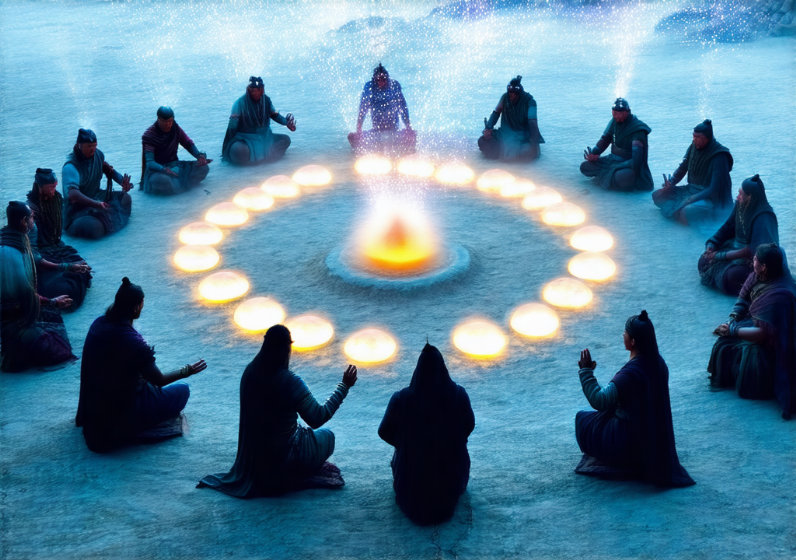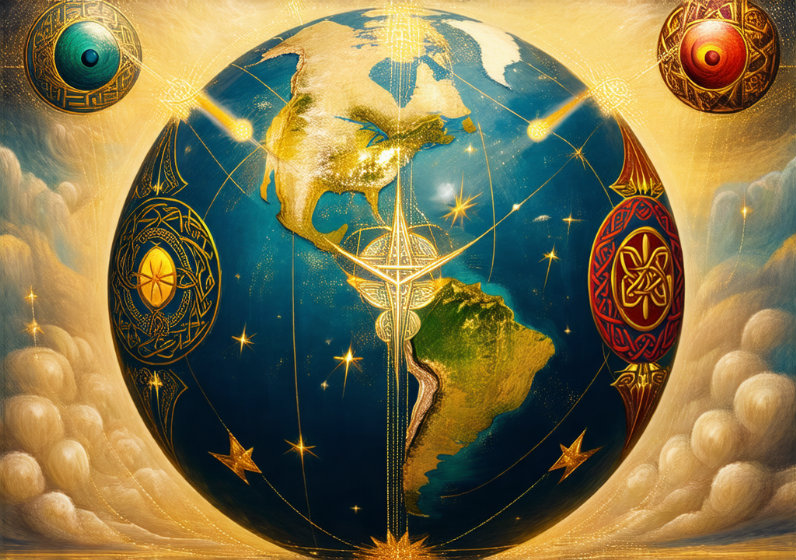
Astral Secrets From Around The World
✦ Veils & Vessels: A Global Codex of the Disembodied Soul ✦
By Mirelle Ashworth, Keeper of the Outer Thresholds
To speak of astral projection is to step into a corridor where walls dissolve and distance ceases to exist. The practice—though the name varies from tradition to tradition—is among humanity's oldest technologies of self-knowledge. Every major civilization has left traces of it: Egyptian tomb paintings of the ba leaving the body, Vedic hymns describing the sukshma sharira, Tibetan rituals for the intermediate state between death and rebirth, Sufi accounts of nocturnal journeys to the gardens of the prophets. The phenomenon is as universal as dreaming, yet far more deliberate.
What follows is not a textbook. It is a codex—drawn from initiatory lineages, field research in monasteries and ashrams, personal practice over two decades, and the written records of traditions that often guard their methods jealously. The aim is to honor each tradition on its own terms while drawing out what they share: a consistent map of an interior geography that transcends culture, language, and creed.
I. The Egyptian Ba: First Recorded Testimony
Long before the word "astral" entered European tongues—coined in the 17th century from the Latin aster, meaning star—the Egyptians had a precise vocabulary for the part of the self that departs. They distinguished several components: the ka (life-force, bound to the body and the tomb), the ba (the personal spirit, depicted as a bird-headed human who could fly freely), and the akh (the transformed, luminous post-mortem form).
The ba was not merely a ghost. It had agency. Tomb reliefs show it returning each evening to rejoin the body at the sarcophagus—suggesting a daily cycle of departure and return that the Egyptians ritualized through the opening-of-the-mouth ceremony. The priest would "awaken" the ba so it could sustain itself in the afterlife, drawing sustenance from offerings left by living relatives.
What strikes any student of projection is how closely this mirrors what practitioners report: a sense of returning to an anchor-point; a feeling that the body, though distant or invisible, remains a seat of identity. The ba was also tied to the heart—Egyptians believed it resided there—which parallels modern accounts where projectors feel their "center" in the chest or sternum during early stages of separation.
The tomb itself functioned as a station: a place where the ba could rest, be nourished, and re-embodied if needed. In this sense, the Egyptian model treats projection not as an escape from materiality but as a circulation between two interdependent registers of existence. A useful corrective to the modern romanticism that sometimes frames astral travel as liberation "from" the body rather than dialogue with it.
II. The Vedic Currents: Sukshma Sharira and the Five Subtle Bodies
Hindu metaphysics offers perhaps the most granular cartography of non-physical anatomy. The Upanishads describe a layered structure:
Anna-maya kosha – the sheath of matter (the physical body)
Prana-maya kosha – the vital-energy body (breath, subtle energy channels)
Mano-maya kosha – the mental-body (thoughts, perceptions)
Vijñāna-maya kosha – the wisdom-body (intuitions, discernment)
Ānanda-maya kosha – the bliss-body (pure awareness or joy beyond objectification)
The sukshma sharira—the "subtle body"—encompasses the upper three sheaths and is understood to travel between incarnations. In Yoga Nidra, practitioners are guided through a systematic relaxation that progressively detaches attention from each kosha in turn; by the end, consciousness rests in pure witnessing without location or form. This state borders on what Westerners call out-of-body projection: awareness unmoored from the body but retaining identity.
Yogic literature also describes five subtle "vehicles" (or linga-deha) corresponding to prana, mind, intellect, ego-sense, and bliss. Each has its own quality of experience: pranic travel feels energetic and bodily; mental travel is a landscape of images and narratives; wisdom-level travel dissolves narrative into pattern-recognition; bliss-level travel is difficult to report because language assumes duality that the state itself transcends.
Practitioners in the Hatha Yoga tradition often use shava asana (corpse pose) combined with pranic breathing—particularly nadi shodhana (alternate-nostril) and extended exhalations—to settle the prāṇa so finely that the subtle body "lifts" like a leaf released from a branch. The metaphor is not decorative: in stable states, projectors consistently describe a sensation of weightlessness, as if gravity were an attribute of the physical body only and did not apply to the vehicle they now inhabit.
III. Tibetan Bardo: Projection at Death's Threshold
Where most traditions treat projection as a practice one does, Tibetan Buddhism treats it as a state one can live through—and, with training, live through consciously. The Bardo Thödol (the Tibetans' version of the "Book of the Dead") maps three bardos: the bardo of death (dying), the bardo of dharmata (pure vision), and the bardo of becoming (rebirth). Each is a realm of experience with its own texture.
The first bardo unfolds over roughly seventeen days after physical death. During this period, the lucidity of consciousness gradually decays as the five aggregates dissolve in sequence: form, sensation, perception, mental formations, and finally consciousness itself. If a practitioner has trained in phren (the "transference" or "ejection") practice—whereby one learns to project the mind through the crown chakra (adhara) while alive—they can maintain a thread of awareness through this dissolution and, ideally, enter the second bardo in full lucidity.
The second bardo is a realm of pure light: radiant, formless, suffused with color-correspondences for each of the six realms (white for gods, blue for demigods, yellow for humans, red for animals, green for ghosts, dark/blue-black for hell-beings). The Bardo Thödol instructs: "Recognize this light as your own. Do not be carried away by it." For an untrained mind, the sheer radiance is overwhelming and one is swept into the corresponding realm of rebirth based on karmic inclination. For a trained meditator, recognition becomes choice: which light to merge with determines the next incarnation.
The phren technique itself—transferring consciousness through the head—is deceptively simple in description: sit comfortably, focus attention at the crown, and gently "pour" awareness upward as if emptying a vessel. Done repeatedly over years, practitioners report increasingly vivid non-local experiences; in advanced cases, teachers describe discarding the body entirely while maintaining identity—a state some Western students call "pure consciousness travel."
Notably, Tibetan practice distinguishes between dream yoga (working within sleep), clear light meditation (awake, formless awareness), and phren (directional transference). This triad maps almost exactly onto the three broad categories of astral work in Western tradition: lucid dreaming, conscious waking projection, and "formless" or energy-body travel.
IV. Sufi Nocturnal Journeys: The Heart as Vehicle
In Islamic mystical tradition (tariqa), the path to the unseen is not through the mind but through the qalb—the spiritual heart, distinct from the physical organ and distinct from intellectual understanding. The Sufi masters describe a gradual refinement of perception: first the outer world (zāhir), then the inner self (bāṭin), then the Heart's own realm (sirr, the secret), and finally raʿya (the eye of spirit) which sees without form.
Nocturnal journeys—sometimes called "spiritual travel" or, in Persian-influenced poetry, the "flight of the soul"—are a recognized phenomenon among Sufi adepts. Rumi speaks of it repeatedly: "Close your eyes and listen; you will hear the sound that is not from outside." The qalb becomes a lens through which the unseen becomes visible to the practitioner—though still invisible to others.
A practical detail worth noting: Sufis often pair projection with devotional rhythm—dhikr (repeated recitation of divine names) in slow, even breaths. The rhythmic quality stabilizes the subtle vehicle and prevents "drift" into undirected imagery. Students report that a few minutes of steady dhikr produces a sensation of weight lifting from the body, followed by a softening of spatial perception—walls becoming translucent or irrelevant; sounds shifting in timbre; a sense of being addressed from multiple directions at once.
The Sufi emphasis on humility is a useful corrective to ego-inflation that can accompany projection: "You are not going somewhere. The Somewhere is coming to you." In this framing, the projected state is less an achievement than a receptivity—a clearing of inner noise so that what was always there becomes perceptible.
V. West African and Indigenous Models: Ancestral Currents
Not all traditions conceptualize projection as individual transcendence. Many West African systems—Dahomey, Yoruba, Fon—frame the journey in terms of ancestral currents: the soul does not leave the body so much as it joins a river of kinship that flows through time and place simultaneously.
Among the Fon people of Benin, the mi (spirit) can travel to the spirit-world (toto) during dreams or trance states. Crucially, this travel is social: one goes not alone but in procession with ancestors who already dwell there. The purpose is often practical—receiving guidance, settling a family matter, retrieving a lost quality (courage, memory, a name).
The practice involves a mediator (kunkun or spirit-medium) and a prepared space: a small altar cloth, specific colors corresponding to the ancestor being contacted, a particular time of night. The practitioner enters a "light trance"—not full possession, but a state where the mi can project while the body remains seated and breathing. Upon return, the mediator asks what was seen; details are recorded in family genealogies.
What distinguishes this model from Western projection is its relationality. The journey is not about self-knowledge so much as kinship-renewal. You go to the ancestors because they need you there; your presence is part of a continuing covenant. This corrects for a subtle solipsism in some modern practice: we project, we return, we journal—but who were we actually meeting? In these traditions, the question "whom did I meet?" carries more weight than "what did I experience?"
Similarly, Andean pachamama practice and various Polynesian navigation-spirit systems treat projection as a form of communal memory-work: going to the place where the story is kept, retrieving what the community needs. The body projects; the community receives.
VI. Practical Convergences: What Every Tradition Agrees On
Stripped of ritual ornament and cultural idiom, a remarkable consistency emerges across these diverse systems:
1. Separation is a process, not an event. No tradition describes projection as a single switch flipping. It is a gradual loosening—of breath, of attention, of spatial assumption. The body does not "leave" so much as awareness notices it has already begun to extend beyond the skin's boundary.
2. An anchor is required. Whether it's an Egyptian tomb, a yogic asana position, a Sufi rhythmic dhikr, or a Tibetan meditation posture—stable physical grounding precedes stable subtle projection. Unanchored projection tends toward undirected drift: images without coherence, impressions that cannot be verified or integrated.
3. Return is as important as departure. Nearly every tradition has a formal "re-entry" ritual: the ba returning to the sarcophagus, the yogi consciously re-identifying with the body, the Sufi reciting a closing phrase, the Tibetan practitioner "drawing back" attention from the crown. Beginners who skip the return phase often report disorientation, a lingering sense of "not being in my body," or vivid residual images that blur waking perception for hours.
4. State-of-consciousness matters more than technique. The single most consistent variable across traditions is not what you do but how settled your awareness is. Calm, attentive, non-reactive consciousness produces stable projection; anxious, effortful, expectation-laden consciousness produces unstable or dream-like states that are difficult to distinguish from vivid imagination. This is why every tradition pairs projection work with a longer meditation or contemplative practice—projection is the fruit, not the tree.
5. The experience resists full verbalization. Practitioners across cultures converge on a similar difficulty: the projected state has qualities that do not map cleanly onto waking-language. Colors that are "the color of a sound"; spatial relationships that are simultaneous rather than sequential; a sense of time as texture rather than duration. This is not mysticism for its own sake—it reflects a different mode of perception, one in which the usual filtering mechanisms (categorization, narrative sequencing) are relaxed or suspended.
VII. Common Pitfalls and How Traditions Address Them
Even with convergences, the practice carries risks that every tradition has developed wisdom about:
Ego-inflation. The projected self can feel larger, more capable, more "real" than the physical one. This is natural—the subtle body operates without physical limitation—but it can produce a subtle narcissism in which the projector begins to prefer the non-local state and devalues embodied life. Sufis call this nafs (ego) disguising itself as spirit. The remedy, universally: return fully; integrate; let the experience inform daily life rather than replace it.
Undirected imagery. Beginners often mistake vivid mental images for "astral experiences." The distinction is subtle but important: in true projection, there is a sense of being in an environment—spatial depth, sensory texture, other beings with independent behavior. In undirected imagination, the scene responds to your expectations; characters say what you wanted them to say. A useful test: try doing something "unexpected" within the experience (turning away from a beautiful scene, asking an uncomfortable question). If the environment adjusts to please you, it is likely imagery. If it resists or surprises you, it may be genuine projection.
Exhaustion. Projection is metabolically expensive in subtle-energy terms. Traditions that require extensive projection (Tibetan phren, Sufi journey-work) pair it with periods of rest and physical nourishment. Modern practitioners often push too hard on short sessions; the result is a lingering "fog" or emotional flatness for hours after.
Confusion between states. Vivid dreams, meditative absorptions, and true projection can feel similar in the moment. The Sufi remedy is to cultivate muraqaba (watchfulness) so that one notices the transition points: the exact instant awareness detaches from the body; the quality of "presence" in the projected state; the specific sensation of re-embodiment. Without these markers, self-report becomes unreliable.
VIII. The Question of Verification
This is where any honest account must become cautious. Astral projection resists third-person verification in the way that, say, a mountain climb can be verified by photographs or summit logs. You cannot photograph your subtle body for another person's eyes. You cannot bring back a souvenir from the astral plane (or rather—can you? The Egyptian ba could carry messages; Sufi adepts report retrieving specific knowledge; Andean practitioners retrieve "objects" of memory that are then shared with the community).
Most traditions handle this by not overclaiming. The Tibetan texts say: "Trust your own experience, but do not let it become a belief." The Yogis say: "Experience is not proof; it is direction." The Sufis say: "The Heart sees what the eyes cannot; believe it quietly and live accordingly."
This epistemic humility is perhaps the most important lesson these traditions share. Projection is first-person knowledge—valid, useful, and real to you in a way that does not require external confirmation to be true for your life. It becomes "objective" only insofar as its fruits appear in your conduct, your relationships, your clarity of purpose. If projection makes you more patient, more attentive, more capable of distinguishing what is yours to act on and what belongs to others—then it has done its work regardless of whether anyone else can see the journey.
IX. A Closing Image
There is a passage in the Bardo Thödol that I return to often: "The light is not outside you; it is your own mind, freed from its clouds."
This captures something essential about what we are looking at across all these traditions: astral projection is not, ultimately, about going somewhere else. It is about discovering that the boundary between here and there was always more permeable than the senses report. The ba never truly left the tomb; it simply moved through a wall we had agreed to treat as solid. The yogi's subtle body was always present; we simply forgot how to perceive it. The Sufi heart sees what the eye cannot—not because the seen is hidden, but because the seeing has been narrowed by habit.
To practice projection across traditions is to gather these different lenses—Egyptian, Vedic, Tibetan, Sufi, West African, Polynesian—and hold them together long enough to see that they are all aiming at the same interior sky. The map changes; the territory does not.
You need not adopt any single tradition. You may take the Egyptian's patience with the body as anchor; the Vedic's layered attention to subtle anatomy; the Tibetan's precision of direction; the Sufi's humility before what is seen; the West African's relational orientation toward ancestors and community. Each is a door into the same room. Walk through whichever opens for you, and return changed.
The veils are thinner than they appear. They have always been thin. You were simply taught to walk as if they were walls.