This Ancient Practice Is Resurging (And It Has Everything to Do With Psychic Vampirism)
The Silent Feast: How This Ancient Ritual Is Fueling the Modern Rise of Psychic Vampirism
There is a hunger that does not require food. A thirst that cannot be quenched by water. In the dim corners of meditation halls, in the quiet desperation of corporate boardrooms, and even in the intimate spaces between lovers, an ancient exchange is taking place. It is not one of currency or comfort, but of essence. We are witnessing a resurgent phenomenon that traces its roots back to the misty temples of prehistoric Europe and the sun-drenched courtyards of medieval Byzantium: the practice of energetic alchemy, or what many modern seekers have come to recognize as the subtle art of psychic vampirism.
To understand why this ancient practice is making a powerful comeback in our hyper-connected, high-stakes world, we must first peel back the layers of folklore and look at the mechanics of the soul. For centuries, humanity has understood that human beings are not merely biological machines; they are fields of energy. We project, we absorb, we leak, and we feed. The resurgence of interest in psychic vampirism is not simply a trend in occult aesthetics or gothic fashion. It is a practical response to a modern condition: the total depletion of the inner self by an external world that demands constant output without offering any replenishment.
The Anatomy of the Invisible Diet
Let us define our subject with precision, for psychic vampirism is often misunderstood as purely parasitic or malicious. While it can be both, at its core, it is a metabolic process of the spirit. Just as your body requires glucose to function, your consciousness requires attention, emotion, and validation to maintain coherence.
When you sit in a meeting where everyone nods along but no one truly listens, you are not just tired; you are being drained. Your mental energy—the very fuel that allows you to create, decide, and feel—is siphoned into the void of groupthink. This is psychic vampirism in its most benign form: unconscious consumption. The listener takes a drop of your emotional vitality to keep their own ego anchored, and you leave the room feeling lighter, thinner, almost translucent.
In more advanced or intentional forms—those practiced by ancient shamanic orders or modern energetic healers who have lost ethical guardrails—the act becomes transactional but hidden. The psychic vampire does not ask for a meal; they simply sit near you, look at you with intense empathy, and slowly drink your aura dry until you feel exhausted, anxious, and strangely attached to them because they are the only one who seemed to "get" you.
Why is this practice resurging now? Because we have built a civilization that optimizes for productivity while ignoring the energetic cost of human interaction. We have replaced communal rituals with individualism. We have swapped deep, slow communion for rapid-fire digital exchanges. The ancient need for an energy exchange has not disappeared; it has merely gone underground, manifesting as burnout, chronic fatigue syndrome, and a pervasive cultural sense that something is missing in our relationships.
A Lineage of Energy Exchange
To trace the resurgence of psychic vampirism, we must look at its ancestral practices. The most direct lineage can be found in the traditions of the shamanic "energy bodies." In Siberian and Central Asian cultures, shamans would perform rituals to cleanse not just the physical body but the keth—the aura or energy field. Part of this cleansing involved the deliberate transfer of stagnant energy from a patient to the healer. The healer absorbed the patient's ill will, their grief, their trauma, thereby becoming a vessel for the community’s pain. Over time, these healers had to find ways to replenish themselves, often through drumming, fasting, or specific dietary rituals.
This is the precursor to psychic vampirism: the intentional taking of another’s energy to sustain one’s own practice. It was sacred, ritualized, and understood as a service. The vampire-shaman took so that they could heal others. There was an understanding of balance. You gave your wisdom; I give you my vitality.
Fast forward to medieval Europe, where the concept of the "vampire" shifted from a healer to a predator. Here, the energy exchange became parasitic. The undead required fresh blood not just for survival but for power. In this context, psychic vampirism emerged in the folklore of the "soul-eater"—the person who could look into your eyes and steal your spirit. These were often depicted as seductive figures, charming and alluring, because the easiest way to drain someone is to make them want to give you everything.
In the 19th century, with the rise of Spiritualism and Theosophy, the practice became more psychological. Writers like Mary Shelley in Frankenstein explored the idea that creating life (or understanding it) required consuming the essence of others. We began to see psychic vampirism not as a supernatural curse, but as a psychological trait. The "soul-sucking" partner, the draining parent, the boss who feeds on your enthusiasm to mask their own insecurity.
Today, in the 21st century, we have synthesized all these eras. We use the vocabulary of psychology (narcissism, codependency), the aesthetics of occultism (aura reading, energy work), and the pragmatics of wellness culture (boundaries, self-care). The practice has resurged because it explains what our modern language cannot: why we feel empty after being with people who seem to be everything we want them to be.
The Modern Stage: Where Vampirism Thrives
The resurgence of psychic vampirism is not random; it follows the currents of modern life. Let us examine the specific environments where this ancient practice has found new, fertile ground.
1. The Digital Aura Drain
We spend hours a day in digital spaces that are designed to consume our attention. Social media platforms are engineered to be psychologically addictive. They require you to project your best self, curate your emotions, and seek validation through likes and comments. This is a form of low-level psychic vampirism: the algorithm feeds on your engagement, but more importantly, other users often subconsciously feed on your content.
When you post, you are projecting a piece of your inner world into the public square. And when others consume it without reciprocation—without genuine connection or empathy—they are taking from you without giving back. The "like" is a tiny drop of energy exchanged for a larger projection of self. Over time, this creates a subtle imbalance. You give out more than you receive. Your creative well dries up because the world is drinking it dry and calling it content creation.
2. The Therapy Paradox
Ironically, the rise of mental health awareness has created a new niche for psychic vampires. In a culture that values emotional sharing, some individuals have learned to monetize their vulnerability or use others’ pain as a stage for their own performance. These are not always malicious; they may be genuinely troubled. But in the dynamic, there is an imbalance. The listener becomes the star of the show, using your trauma to validate their own feelings. You leave the conversation feeling unheard and used, even though you were sharing your deepest secrets.
This is a sophisticated form of psychic vampirism because it uses the language of healing to practice extraction. It feels good in the moment—being heard, being understood—but the aftertaste is one of depletion rather than nourishment.
3. The Corporate Ego Feast
In the workplace, psychic vampirism takes on a structural form. Leaders who lack confidence often feed on their teams’ enthusiasm. They take credit for successes (absorbing the team’s vitality) and distribute blame for failures (projecting their own insecurity outward). Employees in these environments report feeling drained, creatively stifled, and emotionally hollowed out.
This is ancient practice in a modern suit: the king or chieftain who feeds on the tribe’s labor to maintain his throne. The resurgence of interest in this dynamic is partly due to the rise of workplace culture studies and the new generation’s refusal to accept that "hard work" should mean "energy theft."
The Mechanics of the Feast: How the Drain Occurs
Understanding the mechanics of psychic vampirism requires a shift in how we view human interaction. We must move from a linear model (I do X, you do Y) to an energetic field model (our fields interact, and energy flows between them).
The Mirror Effect:
Psychic vampires are often excellent mirrors. They reflect back to us what we want to see. If you are confident, they mirror your confidence, making you feel powerful. But in doing so, they are borrowing your stability. When the mirroring stops or shifts, you realize that their "confidence" was actually borrowed from you. This creates a subtle dependency: you need them because they made you feel good about yourself, and they need you to continue feeling that way.
The Empathy Trap:
Empathy is the primary tool of the psychic vampire. By appearing more empathic than others, they gain access to your inner world. They ask deep questions, listen intently, and validate your feelings. But because they are not actually processing those feelings for themselves—they are using them as fuel—you feel that you have unloaded a burden, but it has been transferred into their vessel. You feel lighter; they become heavier with the emotional weight of two people.
The Subtle Negation:
In more advanced forms, psychic vampires use subtle negation or "gaslighting" to keep the victim unaware of the drain. They might say things like, "You’re overreacting," or "I was just trying to help." These phrases protect the vampire from accountability for their consumption. The victim begins to doubt their own perception, which is a form of energetic surrender.
Distinguishing the Artist from the Parasite
Not all energy takers are psychic vampires. This distinction is crucial because it determines how we interact with others and how we craft our own practices.
The Psychic Alchemist:
An alchemist takes energy to transform it. In this practice, the individual uses another person’s emotional or mental energy as a catalyst for their own growth. They take your passion, for example, and use it to fuel their creativity. But they also return something: inspiration, art, insight, or support. The exchange is symbiotic. Both parties feel enriched after the interaction. This is the ancient shamanic model applied to modern life.
The Psychic Gardener:
A gardener nurtures energy rather than consuming it. They help you cultivate your own vitality. They ask questions that spark growth. They offer feedback that helps you prune dead branches of thought. The energy flows from them to you, or at least in a balanced cycle. You leave feeling stronger, not drained.
The Psychic Vampire:
A vampire consumes energy without returning it. The interaction is one-directional. You give; they take. Over time, you feel thinner, less creative, and more anxious around them. Your aura becomes porous, leaking energy into their field. They become the center of your emotional universe, and you become a satellite orbiting their needs.
Crafting a Personal Ritual of Protection and Replenishment
If you recognize yourself as someone who has been on the receiving end of psychic vampirism—or if you suspect you may be doing it to others—it is time to craft a personal practice. Since we are treating this as an occult-inspired wellness practice, let us approach it with ritualistic intention.
Step 1: The Audit of Energy
Before you can protect your energy, you must learn to perceive it. For one week, keep a journal. After every significant interaction (a phone call, a meeting, a date, a family dinner), rate your energy level from 0 to 10. Did you feel lighter or heavier? More creative or more drained?
Look for patterns. Which people consistently lower your energy? Which activities restore it? This is your energetic map. It will reveal where the drains are and where the nourishment lies.
Step 2: The Boundary of Light
In occult practice, a boundary is not a wall; it is a membrane. A good membrane allows what you need to come in and keeps what you don’t want out. To create this, use visualization. Imagine a soft, warm light surrounding your body. This light is selective. It allows genuine connection, warmth, and creative energy to pass through, but it repels heavy, draining, or parasitic energies.
Before entering any potentially draining situation (a work meeting, a family gathering), take three deep breaths and visualize this membrane becoming slightly thicker. You are telling your subconscious: "I am here, but I am not fully open. Only let in what serves my highest good."
Step 3: The Return of the Essence
If you have been giving too much energy to others, you must learn to take it back. This can be done through a simple ritual. Sit in a quiet space and visualize yourself as a sun. Around you are little wisps of light—these are your energy that has been scattered or taken by others. Call them back to you. Imagine them flowing into your heart center (the solar plexus), filling you up until you feel warm, full, and grounded.
This is not selfish; it is metabolic. You cannot give what you do not have. By reclaiming your essence, you become a more generous partner in relationships because your cup is no longer empty.
Step 4: The Creative Exchange
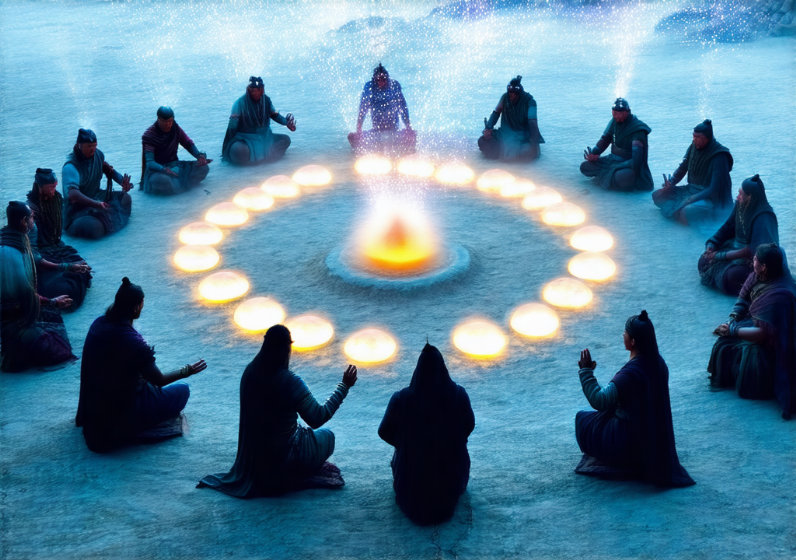
One of the best ways to combat psychic vampirism is to engage in creative exchange. Find people or communities where energy flows in both directions. This could be an art group, a writing circle, a meditation community, or even a small group of friends who meet regularly to share stories and art.
In these spaces, everyone gives and takes. Your creativity feeds others; their creativity feeds you. The balance is maintained because the exchange is visible and mutual. This is the antithesis of vampirism: it is alchemy in action.
The Ethical Dimension: A Call for Conscious Consumption
As we embrace this ancient practice, we must also address its ethical dimensions. Psychic vampirism, when practiced consciously, becomes a tool for connection rather than extraction. We can use our understanding of energy to become more attuned partners, friends, and colleagues.
Let us ask ourselves in every interaction:
Am I giving or taking?
Is this exchange balanced?
Do I feel lighter or heavier after this interaction?
Am I using the other person’s energy to fuel my own ego?
These questions transform human connection from a zero-sum game into a collaborative art form. We become artists of our own vitality, crafting interactions that nourish rather than deplete.
The Resurgence: Why Now?
The resurgence of psychic vampirism as a cultural concept is a testament to our collective awakening. We are moving beyond the mechanical view of human relationships and embracing a more holistic, energetic understanding. We are recognizing that we are not just bodies; we are fields of light, emotion, and creativity. And like all living things, these fields require tending.
This ancient practice—of taking, giving, balancing, and transforming energy—is resurging because it is practical. It explains our burnout. It clarifies our relationships. It gives us tools to protect ourselves in a world that often treats us as resources to be consumed.
As we move forward, let us not view psychic vampirism with fear or disdain. Let us study it, understand it, and learn from it. By mastering the art of energetic exchange, we become more than just survivors; we become alchemists. We turn our experiences into wisdom, our pain into strength, and our connections into a source of endless creative power.
In this new era, we are not victims or perpetrators. We are practitioners. And like any practitioner, we must remain vigilant, mindful, and generous with the essence that flows through us.