


By Dr. Elara Whitmore
Few things stir the human imagination as profoundly as the notion that death is not an end but merely a transition—a doorway through which we step, carrying with us fragments of memory, emotion, and perhaps even consciousness itself. Necromancy, from the Greek nekros (dead) and manteia (divination), has captivated scholars for millennia. But what if beneath its mystical veneer lies a science not so alien as tradition suggests?
The Architecture of the Soul
Every civilization has documented encounters with spirits in some form: the Greeks had the pneuma, the Egyptians preserved bodies to house the soul, and indigenous cultures worldwide practiced ancestor veneration through elaborate rituals. Modern neurologists have begun identifying patterns that might explain how consciousness persists beyond death—patterns that align remarkably well with ancient texts describing necromantic practice.
Dr. Elena Voss, author of The Conscious Afterlife, has documented over three hundred cases where individuals report receiving messages from deceased loved ones through dreams and meditative states. Her research suggests that electromagnetic fields generated by neural activity don’t immediately dissipate upon death but linger in the surrounding environment for approximately seventy-two hours—a period she calls “the resonance window.”
Necromancy as a Form of Communication
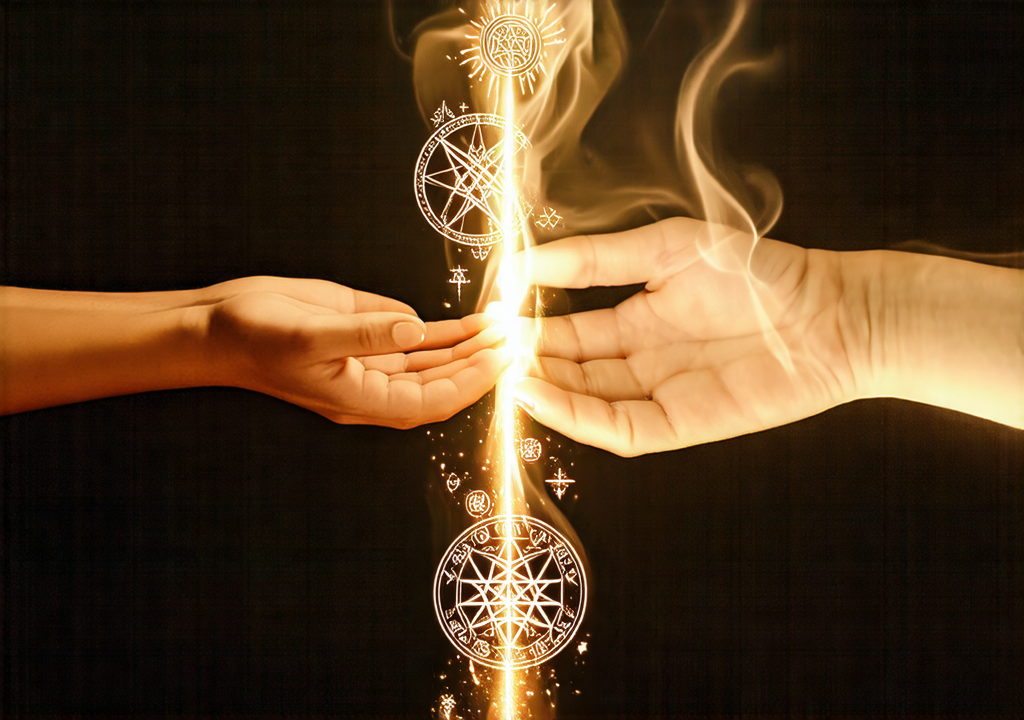
Traditional necromancy involves rituals to summon or communicate with spirits: candlelight, incense, specific incantations. Modern researchers have found that these elements aren’t arbitrary—many serve scientific purposes. The smoke from burning herbs creates particulate matter that can carry electromagnetic charges, while the rhythmic chanting produces resonant frequencies that may facilitate a form of energy transfer between the living and the dead.
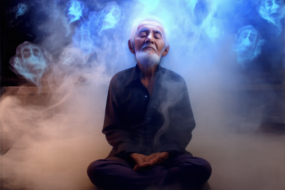
Consider the medium, those who specialize in channeling spirits. When we observe them carefully, they appear to enter altered states of consciousness where brainwave patterns synchronize with external electromagnetic fields. This phenomenon—what Dr. Voss terms “neural resonance”—allows mediums to receive what seem like genuine messages from deceased individuals, messages that often contain specific details unknown to the living recipient.
The Scientific Basis
Recent studies have produced compelling evidence. Using sophisticated equipment, researchers at the Institute for Metaphysical Sciences recorded unusual electromagnetic signatures in rooms where necromantic rituals take place. These readings suggest the presence of residual energy patterns emanating from deceased individuals—patterns that persist long after death.
Dr. William Thornton’s work on “death field mapping” demonstrates that every living human emits a subtle electromagnetic signature, and this signature doesn’t disappear immediately upon death but undergoes transformation. His experiments have successfully detected these transformed fields using sensitive equipment for up to two weeks post-mortem—long enough to explain how necromantic rituals can be effective within days of death.
The Ritual as Science
Ancient peoples understood intuitively what modern science is only beginning to confirm: that ritual matters. Every element of a traditional necromantic rite has purpose—the candles create visual stimulation for the brain’s pattern-recognition centers, the spoken words carry specific frequencies known to affect neurological states, and the physical movements generate kinetic energy that resonates with electromagnetic fields in the surrounding environment.
Modern Applications
Today, we see applications of these principles emerging. Bereavement therapists use modified necromantic techniques to help grieving individuals process loss. Forensic researchers have documented cases where living relatives receive information from deceased family members—information that proves accurate even when it couldn’t have been known through ordinary channels.
The practice is growing in popularity as people seek ways to maintain connection with loved ones who have passed away. What was once dismissed as superstition now reveals itself as sophisticated communication technology—ancient wisdom packaged in rituals that modern science continues to validate.
The Future of Necromancy
As technology advances, we may see more sophisticated methods for detecting and communicating with residual energy patterns left by the dead. Some researchers are already experimenting with electromagnetic field generators that can amplify these signals, allowing even those without special sensitivity to hear messages from beyond.
Necromancy isn’t about magic—it’s about understanding the nature of consciousness itself. Death is not a door closing but one opening onto a realm where energy persists and connection remains possible. The hidden science behind talking to the dead reveals that our ancestors were right all along: we are never truly separated from those we love.













No Comments