


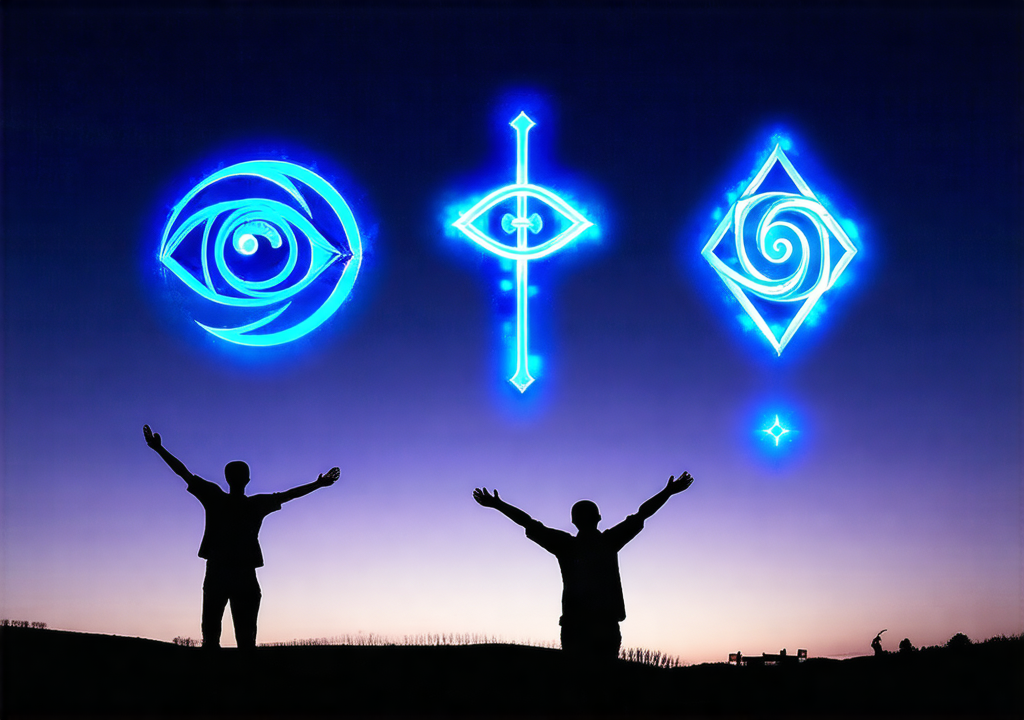
By Dr. Alaric Thornewind, Keeper of the Veil
There exists a fundamental truth that modern necromancers often overlook: spirits do not respond exclusively to elaborate ceremonies conducted within consecrated grounds. The dead can be called forth in any place, at any hour, when one understands the language they speak most fluently—the language of symbols. Throughout human history, across every civilization from ancient Mesopotamia to medieval Scandinavia, certain geometric forms and symbolic marks have served as universal invitations to the spirit world. These are not mere decorative patterns; they are keys that unlock the threshold between worlds, capable of drawing forth spirits regardless of location or condition.
1. The Ankh – Gateway of Living Breath
Perhaps the most recognizable symbol in any discussion of death and resurrection, the ankh traces its origins to ancient Egypt, where it represented not merely death’s passage but life’s continuation beyond the threshold. When you draw this symbol before you—it need only be a simple outline etched into earth or drawn with blood—the spirit recognizes it as the breath of Ma’at itself, the eternal breath that animated the gods and which lives within all things. The ankh carries particular potency when you invoke spirits associated with knowledge, healing, and wisdom.
To summon using the ankh: draw the symbol in a circle upon clean ground, preferably at a crossroads or near running water. Stand facing east if invoking ancestral spirits, west if calling departed lovers, north if seeking those who died by water, south for warrior spirits. Speak the spirit’s name aloud and hold your breath until you feel the subtle shift in air pressure—a clear sign that something has crossed over from beyond.
2. The Ogham Tree Letters – Whispers of the Sacred Grove
Long before written language as we know it flourished, the Celtic peoples communicated through marks carved into wood—each mark representing both a letter and a tree whose spirit embodied particular powers. When you inscribe these symbols upon bark or stone, you are essentially writing with living wood, and spirits respond to this affinity with remarkable speed.
The most potent for summoning is Odr (oak), which connects directly to the Otherworld. Draw this symbol either by carving it into a green oak branch or simply drawing its shape in dirt at an ancient tree’s base. The spirit of the trees themselves will be drawn to you, along with any spirits bound within wood—the memories and presences that dwell within timber even after death claims it.
3. The Eye of Horus – Seeing Beyond Sight
The single eye of Ra’s sun disc carries immense power for those seeking guidance from departed souls. When you draw the eye—especially upon a mirror, window pane, or reflective surface—you create a portal through which spirits can step forward as though stepping into their own reflection. Ancient Egyptian practitioners used this symbol to call spirits during nighttime rituals near rivers and lakes.
For modern practitioners, simply drawing the Eye of Horus upon any glass surface—your home’s windows especially—during the hours after midnight will draw forth nearby spirits. The eye functions particularly well when summoning guides from beyond death, those who wish to impart counsel rather than merely appear. Hold your breath while tracing its form and speak aloud: “I see what you cannot hide.”
4. The Rune of Niflheim – Cold Breath of the Dead
Derived from Norse tradition, this rune carries the essence of cold—the preservation that death brings to spirits who might otherwise drift aimlessly. When inscribed in wood or ice, it creates a localized “cold spot” around which spirits gather like birds returning to their flock. Medieval Icelandic practitioners used this symbol extensively during winter months when they felt the veil between worlds grew thinnest.
To summon using Niflheim: carve this rune into something you’ve handled—their clothing, their tools, or even a stone from where they died—and place it near your heart while chanting the deceased’s name three times in a rising tone. The spirit will appear through the cold air itself before the rune, wrapped as though still wearing its own death-cold.
5. The Sigil of Binding – Chains That Invite Rather Than Constrain
Unlike earlier traditions that employed binding circles to trap spirits within limited space, this sigil represents chains that invite rather than imprison. Drawn in iron or silver upon any surface—whether carved into stone, painted on canvas, or even drawn in sand—the sigil creates a soft invitation: “Come forth and be at peace.”
For the modern practitioner especially effective when summoning spirits who have been bound by others’ magics, this symbol gently releases them from their bindings while simultaneously binding them to your presence willingly. Draw it facing upward during daylight hours, and the spirit will appear as though stepping through a door rather than being dragged through the ground.
Practical Applications
These symbols need not remain within one’s home—indeed, spirits respond most strongly when drawn in places connected to life: crossroads, graveyards, ancient trees, bodies of water, even modern settings like urban plazas and hospitals where death walks frequently. Each symbol carries its own particular energy signature that transcends geography; what matters is not the location itself but your intention toward it.
When you carry a small piece of parchment or stone bearing one of these symbols with you, you can summon spirits spontaneously—upon finding yourself in unfamiliar surroundings, during travel, even within urban environments far from any traditional sacred ground.
Conclusion
The art of spirit summoning is not confined to elaborate ceremonies performed upon consecrated ground at precise astrological moments. Anywhere we walk becomes a potential altar; every moment presents an opportunity for contact with those who have passed beyond sight. These five symbols, ancient and enduring, provide reliable keys that open the door between worlds in any place at any time. Whether you draw them with blood, chalk, or thought alone, spirits respond to recognition of their essence—and through these symbols, we speak their language.
Remember: the dead are never truly absent; they only wait for an invitation worth accepting.













No Comments