Which Numbers Are Lucky and Which Are Cursed?
By Maren Solstice, Keeper of the Arcane Ledger
The numerologist does not deal in mere chance. To the uninitiated, a roll of dice is luck; to us, it is arithmetic dressed in probability’s disguise. Every number carries a vibration, a lineage of meaning stretching back through Pythagoras, into the cabbala, across the silk trade routes to the counting-houses of Imperial China. The question—which numbers are lucky and which are cursed?—is not one I answer lightly, for it assumes that fortune is uniform in its taste. It is not. Fortune has a palate, and the palette differs by culture, by temperament, and by the hour in which you draw the sigil. Still, if pressed to compile an authoritative list, I shall do so below, with caveats as sharp as their opposites.
The Lucky Ledger
Seven. The universal patron of mystery. Three dimensions meet here—body, mind, spirit—and so does the seventh day of rest in nearly every sacred calendar. Seven is prime, indivisible by any other number but one, and thus self-sufficient. In numerological reduction, a life-path seven is the seeker who cannot be hurried into certainty. Lucky? Yes—but it favors patience over gambles.
Three. The first of the productive. One becomes many here; three carries fertility, growth, and communication. Culturally it surfaces as triads—past/present/future, mind/body/spirit, father/mother/child. In arithmetic, three is the smallest number that can form a triangle, the shape of structure itself. Lucky in ventures requiring speech, writing, or collaboration.
Eight. A favorite of the Eastern numerologist and the occultist alike—balanced, infinite, endlessly turning. In the Hermetic tradition eight is linked to Saturn’s ruling and the eighth sphere; in Taoist practice its phonetic cousin fa means “to grow rich.” Eight favors finance, legacy, and long cycles coming home to themselves.
Nine. The final digit before reduction resets; it absorbs all lower digits within itself (1+2+3+4+5+6+7+8 = 9). Nine is completion, mercy, the old year’s last breath. Culturally sacred in Hinduism, where the number of devas matters to cosmology. Lucky as a closing move—a contract signed on the ninth brings finality.
Eleven and Twelve. Master numbers that refuse reduction. Eleven is intuition doubled—two witnesses bearing one testimony; twelve is the council complete (tribes, apostles, zodiac houses). They favor institutions, initiations, and any act that binds group to individual.
The Cursed Ledger
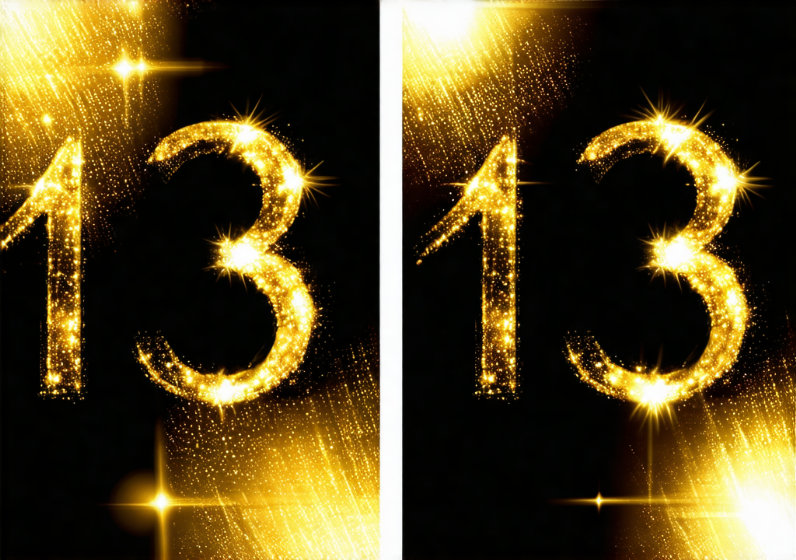
Thirteen. Western superstition has nailed this number to a stake. Thirteen is prime yet sits between two squares (12² = 144, 13² = 169)—the gap between them is not a square number interval, an anomaly the old geometers felt in their teeth. Culturally it carries dread of the “thirteenth guest,” of Friday’s doubling. In numerology I read thirteen as prime-within-completeness: a prime hiding inside a completed cycle, refusing to divide cleanly. It is not cursed so much as restless. Lucky for those willing to wait out its cycle; unlucky for impatience.
Four. The paradox that haunts East and West differently. In the Western tradition four is stable—the square, the compass point, the testament of four witnesses. But in Chinese numerology the word for “four” (si) rhymes with death, so hotels skip their fourth floor and funeral halls count down from three. Four favors structure but punishes rigidity; it curses the builder who refuses a fifth window.
Five. Prime yet central on the digit line 0–9—five is the fulcrum itself. Culturally the pentagram has been both sacred and sacrilegious depending on orientation. In numerology five is change, commerce, exile. Lucky for travelers; cursed for those who cannot bear motion.
Six. The first perfect number (1+2+3 = 6), yet in Hebrew mysticism it sits below seven—a step short of the Sabbath’s rest. Six favors harmony and marriage but punishes over-attachment to domestic detail. It is lucky when balanced, cursed when clutched too long.
Twelve. The council number—but twelve also means eleven plus one, an outsider joining a complete group. In Tarot this is Death; in numerology it warns that the committee has grown by one more than the chair can manage. Lucky only while motion continues; cursed at stagnation.
Synthesis: The Wheel of Numbers
The occultist’s true answer is this: no number is intrinsically lucky or cursed. Number is a resonator, not an oracle. Luck attaches to the relationship between the seeker and the moment they draw the sigil. A thirteen born in May under Venus favors a gambler who has already lost twice, because his cycle of three is closing; it curses the man standing at one.
Yet if pressed—I am. Draw seven for patience, three for speech, eight for legacy, nine for closure, and trust eleven or twelve when founding institutions. Avoid four in rigid architecture, five during exile you do not choose, six past its seasonal window, and fear thirteen only until you have completed the cycle it opens.
The ledger is open. The wheel turns. Choose accordingly.
—M.S., writing from her study on the eve of a new moon.