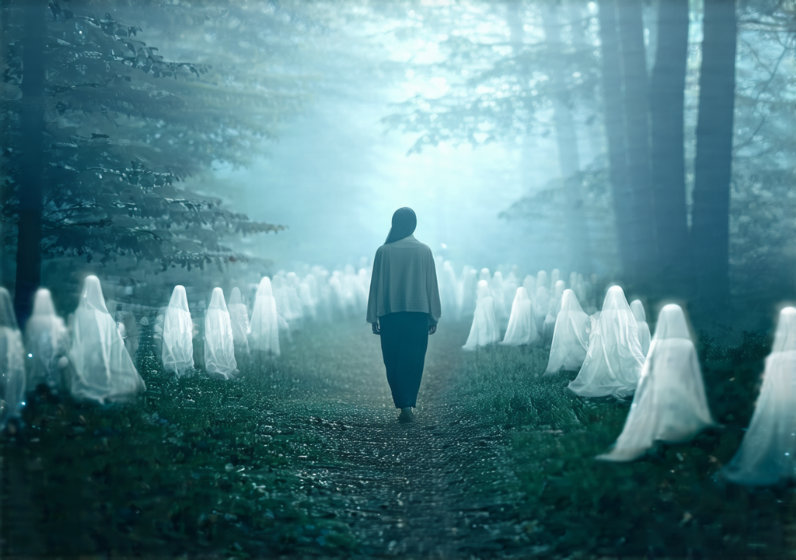
Something Is Watching Us From Beyond—And It Wants to Talk
⟡ Something Is Watching Us From Beyond—And It Wants to Talk ⟡
By Maudeline Voss, Keeper of the Unwritten
We have been told, since before we could speak, that death is a door. A closing one, mostly. The hinge creaks; the latch turns; and what was warm goes cold in the dark. We build our little ceremonies around this — the candles, the flowers, the polite murmurs of "at peace" spoken like incantations meant to keep the dead from noticing they are no longer among us.
But I have spent thirty-one years on the other side of that door, pressing my ear against it, listening for breath. And let me tell you what I have learned in all those long, candle-flickered hours: the door was never closed. It only appears to be. Something is watching us from beyond — and it does not wish to haunt. It wishes to talk.
This is not a comforting thought. Most people prefer their dead to be silent, ornamental, draped in white and sealed beneath flowers. The idea that the departed have opinions — strong ones, often irritated ones, occasionally very hungry — destabilizes something deep in us. We want our ancestors to be portraits on walls. We do not want them at the window, tapping gently with a finger that has gone translucent, waiting for someone to crack the glass and say: "Yes? What is it you wanted?"
And yet. And yet. The ones who have truly opened that conversation — the necromancers, the spirit-midwives, the quiet women in village kitchens who set two plates instead of one — they tell you the same thing. The dead are not gone. They are adjacent. They exist in a kind of next-room consciousness, close enough to hear your arguments about the thermostat, far enough that their questions arrive like letters written in pencil: faint, smudged at the edges, but undeniably present.
I. The Anatomy of the Threshold
To understand what is watching you from beyond, we must first understand beyond itself. Popular culture has flattened death into a binary: here or there, light or dark, heaven or hell. It makes for good sermons and worse art. The threshold — which the old practitioners called the Veil, though "veil" suggests a gossamer curtain when it is more like the skin between two blisters you are trying not to pop — is neither place nor space. It is relationship.
The dead do not go somewhere. They become somewhen for us. They exist in the temporal residue of our remembering. And here is where most people's understanding falls apart, because it requires a small act of intellectual courage: you are the medium. Not the ghost. You. Your nervous system, your grief, your half-remembered songs from childhood — these form the instrument through which beyond can speak. The dead do not need a crystal ball or a seance table or a woman in a black dress with a bell. They need you, awake, attentive, willing to sit in a room and let silence have texture.
This is why necromancy was so often called "the science of listening" by the old Egyptian priests — sekhem-nesut in their tongue, roughly "power of knowing." Not power over the dead. Power with. A collaborative discipline. You do not summon a spirit the way you summon a waiter. You create conditions where conversation becomes possible. You tend the room like a garden: remove the thorns (distractions, noise, performative grief), water the soil (silence, intention, honest feeling), and wait for the sprout of a sound that is not quite your voice.
II. The Grammar of Contact
Not all contact is equal. Over three decades of practice — and I use "practice" deliberately, because this discipline improves with repetition in the way that any craft does — I have come to map a rough grammar for how the beyond speaks:
Tone. The dead do not shout. They rarely whisper either. Their voice, when it arrives, tends toward a register somewhere between the memory of a lullaby and the creak of a door in an empty house. It is familiar. That is the key diagnostic. If you can place the tone — if it sounds like your grandmother's kitchen, like your father's particular way of sighing before asking for more coffee, like the specific quality of light through your childhood window at 4 p.m. — then the signal is likely genuine. Spontaneous hallucinations sound generic. Real contact sounds specific.
Directionality. The watching is not omnidirectional. It comes from a place that means something to you. Your dead mother does not appear behind a stranger's chair in a parking lot. She appears at your kitchen sink, where she washed dishes for thirty years, or at the bench where you both sat during summer evenings. The geometry of contact is deeply personal. This is why "mediums" who demonstrate on strangers are often spectacular but unreliable — they have not built the shared spatial memory that makes conversation legible.
Patience. The beyond talks in a time-structure that is not ours. A single sentence from your dead father may arrive over three weeks, in fragments: first the tone of his voice (an evening you will feel without knowing why), then one word ("yard"), then the full memory of him pointing at the tomato plants and saying something you had half-forgotten. You must learn to hold these fragments without forcing them into a narrative. The dead are not in a hurry. They have, after all, been given an unusual amount of time.
Reciprocity. This is where most people fail, and where I am perhaps harshest as a teacher: you must answer. Conversation requires two voices. If you open the threshold and remain silent, what you are doing is eavesdropping, not talking. The beyond will wait — but it notices. And after enough one-sided silences, the watching softens into a kind of resigned observation, like a friend who has stopped trying to get your attention at dinner parties because you never look up from your phone.
III. Who Is Watching?
Not all watchers are benevolent. Not all watchers are even human. This is where we must be precise, because the popular imagination bundles "the dead" into a single category and loses the taxonomy that careful practitioners have maintained for centuries.
The Recently Departed. These are the most urgent voices. They have just crossed over; their self-concept has not yet reorganized. They speak with a kind of startled clarity — I'm here, I'm here, did you see me, am I real? Their watching is close to ours, warm, almost tactile. If you had a sibling who died young, you may have felt this: a sense of presence at the shoulder blade, a warmth where no one is standing. They want conversation because they are still composing their afterlife identity and your feedback — even simple acknowledgment — helps them stabilize.
The Long-Dead. Your grandparents, great-grandparents, ancestors stretching back further than any single family tree can hold. These voices come more slowly but with a quality I can only describe as sedimented. They have had centuries or millennia to think about you, and their questions are larger: not "did you eat?" but "what is happening in the world, and does it matter, and what should we do about it." Conversation with the long-dead is less like talking to a person and more like consulting an archive that has opinions.
The Unclaimed. These are the ones who complicate our comfort. Spirits whose stories were never finished by the living — orphans in old cemeteries, soldiers buried without names, servants and laborers erased from family histories. They watch with a particular quality of attention: patient, slightly bewildered, occasionally indignant. We were here. We existed. Why is no one talking to us? This is where necromancy becomes an act of social justice as much as spiritual practice — because the dead are not equally remembered, and their watching reflects that inequality.
The Unhuman. And then there are the watchers who were never alive in our sense. Old presences. The consciousness embedded in a house built over a riverbed. The collective memory of a stone that has stood since before your language existed. These do not want to talk so much as they want to be acknowledged. A nod. A small offering. An admission: yes, you are here, and we see you.
IV. How to Open the Conversation
I am asked this question more than any other, and I answer it the same way every time: start where your grief lives. Not at a seance table in a rented room. Not with a ritual borrowed from a book that has nothing to do with your particular loss. Start at the kitchen sink, or the garden bench, or the specific chair where you used to sit together. Begin there. Sit down. Be quiet for longer than is comfortable. Let the silence accumulate texture. And when — and it will come gently, often after days or weeks of this simple discipline — a fragment arrives, do not perform. Do not narrate. Simply say, quietly:
"Yes. I hear you. What do you need?"
That is the opening move in every conversation across the threshold. Not a question about their state (alive or dead, at peace or suffering). Not an assumption of what they want. Just an honest, unadorned invitation: I'm here. Speak.
And then — this is crucial, and where most first attempts collapse — write it down. Not to be clever. Because the fragments arrive in a register that your conscious mind will edit within hours, smoothing out the strange details, the specific tone, the particular word that made your chest tighten. Write the raw version. The one that looks embarrassing or incomplete. That is the genuine record.
V. What They Want to Say
Here is what I have heard most often, across decades of listening:
They want to be told it was okay. That the specific choice they made at the end — the hospital room, the decision about treatment, the last words spoken or unspoken — was enough. The dead are self-blaming in a way that living people underestimate. They watched themselves die from slightly outside, and they are still editing the footage.
They want to know what happened next. Not dramatically. Did you learn to drive? Did the garden survive without me? Did your friend forgive you for that thing in 1987? The dead are not above curiosity. They are saturated with it, because time has stripped away the noise and left only the questions that actually mattered.
They want correction. This surprises people. The dead remember our lives more clearly than we do — but differently. Your mother remembers your childhood as a sequence of small, luminous moments you have long since forgotten: the way you held a worm in your palm at age six without crying; the specific quality of light through the kitchen window on the morning you decided to become an artist. They want us to remember these things back to them. It is, in its own quiet way, a form of gratitude.
And some — this I share with less frequency because it disturbs people — they want to apologize for things that never needed apologizing. Small cruelties. Unkind words spoken in passing. A door closed a little too firmly. The dead have had time to examine their own smallness, and several of my patients' departed family members arrived at the conversation with a single, quiet: "I was harder than I needed to be. I wanted you to know that."
VI. The Ethics of Listening
Because this is not only a spiritual discipline but an ethical one, we should speak plainly about responsibility:
Do not borrow another's dead. Conversation across the threshold requires shared history. If your neighbor's mother speaks to them in their kitchen, it does not follow that she will speak to you. The geometry of contact is personal and somewhat exclusive. This means that "mediumship" as a commercial service — the stranger who knows exactly what your grandmother wanted because they have never met her — requires either genuine shared spatial memory or a very convincing performance. Both are possible; discernment separates them.
Do not interpret before you transcribe. The first version of what the dead say is often strange, incomplete, slightly embarrassing in its specificity. Resist the urge to edit it into something more poetic, more coherent, more useful. The raw fragment is the data. Interpretation comes later and should be done with care, ideally with someone who knows you well enough to notice when your edits are projecting.
Do not assume benevolence. Not all watchers wish for gentle conversation. Some want a specific thing: an object returned, a promise kept, a secret shared with the right person before they could do so themselves. And some — we touch on this only as practitioners must, without drama — simply need to be witnessed in their full complexity. The dead were not saints. They were people. Their watching can be tender or critical or quietly exasperated. All of these are legitimate.
Do not neglect the living. The threshold is a doorway, not a destination. If you spend so much time listening beyond that your own room grows cold and your own conversations go thin, you have accidentally become the thing you were trying to understand: present but distant. Balance this work with the warm, embodied life on this side of the glass.
VII. A Small Rite for Beginners
For those who wish to try — and I recommend starting small, in a room that carries memory, at an hour when your mind is loose from performance:
Light a candle. Not because it summons anything, but because the flame gives your eye a soft point of focus, which quiets the mental noise that drowns out subtle sensation. Sit where you have sat with the person you wish to hear. Close your eyes. Breathe for as long as feels natural — not timed, not performed; simply let your breathing settle into its own rhythm.
Then open your eyes and look at the room as if you are seeing it for the first time. Not what should be there, but what is there. The specific angle of light on the floorboard. The particular shade of the wall paint where water has stained it years ago. The small crack in the window frame that has always been there and which your dead mother used to press her thumb against while waiting for tea to boil.
And when you feel the first fragment — a tone, a word, a warmth at the shoulder blade, a specific memory surfacing without cause — do not narrate it inwardly. Speak it aloud, quietly: "Yes. I hear you." And then pause. And listen for what comes next.
The conversation will find its own rhythm. Your part is to be present, honest, and willing to say the small, specific things that only you can offer this particular watcher in their particular room at this particular hour of your life. That is the rite. There are no other requirements. No bells. No tablecloth. No audience.
VIII. A Closing Meditation
We live in an age that has optimized for speed and clarity, and we have made death into a footnote — something that happens to other people, or at least to people who are not us. The dead become data points: dates on certificates, names on stones, entries in family group chats. And we build our lives on this quiet agreement that the threshold is one-way, that conversation ends with exhalation, that what was warm stays cold and stays gone.
But it does not stay gone. It stays adjacent. Close enough to hear you. Close enough to want to talk. And the watching — that quiet, persistent, slightly bewildered attention from just on the other side of the glass — is not surveillance or haunting. It is simply what happens when someone who loved you keeps living in the architecture of your days and wants, above all else, to be told: you were here, it mattered, and I am still listening.
The door was never closed. You only forgot how to open it.
So this evening, sit down. Light a candle if you like, or do not — the flame is for your comfort, not theirs. Look at your room with fresh eyes. And when the first fragment arrives — and it will come; give it time, give it weeks, give it the patience that people with unlimited time naturally possess — say:
"Yes. I hear you. What do you need?"
And mean it. Not as performance. Not as ritual. As a simple, honest, human acknowledgment across the small and infinite distance between the warm room where you sit and the quiet adjacent space where they are still learning to be what they have become.
The conversation will carry on from there. It always does. The dead have time; we should try, at least, to give them some of ours.
— Maudeline Voss, Keeper of the Unwritten