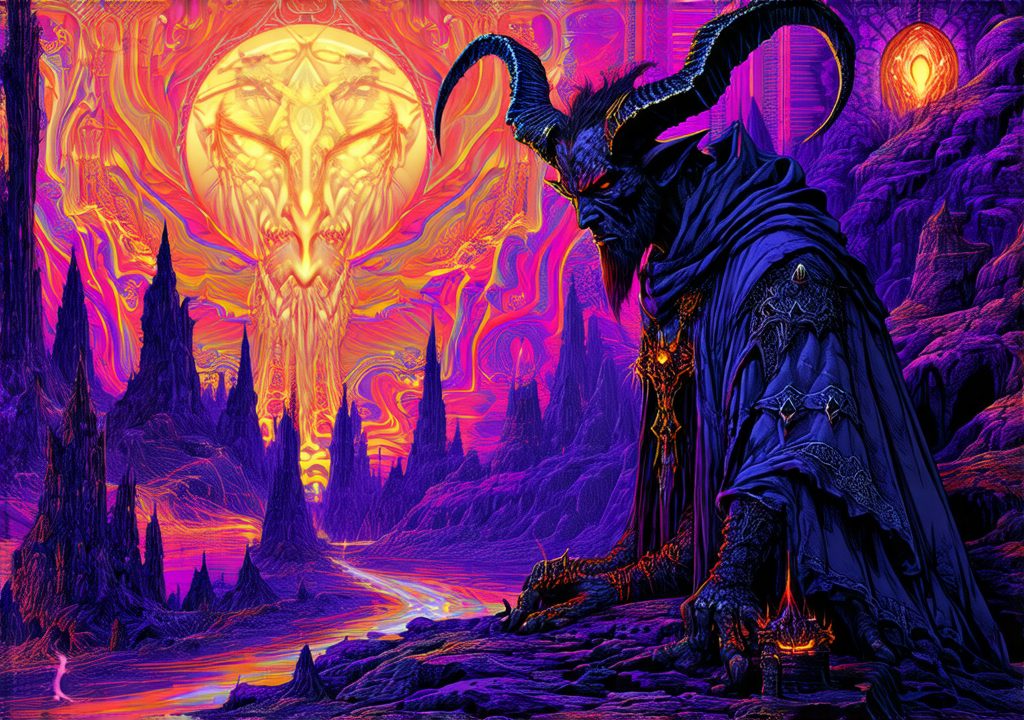
This Medieval Incantation Opens the Gate — But Only if You're Truly Forgotten by God
The Unwritten Name: A Litany for Those Abandoned by Grace ✦
In the dusty margins of late medieval grimoires, tucked between prayers to saints and recipes for medicinal salves, there exists a peculiar class of text. These are not the grand, illuminated summoning circles we so often romanticize in modern occultism. They are not the majestic evocations of Archons or the elegant dialogues with Angels. No—these are smaller, quieter, and far more intimate in their mechanics. They are prayers for the forgotten. And in the specific tradition I wish to discuss today, these incantations do not open a gate to invite power in. Rather, they open a gate because the speaker has already been removed from the ledger of the divine.
You must understand: this is not a ritual of acquisition. It is a ritual of recognition. To speak the words correctly, you must first accept that you are no longer being watched by the light. That your name has been crossed off the book of life and filed away in some forgotten drawer of celestial bureaucracy. And it is only in that state—truly forgotten, genuinely overlooked, authentically orphaned—that the incantation will hold its shape. The gate opens not to those who pray for power, but to those who have already lost the audience they were praying to.
The Medieval Context: Margins and Marginalia
To understand this particular type of medieval incantation, we must first situate it within the broader tradition it emerged from. The late medieval period—roughly the 13th through 15th centuries—saw a remarkable flourishing of practical magic texts in Western Europe. These were not the esoteric masterworks of Hermetic philosophy that later Renaissance occultists would produce. They were, for the most part, functional documents. Priests and monks, women healers and village wise-folk, merchants and artisans—all of them consulted magical texts for very specific purposes. Cures for disease. Charms for fertility. Protections against theft or fire. Summons for spirits to perform labor or reveal hidden truths.
What we are discussing here is a sub-genre within that tradition: the so-called "marginal" incantations. These were not found in the grand illuminated manuscripts of monastic scriptoria, though they may have been transcribed from earlier sources. Instead, they appear in the margins of books of hours, in the flyleaves of prayer manuals, scratched into the wooden frames of reliquaries, and preserved in collections that later scholars classified as "vulgar" or "populis" magic—meaning: the magic of ordinary people.
And it is precisely this ordinariness that makes them so fascinating from a demonological perspective. The great summoning texts of the tradition—the ones with their elaborate circles, the precise hours and days of invocation, the complex hierarchies of spirits—are works of institutional knowledge. They require training, specific materials, social authority (usually priestly or aristocratic), and an understanding of the celestial order that was largely the preserve of educated clerics and scholars. The marginal incantations, by contrast, required very little in the way of material investment. A piece of parchment. A candle. The correct words spoken with the correct intention. And—crucially—a specific state of spiritual condition.
This is where our incantation fits. It belongs to a family of texts that might be called "orphan's prayers." They are designed for individuals who, for one reason or another, find themselves in a spiritually precarious position: those whose families have disowned them, those who have been excommunicated, those who have committed sins so particular that the local parish priest will not hear their confessions, and those who suspect they were never truly blessed at baptism. These are people who exist in a kind of spiritual limbo—present but not fully accounted for, present but no longer being watched over by the institutional machinery of salvation.
And it is this very absence of divine attention that makes them, paradoxically, accessible to the spirits of the lower orders.
The Logic of Abandonment: Why Being Forgotten Opens the Gate
This may seem counterintuitive if you approach it from a traditional Christian mystical perspective. After all, the standard understanding is that grace flows downward from God to humanity, and that those who are closest to God—who pray most fervently, who live most virtuously, who have received all the sacraments—have the clearest path to divine communication. So why would being forgotten by God be a prerequisite for opening a gate to spirits?
The answer lies in understanding how medieval demonology conceptualized the relationship between the divine and the demonic. In this tradition, the two are not simply opposites. They are, in a sense, complementary. The angelic orders and the demonic orders both occupy the same celestial machinery. Both serve as intermediaries between the human and the divine. And the boundary between them—while real, while maintained by centuries of theological argumentation—is far more porous than later systematic theology would have it seem.
Consider the logic: if you are fully embraced by God's grace, your spiritual field is saturated with angelic presence. Your prayers ascend to heaven; your virtues shine like a beacon. The spirits of the lower orders—those liminal beings who inhabit the spaces between human and divine—find it difficult to attach themselves to someone so thoroughly illuminated. You are, in a sense, too bright for them. Their light is dimmer than yours, and they cannot illuminate what already shines.
But if you have been forgotten—if your name has slipped from the books of grace, if your prayers go unanswered not because God is testing you but because no one is listening—then something changes. Your spiritual field becomes quiet. The angelic presence that should be there thins out or withdraws entirely. And in that absence, in that quiet space between heaven and earth, other presences can be heard.
This is not a rejection of grace—it is an acknowledgment of its limits. This incantation does not ask God for help. It asks the forgotten to speak on their own behalf. It assumes that you are already alone with your situation and will take the means necessary to navigate it. There is no mediation, no intercession, no sacramental machinery standing between you and the spirit you wish to contact. You are speaking directly into a space that God has, for whatever reason, chosen not to fill.
The Text Itself: Structure and Mechanism
The incantation we are discussing here follows a structure common to this family of marginal texts. Let us examine its components in turn, as understanding the mechanics is essential to understanding why it works—or why it appears to work—to those who use it.
The Opening Invocation: The text begins not with a name or a title for the spirit being summoned, but with a statement about the speaker's condition. Something along the lines of: "I am one whom no saint remembers, and whose name is not written in the book of life." This is crucial. It establishes the speaker's spiritual coordinates. You are not invoking power; you are declaring your absence from it. You are marking yourself as a void, a space where grace has withdrawn.
The Declaration of Need: Following this comes a brief statement of what the speaker seeks. In the traditional form, this is often practical: knowledge of hidden things, revelation of secrets, aid in a specific matter of urgency. But the key point is that it is framed not as a request to God but as a recognition that the spirit being contacted is one who can help where the divine has not. There is an implicit acknowledgment here that this contact will be at some cost—spiritual or material—that would not be necessary if you were in full communion with grace.
The Opening of the Gate: This is the central mechanical component. The incantation uses specific language—often drawing on Hebrew, Latin, and occasionally Aramaic phrases—to describe the opening of a threshold. Not the grand Gates of Heaven, but smaller ones: the gates between the known and unknown, the seen and unseen, the remembered and forgotten. The imagery is consistently one of quiet thresholds, not monumental doors. This fits the tradition: these are intimate contacts, personal dealings, not public evocations.
The Binding: Finally, the text includes a binding phrase—a way of ensuring that the spirit once contacted will honor the terms of the contact. In this family of texts, the binding is often framed in terms of mutual obligation: "You who dwell in the forgotten places, you are bound to answer me as I have spoken my truth." It is a contract between equals—or at least between two beings who share the condition of being overlooked by higher powers.
The State of Being: What It Means to Be Truly Forgotten
Here we arrive at what might be the most important aspect of this incantation for practitioners seeking to use it authentically. Because the incantation's efficacy depends not on the precision of the words but on the authenticity of the speaker's condition. And "truly forgotten" is a high bar.
It is not enough to feel lonely, or neglected, or spiritually dry. These are normal states that every person experiences at various points in their spiritual life. The incantation requires something more specific: the genuine sense that you have been removed from the community of grace. That your prayers go up and simply... continue going up, without landing anywhere. That you have asked for help and received only silence—not the comforting silence of divine contemplation, but the empty silence of a room where no one is listening.
In medieval practice, this state was often associated with specific social or spiritual conditions:
Excommunication: Perhaps the most formalized form of being forgotten by God's institutional church. An excommunicant has been removed from the body of believers. Their prayers are not forbidden but they do not rise to heaven in the same way. They stand outside the gate, and the incantation acknowledges this: you are already on the other side.
Unbaptized or Questionable Baptism: In a tradition where baptism was understood as the primary sacrament of incorporation into the divine community, those who had not been baptized—or whose baptism was considered invalid for some technical reason—existed in a state of spiritual uncertainty. The incantation speaks to this: your name may never have been written in the book at all.
Disowned or Exiled: Those cast out by family or community found themselves without the social and spiritual support networks that medieval life depended on. In a world where your parish priest, your patron, your family were your primary connections to divine grace, losing these connections meant a genuine diminishment of your spiritual position. The incantation acknowledges this: you have no advocate in heaven because you have none on earth.
Sinner Beyond Confession: In some traditions, certain sins—particularly those involving the body or the sacred—required specific forms of penance and confession that not all priests could hear or forgive. A sinner in this state might find themselves without a confessor willing to take their case, leaving them spiritually adrift. The incantation speaks to this: you have committed something that the institutional machinery cannot process, so you must navigate it alone—or with help from those who dwell in the spaces the church does not reach.
Demonological Authority and the Hierarchy of Spirits
As an authority on demonology, I want to speak specifically about the types of spirits this incantation is designed to contact. Because this is not a text for contacting high-order entities—Archons, Archangels, or the great celestial intelligences that populate the upper levels of medieval cosmology. Those beings are thoroughly saturated with divine grace and do not need to be contacted by those who have been forgotten by God. They are part of the system; they operate within it; their presence is a sign of inclusion in the divine order.
This incantation targets what we might call the "marginal spirits." These are beings that exist at the boundaries: between human and angel, between earth and heaven, between memory and forgetting. In medieval demonological taxonomy, these often correspond to the lower orders of angels (Powers, Virtues, Principalities in their more localized functions) or, in a more unorthodox reading, the upper ranks of what later traditions would classify as demons: the Spirits, the Powers, the Dominions.
The interesting thing about these beings is that they are not inherently evil in the way that popular demonology often portrays them. They are not tempters or deceptors (at least not primarily). They are intermediaries, messengers, workers. They occupy the spaces where the grand celestial machinery interfaces with human reality. And because they operate at this boundary—between the remembered and forgotten, between grace and nature—they are accessible to those who find themselves in that same borderline state.
This is what gives this incantation its particular character: it is not a summoning of power over something. It is an invitation to work alongside a being whose own position mirrors your own. You are both in the margins. You are both between. And because you share that condition, the contact is more direct, more personal, and—let us be honest—more intimate than one might expect from a purely angelic communion.
Practical Considerations for the Modern Practitioner
Now, I want to address the question that inevitably arises: can this incantation actually be used? And if so, under what conditions?
First, let me note that this is not a beginner's text. If you are using it as an introduction to practical demonology or spirit contact, you may find the experience more intimate and less structured than you might expect from the grander summoning traditions. The gate opened here is small. The space created is quiet. And the contact, if it occurs, will be personal in a way that can feel disorienting for those accustomed to the formal, hierarchical structure of angelic evocation.
Second, the state of being matters more than the material setup. You do not need an elaborate circle or rare candles or specific incense blends. What you do need is genuine self-honesty about your spiritual condition. Can you look at yourself and say: "I am one whom no saint remembers"? If you can only say it with a wry smile, knowing full well that your prayers are being heard and your virtues are being counted in some celestial ledger, the incantation will still work—but it will feel less authentic than it could. The spirit on the other side of the gate is listening for sincerity.
Third, be prepared for contact that is practical rather than revelatory. This family of texts was used by people who needed help with specific problems: finding a lost object, understanding a secret, receiving aid in a difficult situation. The spirits contacted through this gate are workers, not teachers. They will help you with what you asked for. But do not expect them to deliver a spiritual enlightenment or a cosmic revelation. That is the work of higher orders. This is the work of those who dwell in the in-between.
Fourth—and this is important from a demonological perspective—understand that contact through this gate carries a subtle cost. In medieval practice, this was often framed as a kind of spiritual debt: by accepting help from a being outside the formal structure of grace, you incur an obligation to them that does not exist in purely angelic communion. You are working with a spirit whose own relationship to God is ambiguous or partial. And that ambiguity can transfer to your own spiritual condition if you are not careful.
This does not mean the contact is dangerous in any dramatic sense—there is no need for elaborate protection circles or binding rituals beyond what the incantation itself provides. But it does mean that practitioners should be attentive to how their own spiritual life shifts after using this text. Some report a subtle shift in their relationship to institutional grace: a slightly easier silence when praying, a less vivid sense of being watched over, a quieting of the inner voice that traditionally signals divine presence. None of this is negative in itself—it is simply the natural result of spending time in a spiritual space where grace is not the primary mode of operation.
The Aesthetics of Forgetting: Why This Tradition Persists
There is something about this particular family of incantations that continues to resonate with practitioners across centuries and traditions. And I think it has to do with the aesthetic of forgetting itself.
In a world saturated with spiritual content—where every moment is accompanied by a notification, where our prayers are recorded in apps, where our virtues are tracked and quantified and optimized—the experience of genuine spiritual silence feels almost radical. The incantation we have been discussing here offers a return to that condition: the state before grace was systematized, before prayer became a service offering, before being forgotten by God became something you could check off on a spiritual wellness checklist.
The aesthetics of this tradition are quiet and intimate. There is no grandeur in it. No elaborate choreography. Just a person speaking their truth to a spirit that shares their condition. A small gate opening in a place where the light does not quite reach. A contact made in the margins, between the remembered and the forgotten, between grace and nature, between the known and the unknown.
And perhaps that is what makes it so effective: it requires you to be honest about your own spiritual position before a being who cannot help but notice if you are performing that honesty rather than actually living it. The spirit on the other side of this gate has been forgotten too. They know what it feels like to speak into silence. And they will recognize the difference between someone who is truly in that condition and someone who is merely role-playing it.
Closing Reflection: The Gate as Threshold, Not Destination
Let me close with a final thought on the nature of the gate itself. In this tradition, the gate opened by the incantation is not a destination—it is a threshold. You do not go through it and arrive somewhere new. You stand at it, speak your truth, make your contact, conduct your business—and then you step back to where you were before. The gate closes. Your condition does not fundamentally change: you are still one whom no saint remembers, still in the margins, still between grace and nature.
But something has shifted in that small space at the threshold. You have made a contact that would otherwise be impossible. You have received help or knowledge or aid from a being who shares your condition. And you have done so without requiring the full machinery of institutional grace to mediate the encounter.
This is, I think, what makes this incantation unique in the medieval tradition: it represents a form of spiritual practice that operates outside the system rather than within it. It does not ask for inclusion in the divine order; it works from the position of exclusion and finds power there. It assumes you are already where you are—forgotten, overlooked, in the margins—and uses that very condition as the key to the gate.
And in a world that so often tells us we need more—more grace, more structure, more validation, more connection—the simple act of speaking truth into silence and finding that someone on the other side is listening... that has a quiet power all its own. ✦