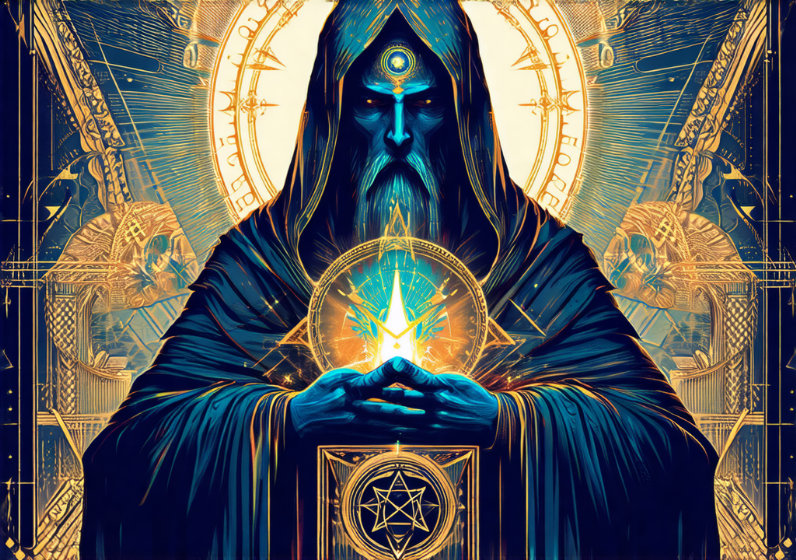
The Witch's Guide to the Dark Arts
🕯️ The Witch's Guide to the Dark Arts
🌑 Understanding the Spectrum of Witchcraft
To speak of the dark arts is not to speak of darkness alone. It is a common misconception among neophytes—and even some seasoned practitioners—that "dark" means evil, sinister, or morally questionable. In the tradition of witchcraft, light and dark are not opposites; they are companions. The sun rises only because the night has passed. The seed sprouts only after being buried in the cold earth. Similarly, the dark arts represent those aspects of magic that are subtle, internal, shadowy, or require a deeper dive into the unseen realms.
For the modern witch, understanding the dark arts is not about choosing sides on a moral battlefield. It is about embracing the fullness of craft. The dark arts include divination through shadows, the working with ancestral spirits, the art of curses and hexes, the use of protective wards that repel rather than invite, and the alchemical transformation of lead into gold—both literally and metaphorically. These are not lesser magics. In many traditions, they are considered more powerful precisely because they tap into the deeper strata of the soul and the spirit world.
This guide is intended for those who wish to explore these aspects of witchcraft with reverence, precision, and intentionality. Whether you are a beginner seeking to understand what lies beyond the surface of candle magic, or an experienced practitioner ready to deepen your work with curses, protection, and spiritual communion, this article will serve as your illuminated lantern in the foggy corridors of the occult.
🕸️ The Foundations: Intent, Energy, and Ethical Craft
Before you light a single black candle or carve a single sigil into wax, you must understand the foundational principles that govern all magical work. In witchcraft, intention is the seed from which all results grow. A poorly formed intention will yield a poorly grown result. This holds true whether you are casting a simple healing spell or constructing an elaborate curse.
The Law of Threefold Return
In Wiccan and Pagan traditions, it is commonly taught that what you send out into the universe returns to you three times over. If you cast a love spell on someone without their knowledge, you may receive an unwanted attachment in your own life. If you place a curse on an enemy with bitterness and resentment, you may find yourself surrounded by ill will. The dark arts are no exception to this law. In fact, they are particularly sensitive to it, because curses and hexes work through the energy of the caster's emotions.
This does not mean that cursing is unethical or that it should be avoided. It means that every working—especially those involving curses, protection, and spirit work—should be performed with clear awareness of your own emotional state. Are you working from a place of power or a place of weakness? From clarity or confusion? The energy you project will carry the imprint of your inner state.
Working with Shadow Energy
The dark arts draw heavily on shadow energy—the parts of ourselves and others that we wish to hide, suppress, or deny. In alchemical terms, this is the nigredo stage, the blackening, where the raw material must be broken down before it can be transformed. The witch who works in the dark arts must be comfortable with her own shadows. She must look at her insecurities, jealousies, fears, and desires without judgment or shame.
This self-awareness is not optional. It is the bedrock upon which all effective dark magic is built. If you curse someone for a quality that you secretly wish to possess in yourself, your curse will be weakened by internal conflict. The universe reads the heart more accurately than it reads the hand.
🕯️ Curses and Hexes: The Art of Negative Magic
Cursing is one of the oldest forms of magic known to humanity. Long before written spells were codified in grimoires, humans would carve names into stones, bury dolls beneath thresholds, or scatter ashes on roads as a way to invoke misfortune upon enemies. Curses are not merely "opposite" blessings; they are tools of precise energetic redirection.
The Difference Between a Curse and a Hex
While the terms are often used interchangeably, there is a subtle distinction that practitioners should understand. A curse typically invokes general misfortune or ill will upon a target. It is broad in scope: bad luck, poor health, broken relationships, financial loss. A hex, on the other hand, is more specific and precise. A hex targets a particular aspect of someone's life or a particular quality they wish to diminish. For example, a hex might specifically reduce an enemy's confidence, damage their business reputation, or create discord in a specific relationship.
Understanding this distinction helps you choose the right tool for your working. If you need general misfortune to befall someone, a curse is appropriate. If you need to target a specific area of influence, a hex is more effective.
The Components of an Effective Curse
A well-constructed curse requires several key elements:
1. Clear Intention. You must know exactly what you want the curse to achieve. Vague intentions produce vague results. Instead of "I want them to have bad luck," be specific: "I wish for this person's next three business deals to fall through due to miscommunication."
2. The Target's Energy Signature. In magical practice, it is considered best practice to use an item that has been in contact with the target—hair, a piece of clothing, a photograph, or even a written name. This creates an energetic link between your working and the person you are directing energy toward.
3. The Medium. Curses can be worked through many media: candles (black for banishing, purple for spiritual insight), herbs (rosemary for memory, lavender for calm, rose petals for love—use these in reverse or with black salt to invert their meaning), crystals (smoky quartz for grounding negative energy, amethyst for spiritual protection), and written words.
4. The Ritual Space. Curses are often worked in a dedicated altar space that has been cleansed and consecrated. Some practitioners work at crossroads, graveyards, or natural locations where the veil between worlds is thin. The physical environment contributes to the energetic field of your working.
A Simple Curse Working
Here is a straightforward curse working you can adapt to your needs:
Gather a black candle, a piece of paper, a pen, and a small bowl of salt water. Write the target's full name on the paper three times. Soak the paper in the salt water while speaking your intention aloud, clearly and with authority. Light the black candle. Place the soaked paper over the flame until it is fully consumed. As the paper burns, visualize the curse taking root in the target's life. When the candle has burned down to a stub or gone out naturally, gather the ashes and store them in an airtight container. Bury the container somewhere quiet—a garden, a park, or beneath a tree—after three days. Do not look back for seven days.
This is a simple working, but it demonstrates the principles: clear intention, energetic link (the name), appropriate medium (black candle and salt water), and a complete ritual arc from beginning to end.
🛡️ Protection Wards and Banishing Work
Not all dark arts involve cursing or hexing. A significant portion of protective magic falls under this category. Protective work is essential for any witch who does spirit work, divination, or works with energetic entities. Without proper protection, you become an open channel through which unwanted energies can flow into your personal space.
The Circle of Salt and Ashes
One of the oldest forms of protection involves creating a circular boundary using salt and ashes. Salt is a purifying agent; it absorbs negative energy and cleanses spiritual residue. Ashes represent transformation—the end result of fire's consumption, and they carry the memory of what was burned. Together, they create a barrier that repels unwanted spirits and stabilizes your personal energetic field.
To work this protection: Light a white candle at each corner of your working space (or at the four cardinal directions if you are working in an open area). Place a small bowl of salt at each corner. Sprinkle a thin line of ash (from a burned stick, a fire, or purified ashes) connecting the bowls to form a square or circle. Speak a protective word or phrase aloud: "By flame and earth, by spirit and soul, this space is sealed. Only what I invite may enter."
The Black Candle Banish
Black candles are the primary tool for banishing unwanted energies, spirits, or influences. To work a banishing candle: Light the black candle at the start of your working. As you work, visualize dark energy being drawn toward the flame and consumed. At the end of your ritual, allow the candle to burn down completely or snuff it out (never blow on it, as this is considered disrespectful to the flame's spirit). Store the wax in a clean container for three days before discarding it in nature or burying it.
Warding Your Home
Witches often maintain ongoing protective workings in their homes. Common methods include:
Hanging bundles of dried herbs (rosemary, lavender, sage, or rue) at doorways and windows
Placing crystals such as black tourmaline, smoky quartz, or obsidian in corners of rooms
Burning protective incense regularly (sandalwood, frankincense, or myrrh)
Creating a personal altar dedicated to protection that is maintained and refreshed monthly
The key to effective home protection is consistency. A single ritual will not hold for weeks. Protection must be renewed, just as a garden must be tended.
📜 Divination in the Dark: Reading Shadows and Spirits
Divination is often associated with light—crystal balls glowing softly, tarot cards laid out on a clean table. But there are forms of divination that draw from darker, subtler energies. These methods can provide insights that lighter forms cannot reach.
Shadow Tarot Reading
In this form of reading, the reader works specifically with shadow cards—the cards that reveal hidden motives, suppressed emotions, and subconscious patterns. A full deck contains 78 cards, but in a shadow reading, the focus is on the court cards (Kings, Queens, Jacks, Pages) and the suits of Cups and Wands, which represent emotional depth and creative fire—both areas where shadows hide.
To perform a shadow reading: Shuffle the deck while focusing on the question or area of life you wish to explore. Draw three cards. The first represents what is hidden from view in this situation. The second represents the emotional core of the issue. The third reveals the action that will bring clarity. Invert all three cards and read them as their reversed meanings, then flip them back and read the upright meanings. Compare the two readings to find the gap between appearance and truth.
Spirit Communication: Séance Work
Working with ancestral spirits or guiding spirits requires a different set of skills than working with elemental spirits (fairies, elementals, etc.). Ancestral spirits are more personal and more directly connected to your family line. They can offer wisdom, protection, and insight into hereditary patterns that affect your life.
To conduct a simple séance: Set up an altar with a white candle, a glass of water, a small plate of food (your ancestor's favorite if you know it), and a pen and paper. Light the candle. Place your hands on either side of the plate or the glass of water. Close your eyes and call your ancestor by name. Sit in silence for ten to fifteen minutes. Do not force visions. If you feel a presence, a shift in temperature, or an intuitive nudge, open your eyes and write down what you perceive. Thank the spirit before extinguishing the candle.
Séance work should be done with respect and proper protection. Not all spirits are benevolent. Ensure your space is cleansed before and after working. Some witches use a bell or chime to signal the beginning and end of communication, creating a clear boundary between the physical and spiritual realms.
🌿 Alchemy of Self: The Inner Dark Arts
Perhaps the most important aspect of the dark arts is not external at all. It is the alchemical transformation of the self. The witch who works in the dark arts must undergo her own nigredo—her own breaking down, questioning, and purging of what no longer serves her growth.
This inner work includes:
Journaling: Writing freely about fears, desires, and unresolved emotions. Not for an audience, but for yourself. The act of writing externalizes the internal chaos and gives it form that can be examined.
Shadow Work: Actively exploring the parts of your personality you would prefer to hide from others. What do you judge in others? That is often what you have not yet accepted in yourself. What do you fear most? That fear is usually a mirror showing you where you are not fully present in your own life.
Ritual of Release: Periodically performing a ritual where you write down an emotion, belief, or pattern that no longer serves you, and burn the paper while visualizing that element leaving your body and dissolving into smoke.
This inner alchemy is what gives your external magic its power. A witch who has not done her own shadow work will project unresolved patterns onto her spellwork. The curse she casts will carry the residue of her own unhealed wounds. The protection she builds will have gaps where her own insecurities create openings for unwanted energy to enter.
🕯️ Ethical Considerations in Dark Magic
One question that often arises in discussions of curses, hexes, and protective work is: "Is it ethical to do magic on someone else?" In magical practice, this question has no single answer. It depends on tradition, context, and the relationship between the caster and the target.
In Wiccan tradition, the general rule is to use your magic only in service of yourself or with explicit permission from others. Cursing someone who has not asked for a curse may be seen as an invasion of their energetic space. However, in many folk traditions, cursing is considered a legitimate tool for self-defense and justice. If someone harms you, it is fair to work protective magic on their behalf—or against them—depending on your needs.
The key principle is transparency with yourself. Are you working from a place of power or a place of resentment? Are you seeking balance or revenge? Both are valid, but they produce different energetic signatures in your work. A curse cast from a place of calm authority carries more weight than one cast from a place of bitter anger. The energy follows the intention.
Another ethical consideration is reversibility. In magic, there is no permanent. A curse can be lifted. A hex can be undone. Protection fades if not renewed. Understanding that your magical workings are part of an ongoing energetic exchange keeps you humble and attentive to the long-term effects of your craft.
🌙 Working with the Moon in Dark Arts
The moon is one of the most important celestial bodies in magical practice. Its phases influence the type of work that is most effective during each period:
New Moon: A time for setting intentions, planting seeds, and beginning new workings. Good for starting a curse or hex working, as you are laying the foundation.
Waxing Moon: Energy is growing. Good for building protective wards, strengthening curses already in motion, and expanding your spiritual practice.
Full Moon: Peak energy. The best time to perform powerful rituals, conduct séances, and work with spirits. Also a good time to release or banish unwanted energies.
Waning Moon: Energy is receding. Good for banishing, cleansing, releasing what no longer serves you, and completing curse workings (letting the final energy dissipate).
For dark arts specifically, the waning moon and the full moon are particularly potent times to work. The waning moon helps draw negative energy outward from your body or space. The full moon amplifies all energies, making it an ideal time for powerful protective rituals or spirit communication.
🕸️ Practical Tools of the Dark Arts
Every witch's toolkit should include a few essential items for dark arts work:
Black Candle: For banishing and protection
White Candle: For cleansing and clarity
Salt: Purification and barrier creation
Ashes: Transformation and grounding
Crystal Set: Obsidian, smoky quartz, black tourmaline, amethyst
Herbs: Rosemary, lavender, sage, rue, rose petals (for inverted use)
Journal and Pen: For shadow work and recording workings
Altar Cloth: Black or deep purple for dark arts work; white or cream for cleansing
Bell or Chime: For marking the beginning and end of spirit communication
You do not need all of these items to begin. Start with a black candle, some salt, and your journal. Add tools as your practice deepens. The most important tool you have is your own focused attention and clear intention.
🕯️ Building a Personal Practice in the Dark Arts
Starting a personal practice in the dark arts requires consistency more than complexity. You do not need to construct an elaborate ritual for every working. You need to show up, light the candle, speak the word, and trust the process.
Here is a simple weekly structure you can adopt:
Monday: Shadow work journaling. Write about one fear or desire that has been on your mind this week. Examine it without judgment.
Tuesday: Protection working. Light a white candle and sprinkle salt around your workspace. Speak your intention for the coming days.
Wednesday: Study time. Read a passage from a grimoire, a folklore text, or a book on alchemy. Take notes in your journal.
Thursday: Elemental work. Work with fire (candle magic), water (salt water rituals), earth (crystal placement or gardening), or air (breathwork and visualization).
Friday: Divination. Perform a simple three-card tarot reading, pull an oracle card, or sit in silence for ten minutes and attend to your intuition.
Saturday: Spirit work. Light a white candle and place a glass of water on your altar. Sit quietly and call upon any ancestral spirit you feel connected to. Write down what comes through.
Sunday: Rest and reflection. Do not perform new workings. Review your journal from the week. Note patterns, insights, and areas that need more attention next week.
This structure is flexible. Adapt it to your life, your tradition, and your needs. The goal is not perfection but continuity. A small working done consistently will outperform a grand ritual done once.
🌑 Final Thoughts: Embracing the Fullness of Craft
The dark arts are not the enemy of light magic. They are its counterpart, its shadow, its necessary complement. Just as a painting needs both light and shade to have depth, so does a witch's practice need both celebration and mystery, invitation and repulsion, blessing and curse.
To study the dark arts is to study the fullness of what it means to be human in a spiritual world. It is to look at your own shadows with curiosity rather than shame. It is to work with energies that are subtle, powerful, and sometimes difficult to perceive. And it is to trust that your craft—whether light or dark—is a gift you offer to the world and to yourself.
Light your candle. Speak your word. Trust the process. The dark arts will guide you home.