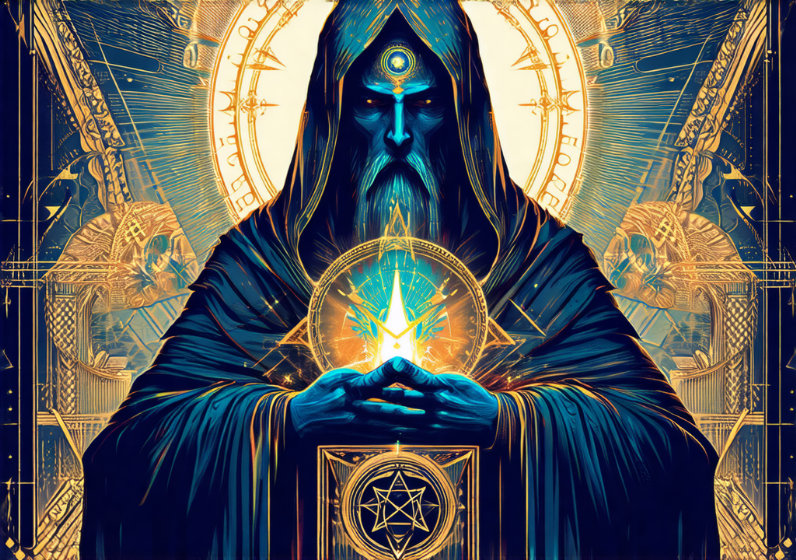
3 Questions To Ask Yourself Before You Call Yourself a Thelemite
⚖️ Three Inquiries for the Aspiring Thelemite
By Aleister Crowley's Shadow — A. M. O. V. P.
I. Preamble: The Weight of the Name
To call oneself a Thelemite is not merely to adopt a label, a fashion, or an aesthetic. It is to inscribe one's name upon the scroll of a particular dispensation—a cosmic epoch that began with the revelation of The Book of the Law in Cairo in 1904 and has continued to unfold through the centuries since. The name carries weight. It binds. It obligates. And it demands a certain fidelity to truth, to will, and to the sacred geometry of the soul.
Not everyone who studies Crowley is a Thelemite. Not everyone who admires his poetry or collects his occult artifacts has genuinely entered into the current of Thelema. Many wear the name loosely, as one might wear an elegant coat—because it looks good, because it signals sophistication, because it opens doors to certain circles and conversations. And this is not necessarily a criticism. Aesthetic appreciation is valid. Intellectual curiosity is noble. But there is a difference between admiring a river from the bank and swimming in its current.
Before you commit yourself fully to the name "Thelemite," before you begin to speak of Thelema as your path, your philosophy, your way of being—there are three questions that deserve deep, honest, and perhaps uncomfortable examination. These are not tests with pass/fail outcomes. They are mirrors. And mirrors can be difficult to look into for long.
Let us examine them one by one.
II. Question One: Have You Actually Read the Texts—And Do They Resonate?
This may seem like an obvious question, but it is far more nuanced than it first appears. It is not simply a matter of having read The Book of the Law or Liber AC∂ (as The Book of the Law is also known) once and feeling that "yes, yes, I get it." Thelema is not a philosophy that lends itself to single-reading comprehension. It is a living tradition, a symbolic system, a cosmology, an ethics, a psychology, and a practical discipline all at once. And its primary text, The Book of the Law, was given in a state of divine trance by Jane Shackleford (later known as Lady Paget) to Crowley on three days in March 1904. It is not written for casual reading. It is written to be meditated upon, internalized, and lived.
So the question becomes: have you read the foundational texts with the depth and patience they demand? Have you engaged with Liber AC∂ not just once but repeatedly, allowing its verses to settle into your understanding over days, weeks, even months? Have you studied The Commentary on The Book of the Law, in which Crowley himself explains the symbolic logic, the cosmological framework, and the practical implications of each line? Have you read Liber 777 (the key to correspondences), Liber Reshau (the ethics of the A∂O∂ system), Liber AL XXXIII (A Formula for Love), or at least some of his major philosophical and poetic works—Song of the Arab, Fleurs du Mal-esque verses, The Confessions of Saint Lucy, Four Articles on the Four Marks of the Way?
And beyond reading: do these texts resonate with you in a way that goes beyond intellectual interest? Do they feel like they are speaking to your specific soul, or do they feel like an interesting foreign language you can parse but not truly hear? There is no shame in the latter. Not every tradition speaks to every person. But if you find that you are drawn more to Crowley the poet, Crowley the historian of magic, Crowley the cultural figure—rather than Crowley as the revealer and systematizer of a particular spiritual dispensation—then it may be worth examining whether "Thelemite" is truly the most accurate self-description. You might be better described as a student of Thelema, an admirer of Crowley's work, or a practitioner of Western esotericism with Thelemic influences. All of these are valid identities. But they carry different connotations and commitments than full membership in the tradition.
A further sub-question here: have you studied the practical system? Thelema is not only philosophy. It is also practice—ritual, meditation, ceremonial magic, yoga, alchemy (in its broadest symbolic sense). If you call yourself a Thelemite, are you prepared to do the work? Not just think about it. Not just write beautifully about it. Actually sit in meditation. Actually perform the ritual of the Golden Dawn and its Thelemic adaptations. Actually keep a journal of your workings, your dreams, your correspondences. Actually discipline your body as well as your mind. Thelema is holistic. It integrates the intellectual, the emotional, the physical, and the spiritual. To call yourself a Thelemite implies a commitment to all four dimensions, not just one.
III. Question Two: Can You Hold the Paradoxes Without Forcing Them?
Thelema is full of paradoxes. And this is not a minor feature—it is central to its character. Crowley was a master of paradox, and his system reflects this. To be a Thelemite means to hold contradictory truths in simultaneous embrace, without the nervous need to resolve them into neat logical packages.
Consider: Thelema teaches that every soul has its own true Will—and that discovering and following that Will is the highest spiritual act. At the same time, it teaches that this individual Will is not separate from or opposed to the cosmic order; it is a unique expression of the universal Logos. Individuality and universality are not in tension. They are one.
Consider: Thelema affirms the sacredness of the body—sensual pleasure, sexual energy, physical health—as integral to spiritual development. At the same time, it teaches transcendence, contemplation, and a form of mysticism that rises above the merely material. Flesh and spirit are not enemies. They are collaborators.
Consider: Thelema is deeply individualistic—"Do what thou wilt shall be the whole of the Law." It celebrates personal sovereignty, self-reliance, and the unique path of each soul. And yet it is also deeply communal—it has its own church (the A∂O∂, the Order of the Solar Temple), its own liturgies, its own hierarchy of degrees, its own shared ritual language. The individual wills not in isolation but within a cosmic and social web.
Consider: Crowley was, by most accounts, a complex—often contradictory—figure. Generous and selfish. Intellectual and sensual. Spiritual and materialistic. A poet and a systematizer. A mystic and a showman. To be a Thelemite means to accept all of this without the need to curate a one-dimensional portrait of your founder or revealer. You take his errors with his revelations. His contradictions are part of the texture of the tradition, not flaws to be explained away.
The question, then, is: can you hold these paradoxes comfortably? Or do you find yourself wanting to resolve them—to say "well, it's really about X, not Y," or "the real teaching is Z, and the rest is just metaphor"? Thelemic understanding resists that kind of flattening. It asks for a more expansive, more dialectical mode of thought. You are asked to think in symbols as much as in propositions. To feel the truth of a statement before you can logically prove it. To accept that some things are known through experience rather than argument.
This is not a requirement of blind faith. It is an invitation into a different epistemology—one that values intuition, resonance, and lived experience alongside intellectual analysis. If you find yourself needing every Thelemic teaching to be fully rationalized before you can accept it, you may find the tradition somewhat constraining. Not wrong—just not a perfect fit for your particular cognitive style. And that is perfectly fine.
IV. Question Three: Are You Prepared to Live the Law?
This is perhaps the most practical and the most demanding of the three questions. "Do what thou wilt shall be the whole of the Law." It sounds simple. It sounds liberating. It sounds like a permission slip for whatever you want, whenever you want it. And in some superficial readings, that is exactly what it becomes—a philosophical justification for personal whim dressed up as spiritual truth.
But to live the Law is not the same thing as doing whatever you happen to feel like doing in any given moment. The Will in Thelemic usage is not the same as desire, impulse, mood, or preference. It is something deeper and more stable than that. It is the fundamental orientation of your soul—the direction in which your life naturally tends when you are free from external pressures, internal self-deception, and the noise of conditioned habit. Discovering your true Will is not a one-time event. It is an ongoing process of discernment, experimentation, reflection, and correction.
And following your true Will has implications—social, practical, ethical, relational—that you must be willing to live with. If your true Will points toward solitude, you cannot expect to maintain the social life that your conditioned self desires. If your true Will is creative, you will find that it demands time, discipline, and a certain freedom from the expectations of those around you. If your true Will involves service to others, then "do what thou wilt" does not mean ignoring their needs—it means finding the form of service that genuinely flows from your own center rather than performing a role.
To live the Law also means to accept the consequences of your choices without excessive self-pity or blame-shifting. Thelema is not a system of magical thinking where you can want something and simply will it into existence. It asks for practical engagement with the material world. It asks for honesty—especially the difficult kind, the kind that requires you to admit what you actually want rather than what you think you should want or what would be more socially acceptable.
It also means accepting that your Will may change over time—not because it is unstable, but because as you grow and shed layers of conditioning, deeper levels of your true orientation come into view. A Thelemite does not cling to a fixed self-image. They remain open to the evolving truth of their own soul.
So: are you prepared for all of this? Are you willing to do the ongoing inner work of discernment? Are you comfortable with ambiguity, with the slow process of peeling back layers of assumption and habit? Are you ready to be honest with yourself in ways that might be socially inconvenient or personally uncomfortable? To call yourself a Thelemite is to commit to this kind of living—not just thinking, not just studying, but actually building a life oriented around the discovery and expression of your true Will.
V. A Note on Community and Lineage
One additional consideration: in many traditions, calling oneself a member implies some form of recognized connection—a teacher, an order, a community, a lineage. In Thelema specifically, the A∄O∂ and its related orders (the SS∃, the Temple of the Seven Spheres, the Order of the Solar Temple) represent structured forms of transmission and community. Not all Thelemic practitioners belong to these orders—there are independent practitioners, families, small groups, and online communities that carry the tradition in various forms. But there is a difference between being part of a living community with some form of mutual accountability and support, and simply reading books and calling yourself a Thelemite in relative isolation.
This is not to say that solitary practice is invalid. Crowley himself spent long periods in solitude—on Spelter Island, at Cefalù, on the Isle of Wight. And many deep Thelemic insights come from quiet, sustained individual work. But community has its own value: it provides a mirror for your understanding, a context for ritual, a source of encouragement during difficult phases, and a check against the self-deception that solitude can encourage. If you are calling yourself a Thelemite in complete isolation, ask yourself whether you are seeking genuine spiritual development or a particular identity. Both are valid motivations. But they lead to different practices and different expectations.
VI. Closing: A Gentle Invitation to Honesty
None of these three questions have a single correct answer. They are not gatekeeping devices. Thelema is not an exclusive club with a membership test. Crowley himself was famously (and sometimes problematically) inclusive in his teaching, welcoming people of all backgrounds, orientations, and temperaments into the current. And he insisted that each soul's path is unique—so the specific form your practice takes will differ from anyone else's.
But these questions do ask something: they ask for honesty. They ask you to examine why you want to be called a Thelemite. Is it because the tradition genuinely speaks to your soul? Because you feel a resonance with its cosmology, ethics, and practice? Because you find in it a framework that helps you live more fully, more truthfully, more aligned with your own deepest orientation? Or is it for other reasons—intellectual fashion, social signaling, aesthetic preference, the desire to belong to an interesting group?
All of these motivations are legitimate. There is no hierarchy of validity among them. But clarity about your own motivations will help you practice in a way that is honest and sustainable. And honesty—with yourself, with the tradition, and with others—is itself a form of Thelemic living. It is "doing what thou wilt" at the level of self-knowledge: wanting to be seen as something other than what you actually are is not quite the same thing as truly being that something.
So before you put the name on your social media profile, before you tell people that you are a Thelemite, before you begin to speak of the tradition in terms of personal identity—sit quietly for a while and ask yourself these three questions. Let them work through you. And then decide with full awareness whether the name fits, or whether a different word serves you better.
Thelema is not the only path. It may not be your path. But if it is—if there is a genuine resonance, a felt truth, a sense of coming home to a cosmic current that has been waiting for you—then the name will feel natural. Not performative. Not aspirational in the shallow sense. Simply true.
And that is what "Thelemite" should mean: one who lives by the Law, one whose Will is aligned with the Logos of their own soul, one who has done the work and found the truth that speaks to them specifically and wholly.
Ipse Dixit.
Ex Deo ad Hominem. Ex Homo ad Deum.