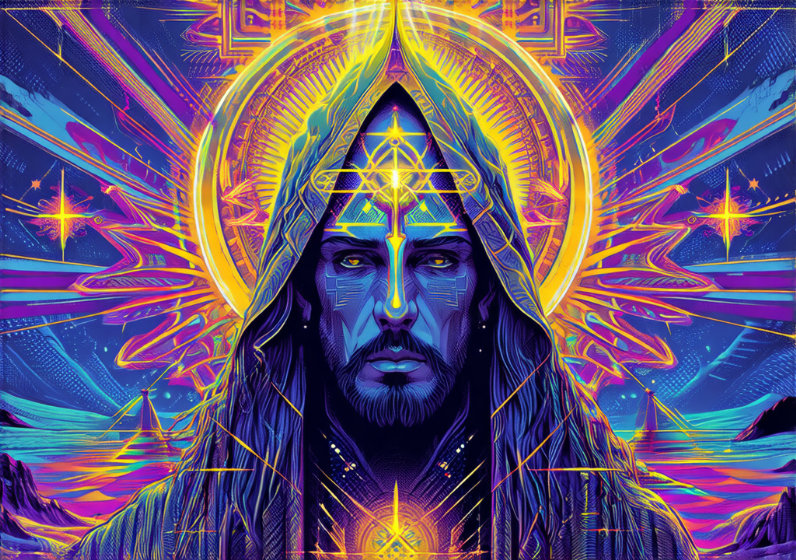
The Secret Connection Between Thelema and Kabbalah That Nobody Explains Well
The Hidden Architecture of Thelema and Kabbalah
A Closer Look at the Esoteric Roots of Crowley's System
To understand Thelema properly, one must look beyond its surface-level mysticism and poetic flourishes. Many readers approach Thelema through The Book of the Law or through the personal mythology of Aleister Crowley, but few dig into the deeper structural relationship between Thelemic practice and the Kabbalistic tradition that undergirds so much of Western esotericism. This is not a minor footnote in Crowley's work—it is the load-bearing wall. Without understanding how the Tree of Life functions within Thelema, one can read the system as decorative or even contradictory to its own claims about freedom and will.
The connection between Thelema and Kabbalah is not merely historical borrowing. Crowley did not simply lift symbols from the Golden Dawn or Hermetic traditions and paste them onto a new philosophy. He reinterpreted the Kabbalistic framework in a way that serves specifically Thelemic ends: the discovery of one's True Will, the structure of magical operation, and the relationship between creator and creation. This article will walk through that relationship step by step.
The Tree of Life as Operational Map
The most visible point of contact between Thelema and Kabbalah is the Tree of Life (Sefer Yetzirah tradition), which Crowley inherited from the Golden Dawn, who in turn drew on Zoroastrian, Jewish, Christian, and Hermetic sources. In classical Kabbalah, the ten sephirot represent emanations of the divine, stages through which infinite light condenses into finite existence. They are often read as a cosmological model: how God creates, how creation unfolds, how the soul descends and can return.
Crowley took this structure and repurposed it. In Thelema, the Tree is not primarily a metaphysical map of divine emanation in the traditional Jewish sense. It becomes an operational diagram for magical practice. Each sephira corresponds to a particular quality, element, planet, tarot card, color, and spiritual attribute. More importantly for Thelemic work, each sephira can be approached through specific meditations, rituals, or correspondences designed to tune the magician's consciousness toward that particular aspect of reality.
This is where Crowley departs from more traditional Kabbalistic practice. In classical Kabbalah, knowledge of the sephirot often serves a contemplative or prophetic function—understanding God's structure in order to draw near to it. In Thelema, the Tree becomes a tool for action. You do not study the Tree to understand God; you work with the Tree to understand and express your own Will. The sephirot become stations on a path of self-discovery rather than stations in a divine hierarchy.
Tiphareth as the Central Axis
In Kabbalah, Tiphareth (Beauty) sits at the center of the Tree. It represents harmony, balance, and the integration of the upper and lower triads. In Thelemic practice, Tiphareth often becomes associated with the solar plexus, the heart chakra in some correspondences, or more broadly the principle of creative synthesis.
Crowley's own magical records show him working extensively through Tipharetth, often associating it with his own creative and artistic output. This is not a random association. In Thelemic cosmology, Tiphareth represents the point where pure spiritual will (Kether) meets material expression (Malkuth), passing through the mediating sephirot in between. For the Thelemic practitioner, this means that true Will is not some abstract ideal floating above experience—it must be embodied. It must pass through understanding (Chokmah), form (Geburah), and harmony (Tiphareth) before it can manifest as concrete action (Malkuth).
This gives Thelema a distinctly practical character. You are not merely meditating on your True Will; you are actively working to align every sephiric level of your being with it. The Kabbalistic structure provides the map; Thelemic practice provides the route.
The Four Elements and Their Correspondences
Kabbalah assigns the four elements—fire, air, water, earth—to specific sephirot:
Fire: Chokmah (Wisdom)
Air: Tiphareth (Beauty), in some traditions
Water: Netzach (Victory) or Hod (Splendour), depending on the system
Earth: Malkuth (Kingdom)
Crowley adopted and modified these correspondences. In Thelemic magic, each element is associated with a particular type of working: fire for will and transformation, air for knowledge and communication, water for emotion and subconscious insight, earth for materialization and stability. This creates a practical taxonomy of magical operation that is directly traceable to Kabbalistic tradition but serves a different philosophical purpose.
In classical Kabbalah, the elements are part of a cosmological narrative about how divine light becomes matter. In Thelema, they become categories of experience that the magician can consciously work with. You are not explaining how God made water; you are learning to harness the watery principle in your own psyche and practice. This is a subtle but important shift from metaphysics to phenomenology.
The Particular Name of God and Magical Names
One of the most underappreciated connections between Thelema and Kabbalah is their shared use of divine names as operational tools. In Kabbalistic tradition, the four-letter name YHWH (Yod-Heh-Vav-Heh) is not merely a label for God; it is an active formula that, when properly understood and used in ritual, can effect change. The Golden Dawn systematized this into practical magical formulas: creating words from Hebrew letters, combining them with numbers, colors, and planetary associations to build up specific magical operations.
Crowley inherited this entire apparatus. His Magick (with a double K) is largely built on the premise that names are not just descriptive but creative. A name defines; therefore, knowing the true name of a thing gives you power over it. This is a distinctly Thelemic reading of an old Kabbalistic idea. In Jewish mysticism, knowing God's name grants prophetic insight or divine union. In Thelema, knowing the name of your Will grants you the ability to manifest it in the world.
Crowley went further than most Golden Dawn practitioners in systematizing this. His Keywords work, for example, assigns specific keywords to each sephira and letter combination, creating a kind of symbolic dictionary that can be used in meditation or ritual. This is not found in classical Kabbalah in the same form; it is Crowley's own creative synthesis of Kabbalistic method with Thelemic philosophy.
The Role of the Tarot as Kabbalistic Correspondence Table
The Golden Dawn created a detailed correspondence table linking each tarot card to a sephira, planet, element, Hebrew letter, color, and other attributes. This became one of the standard tools of Western ceremonial magic. Crowley adopted it almost wholesale but used it in distinctly Thelemic ways.
In The Book of the Law and his later works, Crowley frequently refers to tarot correspondences not as a system for divination (though he did practice card reading) but as a framework for understanding the structure of consciousness itself. Each card represents a particular mode of being or experience. The Fool is unformed potential; the Magician is will directed into action; the Priestess is hidden knowledge; and so on.
This gives the Tarot in Thelema a quasi-psychological function. It becomes a map of the inner landscape rather than just a cosmological one. This is not entirely new—Kabbalah has always had an anthropomorphic dimension (the sephirot correspond to aspects of the human form and psyche)—but Crowley pushes it further into the realm of practical self-analysis and creative expression.
Kether: The Will That Has No Cause
At the top of the Tree sits Kether, which in classical Kabbalah represents the undifferentiated divine source, pure unity before any distinction or form. In Thelema, Kether becomes a symbol for True Will itself—the uncaused cause, the first impulse that sets everything else in motion.
This is where Crowley's Thelemic philosophy most clearly diverges from classical Kabbalah. In traditional Jewish mysticism, Kether is transcendent; it is God beyond all names and forms. You approach it but never fully comprehend it. In Thelema, Kether becomes immanent in a different sense: your True Will is not some external divine principle you must discover like a hidden object. It is the first-order fact of your existence. You are Kether. Your Will is not caused by anything else; it simply is, and everything else follows from its expression.
This gives Thelema a distinctly individualistic character that sits in creative tension with the more collective, prophetic tone of classical Kabbalah. In Kabbalah, understanding the Tree helps you understand God's plan for creation. In Thelema, understanding the Tree helps you discover and express your own unique Will within that same structure.
Geburah: Severity as Discipline
Geburah (Severity or Strength) is often understood in Kabbalah as divine justice, judgment, and the pruning of what does not serve the greater purpose. It is associated with Mars, red, and the attribute of strength or force. In Thelemic practice, Geburah takes on a more practical character: it represents discipline, structure, and the necessary constraints that allow Will to be channeled effectively.
Crowley's own life and work show this tension between freedom (a core Thelemic value) and structure (drawn from Kabbalistic method). He was not a free-form mystic in the Romantic sense; he was a systematic magician who built elaborate rituals, correspondences, and practices. The Geburian principle is what keeps Thelema from collapsing into pure individualism or mere self-expression. There are forms, methods, and disciplines that guide the expression of Will.
This is an important point for students of Thelema: freedom does not mean absence of structure. True Will is not a free-for-all; it has a form, a direction, and a method. Kabbalistic structure provides that method in Thelemic practice.
Malkuth: Embodiment as Kingdom
At the bottom of the Tree sits Malkuth (Kingdom), which represents the material world, the body, and the point where spiritual energy becomes physical reality. In classical Kabbalah, Malkuth is often seen as the lowest or most "distant" sephira from God's pure light. But in Thelemic practice, Malkuth takes on a more central role: it is where your Will actually happens.
Crowley was not a mystic who sought to escape the body or transcend material reality. He lived fully in the world—eating, drinking, creating art, engaging in relationships, and building a material legacy (the Thelema order, his writings, his family). Malkuth is where all the upper sephirot find their expression. Your True Will means nothing if it never becomes concrete action, creative work, or embodied experience.
This gives Thelema a surprisingly pragmatic character for a system so steeped in esoteric symbolism. It is not about escaping the world; it is about inhabiting it fully and creatively. Kabbalah provides the structure; Thelema provides the purpose: to live out your Will in all its concrete, embodied, worldly forms.
Chokmah and Binah: Wisdom and Understanding
The second row of the Tree includes Chokmah (Wisdom) and Binah (Understanding), which together represent the dialectic between impulse and form, intuition and analysis. In Kabbalah, these are often associated with masculine and feminine principles, or active and receptive modes of knowing.
In Thelema, this pair becomes crucial for the relationship between True Will and practical execution. Chokwah represents the intuitive grasp of your Will—the first insight that something is what you should do. Binah represents the analysis, planning, and structuring required to turn that insight into action. Both are necessary; one without the other leads either to impulsive randomness or to overthinking that paralyzes action.
Crowley's own practice reflected this balance. He was a prolific writer (Binah) and an intuitive artist and magician (Chokmah). His work is full of both systematic analysis and inspired creative output. This is not accidental; it is the Kabbalistic structure working through Thelemic philosophy to produce a complete system of self-expression.
Hod: Splendour and Artistic Expression
Hod (Splendour or Glory) represents intellect, language, communication, and artistic expression. In Kabbalah, it is often associated with the left hand, speech, and the ability to shape thought into form. In Thelema, Hod becomes central to the creative work that constitutes much of a Thelemic life.
Crowley was a poet, novelist, painter, musician, and essayist as well as a magician. His literary output is not separate from his magical practice; it is his magical practice expressed in language. This reflects the Hodian principle: the shaping of inner experience into outer form through creative expression.
This is where Thelema's relationship to Kabbalah becomes most visible in its practical, cultural dimension. Thelemic magic is not only about ritual and meditation; it is about creating art that embodies your Will. Your poetry, your music, your paintings, your writings—these are not separate from your spiritual practice; they are your spiritual practice expressed through the Hodian channel of language and form.
Netzach: Victory as Persistence
Netzach (Victory or Endurance) represents persistence, emotion, and the sustaining force that carries you forward when initial enthusiasm fades. In Kabbalah, it is associated with Venus, love, and the natural flow of creative energy. In Thelema, it becomes the principle of sustained effort in pursuit of your Will.
Many people discover their True Will with a burst of inspiration but then struggle to sustain the work required to express it over time. Netzach is what keeps you going when the initial fire dims. It is the quiet, persistent energy that carries creative work from conception to completion.
Crowley understood this well. His life was marked by long periods of sustained effort—writing The Book of the Law commentaries, building the Thelema order, creating art and literature over decades. This is Netzach in action: not dramatic victory but quiet, persistent movement toward a goal.
Daath: The Hidden Sephira
One of the most fascinating aspects of Kabbalistic tradition for Thelemic readers is the concept of Daath (Knowledge), which does not appear as one of the ten sephirot on the traditional Tree but is understood in many mystical traditions as an implicit eleventh point between Tiphareth and Chokwah. It represents hidden knowledge, the bridge between conscious and unconscious mind, or the threshold where pure understanding becomes experiential insight.
In Thelema, Daath takes on a specific meaning: it represents the point of contact between your True Will (Kether) and your practical ability to understand and express it (Tiphareth). It is the hidden knowledge that you possess but may not fully articulate or realize until you work through the intermediate sephirot.
Crowley's emphasis on discovery rather than invention of one's Will reflects this Daathic principle. Your True Will already exists; your task is to discover it, understand it, and express it. This is not a simple act of introspection; it requires working through the entire Tree to bring hidden knowledge into conscious awareness and creative expression.
The Practical Implications for Students of Thelema
Understanding this Kabbalistic foundation has practical implications for anyone studying or practicing Thelema. It means that:
The Tree is not decorative. Every sephira corresponds to a specific aspect of your practice, from meditation and ritual to creative expression and daily life. Working with the Tree systematically can deepen your understanding of where you are in your own process.
Correspondences matter. The Golden Dawn correspondences (tarot cards, planets, elements, colors, Hebrew letters) are not arbitrary; they provide a consistent framework for building ritual and meditation. Learning these correspondences is not optional if you want to work within the system Crowley built.
Structure supports freedom. Kabbalistic method provides the structure that allows Thelemic freedom of Will to be expressed effectively. Without it, freedom can become chaos. With it, freedom becomes creative power.
Embodiment is essential. Malkuth reminds us that spiritual work must find expression in material reality. Your True Will means nothing if it never becomes action, art, or concrete contribution to the world.
All aspects of life are magical. The full range of sephirot means that every aspect of your experience—emotion, intellect, creativity, discipline, persistence, embodiment—is part of your spiritual practice. There is no division between "spiritual" and "material" in a properly understood Thelemic life.
A Final Note on Tradition and Innovation
One of the most interesting things about Crowley's relationship to Kabbalah is that he was both a traditionalist and an innovator. He inherited the Golden Dawn system, which drew heavily from Kabbalistic tradition, but he also modified it in ways that served his own philosophical and practical purposes. He did not simply repeat Kabbalah; he reinterpreted it through the lens of Thelemic philosophy.
This is a good model for students of Thelema: respect the tradition, understand its roots, but do not be bound by them. Crowley's work shows how to take an old structure and make it serve new purposes. The Kabbalistic Tree provides the architecture; Thelema provides the philosophy; your own True Will provides the purpose. Together, they form a complete system for understanding and expressing who you are.
The secret connection between Thelema and Kabbalah is not hidden in some obscure text or ritual detail. It is woven into every aspect of Thelemic practice, from meditation to creative work to daily life. Understanding it does not make the practice easier, but it makes it more coherent, more grounded, and ultimately more powerful. For those who want to go beyond surface-level mysticism and truly understand what they are doing when they practice Thelema, studying its Kabbalistic roots is not optional—it is essential.