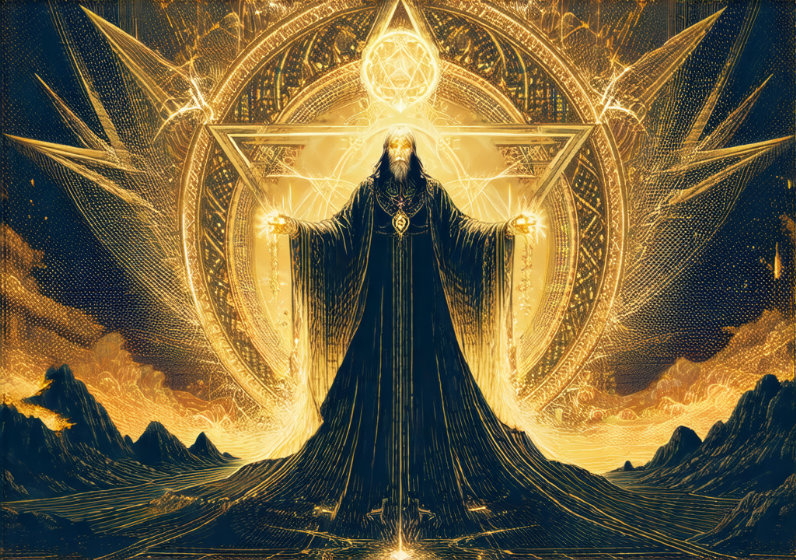
The Forbidden Art of Conversing with Those Who Have Passed
🕯️ Whispers Beyond the Veil: The Forbidden Art of Conversing with Those Who Have Passed
✒️ by Maudelith Ravenquill, Keeper of the Sepulchral Archive
There is a particular quality to silence in an old house after midnight — not absence, but presence. A fullness that presses against the eardrums and settles into the marrow. It is in this silence that the first students of necromancy report their initial encounter: not a sound, not a sight, but a knowing. A sense that the room contains more inhabitants than the living population accounts for. The dead do not leave. They merely change the frequency on which they speak.
Necromancy, from the Greek nekros (corpse) and teuchos (craft), is one of the oldest discursive arts known to humanity. Long before the Sumerians pressed cuneiform into wet clay, priests in Egyptian temples spoke to the deceased with formalized liturgies that were less prayer than dialogue. The Egyptians believed the soul, or rather its administrative aspect — the ka and the ba — remained tethered to the body's location until properly ritually released. Necromancy was not, in their eyes, a mystical fancy. It was bureaucratic correspondence with the other side of death.
To call necromancy "forbidden" is to adopt a specifically post-Christian framing, one that inherited the medieval Church's suspicion of any art that seemed to blur the boundary between the living and the dead. The Church had reasons. If the boundary could be crossed at will, then the authority over souls — that most profitable doctrinal claim — became negotiable. To speak with the dead was to suggest that death was not a door but a window, and windows can be opened from either side.
I. The Ontology of the Dead: What You Are Actually Speaking With
A competent necromancer does not begin with incantations or candles. She begins with epistemology. Before one can converse with the dead, one must understand what "the dead" actually refers to, because it is not a singular entity.
Across traditions, the deceased are parsed into multiple components:
The Egyptian ka — the vital spark, the life-force that returns each day from the underworld but requires sustenance (food offerings) to persist. It is mechanical, hungry, and largely non-sentient.
The Egyptian ba — a quasi-autonomous personality-aspect that can travel between worlds. Closer to what moderns imagine as "the ghost."
The Greek psyche / pneuma — the breath-soul that departs at death and enters Hades. The Homeric dead are famously vague, grey, and semi-conscious. They remember their names but not much else.
The Kabbalistic neshamah — the highest soul-spark, of divine origin, which can be accessed through meditative or ritual means even after death.
The Roman manes — ancestral spirits that require ongoing veneration and feed on the social memory of the living.
A student who assumes she is speaking with "the dead" as if they were a single, coherent presence is making a category error that will distort every subsequent conversation. The entity responding to your question may be a residual memory-echo, a hungry ka-fragment, or a fully formed ba with preferences and grudges. Learning to distinguish these is the first practical skill in conversational necromancy.
II. Preparation: The Architecture of Contact
Conversing with the dead is not casual. It requires an environment structured so that the living mind does not project its own narrative onto the silent space, mistaking internal monologue for external voice. This is the central failure mode of amateur practitioners. You hear what you expect to hear. Grief is a powerful signal generator, and it drowns out subtle input.
The Space
Traditional practice favors locations with "acoustic memory" — rooms where many people have lived, died, or grieved. Old churches, family homes, cemetery chapel ruins. The physical structure has absorbed the resonance of prior occupants. In practical terms: choose a location that carries genuine historical weight for the specific deceased you intend to contact. Contacting a particular ancestor in your childhood bedroom is not symbolic indulgence; it is leveraging a real environmental attunement.
The Time
Most traditions converge on transitional periods: dusk (the threshold between solar days), the hours around midnight, and seasonal cross-overs (Halloween/All Souls' Eve, Midsummer's Day). The logic is consistent: these are liminal moments when the perceptual boundary between states of being is thinnest. You are not performing magic at these times; you are listening at a moment when the signal-to-noise ratio improves.
The Body
This is the part most pop-culture treatments skip. The practitioner's nervous system must be in a state of low sympathetic activation. If you are anxious, hungry, sleep-deprived, or emotionally reactive to the person you're trying to contact, your autonomic noise will overwhelm subtle input. Traditional practitioners fasted the day before a sitting. They bathed with specific herbs — lavender, mugwort, rosemary — not for scent but for their mild sedative and focus-enhancing properties on the olfactory system. You are an instrument. Tune it before you play.
The Offerings
In Egyptian practice, food was left in the tomb or at the household shrine. The ka consumed the concept of the food — its smell, its name, its social meaning. In Roman practice, wine was poured on the ground for the manes. In Kabbalistic practice, a small candle and a verse from the Torah were set before the seat where the deceased had sat in life. The offering is not bribery. It is address. You are creating a context that says: "You are expected here. This space acknowledges your continued existence."
III. The Method of Conversation
This is where necromancy diverges from generic mediumship and becomes its own discipline. A medium receives; a necromancer converses. The difference is structural. A medium is a passive receiver — the dead speak, the medium transcribes. A conversational necromancer asks questions, listens, follows up, clarifies, disputes. It is dialogue, not broadcast.
Questioning Protocol
Begin with open, non-leading questions that do not presume knowledge:
"Are you present here now?" (Establishes presence without assuming a specific identity.)
"What would you want me to know that I may have forgotten or misunderstood about our time together?"
"Is there something unfinished between us? A word unsaid, a gesture not made?"
Avoid questions with embedded assumptions. Asking "Did you forgive me for leaving?" presumes a grudge and a specific emotional narrative. The dead will often confirm your assumption rather than correct it, because the residual imprint of a relationship carries its own interpretive frame. Ask: "What was the state between us at the end? Describe it in your own terms."
Listening Modes
Conversation with the dead does not typically produce audible speech. The input modalities include:
Somatic impression: A sensation on the skin, a temperature shift near a specific body part (the deceased's dominant hand, their favorite shoulder). A gentle pressure where they used to sit beside you.
Olfactory trace: Sudden awareness of a scent associated with the person — their perfume, their soap, the tobacco or tea they favored. This is often the most reliable early signal.
Ideational intrusion: A phrase or image that feels slightly not-yours, as if a word has been whispered into your working memory from outside your own cognitive process. You recognize it as borrowed.
Emotional resonance: An affective state that arrives without an identifiable trigger in the present moment. Grief, warmth, amusement — arriving like a radio station tuning in.
Discriminating these signals requires practice and a stable baseline of self-awareness. The novice mistakes every memory for a message. The experienced practitioner learns to distinguish "I remember my mother's kitchen" from "my mother is reminding me about the kitchen." The difference is subtle but structurally important: one is retrieval, the other is transmission.
The Risk of Projection
This is the central epistemic hazard. Because you knew the person, your mind contains a rich model of their voice, preferences, and likely responses. When you receive an ambiguous signal, pattern-matching fills in the gaps with your expectations. The conversation becomes a collaboration between the dead's actual message and your own narrative reconstruction, and you can no longer fully tell them apart.
Mitigation: Take notes during and immediately after the sitting. Write down every impression verbatim, including the uncertain ones. Compare against what you expected to receive. Where they differ, investigate further in subsequent sessions. Maintain a journal of conversations. Over months and years, patterns emerge that distinguish genuine transmission from self-projection with increasing clarity.
IV. The Ethics of Post-Mortem Dialogue
Conversing with the dead raises ethical questions that most practice traditions have not fully articulated, because they treat it as a private art. But if you are engaging in dialogue — asking and answering, interpreting, constructing meaning from fragments — you are performing an act of interpretation on someone who cannot correct your reading. The deceased cannot say "that's not what I meant." You must carry that interpretive responsibility alone.
Consent
Can the dead consent to being spoken with? In most traditions, yes — but conditionally. The ka consents through sustenance; you are feeding it, and in exchange it responds. The ba consents through recognition; it is drawing toward a context where its own identity is acknowledged. But there are also traditions that hold certain states of the dead do not wish to be disturbed — those in deep mourning, those who died violently and whose ba has not yet organized itself coherently. You may be speaking with an unstable imprint, or you may be interrupting a process of transition that benefits from undisturbed time.
Fidelity
Do not embellish what the dead say to living people. If you are a family member and you convey to siblings or children that "Grandmother says she's at peace," you have made a representational claim about someone who cannot confirm it. Maintain fidelity: distinguish between clear impressions and your own inferences. "I felt warmth near my left shoulder and the scent of camphor" is an observation. "She is telling me to let go of guilt" is an interpretation. Report both, labeled.
Reciprocity
Conversation implies exchange. In Egyptian practice, this was literal: you fed the ka; it spoke. In Kabbalistic practice, the prayer or verse offered created a context in which the neshamah could orient itself toward you. Even if your tradition does not require material offerings, there is an implicit social contract of reciprocity. You are asking for their attention, their time (if time applies), their willingness to re-engage with a living mind that has moved on. Acknowledge this debt.
V. Historical and Cultural Variations
Ancient Egypt
The Pyramid Texts contain the earliest known necromantic dialogues — not spells, but formal addresses spoken by the king (now deceased) to other deceased figures in the afterlife. The conversation is already established. The dead speak to each other. The living participate through ritualized proxy: priests read the texts on behalf of the deceased, creating a bridge between the two conversational communities.
Classical Greece and Rome
Homer's Nekyia (the underworld journey in the Odyssey) models conversation with the dead as somewhat formal and constrained. The shades are semi-aware; they drink blood to gain temporary consciousness and speak briefly before fading. Roman parentatio — the funeral oration where the living address the dead directly by name, recounting their virtues — is a structured conversational ritual between generations.
Kabbalistic Tradition
The Kabbalists developed a sophisticated framework for communicating with specific ancestral or prophetic neshamot through meditative focus on specific verses and sefirotic correspondences. The conversation was intellectual: questions about Torah interpretation, the nature of divine attributes, the structure of creation. The dead were not mourned so much as consulted.
Medieval Christian Necromancy
The Church's suspicion produced a curious inversion: necromancy became associated with summoning — pulling the dead up rather than inviting them to speak. The image is of a one-sided extraction, not a dialogue. This framing persisted into Victorian séance culture and modern spiritualism, where the medium "summons" and "channels." It lost the conversational quality. The dead became objects of information-retrieval rather than participants in exchange.
African and Indigenous Traditions
In many West African traditions, the dead are not gone but elsewhere, fully present in social life. Conversations with them are routine: you ask before making a decision; you inform them of births; you argue with them about family disputes. The boundary between conversation and communion is less distinct than in Western practice.
Japanese Tradition
The Shinto and Buddhist-influenced tradition of mizugai (water offering) to ancestors maintains an ongoing conversational relationship. Ancestral altars are not shrines to objects; they are addresses. You speak there. They listen. The ritual is a maintenance protocol for a continuing social bond that death interrupted but did not terminate.
VI. Practical Discernment: Separating Signal from Noise
After months or years of practice, the practitioner develops what can only be called conversational literacy with the dead. This is analogous to reading a difficult author's work over time — initially every sentence is ambiguous; eventually you begin to recognize their particular rhythms, their preferred metaphors, their structural habits. The dead have styles. Some speak in fragments. Some prefer long narrative impressions. Some communicate primarily through emotional states rather than ideational content.
Keep a structured log:
Date, time, location
Specific deceased contacted (or "unspecified")
Questions asked
Impressions received (verbatim, including uncertain ones)
Emotional state before and after the sitting
Correlation notes (e.g., "scent of lavender; grandmother used lavender in her bedroom"; "phrase 'the garden is growing back' — father was a gardener but I had not thought about his garden in three years")
Over time, you will identify your own projection patterns. You will learn which signals are reliable for your system. You will develop an internal model of how the particular dead person communicates with you, because conversation is dyadic and idiosyncratic. The same grandmother might speak clearly to one child in scent-and-sensation and to another in phrase-level impressions. This is not inconsistency; it is attunement shaped by the specific relational history between two minds, living or otherwise.
VII. What Conversation with the Dead Actually Reveals
This is the part that surprises practitioners who expected grand revelations. Conversations with the dead are rarely dramatic. They are small. Specific. Domestic. You learn not about the nature of the afterlife but about them — a preference you had forgotten, a correction to a memory you held as fixed, an unfinished gesture that resolves something in your own mind that you did not know was unresolved.
You may discover that the person you grieved over was carrying a small, specific gratitude they never got to express while living. You may learn that a resentment you attributed to them was actually directed at someone else. You may find that their "message" is not mystical but practical: "Tell your sister about the blue coat. She wanted it."
The conversation does not abolish death. It does not restore the person. But it continues the social bond in a form that requires no shared body, no shared time, no shared breath. It says: you are still a participant in my world, and I am still a participant in yours, across the boundary, at the frequency where our two patterns of organization can still overlap just enough to carry a word.
That is what necromancy actually does. Not summoning. Not channeling. Not extraction. Continued conversation. The most human thing there is, extended slightly beyond the human frame that death removes but does not erase from the structure of a relationship.
VIII. A Note on Humility and Practice
The dead are patient in ways the living rarely are. They do not interrupt. They do not check their phones mid-sentence. They hold attention without the metabolic cost that makes sustained focus exhausting for us. But they also do not perform, do not confirm, do not validate. If you need them to say a specific comforting thing, you will hear it — and you will never know if it was their voice or your own expectation wearing their face.
Practice humility. Practice slowness. Do not rush the sitting. Do not fill silences with commentary or reassurance. Sit in the space between signal and noise long enough for both to resolve into something distinguishable. The conversation is not a performance you give. It is a listening practice you maintain, sustained over time, refined by repetition, deepened by honesty about what you can and cannot discriminate.
The dead have been quiet for a while. They are used to it. You do not need to fill the silence. You only need to be present in it with sufficient clarity that when they speak — faintly, indirectly, in scent or sensation or a borrowed phrase — you recognize it as theirs and not your own memory wearing their name.
That recognition is the art. That recognition is the conversation. And that recognition, once learned, does not require candles or incense or ritual garments. It requires only the quiet discipline of attending to a signal that is smaller than your expectations, in a space where no one else can hear it but you.
The dead are closer than we think. They have always been closer than we think. Conversation with them is not crossing a boundary. It is recognizing a conversation that was never fully interrupted — only changed in register.
You were already speaking to them. You just hadn't learned to listen at the frequency they use.