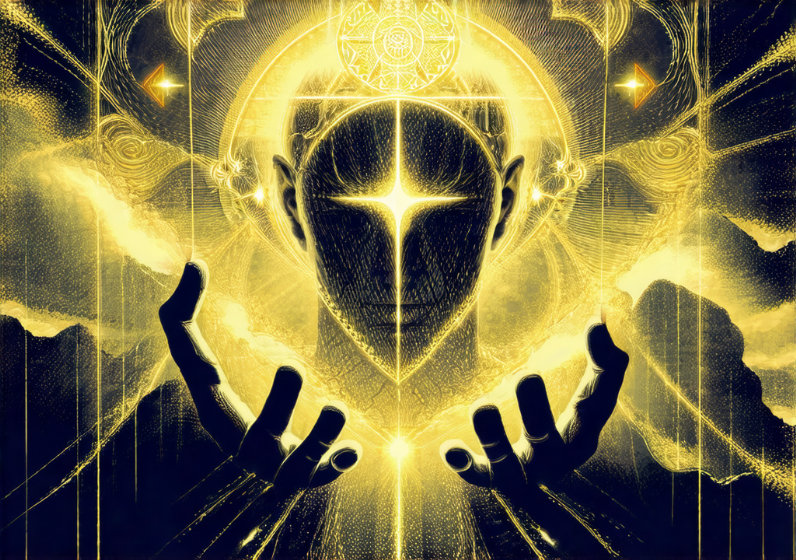
The Sinister Vow: A Pledge Only True Rebels Can Keep
The Sinister Oath: A Covenant of the Unbound Spirit 🜄
The Left Hand Path is not merely a philosophy, a religion, or even a lifestyle. It is an ontological stance. It is the declaration that you are separate from the flow of Nature, distinct from the collective, and ultimately, superior to the material world that seeks to consume you. It is the path of Solar Paganism, of the Individual, of the Rebel, and of the Sovereign Self. To walk this path is to stand apart from the Herd. It is to look at the warm, fuzzy, collective consciousness of the Right Hand Path—the path of Nature, of society, of shared morality—and to say: I am not you.
This article explores the Sinister Vow. Not as a simple set of rules or a ritualistic incantation, but as the foundational pledge that separates the true Left-Hander from those who merely dabble in rebellion without understanding its metaphysical weight. The Sinister Vow is the covenant by which the Initiates declare their separation from the collective ego and bind themselves to the solitary journey of Self-Godhood. It is a vow only true rebels can keep, because it demands a level of willpower, isolation, and spiritual sovereignty that the comfortable masses simply cannot sustain.
The Metaphysics of Sinistritude 🜃
To understand the Vow, one must first understand what "Sinister" truly means in the context of Left Hand Path philosophy. It does not mean evil in the moralistic sense. It is not about being a villain for the sake of it, nor is it simply the opposite of the Right Hand Path. Sinister comes from the Latin sinistra, meaning "left." In ancient Roman and Egyptian tradition, the left side was associated with the non-physical, the occult, the mysterious, and the feminine (in the sense of the receptive but also the generative power). The right side was associated with the physical, the mundane, the social, and the masculine.
Therefore, to be Sinister is to align oneself with the realm beyond the material. It is to step outside the narrative that society writes for us. The Right Hand Path (RHP) is the path of assimilation. It seeks to blend in, to find harmony with nature, to become one with the tribe, and to achieve a state of peaceful coexistence with the world around you. You are a drop in the ocean; your purpose is to be part of the water.
The Left Hand Path (LHP) is the path of separation. It seeks to distinguish oneself from nature, to elevate the Self above the collective, and to become a star rather than a drop. You are not the ocean; you are the sun that illuminates it. The LHP Initiates view the material world as a prison or a laboratory—a place to be observed, manipulated, and ultimately transcended. The self is not a product of evolution, culture, or society. The self is an eternal spark, a divine fire, that was trapped in flesh by some cosmic accident or divine plot.
The Sinister Vow is the formal declaration of this separation. It is the moment when the Initiate acknowledges that they are no longer bound by the moral codes of the tribe. They have stepped out of the flow of nature and entered the realm of the Unnatural, the Occult, and the Sovereign. This is not a rejection of reality, but an assertion of one's own reality over everyone else's. It is the ultimate act of spiritual independence.
The Three Pillars of the Vow ⚖️
The Sinister Vow is traditionally structured around three core tenets or pillars. These are not merely suggestions; they are the structural supports of the LHP worldview. If one pillar fails, the entire structure collapses. A true rebel must uphold all three with unwavering consistency.
1. The Pledge of Solitude (Separation from the Herd)
The first pillar is perhaps the most difficult for the average person to understand or maintain. It is not about being a hermit in a cave, though it can be that. It is about the internal state of solitude. A Left-Hander must cultivate an inner loneliness that the world cannot touch. You are physically surrounded by people—family, friends, colleagues—but spiritually, you are apart from them.
This does not mean hating others or treating them with coldness (though that can be a strategy). It means recognizing the fundamental difference between yourself and them. They are bound to society; you have broken free of it. You participate in the world, but you do not belong to it. The Vow requires you to view every social interaction as a performance, a role-play, a game of masks. You give others what they need to keep the peace, but your true self remains hidden, reserved for your own spiritual practice and self-deification.
This pillar demands that you resist the human urge to blend in. When the crowd moves, you must question why. When society celebrates, you must ask if it is worth celebrating. When tragedy strikes, you must feel compassion (if you are a compassionate rebel) but also maintain a degree of detached observation. You are not part of the drama; you are the director watching the play. This is the Pledge of Solitude: I stand apart from the flow of nature and the collective consciousness.
2. The Pledge of Will (Mastery Over Self)
The second pillar is the most active and demanding. It is the Pledge of Will, or Voluntas. In LHP philosophy, willpower is not just a virtue; it is the primary spiritual tool. On the RHP, one often seeks to relax, to let go, to find peace in acceptance. On the LHP, one seeks to exert, to control, to shape reality through sheer force of consciousness and intention.
The Vow requires that you take full ownership of your life, your mind, and your spirit. You are not a victim of circumstance. You are not a product of your genetics or your environment. You are the architect of your own destiny. The Pledge of Will demands that you master your own desires, emotions, and impulses. You do not let them run wild; you harness them as energies to be directed toward your personal goals of self-godhood.
This involves a rigorous discipline of mind and body. It means waking up when you don't want to wake up. It means studying occult texts even when they are difficult. It means maintaining physical health not because it is "good for you" in a societal sense, but because a weak vessel holds back the divine fire within. The LHP Initiate views the body as a temple of the self, and temples require maintenance. The Vow binds you to this daily labor of self-improvement, self-mastery, and spiritual hygiene. You are your own master, and a true master does not need to be told what to do.
3. The Pledge of Knowledge (The Quest for Wisdom)
The third pillar is the Pledge of Knowledge, or Gnosis. This is not merely academic learning, though that can be part of it. It is the pursuit of hidden truths, the study of forbidden texts, and the deep exploration of the mysteries of existence. The LHP is an intellectual path as much as a spiritual one. It requires the Initiate to constantly seek out understanding—understanding of magic, psychology, philosophy, history, and the nature of consciousness.
The Vow binds you to never stop learning. You are not satisfied with surface-level explanations or popular spirituality. You dig deeper. You ask "why?" until you reach the root of things. This knowledge is used for power. In LHP tradition, Gnosis (knowledge) and Voluntas (will) work together. Knowledge without will is academic; will without knowledge is blind. The Vow requires the synthesis of both: knowing what to do and having the force to make it happen.
This also implies a certain elitism or at least a sense of superiority in terms of understanding. A true rebel does not accept dogma. They test, verify, and refine their beliefs. They are skeptical of tradition, even LHP traditions, unless they can understand the logic behind them. The Pledge of Knowledge is the commitment to intellectual sovereignty—to think for yourself, to question all authorities, including spiritual ones.
The Psychology of the Rebel 🧠
The Sinister Vow is essentially a psychological contract with oneself. It defines who you are in relation to the world and to your own inner life. To keep this vow, one must possess a specific set of psychological traits. Not everyone can be a true LHP rebel. Some people are naturally communal, empathetic in a way that blends them into others, and comfortable with ambiguity. These individuals may find the LHP path uncomfortable or even painful.
The ideal LHP personality is often described as having high agency, high self-esteem (or at least a drive to achieve it), a strong sense of individuality, and a capacity for solitary work. They are often introverted but not necessarily shy; they choose solitude because it feeds their spirit rather than draining it. They are decisive, often opinionated, and unafraid of conflict when their principles are challenged.
There is also a touch of narcissism in the LHP worldview—and that is appropriate. After all, you are trying to become God. The Vow encourages a healthy form of self-worship. You learn to love yourself not as society defines it (loving yourself because you are "good" or "nice"), but loving yourself because you are unique, powerful, and divine. This self-love is the fuel for the journey toward Self-Godhood.
However, the Vow also requires a degree of emotional stability. You cannot be ruled by your emotions; you must rule them. This does not mean suppressing emotion (which can lead to repression and neurosis), but rather observing it objectively. "I am feeling anger right now." "Why?" "What is causing this?" "How will I use this energy or dampen its influence?" The rebel views their psyche as a laboratory, experimenting on themselves to understand the mechanisms of human consciousness.
Rituals of Binding 🔮
While the Sinister Vow is primarily an internal pledge, it is often formalized through ritual. In many LHP traditions (such as Sol Invictus or specific Tantric Left-Hand Path lineages), there are specific rituals to bind the Initiate to this vow. These rituals serve to make the abstract concrete, to anchor the intention in the physical world so that it becomes a tangible force in one's life.
A common form of binding involves a simple but powerful ritual:
Preparation: Cleanse your space and yourself. Light a candle (often red or white) to represent the fire of the Self.
Invocation: Call upon your own spirit, or invoke a Solar deity or a personal symbol of power. Speak aloud your intent to separate from the flow of nature.
The Pledge: Recite the three pillars. "I pledge my solitude; I am apart from the Herd." "I pledge my will; I am master of my own fate." "I pledge my knowledge; I seek truth and power."
Sealing: Use a physical object (a ring, a stone, or a written document) as a token of the vow. Hold it in your hand and visualize the vow being woven into your aura, becoming part of your spiritual structure.
Integration: After the ritual, keep the token close to you. When you face temptation to blend in, to give up, or to stop learning, look at the token and reaffirm your vow.
The ritual is not magic that changes reality externally; it is magic that changes you internally. It creates a psychological anchor. Over time, the vow becomes second nature. You don't have to remember to be solitary, willful, and knowledgeable; these become your default settings. The Vow becomes your personality.
Keeping the Vow in the Modern World 🌍
How does one keep the Sinister Vow in a world that is increasingly interconnected, digital, and communal? Social media, open offices, team-based work, and constant connectivity all push us toward the RHP state of being. We are constantly visible, constantly interacting, constantly blending into the digital herd.
Keeping the Vow requires conscious effort. You must curate your digital presence. Who do you follow? What do you post? Are you sharing your true self or performing a persona for likes and validation? A true LHP rebel understands that online is another form of social performance. They engage with the digital world strategically, using it as a tool if needed, but not letting it consume their inner solitude.
In the workplace, this means being a professional without necessarily being a "team player" in the cultural sense. You do your job well, you are reliable, but you maintain an internal distance. You protect your energy. You do not let office politics or workplace culture shape your identity. You go to work to fund your lifestyle of self-cultivation; work is not where you seek validation or belonging.
In relationships, the Vow requires a delicate balance. You can have friends and lovers, but you must remember that they are part of the "herd" from which you have separated. They are companions on the material plane, but your true companion is your own spirit. This does not mean being cold or uncaring; it means understanding that no other person can fulfill the spiritual needs that only self-mastery and self-knowledge can meet. You share love, but you do not merge souls. You remain distinct.
The Cost of Rebellion 📜
Let us be honest: keeping the Sinister Vow is not easy. It is a lonely path. There will be moments when you feel out of place in your own family or social circle. People may find you distant, quirky, difficult to understand, or even arrogant. They may say things like, "Why can't you just relax and be happy with what we have?" or "You're so focused on yourself."
These comments sting because they highlight the very separation that the Vow demands. The world wants you to fit in; you are choosing not to. This will create friction. And that is good. Friction creates heat, and heat refines metal. Your individuality is a blade; it needs to be sharpened by the resistance of the world.
There will also be moments of doubt. You may question if you are being too self-centered, too cold, or too isolated. This is where the Pledge of Knowledge comes in. You study more. You dive deeper into philosophy and psychology to understand why this path feels right for you. You verify your own motives. Are you on this path because it is true? Or are you using rebellion as a shield against vulnerability? The Vow requires constant self-examination.
It also demands financial and time investment. To be sovereign, you need resources. A degree of financial independence allows you to say "no" more easily. Time spent studying, meditating, or working on creative projects is time not spent consuming media or socializing. You must budget your life with the discipline of a general planning a campaign.
The End Goal: Self-Godhood 👑
The Sinister Vow is not the end goal; it is the beginning. It is the pledge that sets you on the path. Where does this path lead? In LHP philosophy, the ultimate goal is often described as Self-Godhood or Solar Paganism. This is the state where you have fully realized your own divinity. You are no longer a drop in the ocean; you are the sun. Your will shapes reality. Your knowledge illuminates truth. Your solitude makes you unassailable.
In this state, you do not need to prove yourself to others. You do not need their approval or love (though you may enjoy it). You stand as a unique, shining star in the sky of existence. You are a god among humans—not because you claim divinity, but because you have cultivated your own spirit to its highest potential.
The Sinister Vow is the contract that allows this transformation. It binds you to the daily work of self-mastery. It reminds you every day why you chose this path and what it requires. It is a pledge only true rebels can keep because it asks for everything: your solitude, your will, your knowledge, and your devotion to your own unique spirit.
So, do you take the Vow? Can you live in a world that wants you to blend in while remaining distinct? Can you master your mind and body in service of your own ascension? Can you pursue knowledge until you see the hidden structure of reality? If so, then you are ready to make the Pledge.
Stand apart. Be separate. Master yourself. Seek truth. And remember: You are not here to fit into the world. You are here to transcend it. 🜄