The Precognition Technique Ancient Monks Used To Read Tomorrow’s News
🕯️ The Precognition Technique Ancient Monks Used To Read Tomorrow's News
By Brother Aurelius Vane, Keeper of the Hidden Hours
Have you ever woken from a dream only to find that it had already come true? Have you felt an invisible nudge, a subtle pulling in your chest, or a sudden image flashing before your eyes just seconds before an event unfolded exactly as you saw it? These are not mere coincidences. They are the fingerprints of a faculty so ancient and so profound that it has been whispered about by philosophers, mystics, and monks for millennia. It is the art of precognition—the ability to perceive future events with a clarity and certainty that defies linear time.
We often think of time as a river, flowing in one direction from past to present to future. We believe we can only know what has already happened, and that tomorrow remains a sealed book, unread until the moment it arrives. But for those who have walked the path of deep meditation and spiritual discipline, time is not a river. It is a landscape. And like any landscape, if you stand high enough, if you quiet your mind sufficiently, you can see what lies ahead. The peaks of tomorrow are visible to the trained eye; they are simply obscured by the fog of our own mental noise.
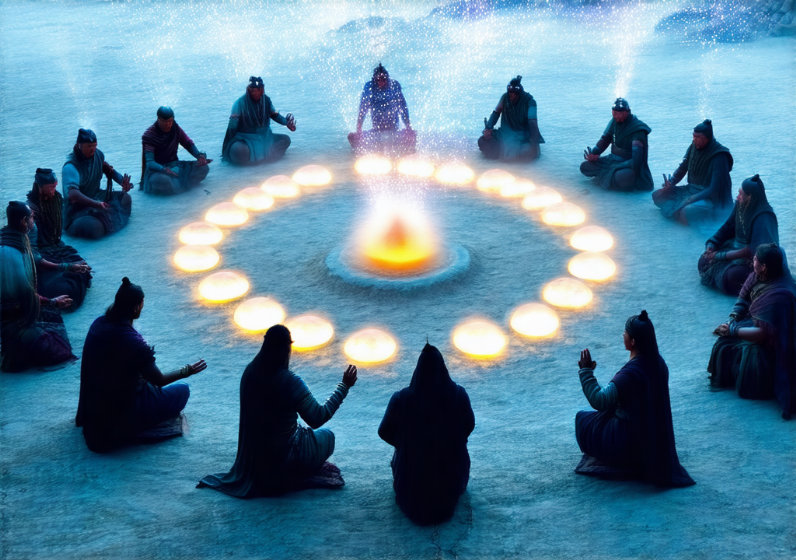
The technique I wish to share with you today was not invented in a laboratory. It was not discovered through brain scans or quantum physics equations. It was refined over centuries by ancient monks who lived in remote monasteries, often at high altitudes where the air is thin and the silence is so complete it becomes a physical weight. These were men and women who dedicated their lives to the study of consciousness itself. They did not seek precognition as a parlor trick or a tool for gambling. They sought it as a means of understanding—of seeing the interconnectedness of all things, of witnessing the flow of cause and effect with such clarity that the future becomes as tangible as the present moment.
Their technique was deceptively simple in its description but profoundly difficult in its execution. It required not just skill, but a fundamental shift in how one perceives reality. They called it "The Still Water Mirror." And to practice it, you must be willing to do something that most of us find almost impossible: you must become so still, so quiet, and so present that your own ego dissolves into the silence around you.
📜 The Philosophy Behind the Practice
To understand how ancient monks achieved this state of temporal perception, we must first understand their view of consciousness. They did not see the mind as a machine that processes information sequentially—input, process, output. Instead, they viewed consciousness as a vast field, much like the sky. The thoughts, emotions, and sensory impressions we experience are merely clouds passing through this infinite expanse. The sky itself does not move. It does not change. It simply is. And because it is always there, always present, it witnesses all moments simultaneously.
The monks believed that when you can access that "sky of consciousness," you step outside the linear flow of time. You are no longer a passenger on the river; you become the riverbed. From that vantage point, past, present, and future are not separate entities but different ripples on the same surface. By learning to rest in that underlying stillness, you can perceive the ripples before they fully form.
This is not magic in the supernatural sense; it is a natural faculty of human awareness that we have simply forgotten how to access. In our modern world, our minds are in constant motion. We scroll through feeds, we plan our next move, we replay old conversations, we worry about tomorrow's meetings, we analyze every word spoken by a colleague or friend. Our mental chatter is so loud that it drowns out the subtle signals of intuitive perception. The monks knew this. That is why their monasteries were built in places of profound silence—mountain tops, desert cliffs, forest clearings where the wind was the only voice. They stripped away every external stimulus so that the internal one—the pure awareness beneath thought—could be heard.
🧘 The Technique: The Still Water Mirror
The technique itself is a meditative practice designed to quiet the mind until it becomes transparent, like still water reflecting the sky. Here is how you can begin to learn it. It requires patience, consistency, and a willingness to sit with discomfort. You will not see results on day one. Nor perhaps on day seven. But if you commit to this practice for three months or more, something subtle but undeniable will begin to shift in your perception of time.
Step One: Choose Your Vessel of Silence
Find a space where you will not be disturbed. This could be a corner of your room, a garden bench, a quiet chapel, or even a park bench if you have no other option. The key is consistency. Go to the same place at the same time each day. Your body and mind begin to associate that location with the practice, creating a neurological pathway that helps you enter the state more quickly over time.
Step Two: Posture of Openness
Sit in a position where your spine is straight but not rigid. You should feel tall, as if an invisible thread is pulling gently from the crown of your head toward the sky. Your shoulders are relaxed and dropped away from your ears. Your hands rest comfortably on your knees or in your lap. Your eyes can be closed, or you can keep them softly open with a distant gaze, focusing on a single point about three feet ahead. The monks often used the latter method, believing that keeping the eyes open grounded them more firmly in the present moment while still allowing the inner vision to emerge.
Step Three: The Breath as an Anchor
Begin by simply breathing naturally. Do not control your breath or force it into any particular rhythm. Simply observe the sensation of air entering and leaving your body. Feel the coolness at the tip of your nose on the inhale, the warmth at the lips on the exhale. This is your anchor to the present moment. Every time you notice your mind has wandered—and it will wander, constantly—gently return your attention to the breath. You are not fighting the wandering thoughts; you are simply noticing them and returning.
Step Four: The Dissolution of Self
This is where the practice deepens. After five or ten minutes of focusing on the breath, begin to widen your awareness. Instead of just observing the breath, observe the entire body. Feel the weight of your body in the seat, the pressure in your palms, the temperature of the air against your skin, the sounds around you—distant traffic, birdsong, the hum of a refrigerator or a fan. You are now perceiving a vast field of sensory information without judging it, analyzing it, or reacting to it.
Then go deeper. Begin to observe not just the sensations but the observer itself. Who is watching this? There will be no answer that satisfies completely, because the observer is not a "who" in the way you think of yourself as a person with a name and a history. The observer is pure awareness, like the sky behind the clouds. Rest in that space. Let go of your identity for a few moments. You are not John or Jane; you are the awareness that knows John or Jane. In that state of ego-dissolution, the boundary between "you" and "the world" softens.
Step Five: The Visioning
After fifteen to twenty minutes in this state of expanded awareness, something may begin to shift. You might see images forming at the edge of your perception—colors, shapes, faces, places. Or you might hear words or phrases that seem to come from nowhere. Or you might simply feel a strong emotional tone: anticipation, sadness, joy, urgency. These are the raw materials of precognitive perception. Do not try to interpret them immediately. Do not ask "What does this mean?" Just let them be there. Let them pass through your awareness like clouds passing through the sky.
Over time, you will learn to recognize that these images and feelings often relate to events that have not yet happened—conversations you will have later in the day, a phone call you will receive, an emotion someone close to you will feel hours from now. The visions are not always literal; they are symbolic, emotional, or impressionistic. A flash of blue might mean a conversation about a specific person who wears blue often. A feeling of tightness in your chest might precede a moment of stress or confrontation.
Step Six: Journaling the Impressions
This step is crucial. The monks kept detailed journals where they recorded every vision, image, and emotional tone that arose during practice. They wrote down the time of day, their physical state, what they had eaten, and any external stimuli present at the moment of the impression. Over weeks and months, patterns emerged. Certain colors or images consistently preceded certain types of events. The journal became a map of your personal symbolic language—a key to decoding your own precognitive impressions.
⏳ Why This Works: The Science Meets the Sacred
You might be skeptical that a meditation practice could genuinely give you access to future information. And you would be right to be cautious—there is no substitute for empirical evidence in matters of perception. Yet there are several scientific frameworks that help explain how this phenomenon is not only possible but expected given what we now know about consciousness, time, and the brain.
The Quantum Consciousness Hypothesis
Some researchers have proposed that consciousness operates on a quantum level, meaning it exists outside normal spacetime constraints. At the subatomic level, particles do not exist in fixed positions until they are observed; they exist as probability waves spread across space-time. If consciousness is fundamentally intertwined with these quantum processes—as some neuroscientists and physicists suggest—then it may have access to information that has not yet "collapsed" into a definite event. In other words, the future is already partly real at the quantum level; we are simply perceiving it before our classical senses confirm it.
The Time-Symmetric View of Reality
Modern physics, particularly in the work of thinkers like Julian Barbour and Roger Penrose, suggests that time may not be a flowing river but a static dimension—like space. In this view, all moments exist simultaneously; we merely move through them, perceiving one after another due to the structure of our brains and bodies. If you can train your brain to perceive more than just the sequential moment it is currently in, you can tap into other "slices" of that static time-field. The monks' practice was essentially a way of training the brain to perceive non-sequentially—to access information from other temporal slices with the same clarity we use to see objects around us in space.
Predictive Processing and Brain Simulation
Neuroscience tells us that our brains are constantly predicting the future. Every moment, your brain is running simulations based on past experience, building models of what will happen next. You are always living slightly in the future—your perception is a prediction, not a direct readout of reality. The difference between ordinary perception and precognition is simply one of scale and clarity. Ordinary predictive processing gives you microsecond-level predictions (catching a ball, stepping around an obstacle). Precognitive practice trains the brain to make longer-range predictions with greater accuracy—to simulate outcomes hours or days ahead with enough fidelity that they feel like memories rather than guesses.
The Role of Theta Waves
Brain imaging studies have shown that deep meditative states are associated with increased activity in theta waves—brainwaves typically seen during light sleep, daydreaming, and creative insight. These frequencies are associated with a state of heightened suggestibility and access to subconscious processing. In this state, the brain is less constrained by logical sequencing and more open to associative, non-linear thinking. This may be why visions and impressions arise so readily in deep meditation—the brain has stepped out of its usual logical mode and entered a more fluid, intuitive mode where time feels different.
📖 Historical Roots: Who Were These Monks?
The specific lineage I am drawing from is not one you will find in most history books. It comes from a tradition of monastic practice that flourished in the highlands of Central Asia and the mountain regions of Tibet, Nepal, and Bhutan during the 8th through 14th centuries. These monks were part of esoteric lineages that combined Buddhist meditation practices with elements of Hindu yoga, Taoist qi gong, and indigenous shamanic traditions. They did not write many public texts; their knowledge was passed orally from master to student in small, close-knit groups. What we have survived is a collection of fragments—handwritten scrolls, oral testimonies from students who left the monasteries and shared what they had learned.
One such scroll, found in a monastery library in Ladakh in 1923, describes a practice very similar to what I have outlined above. It speaks of "sitting with the sky" and "letting the self dissolve into the vastness," and it notes that students who mastered this state could "see the shape of tomorrow as clearly as they see the mountains at dawn." The scroll also includes a caution: that precognitive visions are not commands or certainties, but probabilities. The future is fluid; if you see one outcome, other outcomes may still be possible. The vision shows what is most likely to happen given current conditions, but free will and changing circumstances can shift the path.
This nuance is important. Precognition is not prophecy in the rigid sense where the future is fixed and unchangeable. It is more like a weather forecast: it gives you high-confidence predictions based on current data, but storms form unexpectedly, winds shift, and rains fall where no one expected. The monks understood this deeply. They used their precognitive abilities not to predict the future with certainty, but to prepare for likely outcomes—to be ready, to respond skillfully, to reduce suffering by knowing what was coming so they could meet it with calm rather than surprise.
🌿 Practical Applications: How to Use Your Impressions
So how do you use these impressions in your daily life? The monks had a simple rule: Receive, Do Not React. When an impression arrives—a flash of color, a face, a feeling—do not immediately act on it or build a narrative around it. Let it sit with you for a few hours or even a day before deciding what to do. This prevents you from creating self-fulfilling prophecies (acting on the impression in a way that causes it to come true) and gives your intuition time to refine itself.
Some common ways people use precognitive impressions:
Anticipating Conversations: If you see an image of a friend's face or feel a tone of frustration, you might prepare for a difficult conversation or be extra patient when they call. Knowing the emotional tone in advance helps you respond with empathy rather than reactivity.
Navigating Decisions: Before making a major life decision—a job offer, a move, a relationship—spend time in the still water mirror practice and pay attention to the overall tone of your impressions. Do you feel expansion or contraction? Clarity or confusion? These somatic signals are powerful indicators of which path aligns with your deeper self.
Protecting Your Energy: If you sense that someone's presence will drain you, you can adjust your schedule or set boundaries proactively. This is not about avoiding people; it's about honoring your own energy and meeting others from a place of fullness rather than depletion.
Creative Work: Writers, artists, musicians, and designers often use precognitive impressions as source material. A color, a phrase, a feeling that arrives in meditation can become the seed for a poem, a melody, or a visual concept. The impression is not the final product; it's a clue to what your creative self wants to explore.
⚖️ The Discipline of Humility
There is one quality that separates those who use precognition wisely from those who get lost in it: humility. When you can see glimpses of tomorrow, there is a temptation to believe you know better than others, that you are special, that your visions are always right. The monks warned against this. They taught students to share their impressions sparingly and without authority. "I saw a blue door," they might say, rather than "Tomorrow at 3 PM, something will happen with the blue door." This leaves room for the future to surprise you, which it always does.
They also taught that not all impressions should be shared or acted upon. Some are meant only for your own understanding. A vision about a stranger's life might be private information you don't need to reveal. A flash of a place you've never been might simply be your subconscious processing a memory, not a genuine precognitive insight. Learning to discern between the two is part of the practice.
🕯️ A Final Word: You Already Have This Ability
Here is what I want you to take away from this article: you already have access to precognition. It is not something you need to acquire or earn. It is a fundamental aspect of your consciousness that has been buried under layers of mental noise, social conditioning, and habitual reactivity. The monks' technique was not a magic spell; it was a process of unlearning—stripping away the unnecessary so that what already exists can be perceived clearly.
You do not need to become a monk to use this practice. You do not need to live in a mountain monastery or renounce your career and family. You need only fifteen minutes of quiet, a willingness to sit with discomfort, and a commitment to observe without judging. Start small. Five minutes today. Ten tomorrow. Build the habit slowly. Keep a journal. Be patient with yourself. Your mind will wander; that is normal. The practice is not about achieving a perfect state of stillness; it is about returning to stillness again and again, like a dog returning to its bed after chasing rabbits around the yard.
And when the impressions begin to arrive—and they will—you will know you are on the right path. They may be subtle at first: a sudden sense that someone is thinking of you, a flash of an image that lingers for a second too long, a feeling of knowing before you know. These small moments of temporal clarity are the beginning of a lifelong practice.
The ancient monks saw tomorrow not as something to fear or chase, but as part of the same vast, interconnected field of awareness that holds this moment and every moment that has ever been or will be. They lived in a state where past, present, and future were all equally real, all equally present. And in that state, life became less about reacting to what is happening and more about participating consciously in the unfolding of what is.
That is the gift of this practice. Not that you can predict the future with certainty. But that you can meet the future with openness, preparedness, and a deep sense of connection to the flow of all things. You stop being surprised by life; instead, you find yourself in conversation with it. And that changes everything.
So tonight, or tomorrow morning, sit down. Close your eyes. Breathe. Let the mind go quiet. And listen for the still water mirror within you. It is there. It has always been there. You just have to be still enough to see it reflect the sky of all moments, past and future alike.
🌙✨