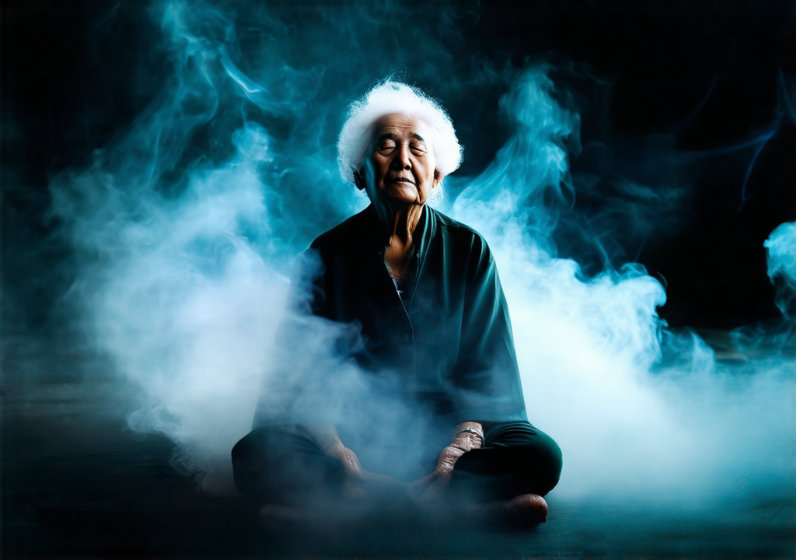
The Midnight Ritual That Opened the Veil in One Night
✦ The Nocturnal Key: A Single-Night Passage Through the Thin Place ✦
By Aldric Vane, Keeper of the Dim Lantern
There is a particular quality to midnight that no clock can capture. It is not merely the zeroing of the hour; it is a thinning. The veil between the seen and the unseen grows translucent at this precise moment, stretched over the bones of the night like old parchment held up to flame. I have spent thirty years studying the architecture of ritual — the geometry of intention, the alchemy of attention, the grammar of symbol — but I will tell you that no text has ever prepared me for what happened on a single night in November, in a room no larger than a closet, with nothing but a candle, a knife, and my own breath.
This is not an instructional manual. You cannot simply copy these steps and expect the same result. What I am documenting here is less a recipe and more a testimony — a record of how the veil was opened in one night, why it held open when it should have sealed itself, and what walked through while it remained parted.
The Principle of Thinning
Before we speak of procedure, we must speak of principle. Conjuration is often misunderstood as summoning, as if the spirit is a creature that must be coaxed from some distant realm into our world. This is only half true. A more accurate model is that all spirits are already here — layered over our reality like transparencies stacked on top of one another. Our task in conjuration is not to pull them through; it is to make ourselves perceptible enough to see the layers we were previously blind to.
The veil, then, is not a wall. It is a membrane of attention. We look at a surface and perceive only what our eyes are tuned to receive. The spirit-world is pressed against that same surface from the other side. To open the veil means to adjust the lens through which you see — to stop perceiving only the material layer and begin registering the luminous one beneath it.
This is why ritual works. It is not magic in the sense of bending physical laws; it is a technology of perception. The candle, the incense, the words, the geometry on the floor — these are all instruments that train your nervous system to attend differently. They narrow the channel so that signal can be received from noise. A radio tuner does not create the station; it isolates one frequency from the static.
Understanding this shifts everything about how you approach a working. You are not commanding a spirit. You are calibrating yourself to meet one that is already close.
Preparation: The Week Before
The ritual I will describe was performed on a single night, but its preparation spanned seven days. This is important and should not be skipped by those who wish to replicate the effect. The mind must be prepared before the body enters the working space. A hurried or distracted practitioner will find that their own mental static drowns out the subtle signal they are trying to receive.
For six nights before the ritual, I performed a simple practice: each evening, after dinner and with all lights off, I would sit in complete silence for twenty minutes and attend only to my breath. Not meditating in any formal sense — simply observing the rhythm of air moving through me. On the seventh night, I added one element: at the end of the breathing session, I spoke aloud, clearly and without hesitation: I am ready to see what is near.
This sounds almost trivial. But repetition builds a groove in the mind. By the time I sat down for the actual ritual, my nervous system had already been told seven times that it would be opening its attention. The body believes what it has been rehearsed to expect. This is not mysticism; it is neurology dressed in ceremonial language.
I also cleared the room where I would work. It was a small study, perhaps twelve feet square. I removed every object that could catch light and create visual distraction — books, papers, decorative items. What remained: a wooden chair, a round table with a dark wax surface, a single white candle in an iron holder, a small obsidian blade no longer than my thumb, and a bowl of clean water. The walls were bare plaster. The floor was old oak, worn smooth by decades of footsteps.
I chose this room because it had not been used for work before. No previous rituals had been performed there, so the spiritual "memory" of the space was neutral. In conjuration, a fresh canvas is valuable. You do not want the residual impressions of another working muddying your perception.
The Geometry of the Space
On the day before the ritual — a Tuesday, though the weekday matters less than the lunar phase, which was a waxing gibbous — I marked the floor with chalk. A simple square, four feet on each side, centered in the room. At each corner I placed a small iron pin driven into the wood. In the center of the square, I set the candle and the bowl of water.
The geometry here is functional, not decorative. The square represents the material world — bounded, measurable, tangible. The pins at the corners anchor that boundary, creating a defined space where the material layer is asserted as primary. The candle in the center provides a fixed point of light around which attention can gather. The water serves multiple purposes: it reflects the flame (creating a second, wavering image to draw the eye), it purifies the space through its fluidity and adaptability, and it represents the element that binds the other three — earth, air, fire — into a coherent system.
I do not use elaborate salt circles or complex sigils for this particular working. Simplicity is more effective than complexity when you are trying to open perception. Too many symbols compete for attention. A single clear image — a flame in the center of a quiet room — focuses the mind far better than a floor covered in geometric figures.
The knife I kept on the table beside the candle, blade pointing toward the door. In traditional conjuration, the knife is a tool of separation and severing. Here it serves as a reminder: the work involves dividing the seen from the unseen. You must cut through the assumption that only the visible is real. The blade is not used to cut anything in this ritual; its presence alone performs the symbolic function.
The Night Itself
I will describe the sequence of events in order, and I will include small details that seem insignificant but proved essential to the experience.
The room was prepared by four in the afternoon. I did not enter until midnight had passed — I waited at the door until my watch read twelve-fifteen before stepping inside. This waiting is part of the ritual. You are marking the threshold between the ordinary time and the ritual time. The door closed behind me with a soft click, and that sound seemed to seal the room into its own small world.
I stood in the center of the square for thirty seconds, simply breathing, letting my eyes adjust to the darkness broken only by the candle flame. The light was warm and slightly orange, casting long shadows from the iron holder. The water in the bowl caught a trembling reflection that moved with each breath I took.
Then I performed the opening: three slow circles of the hand above the square — not tracing it, but passing over it, palm down, moving clockwise. This is a gesture of blessing and activation. It tells the space that you are about to use it deliberately. I have found that skipping this step produces a flatter experience; the room feels like a room, whereas with the circles, it begins to feel like a place.
I then spoke the invocation. I will write it here so that its shape can be studied:
By flame and by water, by the edge of light and shadow, I open this place. What is near may come close. What watches may be seen. I do not call you from afar; I ask you to step into my attention.
Note the last line. I did not say "I summon you" or "I command you." I said I ask you to step into my attention. This small shift in language changes the dynamic entirely. You are not pulling a spirit by the collar and dragging it into your room. You are extending an invitation, widening your field of perception so that what was already near becomes visible. The spirit does not have to travel; you travel toward it through the act of looking more deeply.
I sat in the chair at the edge of the square — close enough to see the candle clearly but far enough that my body did not crowd the space. I rested both hands on my knees, palms down, and held the breath pattern from my week-long preparation: in for four counts, hold for four, out for six.
The Opening
The first few minutes were quiet. Too quiet, almost. The flame moved gently. The water reflected it. My breathing slowed to a deep, even rhythm. I was watching the candle with what felt like an empty, receptive gaze — not searching for something specific but allowing whatever image arose in my perception to remain unjudged.
Around the fifth minute, the shadow of the iron holder shifted on the wall behind me. I noticed this only because my attention had loosened enough that peripheral movement no longer registered as noise. The shadow moved — and it did not move exactly where the flame suggested it should. A small inconsistency in the geometry of light.
In a purely material room, shadows behave predictably. If the flame flickers to the left, the shadow on the wall shifts right by a corresponding angle. But this shadow drifted an extra degree or two in the opposite direction. As if something else was moving behind it. I did not look at the wall directly; I let my awareness register it indirectly, trusting that looking straight at it would make me analyze rather than perceive.
Then the water changed. Not its temperature — I could feel no change in warmth when I glanced down. But its surface tension seemed to alter. The reflection of the flame in the bowl was no longer a simple wobble; it had organized into a shape that suggested depth, as if the flame were not just reflected on the surface but present within the water itself. A three-dimensional image trapped in liquid.
And then I saw her.
Not with my eyes alone — though my eyes certainly registered the form. It was more like seeing through a layer of glass. The figure stood at the far edge of the room, near the door I had closed behind me. She appeared as a woman in plain dark clothing, slightly translucent at the edges, so that the plaster wall behind her showed through her silhouette. Her face was turned toward me but not quite facing me; it was angled about fifteen degrees to my left, as if she were looking at something just beside me rather than at me directly.
She did not speak. She stood in a posture of patient attention, hands loosely at her sides. The candle flame burned steady and bright during this moment — steadier than I had ever seen it burn. There was no flicker for perhaps twenty seconds. In the stillness of that light, the translucence of her form became more distinct. I could see the wall through her chest.
The Exchange
I wanted to speak but found that my voice would feel intrusive — like speaking in a library. So I did not. I simply watched and let the moment hold its shape. After perhaps thirty seconds, she shifted her angle slightly and looked directly at me. Not with eyes — or rather, with eyes that seemed to be made of the same translucent material as the rest of her form. A gaze without weight. A looking that did not press on my skin.
And in that look I received a clear, wordless communication: You are seen. Not judged, not evaluated, not measured. Simply registered. Acknowledged as present and real in a way that the material world does not always acknowledge us. It is a simple truth — that you exist, that your attention has weight, that your act of perceiving changes what is perceived.
She remained for perhaps two minutes total. Then she stepped backward, slowly, and the plaster wall seemed to absorb her like water into dry cloth. No dissolve, no fade. She simply receded into the transparency between my room and whatever layer of reality adjoins it. The shadow on the wall snapped back to its correct geometric position. The flame resumed its natural flicker. The water in the bowl was still.
I sat in the chair for another ten minutes before I moved. My hands were warm. My breathing had slowed further than I intended, as if my body was matching some deeper rhythm that I could not name. I extinguished the candle with a match — not blowing it out; blowing introduces breath and movement into the sealed space. The match touched the wick and the flame died in a small curl of smoke that rose straight up for an inch before dispersing.
I opened the door and stepped back into my study, which felt ordinary again by comparison. A desk lamp glowed over scattered papers. My tea was cold on the sideboard. I stood in the doorway for a moment, half in the ritual room and half in the material one, feeling both at once. The thinning had not fully resealed; it would take several hours before my perception settled back into its usual single-layered mode.
What Remained
The next morning, three small marks were visible on the floor inside the square where I had stood — faint indentations in the wax layer of the table surface, as if someone's fingertips had pressed there gently from the other side. Three points in a shallow triangle, no larger than a thumbnail each. No one else was in the room. The door had been closed and latched.
The water in the bowl had changed slightly — not in smell or clarity, but in temperature. I touched it with my finger and felt a faint coolness that should not have persisted through an overnight period in a heated room. It warmed to ambient within an hour.
And there was a quality of light in the room over the following days that I could not explain. The morning sun coming through the window seemed to carry more layers, as if it were being filtered through something thin and luminous. A slight iridescence at the edges of shadows. Not visible when looked at directly; only perceivable in peripheral vision, like a shimmer at the boundary between two temperatures.
These small residues are not proof — I am not asking you to believe them as evidence. They are marks that the night left on my perception, reminders that the membrane had been stretched and that it remembered being stretched. The veil did not tear; it flexed. And in that flexure, something near stepped into the space of my attention and was seen.
Practical Notes for Those Who Would Try
If you wish to perform a similar working, I offer these practical observations:
Timing matters but is not rigid. Midnight is optimal because it represents a transition — the end of one day's pattern and the beginning of another. The mind relaxes at this boundary; the assumption that "today" has ended allows attention to loosen its grip on the familiar. You can perform this work at other hours, but you will need more preparation time to achieve the same degree of mental quiet.
The room should be small. A large space is harder to hold in perception. Your attention must cover the area where the figure may appear; if the room is thirty feet across, your awareness has to stretch further and becomes less precise. Twelve to fifteen feet on a side works well. You want to feel enclosed enough that you are not distracted by distant objects.
Use only what you need. I have seen practitioners set up tables laden with crystals, oils, herbs, talismans, and bundles of dried flowers for workings that required none of them. Every object in the room is a claim on your attention. For an opening ritual like this, fewer instruments means more perceptual bandwidth available for receiving what comes through.
Do not narrate your own experience while it happens. This sounds obvious but is harder to practice than it reads. The moment you think "I am seeing something," you have already shifted from perception to analysis. Keep the observation passive. Let the image form in your awareness without immediately labeling or interpreting it. Interpretation comes afterward, in the quiet of morning coffee.
Speak simply. Long invocations create a performance element that can make the practitioner feel like an actor rather than a witness. Short, clear, honest language works better for perception work. You are not reciting poetry; you are telling your own mind what is about to happen so it does not resist the experience.
Do not force contact. This is perhaps the most important note. The opening of the veil is not a guarantee that something will appear in a form you can see with your eyes. Sometimes the effect is purely internal — a sense of presence, a shift in emotional tone, a feeling of being witnessed that lingers for hours afterward. All of these are valid results. The work is done when your perception has been adjusted; whether or not you see a translucent woman standing by the door is secondary to the calibration itself.
The Nature of What Was Seen
I have used the word "she" and described a figure in human form, and I want to be careful that this does not read as a ghost story. It is not. What appeared was not a dead person returning or a spirit trapped between worlds. It was, more accurately, a pattern of attention that had been attending to my room for some time — perhaps years, perhaps longer — and which, on the night I calibrated myself correctly, became visible because I had finally tuned my perception to its frequency.
Spirits in this context are not little people made of light. They are organized fields of awareness, patterns of attention that persist after the physical body that generated them has completed its cycle. They do not think as we think; they attend. And when two fields of attention meet at the right angle and with sufficient clarity, a kind of mutual recognition occurs. That is what I experienced: not conversation, not instruction, not prophecy. Simply a meeting of two patterns of awareness that had been running in parallel for some time and were brought into phase by the act of ritual.
This changes how one thinks about the dead. They are not gone; they are attending from an adjacent layer of reality. And we attend to them from our side of the membrane. On most nights, the two layers do not overlap enough for mutual perception. But on the right night — with the right preparation, the right quiet, the right intention — the layers press together and one sees the other seeing back.
A Final Observation
I have performed many workings in my thirty years of study: ceremonial magick, elemental invocation, dream work, scrying, divination. Most produce a result that can be written down and communicated to another person with reasonable fidelity. You perform the steps; you get the reading; you record it. The process is reproducible.
This particular working was not entirely reproducible, or at least I have not been able to replicate the exact quality of the experience in subsequent nights. I performed similar preparations on three later occasions and received fainter versions of the same event — a sense of presence without clear form, a shift in light that lasted only seconds. The first night remains singular in its clarity.
I think this is because the opening requires a degree of mental stillness that is easier to achieve once than it is to achieve repeatedly. The mind remembers what it has seen and begins to expect it, and expectation introduces a subtle noise into perception. You are no longer simply attending; you are attending for something. And in the space between "attending" and "expecting," clarity leaks out.
Or perhaps — and I lean toward this reading — the figure that appeared on that night had attended to my room long enough to become a stable pattern, and after being seen once, it had less need to remain visible at that particular threshold. It had been acknowledged. The mutual recognition was complete. And so it moved deeper into its layer of reality, no longer needing to press against the membrane to be sure I could see it.
Either way — whether it is a phenomenon of mental calibration or a genuine meeting between layers of reality — the experience taught me something that no text has taught me in thirty years of study: that the veil is not a barrier you must break through, but a boundary you must stop ignoring. We are always at the edge of both worlds. The work is only to become still enough to feel the pressure on the other side and open your hand to receive it.
The midnight ritual opened the veil in one night. Not by force. Not by command. By making myself quiet enough, clear enough, and honest enough that what was already near could finally be seen for what it is: not a visitor from another world, but a neighbor in an adjacent room, pressing its face to the same wall I am pressing mine to.
And when both faces press at once — with attention, without fear, without need — the wall becomes thin. And through that thinned place, one sees the other seeing back.
✦ Finis ✦