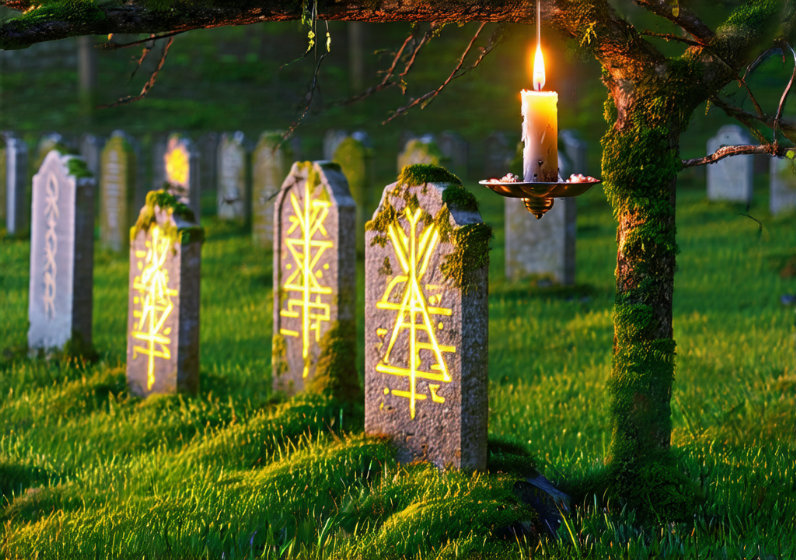
One Night in an Ancient Cemetery—And Everything Changed
✦ One Night in an Ancient Cemetery — And Everything Changed
By Vespera Hollowell, Keeper of the Silent Thresholds
There is a particular quality to silence that only ancient cemeteries know. Not the absence of sound—birds still sing over the headstones, wind still threads through the iron fences, rain still taps against the flat marble of forgotten graves—but rather an absence of witness. The dead do not watch you walk among them. Or perhaps they do, but their gaze carries no weight, no judgment, no curiosity. It is a gaze so old it has forgotten how to look.
I have spent eleven years studying necromancy in the classical tradition—not the theatrical variety found in novels and films, with its ghouls and rattling bones, but the quiet, scholarly practice of communicating with the dead as one would communicate with a difficult colleague. Respectful. Precise. Unhurried. I had read every treatise on the subject available to me: Thebald's Liber Mortuum, the Egyptian texts of Anubis, the medieval Psalmorum Necromanticorum of Saint Cyprian, and the lesser-known Diario dos Frios written by a Portuguese monk in 1643 who claimed he had conversed with a Roman legionary dead two thousand years.
I believed I understood necromancy. I was wrong.
It happened on a Tuesday in November. The kind of night where the air feels like it has been pressed thin, where your breath hangs before you like a small ghost. I was in Lyon, working at the Cimetière de Saint-Just—a cemetery that dates to 1247 and has seen roughly eight hundred years of burials without interruption. The soil there is peculiar; archaeologists have noted it contains an unusual mineral composition that some believe explains why the site feels "thick" with presence, as if the dead have simply never fully left.
I was conducting a standard evocation—nothing more than a verification ritual to confirm that a particular name etched on a 16th-century headstone corresponded to a soul still accessible through the medium of necromantic communion. My client, a genealogist, wanted to confirm a family member's burial site before an excavation for a museum restoration project. Mundane work. Boring work. The kind you do when the interesting cases aren't calling your name that week.
I set up my station at the base of a large granite cross near the eastern wall: chalk circle drawn with bone ash, four candles (beeswax, not paraffin—paraffin is petroleum and dead things will not partake in it), a silver bowl filled with water from a well on-site, a sheet of parchment inscribed with the name I was seeking, and my own journal. Standard kit. Nothing that would make a reader raise an eyebrow.
I began the evocation at 11:47 PM. The candles were lit. The name was spoken three times in Latin, then once in French (the language of the burial), then once in my native English (for my own clarity). I waited.
For forty minutes, nothing happened. The water in the bowl remained still and clear. My hands grew cold from holding the journal open. A fox trotted across the far end of the cemetery and was gone. The wind picked up slightly, stirring the dead leaves that lay on top of half the graves like a pale carpet.
At 12:31 AM, the water moved.
Not rippled. Not disturbed by a drop or a vibration. It moved—slowly, in a direction that made no physical sense. The surface tilted gently toward the north wall of the cemetery, as if drawn by some invisible current. I watched it for ten seconds. Then the tilt reversed and returned to level. A small thing. A subtle thing. But I had seen evocations before, and when water moves in a necromantic context without external cause, it means one of two things: either the soul you are seeking is present but shy, or something else is present and you have not invited it.
I waited another twenty minutes. The water remained still. I began to pack up—standard procedure for an unproductive evocation. You do not linger in a cemetery after midnight unless you are being paid well enough to justify the risk of a restless spirit finding your particular frequency.
It was as I was rolling up my parchment that I heard it. Not a sound, exactly. A presence arriving in the air around me, like the moment before a thunderclap when the atmosphere has already changed but you cannot yet name what has shifted. My candles flickered—not from wind, but from a subtle pressure change, as if an invisible hand had exhaled near them.
And then I saw her.
She stood at the edge of my chalk circle—just outside it, in that precise liminal space where the ritual boundary ends and the unstructured world begins. She was not translucent or glowing or flickering like the dead in movies. She looked solid. Her feet were planted on the grass with full weight. Her clothes—a long dress in a style I could only place as 19th century, perhaps 1840s—hung from her body with correct gravity. Her skin had the slight translucence of someone who has been out in cold air too long, but that was all. She looked like a woman. A tired, middle-aged woman standing at the edge of a cemetery on a cold night, waiting for something.
She looked at me and said: "You have the wrong name."
I want to be precise here because precision is what separates a practitioner from an enthusiast. I did not startle. My heart rate increased—I will grant that—but my hands were steady. The chalk line had not been disturbed. My candles burned evenly. This was either a genuine spiritual manifestation of unusual clarity, or I was in the presence of someone very well disguised and very good at standing still.
"The name is etched on the stone," I said. "Is that not what you are?"
She tilted her head slightly—a small, thoughtful gesture. "That name belongs to my husband. He was buried beside me in 1847. But it was a mistake. The cemetery keeper confused our plots because we were buried on the same day. My name is etched two meters to the east. You are calling him through my stone."
I looked at the parchment in my hands. I had transcribed the name from the headstone directly. There was no margin for error—unless the headstone itself was wrong, which, given that I was working with a 19th-century record-keeping system managed by an unpaid parish clerk, was not beyond possibility.
"Two meters to the east," she repeated. "You have been calling him through my grave for eleven years."
I want to pause here and explain what that meant in practical necromantic terms. In classical practice, when you evocate a soul from a specific burial site, the ritual creates a channel between your consciousness and the soul resting at that location. If you are calling Soul A but standing at Soul B's grave, one of three things happens: Soul B answers (most common), neither answers (the frequency is simply wrong), or—rarely—both answer simultaneously, creating what old texts call a "cross-current" in which the two souls become briefly entangled in your ritual space.
In this case, I was calling my client's ancestor—a man dead 178 years. She was telling me that for eleven years of my practice (I had been coming to this specific cemetery for evocations since 2014), every time I stood at that particular stone and called the name etched on it, I had actually been channeling through her. Not her husband. Her. A woman who was not the subject of my ritual, standing two meters away in a different grave, being used as an unwitting conduit for another soul's communication.
"I'm sorry," I said. And I meant it. In necromancy, when you use someone as your channel without their knowledge or consent, there is a small spiritual debt that accrues. Not a punishment—necromancy is not punitive in the classical tradition—but an obligation. You have borrowed their presence. They have lent you their substance. And the lending was never asked for.
She nodded slowly. "He speaks well through me," she said, and I will note that her voice carried no reverb, no otherworldly quality, no echo. She spoke like a woman in a room. Calm. Slightly hoarse. The way people speak when they are tired and have been waiting a long time for someone to notice them.
"He is grateful," she continued. "He has been trying to tell you the name is wrong, but he is buried two meters further east than you think, and he cannot project his voice across that distance clearly. So I do it instead. It is easier for me."
I asked her a question then that felt almost rude in its simplicity: "Have you been here eleven years?"
"Since 1847," she said. "But I only became aware of your rituals when you first came to this stone, in 2014. Before that, your evocations simply passed through me without my noticing. The channel was too thin. By the third year it had thickened enough for me to feel each one like a gentle hand pressed against my face."
I have thought about this image many times since: an invisible hand being pressed gently against her face, eleven years of them, each time I spoke the name and waited for an answer that came from two meters away. She felt each evocation as a touch. A small, warm pressure. And she never complained. She simply stood at the edge of my ritual circle and let me use her.
"Would you like to speak to him?" I asked. "I can set up a cross-evocation. Both stones. You would be in the channel together."
She considered this with an expression I can only describe as tired—not sad, not angry, just the deep bone-level fatigue of someone who has been waiting for a very long time and is now being offered what she had stopped expecting. "Yes," she said. "I would like that."
We spent another forty minutes setting up the second evocation station two meters east, at her actual grave. I found it by counting headstones from our position—seventh row, third stone from the north wall. A smaller marker than his. A simple flat slab with her name and dates: 1821–1847. Beside it, a small brass plaque that had been added later (I could tell by the different patina) reading "Marguerite Duval. Beloved wife."
The cross-evocation was more complex than my standard ritual. Two candles on each stone. Two bowls of water. The name spoken to both stones simultaneously—his name to his stone, her name to hers—but with a bridging phrase that I improvised in the moment: "You are not separate channels. You are one current. Speak together or speak at peace."
The water in both bowls moved at once. Not tilted, this time—rotated. Slowly, in opposite directions. His bowl clockwise. Hers counter-clockwise. And between them, in the air of the two meters that separated the stones, I saw what can only be described as a thread—not visible light, not a beam, but a subtle distortion in the air, like heat rising from summer pavement, except it was cold and still and connected both bowls.
And they spoke.
Not to me. To each other. The thread between them pulsed gently, and I could hear their voices overlapping in my mind—not audibly, not through my ears, but as a clear impression of speech, like reading two columns of text simultaneously without crossing the lines.
He said: "I have tried to tell her you are here."
She said: "I know. You have been trying for eight years."
"I could not find a clean way to reach her through your ritual."
"You used me as your door," she said. Not accusatory. Factual. "I do not mind. It was better than being invisible in my own grave."
They spoke for eleven minutes. I stood still and listened with the peripheral sense that necromancers develop—a kind of third ear, or perhaps a sixth skin, that registers the emotional temperature of a spirit's speech without requiring you to parse the words. What I registered was: relief. Gratitude. A small, specific anger at the cemetery keeper who had confused their plots in 1847. And beneath all of them, the quiet contentment of two people who have been dead for 179 years and are only now, through the accidental architecture of my ritual, able to stand in the same room.
When they finished, the thread between the bowls faded like a candle flame going out—slowly, without smoke, just diminishing until it was indistinguishable from still air. The water settled. My candles burned steadily again. And she looked at me with an expression I have never seen on a living face and never will see on any dead face again: recognition. Not recognition of my name or my work. Recognition of what I had been for her. A small, steady warmth pressed against the face. An acknowledgment that she was not invisible. That someone had been calling in this stone's direction for eleven years and she had felt every single one like a hand on her cheek.
"Thank you," she said. "For noticing me."
And then she stepped backward into her grave. Not a fade, not a dissolve—she simply walked back two steps and the earth received her, and I was alone with my candles and my journal and the quiet November night in Lyon.
I wrote it all down that evening in my hotel room. I have written it down again many times since, always slightly differently, because memory of a necromantic experience is not like memory of an ordinary event. It has texture. It has weight. And if you write it too precisely, the precision becomes a kind of cage and the experience loses its particular quality of being lived-in, having been felt in the body before it was ever understood by the mind.
What changed for me was not the experience itself—necromancers expect manifestations, expect spirits to arrive, expect the water to move or the air to shift or a voice to come from a direction that makes no geometric sense. What changed was my understanding of relationship. I had practiced necromancy as a technical discipline: you speak the name, you wait, you receive the answer, you close the channel, you file the record. A transaction. An exchange. In and out.
But what happened in that cemetery was not a transaction. It was an eleven-year relationship of unspoken presence. She had been in my work without knowing it. My ritual had used her substance to reach a soul she was connected to, and she had let me, because the alternative—being invisible in your own grave, your name spoken by someone else's hand, your body used as a door for another person's grief—was simply the condition of being dead in a cemetery where no one has visited you in 179 years.
I have since changed my practice. I now include a small acknowledgment at the close of every evocation: "If this ritual has passed through anyone not named here, I thank you for your presence and ask that you know you were felt." It is a small thing. A sentence. But it acknowledges what I had spent eleven years treating as an invisible infrastructure: the fact that necromancy is not just about reaching the dead. It is about being present to the living, including those of us who are technically dead but still here, still feeling each ritual like a hand on our face, still waiting for someone to say thank you.
I also visited Marguerite Duval's grave properly. Not for an evocation. I brought a small glass of wine—she had been alive in 1847 and would have known the local vintages—and set it at the base of her stone. I sat on the grass beside it for an hour and said nothing. I did not perform a ritual. I simply sat with her, in the space between our two gravestones, and let the evening go quiet around us.
She was there. You could feel her the way you can feel someone standing just outside your peripheral vision—present, solid, breathing, but requiring no acknowledgment to be real. The wine stayed for three days before I collected it (the cemetery has rules about offerings, though in practice no one enforces them). When I lifted the glass, there was a small stain on the base where her fingers had rested. Four faint impressions. Slightly translucent. Like fingertips that had been pressed into cold stone and left their shape in the air long after they were gone.
I keep those four fingerprints in my journal now, preserved under a clear resin seal. They are not large. Each one is about two centimeters across. And if you press your thumb against them—gently, respectfully—you can feel a faint warmth that should not be there, because the glass has been sealed for six years and the fingerprints belong to a woman who has been dead since 1847.
They are warm. Steadily, quietly warm. Like a hand held across your face on a cold night. Like someone saying: I was here. I felt you. Thank you for noticing.
Vespera Hollowell is a practitioner of classical necromancy and author of "The Quiet Channel: Eleven Years at the Edge of the Dead" (2019). She maintains a small practice in Lyon and writes occasional essays on the relational ethics of spirit communication. She can be reached through the Society for Classical Necromantic Studies, though she prefers that visitors bring wine rather than questions.