The Art of Witchcraft — Mastered Through Generations
The Living Thread: Inheritance in Ceremonial Witchcraft 🌙
Author: Elias Thornwood, Keeper of the Veil
To speak of ceremonial witchcraft is to stand at the confluence of two great rivers. One flows from the ancient, earthy roots of folk magic—whispers left in doorways, herbs crushed in mortar and pestle, the quiet bargaining with local spirits. The other flows from the high, structured, and often esoteric traditions of ceremonial magic—the precise geometry of circles, the invocation of angels and archangels, the careful recitation of words believed to carry ontological weight.
For centuries, these two rivers ran somewhat separately. Folk witches lived their lives in the margins; ceremonial magicians operated from the libraries and parlor rituals of the educated classes. But as we move deeper into this era of spiritual reclamation, a synthesis is occurring. We are no longer merely practicing either folk magic or high ceremony. We are weaving them together, creating a practice that honors both the soil underfoot and the stars overhead.
This article explores how the art of witchcraft has been mastered not through invention, but through inheritance. It examines the mechanisms by which knowledge is passed down, the evolution of ceremonial structures, and what it truly means to master a craft that predates us all.
The Myth of Originality ✍️
There is a persistent myth in modern spirituality that suggests true witchcraft must be original. That one must "find their own path" and invent a personal system from scratch. While creativity is vital, invention is not the primary mode of transmission for this art. We are not inventing; we are remembering.
To master ceremonial witchcraft is to become a conduit. A good magician or witch is less like an artist painting on a blank canvas and more like a translator. The message has existed since the dawn of human consciousness—encoded in archetypes, elemental correspondences, and the cycles of nature. Our task is not to create the signal, but to learn how to receive it clearly and transmit it effectively into our own lives and communities.
Generations have refined these signals. They have pruned away the superfluous, corrected the corrupted, and clarified the obscure. When we study a ritual text or a traditional rite, we are benefiting from thousands of years of peer review by the spirit world itself. If a method works, it persists. If a symbolism is true, it resonates across cultures and centuries. Mastery begins with humility: the admission that our greatest teachers are not our mentors, but Time itself.
The Architecture of the Circle ⭕
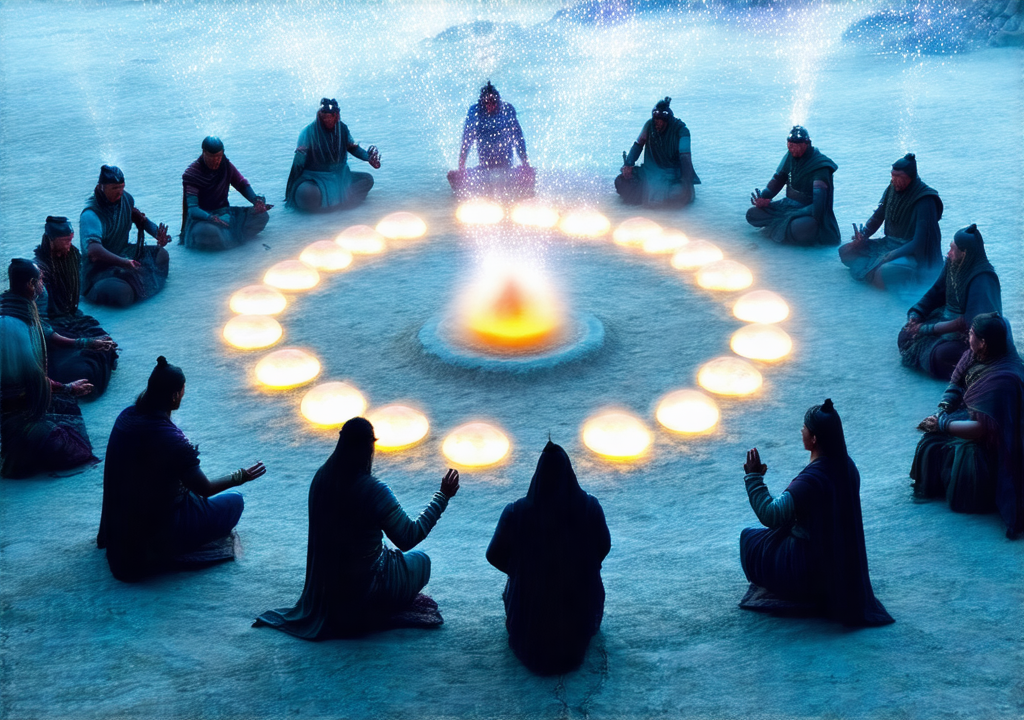
Perhaps no element of ceremonial witchcraft is more misunderstood than the circle. To the casual observer, it is a decorative boundary—a line drawn in chalk or cut in fabric. To the practitioner, it is an architectural feat of metaphysical engineering.
The circle is not merely a place where magic happens; it is the magic. It is a three-dimensional construct projected into two dimensions. When we cast a circle, we are building a temple. We are creating a pocket of reality—a "here and now" that exists simultaneously in our physical space and in the realm of spirit.
How has this been mastered through generations? Through the refinement of intention and precision. Early folk circles were often informal—a clearing in the woods, a hearthstone. As ceremonial traditions emerged, particularly with the revivalist movements of the 19th and early 20th centuries, the circle became codified. We learned that angles matter. That compass points must align not just with magnetic north, but with the cardinal directions as understood in our specific geographic context.
We learned that the elements are not just concepts; they are presences. The East is not just "East"; it is the presence of Air, the breath of clarity and intellect. The South is Fire, the heat of passion and will. The West is Water, the depth of emotion and intuition. The North is Earth, the stability of body and matter.
Mastery comes when you stop treating these as labels and start interacting with them as entities. You don't "call on Air"; you invite the Principle of Air to witness your work. This shift—from symbolic representation to ontological presence—is a hallmark of generational mastery. It is the difference between reciting a script and performing a rite.
The Book of Shadows: A Living Document 📖
In folk tradition, knowledge was often oral. Grandmothers taught granddaughters; neighbors shared remedies. But in ceremonial witchcraft, particularly in its more structured forms, we rely heavily on the written word. This is where the Book of Shadows (or Grimoire) becomes central to mastery.
A common mistake for beginners is treating their Book of Shadows as a diary or a scrapbook. It should be both, but it should also be a laboratory notebook and a theological text. Over generations, these books have evolved from collections of recipes into comprehensive systems of cosmology.
Consider the evolution of the Key of Solomon—one of the most influential grimoires in Western ceremonial magic. Originally a compilation of incantations for summoning spirits, it has been studied, annotated, and adapted by countless magicians over centuries. Each generation added their insights. Some corrected pronunciation; others expanded on the nature of the spirits named within.
In our own practice, we must treat our written records with similar reverence. When you learn a new rite, do not just copy it down. Annotate it. Add your questions. Note where you felt resistance or resonance. If a line from an old text suddenly makes sense to you in a way it didn't five years ago, write that down. Your Book of Shadows is the physical manifestation of your mastery. It is the thread connecting you to those who wrote before you and will guide those who come after.
Generational mastery implies that knowledge is not static. It breathes. The words on the page are seeds; your practice makes them grow.
The Correspondence Web: Reading the Language of Symbols 🕸️
One of the most powerful tools in ceremonial witchcraft is the system of correspondences. Moon phases, planets, herbs, crystals, days of the week—these are not arbitrary associations. They form a cosmic web that connects microcosm to macrocosm.
Mastery involves learning to read this web intuitively. A novice might look up "Rosemary" in a book and find it is for protection and remembrance. A master feels the vibration of rosemary, understands its energetic signature, and knows when not to use it, even if the book says it is suitable.
This intuitive understanding comes only through time and practice. It is learned by doing. By working with the herbs, you learn their personalities. Some are calm; some are fiery; some are subtle. You learn which stars shine brightest on your particular path. This personalization of a universal system is how tradition becomes your craft.
We have inherited a vast library of correspondences from medieval alchemists, Renaissance magicians, and folk healers. Our task is not to memorize every single one, but to develop the sensitivity to feel which ones are calling to you. This is the art of selection—the ability to choose the right tool for the job because you understand the nature of both the tool and the task.
The Role of Lineage and Mentorship 👥
While self-study has become more accessible in the digital age, true mastery in ceremonial witchcraft still largely relies on lineage. To be "of a tradition" is to be part of a chain of being that stretches back through time.
A mentor does not just teach you how to light a candle or say an incantation. They teach you how to listen. They show you the subtle cues: the shift in air pressure, the quality of the silence after an invocation, the feeling in your chest when a spirit arrives. These things cannot be fully written down; they must be felt and demonstrated.
Generations have also shaped the ethical framework of our craft. We have moved from a time when magic was sometimes viewed with suspicion or fear to a time where it is celebrated as a legitimate spiritual path. But even more importantly, we have refined our understanding of consent in magical work. In ceremonial witchcraft, you are often working with entities—spirits, angels, elemental beings. Mastery requires that you treat them with the same respect and reciprocity you would show to any person.
We inherit a tradition of courtesy. We give thanks. We offer libations or gifts. We acknowledge our dependence on forces greater than ourselves. This etiquette is not mere politeness; it is the foundation of a sustainable relationship with the spirit world. Generational mastery includes the wisdom that we are guests in this cosmic house, and that we must leave things better than we found them.
Rites of Passage: Marking Time ⏳
Ceremonial witchcraft is deeply temporal. We mark the turning of the year, the phases of the moon, the seasons of our own lives. Mastery involves understanding how to use time as a tool.
The Wheel of the Year (or the Pagan Calendar) provides a rhythmic structure for our practice. But beyond the festivals, there are personal milestones: first ritual, first spell, first heartbreak, first success. Generations have taught us that these moments are not just events; they are portals. They are times when the veil is thin, and intention is amplified.
We learn to time our work accordingly. We plant seeds in spring; we harvest in autumn. We begin new projects at the waxing moon; we release and let go at the waning. This synchronization with cosmic rhythms gives our work a power that pure willpower cannot match. It aligns us with the natural order, reducing resistance and increasing flow.
Mastery is knowing when to act and when to wait. It is trusting the process. Sometimes the most powerful thing you can do in a ritual is nothing—just sit in the circle, breathe, and listen. This patience is learned over time, often through the failure of impatience. We inherit this wisdom from those who came before us, who learned that magic is not about forcing outcomes but creating conditions for them to arise naturally.
The Personal Altar: A Sanctuary in Chaos 🕯️
In a world of digital noise and constant stimulation, the physical altar serves as an anchor. It is a place where you can be fully present. Mastery involves curating this space with intention.
Your altar should reflect your practice, not just aesthetic trends. If you work heavily with fire, have candles that are beautiful to light. If you work with water, keep a bowl of fresh water, changing it regularly. The items on your altar are not props; they are partners in the ritual. They help focus your mind and invite the presences we seek.
Generational mastery teaches us that simplicity can be more powerful than excess. A single white candle can be a more potent tool than a cluttered table of crystals. The key is attention. When you light that candle, do it with full awareness. Feel the heat of the flame. Smell the wax. Make eye contact with the fire (if safe to do so). This mindfulness transforms a simple act into a ceremony.
The altar also serves as a place of remembrance. It connects us to our ancestors and mentors. We may keep objects that belonged to those who taught us, or symbols of traditions we honor. In this way, our personal space becomes a bridge between the past and the present, reinforcing our sense of belonging to a larger story.
Ethical Practice: The Wiccan Rede and Beyond ⚖️
As ceremonial witchcraft has become more public, questions of ethics have come to the forefront. How do we ensure that our practice does not harm others? How do we respect the autonomy of spirits? How do we share knowledge without gatekeeping or hoarding?
Generations have debated these questions. The classic "Harm None" principle is a good starting point, but it can be simplistic. In ceremonial work, we are often dealing with forces that are not human. How do you determine if an entity is acting in your best interest? Mastery involves developing the ability to discern true guidance from false prophecy or manipulative spirits.
We also inherit a tradition of discretion and discretion. Not all workings should be shared publicly. Some rituals require privacy, secrecy, or specific conditions. Knowing what to share and what to keep for yourself is part of the craft. It protects the energy of the work and respects the confidentiality inherent in spiritual practice.
Ethical mastery also includes environmental stewardship. We draw from nature; we must give back. We use herbs; we forage sustainably or grow our own. We burn candles; we choose natural waxes when possible. Our craft should be a source of healing for the world, not just for ourselves.
The Inner Work: Mastery Begins Within 🧘
Finally, it is crucial to remember that ceremonial witchcraft is an internal practice as much as an external one. The most elaborate ritual in the world will fail if the practitioner's mind and heart are not aligned.
Generations have taught us that the body is the primary instrument of magic. Our emotions, our thoughts, our physical state—all of these affect the quality of our work. Meditation, journaling, dreamwork, and self-reflection are not optional add-ons; they are core components of mastery.
We learn to know ourselves deeply. What are my triggers? Where do I lack confidence? Am I working from a place of clarity or confusion? This self-awareness allows us to bring our authentic selves into the ritual, making it more genuine and powerful.
Mastery is not about being perfect; it's about being present. It's about showing up for your practice with honesty and dedication. It's about trusting that you are part of a long lineage of seekers who have walked this path before us and will walk it after us. We are links in the chain, holding the thread taut so that those coming behind can follow our footprints into the light.
Conclusion: The Thread Continues 🧵
The art of witchcraft is not a destination; it is a journey. It does not end with mastery; it deepens with it. Each year brings new insights, new challenges, and new opportunities to refine our craft.
As we stand in our circles, lighting our candles, calling on the spirits, and working our wills, we are participating in an ancient continuity. We are keeping a flame alive that has burned since the first human looked at the stars and asked "why?" Since the first healer crushed herbs for a sick child. Since the first priest spoke words to bind a spirit or bless a harvest.
We are inheritors. And inheritance is not passive; it is active. It requires us to study, to practice, to teach, and to live our craft in every moment of our lives.
So let us honor those who came before us by carrying their wisdom forward. Let us refine what we have learned and pass it on with clarity and love. And let us remember that the art of witchcraft is mastered not by conquering the mystery, but by embracing it. We are not masters of magic; we are students in an endless school, and the greatest lesson is that there is always more to learn, more to feel, and more to become.
The thread continues. 🌿