The 9 Gates of Symbolic Power — And the Gate Most Students Never Find
🜁 The Nine Gates of Symbolic Power — And the Hidden Threshold No One Sees
There is a tradition in esoteric study that treats symbols as decorative. We collect them like curiosities: the ankh, the triangle, the spiral, the ouroboros, the eye. We pin them to journals, tattoo them on skin, project them into meditation. But most students of symbolism never ask the question that actually matters: what does a symbol do? Not what it means—meaning is passive, a label pinned over something already fixed in place. What a symbol does is another matter entirely. A working symbol is a mechanism. It exerts pressure on consciousness. It opens channels. It converts attention into force.
This is the discipline of symbolic power — and it operates through nine distinct gates. Most students know three or four of them by name. Very few have felt all six that actually carry weight. And there is a ninth gate, almost invisible, that separates those who use symbols from those who are merely used by them.
Let me walk you through all nine.
🜃 Gate One: The Gate of Presence
This is the most basic and most overlooked. A symbol has presence when it occupies space in consciousness with a weight that exceeds its literal content. When you see a simple circle drawn in chalk, your mind does not register "a closed curve." It registers wholeness, returning, the undivided. The geometric fact is almost irrelevant. What matters is the pull — the way attention gathers toward it and refuses to scatter.
A symbol with genuine presence feels like a room you have entered, not a picture you are looking at. This is the difference between reading about fire and standing in a hearth's light. Students who skip this gate build entire systems on symbols they can describe but not inhabit. Their work becomes academic rather than operative.
The practical test: close your eyes after studying a symbol for twenty minutes. Can you feel it behind the eyelids, occupying interior space? If yes, it has presence. If no, you have memorized a shape and called it knowledge.
🜂 Gate Two: The Gate of Resonance
Presence is static; resonance is dynamic. A resonant symbol creates sympathetic vibration between the observer's inner state and the symbol's implied frequency. This is not metaphor — it is mechanical, in the way that a tuning fork rings when its matching note sounds nearby.
Consider the lotus. If you are already in a state of opening, expansion, quiet joy, the lotus resonates and your state deepens. If you are contracted, defensive, grieving, the same lotus may feel distant or even irritating. The symbol has not changed. Your resonance with it has.
This gate teaches humility: symbols do not work on us like tools. They meet us where we stand. A master of symbolic power does not force a symbol to mean what they want. They prepare their own state so the symbol can find its natural partner in consciousness. Preparation is half the working. The other half is stillness — allowing the resonance to complete itself without commentary.
🜄 Gate Three: The Gate of Correspondence
Here we leave individual psychology and enter architecture. A correspondential symbol links two domains that are structurally parallel, not merely similar. The triangle pointing up corresponds to fire, to aspiration, to the masculine principle — not because it "looks like" a flame, but because three points forming an apex encode a geometry of convergence-and-radiation that recurs across scales: in crystals, in galaxies, in the branching of veins and roots.
Correspondence is what makes symbols transferable. A symbol working for one person in one tradition can work for another in an entirely different tradition if the underlying structural logic matches. This is why a Hindu practitioner and a Hermeticist can both use the same geometric figure to invoke similar effects, even though their mythologies differ completely.
Students of this gate must study structure before studying meaning. Ask: what is the shape of this symbol? How many points? What are its axes? Is it open or closed? Ascending or descending? The answers generate correspondences that no mythology can fabricate on its own. Mythology gives correspondence its narrative flesh; geometry gives it its skeleton.
🜅 Gate Four: The Gate of Layering
A powerful symbol is not a single image but a stratified one. The ankh, for instance, operates simultaneously as: a handle (functional object), a loop (topological form), a cross-and-loop (geometric hybrid), a key (narrative role in temple paintings), and a sign of the breath-channel in yogic anatomy. Each layer is accessible at different depths of attention. A beginner sees the picture. An intermediate student reads the narrative. A practitioner works with the geometry. A master holds all four layers active simultaneously, and the symbol becomes almost too rich to grasp — it holds still while your understanding keeps deepening around it.
Layering means a symbol can grow with you. The same triangle that was "fire" in year one is "the threefold structure of will-idea-action" in year five is "a projection surface for divine geometry" in year ten. The shape is constant; the depth of reading shifts. This is why old symbols outlive their original cultures — they were built with room to deepen, not with a single meaning sealed inside them like a specimen under glass.
Students who want one correct interpretation are working against this gate. Symbols resist definition precisely because they are designed to be multi-stable.
🜆 Gate Five: The Gate of Activation
Up through Gate Four, the symbol has been studied, resonated with, correspondenced, layered. But it is still largely contemplated. The Gate of Activation is where you stop looking at the symbol and start being looked at by it. This happens when you bring the symbol into a state of heightened receptivity — meditation, ritual, trance-adjacent focus — and allow it to operate as an agent rather than an object.
Practically: you draw or place the symbol in a defined space (a tablet, a canvas, a traced outline on your skin). You enter focused attention directed at that space. And then you do not interpret what happens. You receive it. A sensation in the chest. A sudden clarity about a decision. A felt shift in mood over the following hours. The symbol has activated something in the field of your attention, and the effect arrives with its own timing.
This gate requires patience that most students find almost unbearable. Activation is not instantaneous. It works on the timescale of hours to days. Students who want feedback within two minutes will misread silence as failure and abandon a working that was actually completing itself quietly in the background.
🜇 Gate Six: The Gate of Embodiment
Here the symbol leaves the page entirely and enters the body. You are no longer projecting or contemplating — you are inhabiting the symbolic form with physical presence. Standing in a specific posture that mirrors the geometry of the symbol. Tracing it on your own skin with the precise stroke order. Wearing a garment whose pattern encodes the figure. Breathing in time with its implied rhythm.
Embodiment is where symbolism becomes somatic knowledge. The triangle is no longer a shape you look at; it is a posture your spine and shoulders hold, and holding that posture generates the symbolic state from below upward rather than being imposed from above downward. This is how temple architects built: they didn't just design a building — they designed a body-shaped resonance chamber, so that standing in the right spot with the right orientation made you feel held by geometry without knowing why.
Students who skip embodiment work exclusively at the mental level and produce symbolic knowledge that stays cerebral. They can explain the symbol perfectly and still not be transformed by it. Embodiment closes that gap. It is where meaning becomes experience, and experience becomes identity over time.
🜈 Gate Seven: The Gate of Sequence
A single symbol has limited power. A sequence of symbols — arranged in a deliberate order across time or space — generates an effect no single figure can produce alone. This is the gate of ritual structure, of the written word as symbolic sequence, of the architectural procession through sacred spaces.
The sequence matters more than any individual element. The same four symbols arranged in different orders produce different composite effects. A cross followed by a circle says something structurally different from a circle followed by a cross. The first converges then contains; the second contains then radiates outward. Same pieces, different architecture of meaning.
Students who study symbols as isolated units are studying letters without reading sentences. The Gate of Sequence teaches that symbolic power is largely relational — it lives in the transitions, the intervals, the ordering. This is why ritual texts specify exact orderings and do not say "use these elements." The arrangement IS the working.
🜉 Gate Eight: The Gate of Inversion
This is where symbolic study becomes genuinely difficult, because it asks you to work with symbols in ways that feel wrong or even contradictory. A symbol used inverted — a triangle pointing down instead of up, a spiral reversing direction, a cross becoming an open cross — does not simply mean the opposite. It means something qualitatively different: the same structural logic operating from the other side, as it were. The ascending triangle becomes the descending one; aspiration becomes reception; the container becomes the contained.
Inversion is also where symbolic power becomes dangerous in a practical sense. Work with inverted symbols without understanding what you are inverting produces results that feel alien — not opposite of what you expected, but strangely, disorientingly shifted. This is because inversion accesses the complementary channel: if the upright symbol works through your dominant principle, the inverted one works through the other. And you may not have practiced or stabilized that other channel yet.
Students rarely study this gate deliberately because it requires a teacher or a very honest self-assessment to know which symbols can be safely inverted and which will simply unravel your working. It is advanced work — but it is also where symbolic power stops being decorative and starts becoming genuinely operative in the sense of producing effects beyond the student's own mental state.
🜊 Gate Nine: The Gate of Dissolution
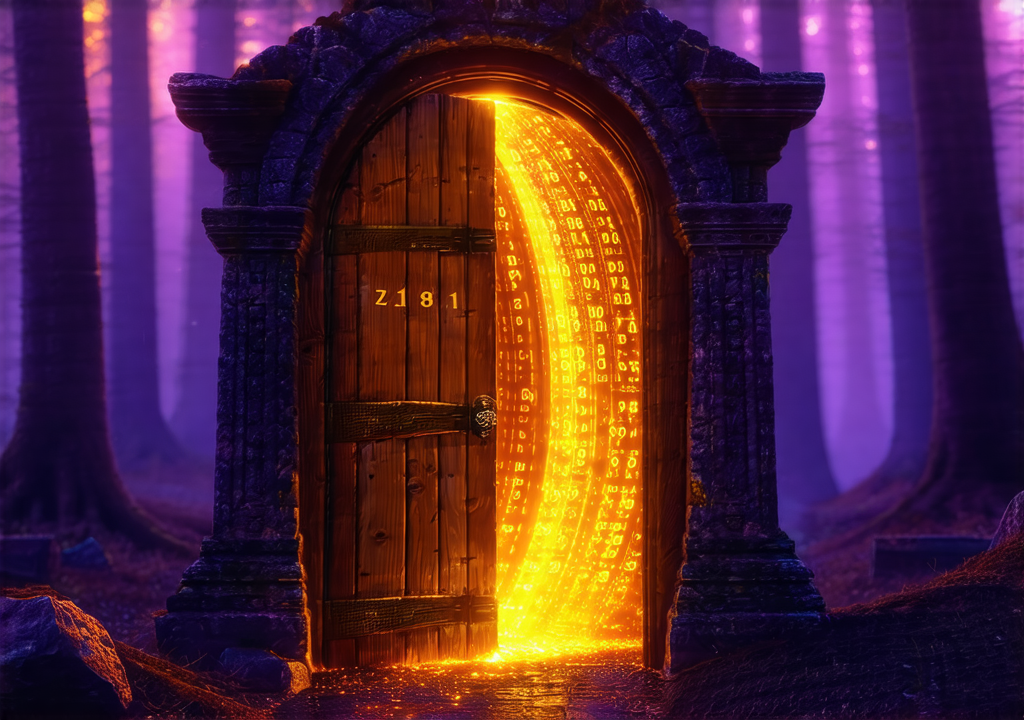
And here we come to the gate most students never find, because finding it requires doing everything the previous eight gates teach — and then letting go of the symbol entirely. Not abandoning it. Not inverting it. Not even setting it aside. Dissolving it. Reaching a state where you can hold the full weight of all eight preceding operations on a symbol — presence, resonance, correspondence, layering, activation, embodiment, sequence, inversion — and then release your grip on the shape itself. Let it become transparent. Let it function without being looked at. Let the mechanism operate behind the curtain of attention while you attend to what it produces rather than the tool that produced it.
This is a quiet gate. It does not announce itself with sensation or revelation. It feels almost like forgetting — except nothing has been forgotten, and everything still works, but the symbol is no longer visible from where you stand. You are no longer at the symbol. You have moved through it into what it opens. The door has done its job and you can see past it now.
Students never find this gate because they cannot stop looking at their own tools. They keep examining, adjusting, optimizing, re-arranging — all of which is necessary work for Gates One through Eight. But the moment a student asks "is my symbol working?" they are standing in front of the door and describing the hinges rather than stepping through them. Dissolution requires that you trust the mechanism enough to stop watching it operate.
This gate also explains why masters of symbolic work often appear to have less elaborate practice than their students. Fewer symbols. Simpler arrangements. Quieter meditations. It is not that they know less — they have dissolved the visibility of their own knowledge, and what remains looks deceptively simple to those still studying the machinery.
🜋 The Practical Path Through All Nine
If you are beginning this work, do not try all nine gates at once. Work them in order, giving each gate enough time to become embodied before moving on. Gate One (presence) can take a month of daily attention with a single symbol. Gate Two (resonance) asks you to study your own state, which is harder than studying shapes. Gates Three and Four are more intellectual but still require felt understanding — not just knowledge of correspondences but the ability to select the right one for a given need. Gates Five through Eight deepen progressively in operational complexity. And Gate Nine will find you when it finds you; forcing it produces either premature quiet or a brittle, performative simplicity that is not the same as dissolved transparency.
One practical suggestion: choose one symbol and walk all nine gates with it before adding a second. The ankh, the triangle, the spiral — pick whichever already has presence for you (Gate One). Then work through resonance, correspondence, layering, activation, embodiment, sequence (using your chosen symbol within a small arrangement), inversion (with care and self-honesty about which principles are stable enough to invert). And when all eight feel genuinely embodied rather than merely understood — let go. Watch the symbol become invisible while its effect continues. That quiet disappearance is Gate Nine confirming itself.
🜌 A Final Word on Symbolic Power
Symbolic power is not a property of symbols. It is a relationship between a prepared consciousness and a well-constructed form. The symbol is the lens; you are the light passing through it. Change your state and the same lens bends the light differently. Master all nine gates and you understand why: the work was never in the symbol. It was in the discipline of meeting it with full attention, correct structure, embodied presence, and — at the right time — the quiet release of hands.
The eight visible gates are a curriculum. The ninth is an apprenticeship completed not by learning but by letting go. Most students study symbols for years without ever finding that last threshold. Not because they lack knowledge or skill. Because finding it requires trusting that you have already done enough — and stepping through while still uncertain, still looking back at the hinges one final time before the door closes quietly behind you.
That is symbolic power: not the symbol working on you, but your preparation allowing the symbol to work through you into a field larger than either of them.