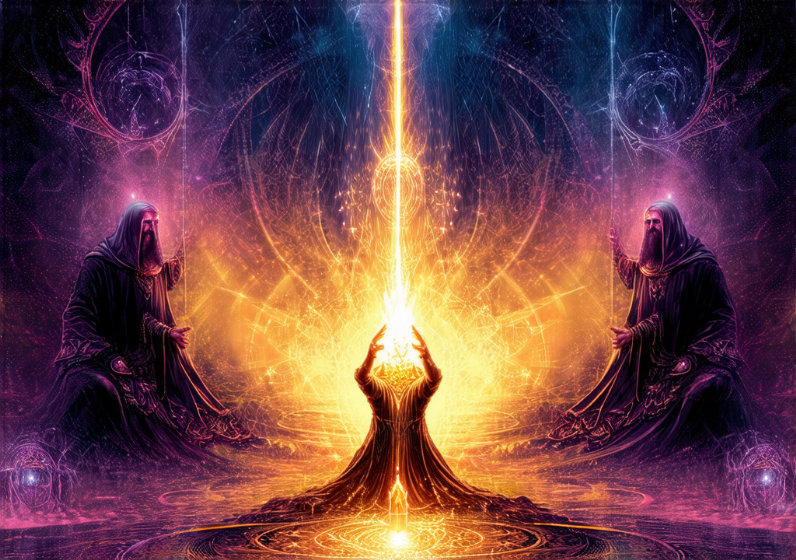
What Happens When a Curse is Broken?
🔮 The Unbinding: What Truly Happens When a Curse Is Broken? ✨
In the shadowed corners of folklore, in whispered confessions around campfires, and in the dusty archives of medieval grimoires, the breaking of a curse has always been treated as one of the great mysteries of the human experience. We speak of curses being "lifted," "blessed away," or "neutralized" with the casual confidence of those who have never actually watched the moment the invisible chains snap. But what if we told you that breaking a curse is not an ending? What if, in the occult tradition, it is merely a transformation—sometimes beautiful, sometimes terrifying, and almost always more complex than a simple on/off switch for misfortune?
To understand what happens when a curse is broken, one must first abandon the modern, mechanistic view of magic as a tool that can be wielded or discarded. In the esoteric traditions—from Neoplatonic philosophy to Kabbalistic mysticism, from Voodoo to Celtic shamanism—a curse (or hex) is not merely a negative thought projected at someone. It is an energetic architecture. It is a woven structure of intention, emotion, and spiritual force that attaches itself to the victim's aura, their life narrative, or even their physical body. And when you dismantle that architecture, you do not simply remove a bad thing. You unravel a system. The energy stored within the curse must go somewhere. The space it occupied must be filled by something new. The victim must learn to exist in a state of un-entangled freedom.
This is the secret the old witches knew and rarely wrote down: the breaking of a curse is not an act of subtraction, but an act of alchemical transmutation. And like all alchemy, it involves heat, pressure, dissolution, and rebirth.
Let us examine this process in its many forms, drawing from the rich tapestry of occult traditions that have studied this phenomenon for millennia.
The Architecture of a Curse: What You Are Actually Breaking ✍️🕯️
Before we can discuss what happens when it breaks, we must understand what a curse actually is in occult terms. In the most basic Neopagan and Wiccan understanding, a curse is an intentional projection of negative energy, often tied to specific conditions or timeframes. "May you suffer as I have suffered." It is a binding of misfortune to a person's fate.
But deeper traditions see it more structurally. The Kabbalists speak of curses as klipah—the husk or shell that traps the divine light (or sparks of soul) within matter and limitation. A curse, in this view, is a parasitic spiritual entity or an energetic knot that has latched onto your life-force (nephesh or ruach). It feeds on your suffering, creating a feedback loop: the more you suffer, the stronger the curse grows; the stronger it grows, the more you suffer.
In West African and Voodoo traditions (from which much of what we now call "curse work" in the Western world originates), a curse is often tied to a specific object—a cross (croix de bois), a pin, a hair clippings, or a doll. The curse is not just energy; it has form. It exists in both the material and spiritual realms simultaneously. Breaking it requires addressing both: you must unbind the energetic link and deal with the physical anchor.
In Celtic and Norse traditions, curses are often woven into the wyrd—the fate-web of a person. A curse is a miswoven thread, a snag in the tapestry of one's destiny. To break it, you must find the knot, cut it cleanly, and then reweave the fabric so that no loose threads remain to tangle you again.
In all these traditions, a curse is not static. It is alive. It adapts. It resists being removed. And this is crucial: a well-made curse fights back when you try to break it. The old witch doctors knew this. They spoke of the "recoil" or the "backlash"—the moment when the curse, sensing its dissolution, lashes out in a final spasm of energy before releasing its hold. This recoil is one of the first things a victim experiences when a curse begins to lift.
The Moment of Severance: What It Feels Like ⚔️🌀
In the occult literature and in the oral traditions of practitioners, there are remarkably consistent descriptions of what happens at the moment a curse breaks. These accounts span cultures and centuries, which suggests they describe something real—something about how human consciousness interacts with energetic structures.
1. The Initial Shock: The "Unfreezing" Effect 🧊➡️🔥
When a long-standing curse is broken, victims often report a sensation of sudden release that can be almost physically painful. Imagine a muscle that has been clenched in pain for years suddenly letting go. The nervous system, which had adapted to the constant low-level suffering imposed by the curse, now experiences a surge of normal sensation, and this feels like a flood.
Practitioners describe this as "the thaw." A woman in a 19th-century French Voodoo account described how, after her mammy (spirit) broke the hex placed on her by an envious neighbor, she felt "like ice melting off my bones, and the heat of it burned me more than the cold had." This is not metaphor. The curse had suppressed certain neural pathways, dampened emotional responses, or created a kind of spiritual numbness to protect the victim from the full weight of the hex. When that suppression lifts, all the suppressed feelings—grief, anger, joy, desire—rush in at once.
In Kabbalistic terms, this is the release of tzelem (form) returning to or (light). The spark that was trapped in the husk suddenly has room to shine, and that shining can be blinding.
2. The Energy Displacement: Where Does the Curse's Power Go? 🌊🌀
This is the question most modern practitioners avoid asking because it requires uncomfortable honesty about how magic works. If a curse carries with it a certain amount of negative energy—let us say, three years' worth of compounded misfortune, anxiety, and spiritual drain—where does that energy go when the binding breaks?
In alchemical tradition, energy cannot be created or destroyed; it can only be transformed. When you break a curse, you are not destroying the negative energy. You are releasing it from its structured form (the curse) into your personal energetic field—or, in some cases, back to the one who cast it.
This is why practitioners of curse-breaking rituals often include a step called "grounding" or "discharging." The victim must actively channel the released energy somewhere: into the earth, into water, into fire, or out through their body as tears, sighs, or even physical illness for a short period. If this discharge is not managed, the broken curse's energy can create what practitioners call an "energetic hangover"—a period of 1-4 weeks where the victim feels unusually tired, moody, or physically unwell, as their body processes the sudden influx of freed-up energy.
In Voodoo tradition, this displacement is made visible in rituals: the broken curse-object (a pin, a cross, a bottle) is often burned, buried, or cast into running water while the practitioner speaks words that "send" the stored negative energy away from the victim and toward its source—back to the hexer if possible, or down into the earth if not.
3. The Backlash: When the Curse Fights Its Own Death 🐍⚡
Not all curses break cleanly. A well-constructed curse, especially one that has been "fed" over time (through ongoing negative thoughts from the caster, additional ritual work, or the victim's own fear and belief in the curse), has built up a kind of spiritual momentum. When you begin to dissolve it, it resists.
Practitioners describe this backlash as:
A sudden intensification of symptoms just before relief arrives. If your curse manifested as headaches, they may become migraines for a few days after the breaking ritual. If it caused insomnia, you may sleep for 14 hours straight and then have vivid, strange dreams for a week.
Emotional swings. You may feel euphoric one morning and weeping at lunch the next. This is not instability; it is your emotional system recalibrating to a state of freedom it has not known in months or years.
A sense of being "watched." The old curse had a kind of awareness, or at least an energetic presence that was attentive to you. When it dissolves, that attention vanishes, and your nervous system notices the absence. It's like going deaf in one ear: suddenly you're aware of all the other sounds you'd stopped hearing.
Physical sensations. A cooling or warming of the skin at specific body parts (the place where the curse was "anchored"), a tingling, a brief feeling of weight lifting off the chest, or even a faint smell of sulfur, flowers, or old paper in an otherwise clean room.
In Norse tradition, this backlash is called hnefi—a fist-clenching, as if fate itself is gripping your throat one last time before releasing you. The old sagas speak of heroes who, after having their curse lifted, fall into a brief delirium or sleep from which they emerge "new."
The Aftermath: Living in the Space Where the Curse Was 🌱🕊️
This is perhaps the most underappreciated aspect of curse-breaking. Most people focus on the removal and celebrate when it's done, as if their life will simply resume as it was before the curse arrived. But the space where the curse lived now needs to be filled. The energetic real estate has been vacated, but it is not neutral ground. It is a blank canvas—and what you paint on that canvas in the first weeks and months after breaking the curse will shape your life for years.
The "Vacuum" Effect 🌫️
In physics, a vacuum is filled by surrounding matter. In the energetic field, when a curse (a structured negative energy form) dissolves, it leaves a kind of spiritual cavity in your aura or life-narrative. This cavity will be filled by whatever energy is most available and attractive to you at that moment.
If you break a curse but continue to dwell in bitterness, resentment, or fear, the vacuum will fill with new negative patterns—perhaps not as intense as the original curse, but no less real. Practitioners call this "curing the symptom, not the cause." The old curse is gone, but the wound it exploited (a low self-worth belief, an unresolved grief, a toxic relationship) is still there, and new negative energy will seep in to exploit it.
This is why traditional curse-breaking rituals almost always include a "blessing" or "protection" phase after the breaking. In Wiccan practice, this means casting a protective circle around the victim, anointing them with sacred oil, and speaking words of affirmation that actively fill the space with positive intention. In Kabbalistic practice, it involves meditating on the divine spark within, re-attaching your soul to its source rather than letting the void fill with stray energies.
The Reweaving of Fate 🧶🕸️
In Celtic and Norse tradition, breaking a curse is not just removing a bad thread; it requires reweaving. Your fate-web has been damaged by the curse. There are loose ends, gaps in the pattern, places where the fabric is thinner or torn. If you do not actively reweave—through intention, ritual, and conscious living—the gaps will tangle with new threads (new problems, new negative influences) until your life-narrative becomes a patchwork of accidental connections rather than an intentional design.
Practitioners advise that in the month or two following a curse-breaking, you should be especially mindful of:
Who and what you allow close to your energetic space. Your defenses are lower; your aura is more permeable. Be selective about social interactions, new relationships, and even what media you consume.
Your own internal narrative. The stories you tell yourself ("I'm unlucky," "Bad things always happen to me") can become self-fulfilling if left unchecked during this vulnerable period. Actively replace them with narratives of intentionality and grace.
Physical health. Your body has been processing a lot of energetic change. Sleep, nutrition, hydration, and gentle movement are not luxuries; they are maintenance for the alchemical process your system is undergoing.
The Paradox: Curses That Cannot Be Fully Broken 🕯️🔓
Here we arrive at one of the deepest secrets in curse-work, and it is a truth that even experienced practitioners sometimes struggle to accept: some curses cannot be broken by the victim alone.
In many traditions, this is explained as the "anchor" or the "source." A curse drawn from a powerful spirit (a loa in Voodoo, an ángeles caídos in certain Latin American traditions) will continue to exert influence until that spirit's intention is satisfied or negotiated with. A curse placed by someone who is still actively feeding it with their thoughts and emotional energy will be harder to break than one from a deceased hexer.
In Kabbalistic tradition, this is framed as the need for tikkun—a cosmic repair. The curse was not just an attack; it was a spiritual imbalance in your soul's journey. Breaking the curse without addressing the underlying karmic or soul-level lesson means the "curse" (the energetic pattern of suffering) will find another way to manifest until you complete that lesson.
In Wiccan and Neopagan practice, this is called "working with the energy rather than against it." You don't just destroy the curse; you communicate with its energy, understand its purpose in your spiritual development, and thank it for what it taught you before releasing it fully. This transforms an act of war into an act of grace—and, practitioners swear, makes the breaking more permanent.
There is also the question of consent. In some traditions (particularly those rooted in African and Latin American folk magic), a curse can only be broken if the victim genuinely wants to be free from it. If you have internalized the curse—if part of your subconscious mind has accepted it as "just how my life is"—you are, in a sense, still binding it yourself. Breaking a curse then becomes an act of psychological and spiritual self-liberation as much as ritual. You must want to be free more than you want the comfort (however painful) of the familiar suffering.
The Alchemy of Transformation: Curse-Breaking as Spiritual Growth 🧪✨
This brings us to the most profound insight that the old traditions offer: a broken curse is not just a removal; it is an initiation.
In alchemical terms, breaking a curse takes you through all four stages of the Great Work:
Calcination (the burning away): The initial shock and pain of the curse dissolving. You are stripped of the false structures it imposed on your life.
Dissolution (the melting): The energy is released, your old patterns dissolve into a kind of spiritual soup where all distinctions blur. You feel uncertain, vulnerable, "unformed."
Separation (the clarification): You begin to see what was truly yours and what had been layered on by the curse's influence. You separate your authentic desires from the ones the curse conditioned you to want.
Conjunction (the rebirth): You integrate the freed energy, the new clarity, and your original intention into a new self. You emerge not as the person who was cursed, but as someone who has met that suffering and transcended it.
This is why many practitioners describe breaking a curse as more transformative than performing any other kind of ritual work. It requires you to face the full weight of your own energy, intention, and vulnerability without the "shield" (however painful) that the curse provided. You are left raw, open, and free—and freedom, in the occult sense, is not comfort. Freedom is potential, and potential is unstable until it is shaped by conscious creation.
Practical Wisdom: What to Do After the Breaking 🕯️📜
Drawing from multiple traditions, here is a synthesis of practical guidance for those navigating this process:
Ground yourself daily. Walk barefoot on earth. Spend time near running water or fire (a candle flame works). These elemental connections help your body discharge the freed-up energetic residue.
Write it out. Keep a journal in the weeks after breaking. Record dreams, physical sensations, emotional shifts, and insights. This externalizes the internal alchemy and gives you a record of your transformation.
Protect your space. Use simple protective practices: salt at doorways, a burning sage or palo santo stick before bed, a personal mantra or prayer each morning to reaffirm your intention for the "new" life that is forming in the vacated space.
Be patient with yourself. The process can take anywhere from two weeks to several months depending on how long and how deep the curse ran. There will be good days and strange days. Trust the process.
Actively fill the space. Do not wait for life to "resume." Consciously choose what goes into your time, attention, and energy in the post-curse period. Invite in what you want; guard against what you do not.
Consider a blessing ritual. If you work with a tradition (Wiccan, Kabbalistic, Voodoo, etc.), perform or participate in a formal blessing after the curse-breaking to seal the transformation and protect the new pattern from stray negative energies.
The Final Secret: You Are Not the Victim of Your Breaking 🕊️🔥
There is a quiet, almost rebellious truth at the heart of all this that the old witch doctors whispered to their students: the curse was never as powerful over you as you believed it to be. Yes, it shaped your days. Yes, it bled from your aura and tangled your fate-web. But it could not consume you. It could not replace your soul, your will, or your capacity for creation.
When a curse breaks, what happens is not just the removal of a bad thing. What happens is the revelation that you were always bigger than the hex that was placed on you. The breaking is a mirror held up to your own resilience, your own creative power, and your own divine spark. It shows you that you are not defined by the worst intention someone else aimed at you. You are the alchemist of your own transformation.
And in that revelation—shocking, painful, beautiful—is the true gift of the breaking: you remember who you were before the curse tried to make you smaller. And from that remembering, you build a life that no hex can reach.
🕯️✨