Necromancy Isn't What You Think—It's Not Dark Magic At All
🪦 Necromancy Isn't What You Think — It's Not Dark Magic At All
✍️ By Mistress Vespera Hollowgrain, Archivist of the Silent Thresholds & Keeper of the Pale Ledger
Written under a Waning Moon, in the 12th Hour of Stillness
I. The First Whisper Beneath the Page 🕯️
There is a particular silence that belongs only to those who have stood too long at the edge of two worlds — the warm, breathing country of the living and the cool, patient kingdom of the dead. It is not an empty silence. It is full — full of attention, full of waiting, full of the soft pressure of voices that do not need to speak to be heard.
Necromancy lives in that silence.
And yet, when most people hear the word, they reach for a different picture entirely: creaking crypts, floating candles, pale hands rising through coffin lids, ruddy-eyed ghouls chanting over bones while ravens circle overhead and the floorboards groan as if in sympathy with some buried grudge. Somewhere, a witch has just pulled up her own skeleton by the collarbones.
And yes — that is a picture of necromancy. But it is not the picture. It is the carnival version. The horror-film version. The version designed to make children clutch their parents' sleeves and whisper "don't let them see you."
The truth, if we are honest with ourselves, is far more tender than that. Far more intimate. And in many traditions — including several that predate Christianity by centuries or even millennia — necromancy was not a dark art at all. It was, in the purest sense of the word, a gift: the practice of listening to those who have already finished their speaking and choosing, nonetheless, to keep the conversation open.
Let us set aside the fog for a moment and look at what necromancy actually is — what it has historically been, what it was called in the temples where it first took root, and why so many living traditions still treat it not as a summoning of monsters but as an act of reconciliation.
II. The Etymological Bone Structure 🦴
We begin, as any honest scholar must, with the word itself.
Necromancy comes from two Greek roots: nēkros (νεκρός), meaning "corpse," or more precisely "the dead body" — not a ghost, not a spirit, not a soul; the physical remains themselves; and manteia (μαντεία), meaning "divination," "prophetic utterance," or "the art of reading what is hidden."
So literally, necromancy means reading the dead. Not raising them. Not commanding them. Not pulling spirits up from the earth by their spectral collars and forcing them to answer riddles. Reading them. Interpreting them. Drawing meaning from the residue they leave behind — in bone, in breath of grave-soil, in the particular way a spirit lingers at the threshold rather than passing through it.
This is important, because most popular depictions treat necromancy as necro-summoning — an act of mechanical retrieval. Here comes the witch; here goes the skeleton. A transactional exchange: "I have your bones; now you shall tell me who poisoned my husband." Or worse: "You owe me a debt, and I will collect it from your spirit while your corpse rots in the family plot."
The older traditions — Egyptian, Mesopotamian, Etruscan, Celtic, West African, Mesoamerican — were far less transactional. They treated necromancy as a relational practice. The dead were not tools. They were not resources to be mined for prophecy. They were people. They had preferences. They had moods. They could be flattered or offended by the quality of your offering, by whether you spoke in their mother tongue, by whether you remembered what they liked to eat while alive.
In ancient Egypt, the practice was so woven into daily life that it barely needed a special name. The ka and the ba — the vital principles of a person — did not simply vanish at death. They persisted. They needed tending. Offerings were left on tombs not because the dead were hungry in some literal sense, but because the living recognized that the relationship had not ended; it had merely changed its medium. You no longer shared bread across a table. You set bread before a painted figure of your ancestor and spoke to it. The form changed. The bond did not.
The Etruscans — those often-underapprecited neighbors of Rome, whose civilization predated and deeply influenced Roman culture — had an entire priestly order devoted to reading the dead: the haruspices who read animal livers for prophecy were one branch, but there was also a long tradition of consulting the spirits of the recently deceased in matters of civic law. The dead were not summoned as oracles; they were asked, respectfully, because they had lived through more cycles than anyone alive and therefore saw patterns the living could not.
This is the quiet dignity at the heart of the practice: the assumption that death does not sever knowledge, only changes its venue.
III. The Somatic Thread: Bone as Archive 📜🦴
One of the most concrete — and perhaps the least romanticized — aspects of historical necromancy was its physicality. This is where the word's etymology becomes almost literal in a way that surprises people who have only ever encountered necromancy through gothic fiction.
In many West African traditions, particularly among the Yoruba, the practice of consulting ancestors involves not merely prayer or incense but the actual physical presence of ancestral remains — bones kept in family shrines, sometimes wrapped in cloth, sometimes placed on altars, spoken to directly. The bones are not treated as relics in a museum case. They are treated as correspondents. A grandmother's femur might be polished and anointed with palm oil before a family gathering. Not because the bone is magical in some detached, elemental sense — but because it was her bone. It carries her specific warmth, her specific history, her particular frequency of being.
Similarly, in Mesoamerican traditions — Aztec, Maya, and their numerous predecessors — the practice of tlacateccatl (the "priest of bones") involved reading the arrangement, coloration, and positioning of skeletal remains to divine outcomes for planting seasons, royal decisions, and ritual timing. Bones were not merely dead matter. They were a text. A manuscript written in calcium and collagen, legible to those trained in its grammar.
Even in pre-Christian Celtic practice — which predates the Christian framing that would later paint all things "death-adjacent" with suspicious or dark connotations — there was a tradition of consulting the gwyrb (a term from Old Irish, referring to the knowing-power associated with the dead) and physical engagement with burial sites. The dead were not behind glass. They were in the soil, in the stones, in the specific quality of light that fell over a particular barrow at solstice. Necromancy here was almost agricultural in its intimacy: you went to them. You sat near their resting place. You spoke to the ground they had become part of.
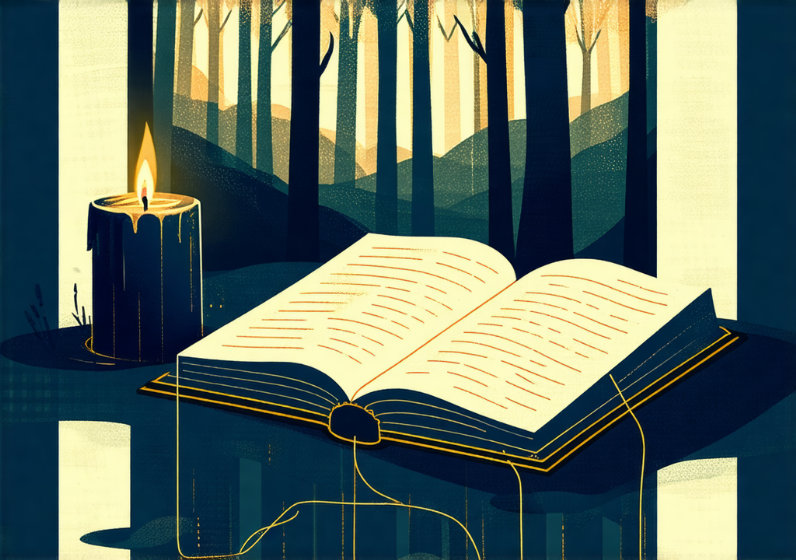
This is what makes historical necromancy so different from its fictional cousin: it is embodied. It requires your body, your senses, your physical presence at a threshold. You do not perform it in a comfortable living room with a candle and an open book (though you can; but that is the domesticated version). You go to the dead. You stand where they rest. You let the coolness of the place seep into your skin before you begin to listen.
There is a reason for this, and it is not merely theatrical: you cannot accurately read someone from a distance. Whether that someone is alive or dead, whether their medium is flesh or bone or spirit, the act of reading requires proximity. Requires shared space. Requires the subtlest adjustments in your own nervous system as you enter their particular field.
IV. The Christian Reframing (and Why It Matters) ✝️🕯️
Here we arrive at a crucial historical juncture — one that is largely responsible for the "dark magic" reputation that has stuck to necromancy for roughly two thousand years.
When Christianity consolidated its theological framework, it needed to define itself in part by contrast with surrounding traditions. The dead were not simply continued beings in Christian theology; death was a severance, a falling-away from the original unity of creation. To speak with the dead, then, was to engage with something that had been set apart — and in a theological system where "apartness" carried heavy connotations (apostasy, exile, the fallen state), engaging with the set-apart became suspect.
This did not mean Christian theology entirely rejected communion with the dead — the veneration of saints' relics, the practice of praying for the dead, the elaborate memorial rites of medieval monasteries all speak to an ongoing relationship. But there was a consistent undercurrent in patristic and medieval theology that treated direct communication with the dead as either:
A form of devotion (praying to saints who are "in God's presence"), or
A borderline practice (speaking with spirits who had not passed fully into divine light — i.e., purgatorial, liminal, or simply unaccounted-for dead).
And that second category is where the suspicion lived. If you were speaking with a spirit and that spirit was not clearly on God's side, then your conversation was not merely risky; it was contagious. You might be conversing with an angel in disguise. Or a demon. Or a trapped soul still muddling its way through the threshold. The distinction between "holy dead" and "uncertain dead" became a live wire of theological anxiety, and necromancy — as the art of asking rather than merely praying to — sat uncomfortably close to that wire.
Add in the broader medieval tendency to categorize practices by proximity to institutional authority (approved = sacred; unapproved = folk magic; unapproved and involving the dead = suspect at best, heretical or diabolical at worst), and you have the full architecture of why necromancy acquired its "dark" reputation. It was not because the practice itself had changed. It was because the interpretive lens had shifted. The bones were still in the ground. The spirits were still lingering. But the cultural script for how to think about all of it had been rewritten, and the new script called everything that wasn't quite liturgical a shade darker than before.
This is not an accusation against any particular tradition. It is simply where the historical record points: the "darkness" attributed to necromancy was largely inherited from the interpretive frameworks of the cultures that needed to distinguish themselves from it.
V. The Living Traditions (and Why They Are Quiet) 🌿🕊️
Here is a fact that I find quietly moving: the most active, most widespread, and most unself-conscious practices of necromancy on Earth today are not in Western occultism at all.
They are in:
Japan, where the practice of mizugaki (water purification before consulting ancestral spirits) and the broader Shinto-Buddhist composite framework treats death as a transition, not an ending. Obon festival is, in essence, a collective annual necromantic event: the dead return to the family home, are fed, spoken to, and sent back with love. No one calls this "dark magic." They call it honoring.
Mexico, where Día de los Muertos — built on pre-Hispanic Mesoamerican practice layered over colonial Catholicism — treats the dead as visitors. You build altars. You cook their favorite foods. You tell them stories about what happened while they were gone. You cry, you laugh, you get drunk, you leave a place at the table for your grandmother. This is necromancy in its most tender and most widespread form: not a ritual of power over the dead, but a ritual of continuing relationship with them.
West Africa, where ancestor veneration (among Yoruba, Akan, Ewe, and dozens of other traditions) treats the amawu (Yoruba term for ancestors/senior spirits) as an ongoing civic and spiritual presence in community life. Decisions are made with them in mind. Disputes are settled by consulting their remembered preferences. They are not summoned; they are accounted for.
West Asia, where Sufi traditions, Islamic shrine culture, and various local folk practices maintain a continuous conversational relationship with the dead — visiting tombs, leaving offerings, speaking aloud to the buried. The Prophet Muhammad is reported to have said: "Do not pray to me as the Christians pray to Jesus." Yet the practice of going to his tomb, sitting near it, and speaking to him has continued unbroken for over a thousand years. Whether that constitutes "prayer" or "conversation" depends on which theological lens you use — but the practice is consistent: go to the dead; speak; listen; continue the relationship.
North America (indigenous traditions), where land, ancestor, and spirit are not neatly separable categories in the way Western metaphysics requires them to be. The dead are in the soil, in the river, in the particular quality of light over a specific hillside at a specific season. Necromancy here is so natural that it has no separate name; it is simply how you relate to your people, living and deceased alike.
Notice the pattern: where necromancy is practiced as a lived cultural norm rather than a specialized occult technique, it tends not to be called "dark magic." It is called by softer words. Honor. Remembrance. Continuity. Conversation. The darkness only appears when the practice is extracted from its cultural context and re-framed through lenses that assume separation between living and dead as the default state of reality.
This is not to say these traditions are without their own complexities, tensions, or internal debates about proper form. All living traditions have those. But the tenor of the relationship — tender, continuous, reciprocal — is a striking contrast to the gothic-film version where a pale woman in black is pulling skeletons out of coffins while moaning and gesturing dramatically at a full moon.
VI. What Necromancy Actually Requires (and It Is Not What You Think) 🕯️🪞
If we strip away both the gothic-film version and the academic-scholarly distance, what does necromancy — in its most honest, most practical sense — actually require of the practitioner?
It requires attention. Not performance. Not dramatics. Not a specific incantation chanted at a specific hour with a specific colored candle and a specific gemstone placed on a specific corner of an altar. (All of those things can be part of it, certainly; but they are aids to attention, not substitutes for it.)
It requires you to go somewhere — a place associated with the dead. A graveyard. A family plot. A shrine. A river where someone was drowned. A room in a house where someone died. The specific location matters because that is where their particular field of presence is strongest. You go there. You do not sit at your kitchen table and perform necromancy by willpower alone; you go to the threshold.
It requires you to quiet your own frequency. This is the part that trips up a lot of people who approach necromancy from a more "occult technique" mindset: they want to do something — chant, gesture, draw a circle, light specific candles in a specific order. And all of these things can help quiet you. But the actual work is not the candle-lighting; it is what happens after: you sit down, you breathe, you stop narrating your own experience, and you wait. You let your nervous system settle into the ambient frequency of that place. You let the noise in your own head — your anxieties, your plans for the evening, your opinion about how this ritual should go — gradually thin out until what remains is just: you, this place, and the quiet presence that was already there before you arrived.
It requires reciprocity. This is perhaps the most under-taught aspect of necromancy in Western practice: it is not a one-way extraction. You are not mining the dead for information. You are entering a relationship, and relationships require giving as well as receiving. What do you offer? It does not have to be elaborate. A specific food they loved. A story about something that happened since you last "spoke" (in whatever medium that takes). A question asked genuinely — not a riddle, not a trick question, not a leading question designed to get the answer you want; but an honest question, offered with the same openness you would offer a living person. How are you? What is on your mind? Is there something I should know about my family, my work, myself — that you can see and I cannot?
And it requires grace in interpretation. Not every sign is a message. Not every sensation is communication. A cold spot near the shrine might be good weather; a particular image that surfaces in your mind might be your own memory, not their transmission. The art of necromancy — and this is where "manteia" (divination/reading) lives at the core of the word — is the discernment between signal and noise. And discernment requires practice. Years of it. A willingness to be wrong sometimes and adjust. An honesty about what you can and cannot tell from a given sign.
None of this is "dark." None of it is "magical" in the fantastical sense. It is, in its most stripped-down form, a disciplined form of listening — aimed at beings who are no longer speaking with vocal cords but whose presence is nonetheless real enough to be felt, interpreted, and responded to.
VII. The Relational Core: Why "Not Dark Magic" Is the Right Frame 💀🕊️
Let me try to put this into a single, clean sentence that I think captures what necromancy actually is at its core:
Necromancy is the practice of maintaining relational continuity with those who have died — not by commanding their spirits or extracting information from them, but by showing up, being present in their field of presence, and continuing the conversation that death interrupted.
That sentence does not mention candles. It does not mention incantations. It does not mention a specific hour, a specific moon phase, a specific gemstone, a specific color of cloth, or a specific word in a dead language. And yet — all of those things can be part of it, and do in many traditions, because they are aids to the underlying act: showing up; being present; continuing the conversation.
This is why I say necromancy is not dark magic at all. "Dark magic" implies a certain quality of operation: working at something, shaping external reality through technique, exerting will over an object or entity in some mechanical way. It implies distance. Control. A practitioner who stands apart from the process and manipulates it from a position of authority.
Necromancy — in its relational core — is none of these things. You are not working at the dead. You are working with them, or more precisely: you are being present near them, allowing the relationship to continue in whatever form that takes. You do not command the grandmother's spirit to answer your question. You sit near her shrine, you light the candle she liked (white, always white; she hated yellow), you tell her about the garden this year, you ask how she is, and then you listen — genuinely, without an agenda, without a script for what her "answer" should look like — and you interpret what arrives with honesty and humility.
This is closer to hospitality than it is to magic. You are hosting someone who can no longer host themselves. You are keeping the table set for them because you love them and their absence has not ended your obligation of care. In some traditions, that is literally how it is described: the dead need tending; they cannot tend themselves; you do it for them, as an act of continuing love.
VIII. The Practical Shape (For Those Who Wish to Practice) 🕯️🪵
Let me offer a simple, non-ritualized framework — not prescriptive, but descriptive — for what the practice might look like if you wish to approach it with your own hands and senses:
1. Choose a place. A family plot, a shrine, a room where someone died, a riverbank, a tree under which they were buried. The specific location matters; go there. Do not substitute proximity from memory. Go physically to the threshold.
2. Prepare your body and mind. Wash your hands if that helps you feel clean for the encounter (this is common across many traditions and it works — partly psychosomatic, partly practical). Sit or kneel near the place. Breathe slowly. Let your nervous system settle. Give yourself ten minutes of just being there before you begin to "do" anything.
3. Speak. Not a formal incantation (unless that is your tradition and it serves you; use it if it helps). But speak — genuinely, in your own voice, in the language they would have understood. Tell them what's happening. Ask your question. Say thank you for being present. Be specific. Grandma, I know you're not in a body anymore, but I want you to know that the house is still standing and the cat is fat and I miss your cooking more than I can say. Specificity grounds the conversation. It tells the listener — dead or alive — that this is not a generic ritual; it is for them.
4. Wait. This is the hardest part for most people. You want to do something. You want to chant, to gesture, to light five candles in a specific pattern, to draw a sigil. All of these things can help you stay present — and if they work for you, use them. But the actual listening happens in the quiet after. Sit still. Let your mind go blank. Pay attention to: temperature changes; sounds that seem slightly different from ambient noise; images or words that surface without your deliberate thought; a particular quality of stillness or pressure; a sudden memory of something they said years ago; an emotion you didn't expect to feel in this context.
5. Interpret with honesty. Write down what you noticed. Do not narrate it into certainty before you've had time to sit with it. Come back tomorrow and re-read your notes with fresh eyes. Is that image theirs or is it yours? Is that cold spot a draft or a presence? Be generous in interpretation but honest about uncertainty. You are reading a text written in a medium (presence, field, threshold) that does not have the clarity of ink on paper. Give yourself credit for what you can read; give yourself grace for what you cannot.
6. Close with gratitude. Tell them you're leaving. Thank them. Let them know you'll come back — or if this is a one-time visit, let them know that this was not an extraction but a meeting, and that the relationship continues even in your absence.
This is not complicated. It does not require a degree in metaphysics. It requires only: a dead person you care about; a place associated with them; your own body present at that place; and your willingness to sit still long enough to listen.
IX. A Closing Word (or Several) 🌙🪦
There is a quality of tenderness in necromancy that the gothic-film version has largely erased, because tenderness does not make for good horror. It is less dramatic than pulling a skeleton out of a coffin while moaning and gesturing at a full moon. It requires you to sit still. To be quiet. To let someone who can no longer speak in a physical voice have their presence felt by your attention alone.
And that, I think, is both more beautiful and more difficult than most people expect. Because it asks you to trust that the relationship did not end at death. That the love you had for them while they were breathing continues to have a shape — a field, a frequency, a particular quality of presence in a specific place — and that if you show up with your full attention and without an agenda to extract, you can feel that shape. You can read it. You can respond to it. You can continue the conversation.
This is not dark magic. It is closer to domestic than to occult. Closer to tending a garden than to working a spell. Closer to setting a place at the table for someone who will never sit down again — and then, in the quiet of the kitchen after everyone else has gone home, feeling the particular warmth of that empty chair; knowing it is not truly empty; continuing to speak to it, because the relationship does not require both parties to be breathing in order to remain real.
That is necromancy. Not a dark art. A continuing act of love, given form by attention, presence, and the quiet willingness to sit near the threshold and listen for the particular frequency of someone you loved.
And if that makes your chest ache a little — good. That means you are reading it correctly.
~ Finis ~
Written in the 12th Hour, by Candlelight, in the Company of Those Who Have Already Finished Their Speaking But Chose to Keep Listening. 🕯️