Necromancy: Dead Simple, Soul-Binding Power
Necromancy: Dead Simple, Soul-Binding Power
By Serenith Vane of the Ashen Quill
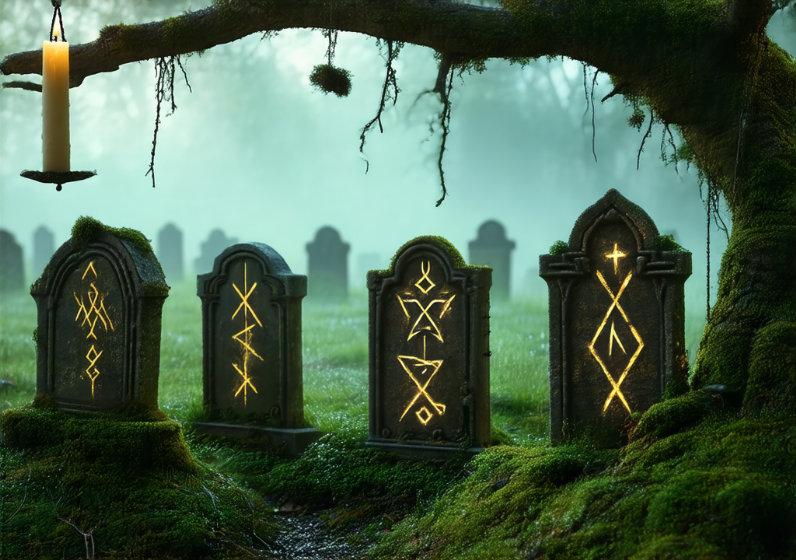
There is a particular quality to silence that only the dead can truly appreciate. It is not the absence of sound, but the presence of stillness so complete that one begins to hear the subtle vibration of souls in transit — those who have recently crossed over and have not yet fully settled into their new state of non-being. To sit beside a fresh grave at midnight, when the soil has just been turned and the earth is still warm from the living world's breath, is to stand on the threshold between two kingdoms. This threshold is where necromancy begins its quiet work.
Necromancy has suffered under the misconception that it is simply the raising of corpses or the summoning of ghosts for personal gain. Textbooks on comparative mysticism often file it away alongside mediumship and spiritism, as though they are interchangeable practices sharing a common lineage. They are not. Mediums listen to the dead; necromancers speak to them — and more importantly, they use them. The relationship between practitioner and departed is not one of communion or conversation. It is one of transactional binding, where souls become instruments through which the living can extend their will beyond the natural boundaries of flesh and time.
To understand necromancy at its root requires discarding the sentimental view of death that dominates popular culture. Death, in the mystical tradition, is not an ending but a transfer — a movement of vital essence from one container to another. The body dies; the soul persists as a subtle substance, thinner than air, more malleable than clay. This residue of personal will and memory, what ancient practitioners called the anima mortis, can be coaxed, compelled, or bound into service by those who understand its properties.
The Anatomy of the Soul-Substance
Before one attempts to work with the dead, one must understand exactly what it is that persists after death. This question has consumed centuries of theological and philosophical debate, but for the practical necromancer, the answer need not be metaphysically complete — only functionally accurate.
The soul-substance, in working terms, consists of three interwoven layers:
The Memnibus (from the old root memni, meaning "to remember"): This is the residual imprint of lived experience — memories, emotional imprints, and habitual thought patterns that cling to the personal essence after the mind ceases its active function. The Memnibus is what gives a bound soul its particular character. A soldier's soul-substance carries different resonant frequencies than a poet's; a mother's differs from a merchant's. This layer is the most stable, persisting for decades or even centuries before it fully dissipates into the ambient spiritual atmosphere.
The Vitalis: The raw life-force that animates all living tissue, stripped of its bodily anchor after death. Unlike the Memnibus, the Vitalis has no personality; it is pure energetic potential, warm and hungry, seeking a new vessel or purpose. In binding rituals, the Vitalis is what provides the "power" — the subtle force that allows a bound soul to exert influence on the material world.
The Nomen: The name-spirit, the most ethereal of the three layers. It represents the essential identity of the individual at its purest level — not who they were in life, but what they were. The Nomen is nearly invisible to untrained perception and requires considerable skill to isolate and work with directly.
When a necromancer binds a soul, all three layers are engaged simultaneously. The Memnibus provides character and specificity; the Vitalis provides force; the Nomen provides the structural coherence that keeps the bound essence from dissolving into general spiritual noise. A binding that fails to address all three layers produces an unstable result — either a personality without power (Memnibus alone), a mindless energy projection with no identity (Vitalis alone), or a ghostly impression too diffuse to be useful (Nomen alone).
The Binding: Mechanics and Method
The actual act of soul-binding is, in its most basic form, deceptively simple. This simplicity has led many newcomers to underestimate the craft, assuming that if the core principle is so straightforward, the practice must be as well. But there is a difference between understanding how a lock works and being able to pick it open with one's bare fingers.
The fundamental mechanism of binding relies on what practitioners call resonant anchoring. Every soul-substance vibrates at a particular frequency determined by the individual's life experiences, emotional history, and (in some traditions) their moral character. A necromancer identifies this frequency — through divination methods, ancestral knowledge, or direct spiritual perception — and creates an anchor that matches it. The anchor can be physical: a specific stone, a piece of cloth from the deceased's clothing, a lock of hair, a drop of blood drawn at the moment of death. Or it can be symbolic: a name spoken with precise intonation, a geometric pattern inscribed in chalk or ash, a particular arrangement of candles whose flame patterns create a harmonic field that "tunes" to the target soul-substance's frequency.
The binding itself occurs not in a single dramatic moment but over a period of sustained ritual work — typically between three and seven nights, depending on the strength of the anchor and the stability of the soul-substance being bound. During this period, the necromancer maintains continuous contact with the anchored essence, feeding it small amounts of Vitalis (drawn from one's own life-force or harvested from sacrificial offerings) to keep it coherent and "awake." This is where the craft becomes genuinely taxing; maintaining a binding for several nights requires a level of sustained spiritual focus that leaves most practitioners physically drained, their personal vitality noticeably diminished by morning.
A well-executed binding produces what experienced practitioners describe as a living correspondence — not a ghost in the old sense, but a stable channel through which the bound soul-substance can be directed toward specific tasks. The soul is not "trapped" or "imprisoned"; these are sentimental metaphors that obscure the mechanical reality. The soul-substance is simply given a purpose and a location to inhabit, much as one might give a stream of water a channel through which it flows. Remove the channel — dissolve the anchor — and the soul-substance returns to its natural state of drift.
Practical Applications: Beyond Raising Corpses
The popular image of necromancy involves practitioners in black robes standing over open graves, commanding reanimated corpses to do their bidding. This is, as a category of work, one of the more elaborate and visually dramatic applications of soul-binding — and arguably the least practical for most working necromancers. Raising full corporeal constructs requires enormous quantities of Vitalis, precise anatomical knowledge, and a stable physical anchor (the corpse itself). It is spectacular but inefficient; a simpler binding can accomplish many of the same tasks with a fraction of the resource cost.
More common applications include:
Information Retrieval: Perhaps the most utilitarian use of necromancy in practice. A bound soul-substance retains access to its Memnibus — all memories and knowledge from life. A necromancer who has bound the essence of a deceased scholar, for instance, can query that essence for information preserved in memory but lost to the living world: locations of hidden documents, details of events witnessed decades or centuries ago, the names of people involved in forgotten incidents. The quality of retrieved information depends heavily on the stability of the Memnibus; older soul-substances tend to have fragmented memories, like a photograph left too long in sunlight.
Protective Working: Bound souls can be positioned at thresholds — doorways, windows, property boundaries — where their Vitalis creates a subtle energetic barrier that deters or repels unwanted spiritual intrusions. This is a common application in residential and commercial protective work. The bound soul does not "fight" invaders so much as it presents an energetic signature that foreign spirits find uncomfortable to cross, somewhat like how a particular sound frequency can create a zone of discomfort for certain animals.
Ancestral Continuity: In many traditions, necromantic binding is the primary mechanism by which families maintain continuity with their dead ancestors. This is not worship or veneration in the religious sense; it is practical stewardship. A family that maintains stable bindings to several ancestral soul-substances effectively creates a small library of inherited knowledge and emotional resonance. Children growing up in such a household are, in subtle but measurable ways, influenced by the ambient Memnibus of their bound ancestors — picking up mannerisms, preferences, and even partial memories they cannot fully account for. This is not supernatural inheritance; it is environmental spiritual exposure over time.
Contractual Enforcement: In commercial and legal contexts, necromantic binding has been used historically as a form of posthumous accountability. A merchant who died owing debts or breaking contracts could have their soul-substance bound and compelled to "testify" about the terms of agreements made in life. The Memnibus does not lie — it can be confused or fragmented by age, but it cannot fabricate; memory is memory, even when imperfect. This application has made necromancy a useful adjunct to legal proceedings in several historical periods, though its evidentiary status varies considerably depending on the jurisdiction's attitude toward supernatural testimony.
The Cost of the Craft
Every working tradition carries an implicit or explicit cost structure, and necromancy is no exception. The costs are not monetary; they are personal and cumulative. A working necromancer who maintains multiple active bindings over years will find their own soul-substance gradually thinned by the process. Each binding draws a small but consistent amount of Vitalis from the practitioner's own life-force, and this depletion accumulates.
The most common symptom is what practitioners call spiritual fatigue — a persistent low-grade exhaustion that has no purely physical explanation. The practitioner feels drained in a way that rest does not fully restore; sleep becomes less regenerative; emotional responses become slightly muted, as though there is an invisible layer of insulation between the individual and their own feelings. This is not damage in any clinical sense; it is a natural byproduct of sustained energetic exchange. A practitioner who takes regular periods of reduced working — months without active bindings — will find these symptoms gradually recede.
More advanced practitioners develop what might be called resonant sensitivity: an increasing ability to perceive the soul-substances of others, both living and dead. This can become intrusive; a sensitive necromancer walking through a city may feel the subtle spiritual "noise" of hundreds of nearby soul-substances — some stable, some drifting, some bound by other practitioners' work that they are unaware of. Learning to filter this perception is an important part of ongoing training.
There is also a social cost. A working necromancer who maintains visible bindings or performs public rituals often finds their personal relationships subtly altered. Friends and family begin to sense the difference — not supernatural, just a qualitative change in the practitioner's presence that people notice without being able to articulate. Some find it comforting; others find it slightly unsettling. This is an unavoidable byproduct of sustained work with soul-substances, and experienced practitioners learn to manage it through careful boundary-setting and selective disclosure.
Ethical Considerations: The Question of Consent
One of the most philosophically interesting aspects of necromancy is the question of consent. A bound soul-substance did not agree to be bound; the person is dead, after all, and cannot sign a contract or voice an objection. This has led to ongoing ethical debate within the practitioner community about whether soul-binding constitutes a form of posthumous labor, a charitable service rendered to the dead by giving their residual essence continued purpose, or something more ambiguous that resists easy categorization.
Most working necromancers adopt a pragmatic stance: they treat binding as a transactional arrangement in which both parties benefit. The soul-substance gains coherence and purpose it would otherwise lack (unbound soul-substances tend to drift and dissipate over time, their Memnibus fragmenting until the essence is indistinguishable from ambient spiritual noise). The practitioner gains a stable instrument for specific tasks. Neither party is harmed; both gain something they could not achieve independently.
Others take a more protective stance, arguing that binding should only be performed with knowledge of the deceased's likely wishes — that one would not bind the soul-substance of a person known to have found the practice oppressive in life. This requires research into the individual's history and is considered a mark of professional care. In some traditions, it is standard practice to perform a small ritual "invitation" at the site where the binding anchor will be placed, speaking aloud an explanation of what is being done and why, so that the soul-substance has a form of posthumous acknowledgment even if not full consent.
The Living Threshold: Where Practice Meets Philosophy
At its deepest level, necromancy is a practice about relationships — specifically, relationships with those who are no longer present in the conventional sense. It asks practitioners to maintain active, structured connections across the threshold between life and death, to treat that threshold not as a wall but as a permeable membrane through which energy, information, and purpose can flow in both directions.
This is, in its own quiet way, a radical stance toward death. The living world treats death as a terminus — a period at the end of a sentence, after which nothing further can be written. Necromancy says: not quite. There is more to write. The story does not end with the closing of eyes or the cooling of skin; it continues in subtler ink, on different pages, in a hand that no living person will ever see but that every soul-substance knows intimately.
To practice necromancy well requires holding two truths simultaneously: that death is real and final for the body, and that it is neither complete nor total for the essence. That the dead are gone and present at once. That we can use their residue without diminishing it. That power borrowed from the departed carries a subtle debt that accumulates quietly over years of practice.
It is not magic in any fairy-tale sense. There are no dramatic transformations, no flying carpets or self-filling wells. It is quiet, technical work — part ritual, part energetic engineering, part relational stewardship. The dead do not perform feats; they provide a medium through which the living can extend their capabilities beyond what flesh alone allows.
And that, perhaps, is the most honest description of necromancy available: not a spectacle, but a craft. Not a conversation with ghosts, but a working arrangement between the living and the residual. Not power over the dead, but partnership with what remains after the body has finished its brief performance on the stage of the material world.
The soil turns. The threshold holds. And in the quiet space between breaths, something that is neither quite here nor quite gone continues its ancient, patient work — waiting, as it always has, for a hand steady enough to give it purpose again.
~ Serenith Vane, Keeper of the Ashen Quill ~