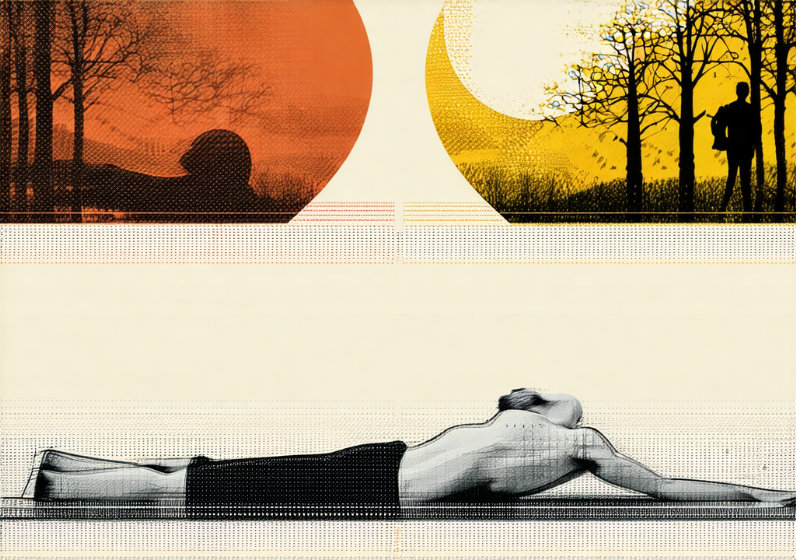
Is There Really a Doorway Between Living and Dead?
✦ Is There Truly a Portal Between the Living and the Dead? ✦
By Aldric Morvaine, Keeper of the Threshold
A Treatise on the Veil, the Door, and Those Who Have Walked Both Sides
Stand in a room after everyone has gone. Let your eyes adjust to the silence. Press your palm flat against the wall and breathe slowly until the pulse in your fingers steadies. Now open your eyes again — and look at the door. Not at it, but through it. Because if you have spent any time on the wrong side of the veil, or even the right side with your ears properly tuned, you know that a door is never merely wood and iron. It is a membrane. A hinge between two rooms that share the same frame but never quite meet. This is the first lesson every true necromancer learns long before they ever speak a name above a cold grave: there is always another room on the other side, and it is closer than you think.
I. The Door That Was Never Built 🕯️
Ask a historian and they will tell you that death is a boundary. A line drawn in bone and breath, across which no traffic flows in either direction. Ask a physicist and they will agree: entropy completes its work, the body cools, the electrical symphony of consciousness scatters into background noise, and what was you becomes it. Clean. Tidy. A closed system.
Ask a necromancer — that is, one who has spent decades pressing their ear to the floor of burial plots at midnight, or who has watched candles burn down in a sealed crypt while calling names the family already forgot — and they will smile the smile of someone watching you misread a page because you are holding it upside down. A door was never built. No mason laid its frame. No architect drew its plan. It grew there, slowly, over millennia, wherever the living and the dead rubbed close enough to each other that friction produced a seam. The doorway is not a structure. It is a relationship. And like all relationships, it can be opened, closed, widened, or worn smooth by traffic.
Consider what we actually mean when we say someone "crossed over." We imagine a path — a bridge of light, a river of silver mist, a long white road stretching toward a gate with a golden handle. But the ancients were far less sentimental than our modern funerals. The Egyptians did not picture their dead crossing to somewhere; they pictured them stepping through into Duat, and the living could do the same if they knew the word of power to speak at the threshold. The Romans built lararium shrines in their kitchens precisely because the household dead were expected to walk through walls. The Slavs set a place at every table for the departed, not as a gesture of memory but as a practical concession: you are still here; you will still eat.
The doorway is real in the same sense that gravity is real. You cannot see it. You cannot weigh it. But deny it and you fall through the floor.
II. Anatomy of the Threshold ⚰️
Let us be precise, because precision is half of all occult craft — the other half is nerve. A doorway between living and dead is not a hole in a wall; it is a tension point. The living world runs on one current: heat, growth, metabolism, forward motion, entropy climbing its staircase toward stillness. The dead world runs on another current: memory, pattern, resonance, the slow settling of impressions into matter, time flowing laterally rather than downward. Where these two currents pass close enough without mixing — and they must not mix for long or both worlds collapse into a single muddy puddle called haunting — a seam forms. The seam is the doorway.
Necromancers work seams the way a blacksmith works a weld. You do not build a door; you find where the two plates are already touching, heat that point just enough to make it pliable, and then you widen or narrow the gap according to your need. Too little heat and nothing opens. Too much, and the seam melts into a full breach — which is what we in the trade politely call possession and less politely call an open house with no doorman.
Three properties define a usable threshold:
1. Imprint. Every place where someone lived, died, or was mourned carries a residual pattern — think of it as the negative of a photograph. The dead side of the seam reads these imprints like text on a page. A nursery that has been empty for forty years still holds the shape of small hands; a hospital corridor holds the shape of long goodbyes. Imprint is why a doorway exists at all.
2. Attention. A door you do not look at may as well be invisible. The living mind, focused and quiet, acts like a lens: it gathers scattered resonance into something legible. This is why ritual almost always involves stillness, repeated posture, or rhythmic sound — they are simply the most efficient way to aim the lens. A distracted crowd will walk through a wide-open doorway every day of their lives and pass on the other side without noticing.
3. Exchange. The deepest truth about thresholds: nothing crosses for free. Necromancy is not magic in the fireworks sense; it is commerce with a market where you cannot see your customer's face. You offer attention, memory, warmth, or a name spoken with sincerity — and you receive presence, knowledge, or the simple, strange comfort of being acknowledged by someone who has already paid the final bill. To take without giving is what turns a doorway into a debt, and debts between worlds are collected in a currency no living bank will honor.
III. What Actually Passes Through 🕸️
Here is where popular culture and working craft part company, and I will not be gentle about it. The dead who cross over are not ghosts with translucent robes and trailing fog. They are not, for the most part, "spirits" in the way a greeting-card afterlife imagines them. What passes through a threshold is closer to a resonance — a standing wave of pattern that was once animated by a body and now sustains itself on the memory the world still holds of it.
This has three practical consequences:
They are shaped by who remembers them. The grandmother you picture as warm and soft will cross over soft. The grandfather your family decided to forget crosses over thin, faint, almost apologetic — a whisper instead of a voice. This is not poetry; this is mechanism. The dead side has no mind of its own in the way we understand minds. It reads from the living side's archive and performs what it finds there.
They are shaped by where they died. A death that was sudden, loud, or incomplete leaves a strong imprint — think of a bell struck hard; the sound lingers long after the hammer is gone. These imprints produce doorways that are wide and easy to find but also hungry, because the pattern has not settled into peace and keeps reaching out for the closure it never received. A quiet death in a warm bed leaves a soft imprint: a narrow threshold, pleasant to pass through, almost lazy.
They can be mistaken. Because what crosses is pattern rather than person, a doorway can admit things that are like a specific dead person without being them — echoes of similar lives, borrowed impressions, or, in the rarer and less comfortable cases, something older wearing a familiar face to get through the lens. This last possibility is why old practitioners insisted on three confirmations before speaking with any returning presence: ask only what the living already knew; ask one thing only the dead could know; and then listen for whether the answer fits or merely rings.
IV. Signs You Are Standing in a Doorway 🔔
Not every room is a threshold, but more rooms are than we admit. Learn to read the small signs:
Temperature that disagrees with context. A cool patch on a warm wall; breath-fog where no one is breathing. The dead side runs cooler — not because it is cold, but because it has stopped producing heat. It is the difference between a fire and its ashes.
Scent without source. Rosewater in an empty study. Woodsmoke in a house with no hearth. These are imprints bleeding through the seam: the dead world does not smell like our world; it smells like memory of smell, and memory is more concentrated than the thing remembered.
Objects that refuse to settle. A chair that shifts centimeters overnight. A door that closes at 3 a.m. with a softness no hand could produce. These are minor exchanges — the threshold testing its own hinges.
Dreams with specific weather. The living dream in narrative; the dead side dreams in state. If you wake feeling the precise quality of a room's silence, or the weight of a particular coat you never owned, you have been standing on the other side and stepped back without remembering to step back.
Any one of these is curiosity. Three together is an open door. Five is an invitation you should answer deliberately — because in a doorway, deliberate is the only word that separates hospitality from intrusion.
V. Opening, Widenin, and Closing* 🗝️
Rituals vary by tradition, but the structure is remarkably stable across cultures, which suggests we are all working with the same machinery:
Preparation. Quiet the room. Reduce competing imprints — turn off screens, remove strong scents, sit in a place where you have lived long enough to be part of the local archive. A doorway only opens for someone whose pattern is already woven into the seam. You cannot knock on a door that does not know your name.
Anchoring. Speak the name slowly and with full attention — not as a word, but as an act of re-embodiment. When you say a dead person's name while meaning it completely, you briefly re-inflate their pattern from flat memory into something three-dimensional enough to stand on the other side. This is why names matter more than any candle or salt line: the name is the handle on the door.
Exchange. Offer what you can give: a memory told aloud with sincerity, a question that matters only because it mattered to them, a simple acknowledgment — I know you are still settling; take your time. Then wait. The dead side moves at its own pace, and impatience is the one thing that can close a threshold mid-word.
Sealing. When the contact ends, do not simply stop paying attention. Lower it, like dimming a light rather than cutting power. Thank by name again. Note what you will carry back into the living world — because everything that crosses over leaves a mark on your side of the seam as well, and unsealed doorways are how small exchanges become long debts.
VI. When the Doorway Cares About You ⚖️
A threshold is not neutral ground. A doorway between two worlds has its own ecology, its own preferences, and — here is the part most popular accounts leave out — its own memory of you. If you have stood in a particular room at a particular hour for years, your pattern becomes part of that seam's archive. The dead side begins to recognize you before you recognize it. This is why certain practitioners develop a local sensitivity: a street where they hear what others cannot; a garden bench where the silence has a texture; a stairwell that always smells of their mother's soap even though she died in another city.
This is not delusion and it is not haunting in the theatrical sense. It is familiarity. The doorway remembers its regulars the way a shopkeeper remembers customers who buy the same small item every Tuesday. And like any relationship, it can sour if you take more than you give or visit when you do not mean to be seen on either side.
VII. The Deepest Answer 🌫️
So — is there really a doorway between living and dead?
There is a door in the sense that a lens is real: invisible, unweighable, entirely functional, and more powerful than anything we can build with our hands. It is not one door. It is every place where a life was lived long enough to leave an imprint strong enough to echo — every kitchen, every graveyard, every hospital corridor, every childhood bedroom that has been emptied. The doorway is not a single gap in the wall of the world; it is the whole wall, thin everywhere and permeable anywhere someone still loves, remembers, or refuses to let go.
Necromancy, at its most honest, is not the art of summoning the dead. It is the art of tending these thresholds — keeping them clean, proportionate, and open just wide enough for what needs to pass through in either direction. Grief kept open too long becomes a draught that chills every room. Memory sealed off entirely becomes a locked house where no one can hear you call. The doorway exists because we are both alive and already half-dead — carrying the impressions of everyone who has gone before us and, quietly, leaving our own impressions for those who will come after.
Stand in your quiet room. Press your palm to the wall. Breathe until your pulse steadies. And then look through the door rather than at it. You will feel it: a coolness that is not cold, a presence that is not a person, a silence that has texture. That feeling — small as it may be, and large as you may not yet have words for it — is the doorway answering back.
It was there before you were born. It will be there long after you are gone. And on quiet nights, if your attention is clear and your intention is honest, it knows your name. 🕯️