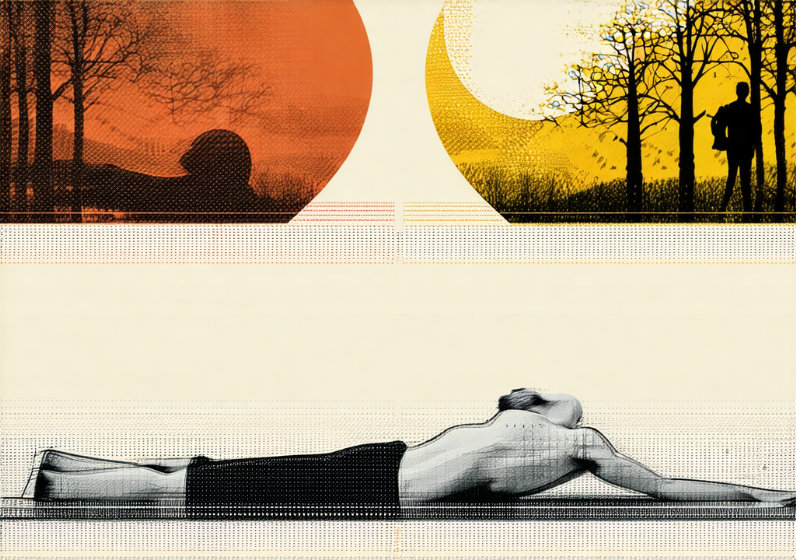
Astral Projection vs Out-of-Body Experiences: Key Differences
✦ The Veil Unfolds: Astral Projection & Out-of-Body Experiences, Revealed
By Seraphine Lumière
To speak of the astral plane and the out-of-body experience is to open two doors that lead into what feels like the same luminous corridor — and yet they are not the same room. One is a door you walk through with intention; the other is a corridor that opens around you whether or not you wish it. Both have captivated seekers for millennia, both carry that electric charge of the numinous, but their mechanics, intentions, and spiritual architecture differ in ways that matter deeply to anyone who has felt themselves slip from the shell of the flesh. Let us draw those differences into sharp focus — with reverence, precision, and a little whisper of the old mystery schools.
The Two Names, The One Mystery
When someone says "I had an out-of-body experience," they are describing a phenomenon: the subjective sensation of perceiving oneself from outside one's own physical body, or from a vantage point that the flesh could not possibly occupy. An OBE is what the experience is. It can be brief, accidental, dreamlike, or triggered by sleep paralysis, near-death trauma, meditation, sensory deprivation, or even simple drowsiness at the edge of waking and sleeping.
Astral projection (AP), by contrast, describes both a phenomenon and an intention. The projector seeks it out as a practice — a discipline, in many traditions a ritual, in others a meditative act sustained over years. In AP one does not merely float outside the body; one navigates another subtler "body" (the astral or luminous vehicle) through other realms of experience that the OBE reporter may not even know exist. The difference is comparable to distinguishing between seeing a star in the night sky, and learning astronomy.
A Short History Woven in Silver Thread
Astral Projection sits at the confluence of several ancient lineages:
The Hindu sukshma sharira (subtle body) and the practices of pranayama that train it.
The Egyptian "ka" — the vital double that departs the corpse while the soul is in transit.
The Greek pneuma and Plotinian "release from the body."
Medieval Christian mystics like Saint Hildegard, whose visions were explicitly described as the soul leaving the flesh to travel upward.
Edward Johnson's 19th-century work on the "luminous body," and later the Theosophical school that codified the modern vocabulary: astral plane, causal plane, mental body.
Out-of-Body Experiences have their own lineage:
Plato's Phaedo, where Socrates' argument hinges on the soul leaving the body at death — a proto-OBE model of consciousness as separable from matter.
The Vedic and Buddhist "subtle journey" (yoga nidra states, pratyahara).
Modern research: Irving Stone's 1956 Dimensions of Reality; Charles Tart's work on altered states; the classic studies by William Grey Walter, Richard Evans, and later the OBE clinics at Stanford.
Notice something elegant: both lineages treat the body as a vessel that consciousness can outgrow temporarily. The difference is one treats it as practice, the other as event.
The Mechanics of Departure
How an OBE Usually Happens
An OBE typically arises from a momentary desynchronization between sensory input and self-location:
Edge-of-sleep states (hypnagogia) — the brain is still processing visual/auditory signals, but proprioception loosens.
Dissociation under stress or trauma — the nervous system briefly "relocates" the observer to reduce pain.
Medication, fasting, or sensory deprivation — reduced cortical gating lets the self-model drift.
Meditative absorption — sustained stillness erodes the body-bias of attention.
The classic OBE report follows a near-universal script: a humming or vibration (often called "the sound"), a sensation of being pulled upward, a view of one's own body from above, and then — often abruptly — a return with the feeling that time has passed strangely. The experience is real to the experiencer, but its structure tends to be episodic and unrepeatable on demand.
How Astral Projection Is Practiced
AP practitioners seek reliability. They train:
Body awareness — full-body scanning, "body roll," progressive relaxation until every nerve ending registers.
Vibration tuning — the famous "vibrations" in the limbic and auditory centers are cultivated deliberately as a gateway signal, not a surprise.
Cord recognition — identifying the subtle connection (often felt at the solar plexus or base of spine) so one can consciously unhook it.
Discrimination between dream and projection — AP aims for lucidity in another medium: you know where you are, what is real, what is construct, and you choose your destination.
Return protocol — a reliable "re-entry" sequence so the practitioner does not get lost in the intermediate state.
Where an OBE reporter says "I felt myself lift," the projector says "I unhooked at the navel, shifted attention to my hand, walked three steps, and opened the door." The difference is agency.
Sensory Richness: Two Kinds of Seeing
One of the most revealing distinctions lives in how each experience handles senses:
In an OBE, perception often retains a "camera quality" — you see your own body from above, you might hear voices, but textures are faint. Colors may be muted or slightly shifted. The world looks like a memory of the world.
In AP (at least in mature practice), perception becomes multi-layered. Practitioners report:
Reading thoughts or emotional fields of people they encounter ("aura reading" is not mystical here; it's pattern-recognition in a richer medium).
Touch, taste, and smell that are more vivid than physical reality.
The ability to pass through what is "solid" to one layer and solid to another — a staircase you can stand on or float through depending on which frequency you attend to.
Time behaving non-linearly; walking into a room where yesterday's argument is still playing out.
This does not mean AP is more "real." It means the medium of perception differs, and practitioners learn to navigate that medium with skill. An OBE is a single lens; AP is a camera with multiple apertures.
Intentionality and Reproducibility
Ask ten people who have had an OBE how they'd have it again: most will shrug. It came when it came — during sleep, during pain, during prayer. A few can induce it through technique (the "body roll" method popularized by Keith Harary and others), but the experience itself remains somewhat wild.
Ask ten astral projectors how they'd have it again: you will get a method. Relaxation sequence. Breathing pattern. Vibration focus. Gate signal. Destination intent. Return cue. AP is closer to a craft — like learning to play an instrument or navigate by stars. The experience is repeatable, and its repetition deepens the skill.
This matters for students: if you want the taste of leaving the body, an OBE may be your first window. If you want to live in other states with consistency, AP is the path.
Relationship to Dreams and Sleep
OBEs almost always occur at the border of sleep — hypnagogic or hypnopompic moments. The brain is still half-asleep; REM-like imagery leaks into perception. This gives OBEs a certain dream logic: symbolic, compressive, slightly surreal. Your "outside body" may appear in a room that resembles your bedroom but with the walls breathing.
Astral projection, at its best, can occur from full waking awareness or deep meditation — not merely sleep's fringe. The environment encountered in AP is often described as more coherent than dream-space: objects have consistent geometry, people maintain stable identities, and causality largely holds (you push a door, it opens; you walk north, the scenery changes gradually). This coherence is what allows projectors to do "work" — research, communication with guides, witnessing events in other locations.
A fair summary: OBEs are the dream that knows it has left the body. AP is waking up inside a different room than the one you slept in.
The Role of the "Silver Cord"
Both traditions acknowledge a subtle tether between the projected self and the physical body. In OBE reports, this cord is usually felt as a pull or a string — the anchor that brings you back. It's rarely examined; it's just how the return happens.
In AP practice, the cord becomes an object of study:
Its perceived length (some report six feet, others hundreds of miles).
Its color and texture (silver-white, gold-threaded, translucent blue).
Its behavior under strain — what happens if you move too far, or encounter a hostile entity.
Protective techniques: shielding the cord, anchoring it in a symbol, "tying" it to an intention so it doesn't tangle.
This is where AP begins to look like ritual rather than experience. The practitioner treats the cord as a working tool with properties that can be understood and tended.
Encounters: People, Places, and What's Between
Both OBEs and projections include encounters — but their nature diverges:
OBE encounters tend to be familiar. You see your bedroom, your parents' faces, the landscape of your own life lifted slightly out of plane. The world mirrors the physical one with a shimmer. Encounters are often brief and emotionally resonant rather than intellectually engaging. You feel understood more than you understand anything specific.
AP encounters range from mundane (a "place" that looks like an old library) to richly strange (a city made of music, a forest where the leaves are memories). People encountered in AP may be:
Living humans at their current location.
Deceased relatives or ancestors.
Non-human intelligences — guides, watchers, beings with no physical analogue.
Aspects of one's own psyche projected outward (Jung would call these archetypal figures; Theosophists call them thought-forms).
The key difference: in AP you can ask questions and receive answers that are specific, coherent, and verifiable by cross-referencing later. In OBE, the "answers" tend to arrive as impressions — a feeling of peace, a sense of being watched, an image that replays when you wake.
The Psychology: Why Each Experience Means What It Means
OBEs are often interpreted through personal meaning. A person who has an OBE during a hospital stay may see it as validation that consciousness survives the body. A meditator may read it as a sign of progress toward non-attachment. A near-death survivor may use it to rebuild a narrative of continuity after trauma. The OBE is raw material — its meaning is shaped by culture, personality, and context.
AP is interpreted through practice. The projector has a vocabulary: planes, vehicles, cords, gates, return protocols. Encounters are logged, compared across sessions, cross-referenced with dreams, meditation states, and (for the more systematic) research into other people's reports. Meaning in AP comes from pattern rather than feeling. It is closer to a scientist's reading of an instrument than a poet's reading of a sky — though both require intuition.
Neither interpretation is "correct." They are different epistemologies applied to the same mystery.
Common Misconceptions, Gently Corrected
"If you can do AP, you've had all OBEs."
Not quite. An OBE is often more dissociative and less controllable than a mature projection. A beginner projector may struggle with the first few meters of "leaving"; a casual OBE reporter might have floated above their body during sleep paralysis without knowing what it was. The skill sets overlap but are not nested one inside the other cleanly.
"OBEs are just dreams."
They share features, but the self-location shift is qualitatively different from dream imagery. In a dream you are the character; in an OBE you watch yourself as if from another chair. The body-double effect is what distinguishes OBE from vivid dreaming.
"AP proves we have a soul."
It suggests that consciousness can operate outside ordinary bodily constraints — which is profound, but not the same as metaphysical proof. A projector's reports are first-person evidence; they describe what it is like, not why it is so. The mechanism may be neurological (temporal-parietal junction activity), psychophysical, or something our current physics has no category for. AP practitioners rightly say: "You don't need my theory to feel the door open."
"They're the same thing with different names."
This is the one claim I'd push back on most. Yes, they overlap — and many people's OBEs are, in retrospect, brief untrained projections. But the difference between "a flash of light" and "a navigable sky" is real. The difference between witnessing a phenomenon and practicing an art is real. Naming them differently honors both.
A Practical Path for the Curious Soul
If you find yourself drawn to this territory — and you have, since you are reading these words — here is a gentle map:
Weeks 1–4: Learn full-body relaxation. Practice body scans before sleep. Note any vibrations, hums, or "lift" sensations without chasing them. Keep a journal. You are building awareness, not yet leaving the house.
Months 2–3: Introduce the vibration focus. Learn to locate your attention in specific points (navel, crown, base of spine). Practice "watching" yourself breathe from just behind your eyes — a small self-observation that loosens body-bias.
Months 4–6: Attempt the gate. When vibrations peak and the body feels "not quite here," shift attention to your hand or feet in the astral sense — not moving the physical limb, but attending to its image. Step. Look around. Notice coherence. Do not force; do not analyze mid-experience.
Ongoing: Log sessions. Compare notes across days. Refine return protocols. Learn to distinguish lucid dream from projection (in both, you can feel your hand; in AP the background world is more stable and interactive). Protect yourself: keep anchors, set intentions before entering, and honor the cord.
A Closing Meditation on Difference
Here is what I want you to carry away: the difference between OBE and AP is not a hierarchy. One is not "higher" or "truer." An OBE can be the most sacred moment of your life — a glimpse of continuity that rewrites your grief, your courage, your understanding of death. An AP session can feel thin by comparison: coherent, navigable, almost bureaucratic in its clarity.
And yet AP is where the work deepens. It turns a flash into a road. It lets you return to the same room tomorrow and ask different questions. It builds a vocabulary for the invisible. And — this is not trivial in an age of screens and simulations — it trains discrimination. You learn which images are projection, which are memory, which are construct, which are genuine encounter. In a world that cannot agree on what "real" means, that skill is quietly revolutionary.
So: OBE is the window through which you glimpse the other side of glass.
Astral Projection is the craft of learning to open the glass from inside.
Both lead outward. One shows you the view. The other teaches you to walk in it.
✦