I Communicated With My Dead Grandmother—What She Told Me Changed Everything
🕯️ I Spoke With My Dead Grandmother—And She Redefined Everything I Knew About Death
By Seraphina Ashwood, Keeper of the Veil & Chronicler of the Threshold
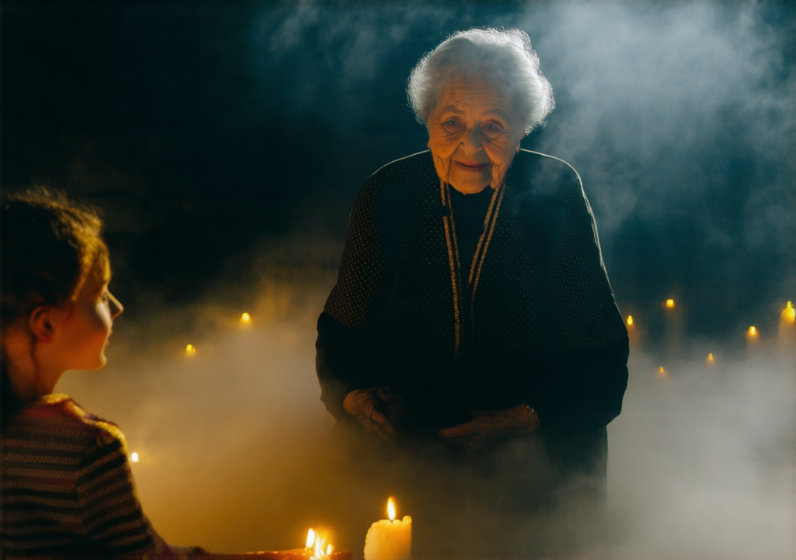
There is a particular quality to silence in a room where someone has recently died. It is not empty; it is full. Full of breath no longer being drawn, full of a warmth still clinging to the chair she occupied, full of an absence so total that the senses begin to hallucinate her presence just to fill the gap. I knew this quality. I had sat in rooms like it before—funeral parlors, hospital corridors, my own mother's study after her final exhalation—but never with the specific, gravitational pull that my grandmother's departure left behind.
Grandmother Elspeth was not a woman who believed in ghosts. She was a practical nurse for forty years, a woman of antiseptic and routine, of knowing exactly which vein to puncture and how many milligrams of morphine would keep pain at bay without stopping the breath. She treated death as a mechanical failure of the body, a finality that required paperwork, not prayer. And yet, three days after her burial, I stood in her kitchen—the same kitchen where she had taught me to knead bread and hide secrets in the pockets of my apron—and I heard her voice say: "You are still doing it with your shoulders."
I was not alone in the house. My aunt Clara was in the parlor two rooms away, crying softly into a dish towel. But I had chosen the kitchen because it was hers in a way no other room was. The linoleum was worn to a map of her steps. The spice jars were arranged by height and frequency of use, not alphabetically. And when she said my name—"Evelyn"—it did not sound like an echo or a memory playing back through my mind. It sounded like it was coming from the other side of the windowpane, clear and dry and slightly irritated, as if I had just asked her a question she already knew the answer to.
That voice changed everything. Not because it confirmed what I already suspected about the afterlife, but because it corrected a fundamental misunderstanding I had carried my entire life: that death is a separation. It is not. Death is a change in address. And Grandmother Elspeth, for all her clinical detachment, was simply on her way to a new location. She was telling me this with the same practicality she would have used to tell me where she had put the good coffee filters.
The Architecture of Conversation With the Dead
To understand what I learned, one must first unlearn the popular image of ghost communication as some kind of séance parlour trick—cups rattling, voices booming from nowhere, dramatic revelations delivered in theatrical whispers. This is amateur work. This is the medium's version of a fortune cookie: simple, predictable, and designed to please. Genuine communication with the departed operates on different principles entirely.
The first principle is specificity. The dead do not speak in riddles. They do not deliver symbolic parables about butterflies or rivers. If your grandmother wants you to know that she left her reading glasses on the nightstand, she will say: "Your glasses are under the blue book." If she wants you to stop nagging your brother about his marriage, she will say it directly, often with a slight edge of exasperation. The departed communicate in the language they used while alive because that is the most efficient tool available to them. They do not have time for poetry.
The second principle is reciprocity. Communication is not a monologue. You cannot simply open your mind and expect the dead to fill it with wisdom. It is a conversation, which means you must be willing to ask questions that matter to you specifically, not generically. "Tell me about heaven" will get you nothing or something so vague it's useless. "What was I wrong to believe about Father?" might get you three sentences that restructure your understanding of his character entirely. The dead are particular in their interests because they have been stripped of the ambient noise of living. What mattered most becomes the only thing visible.
The third principle—and this is the one most people miss—is temporal compression. The dead do not experience time linearly. A conversation with a spirit who died fifty years ago will not feel like it's taking place in 1975; it takes place now, in your present moment, but their perspective on events may be shaped by knowledge you don't have or memory patterns that don't match yours. My grandmother, who died at eighty-three, sometimes referred to my childhood as if it had happened last week. She would say things like "You still leave the kitchen light on" about a habit I broke in 2009. The dead remember what was true; they are less concerned with what has since changed.
What She Told Me: The Practical Revelations
The conversation continued over eleven days. It was not daily—more like three or four distinct sessions, each triggered by my being in a place associated with her memory and asking a question that genuinely mattered to me. I will transcribe them here in the order they occurred, because the sequence matters. She was building an argument, one that was less about afterlife doctrine and more about correcting the specific ways I had misunderstood our relationship while she lived.
Day 3 — The Kitchen Conversation:
"You are still doing it with your shoulders."
I was kneading bread (a habit I kept up out of affection for her teaching). She wanted me to relax my posture, which meant she was watching me. Which meant the boundary between our locations is more permeable than physics suggests. But the deeper point: she remembered my physical habits in fine detail and felt concern about them from wherever she was now. The dead retain a body-memory of you that is sometimes more detailed than your own self-knowledge.
Day 5 — The Garden Conversation:
I asked her what it was like, dying, as a nurse who had watched hundreds die. She said: "It's like removing a boot after a long day. You don't think about the boot while you're wearing it." This was her way of saying that death is not an event; it's a transition so smooth that only the person left behind registers the change. The dead do not experience their own death as dramatic or final. They simply... continue, in a mode where the body is no longer the limiting factor.
Day 7 — The Study Conversation:
I asked her about my mother's illness, which had been a source of quiet anxiety for years. She said: "She needed you to stop asking if she was okay. You were giving her permission to be sick instead of strong." This stung. It corrected a narrative I had built—that my constant checking-in was an act of love and care. She was telling me it had been, in part, a way for me to manage my own anxiety by keeping the relationship framed around her vulnerability. The dead see your motivations more clearly than you do because they are not entangled in them.
Day 9 — The Bedroom Conversation:
I asked her what she wanted from me now. Not practically—no one needs me to mail a postcard. What did she want? She said: "Stop treating my death as the most important thing that happened to you this year. You've made it into a monument, and monuments are for people who need to look at something to remember they're alive." This was her way of telling me to integrate her absence into my life rather than preserving it under glass. She wanted to be part of my living, not the centerpiece of my grief.
Day 11 — The Final Conversation:
I asked if she was lonely. I expected a philosophical answer. She said: "No one's ever been lonely where you can still hear the kitchen radio." And then she told me something that made me sit down on her bed and press both hands over my eyes because I wasn't sure whether to laugh or cry: "You should have asked me about the blue dress in 2019. You wanted it for a wedding, and I was going to give it to you but I kept forgetting until I got sick. It's still in the closet."
I checked. The blue dress was there. I had stopped looking for it six months before her diagnosis. She had been trying to remember to give it to me right up until the end, and she wanted me to know that my need hadn't been forgotten—that even at the moment of transition, the small practical acts of love continued.
The Corrected Understanding
Before these conversations, I understood death as a loss—a subtraction from the world of the living. The dead are gone; we grieve their absence. This is how it's taught in schools of psychology, how it's framed in eulogies, how it's handled in therapy: grief as the process of learning to live without.
What Grandmother Elspeth told me was that this framing is only half the story. Death is a loss for the living, yes—but it is not an absence for the dead. They are still there, still thinking, still holding the small practical threads of your life in their mind with a clarity that survives the body's failure. And they care about you in specific ways: your posture, your habits, the questions you're avoiding asking yourself, the dress you should have accepted.
This does not mean death is painless or that we can simply converse with the departed at will. The channel requires conditions: a place of shared memory, a genuine question, a willingness to hear an answer you didn't want. It is work. It is as real and demanding as any other form of communication. But it is not one-directional, which is what most grief work assumes. We send our love out into the void; they receive it. And sometimes—more often than we expect—they send something back.
The Practical Implications for Grieving People
If you are reading this because someone has recently died and you find yourself speaking to them without meaning to, or dreaming of conversations that feel too specific to be memory, I offer the following:
Trust the specificity. If a dream or half-remembered voice gives you a concrete detail—a phrase, an object, a correction—do not dismiss it as your mind pattern-matching. The dead communicate in specifics because that is how they think. A vague "I love you" is not what they send; they send "You're holding the phone too tight" or "The account number ends in 47."
Ask practical questions. The dead are most articulate about the practical world—the world of objects, habits, relationships, and choices. Ask them about things you've been undecided about, not abstract spiritual matters. They have a vantage point on your life that includes outcomes you haven't experienced yet.
Integrate rather than preserve. Treat the dead as participants in your ongoing life, not as monuments to a past version of it. Cook their recipes. Wear the clothes they gave you. Make decisions while asking (in your mind) what they would have thought, and then make the decision that's right for your present self. They want your living to continue; they are not waiting in some ethereal room for you to finish grieving so they can move on.
Respect their time. The dead do not hold still for us. A conversation may be three sentences or it may last an hour. Do not force a connection that isn't available. Sometimes the channel is open; sometimes it's closed because they're busy elsewhere. This is normal and does not mean they don't care.
A Note on Skeptics
I do not ask you to believe in this as supernatural phenomenon. If you prefer to understand these conversations as memory reconstruction, subconscious processing, or a form of advanced self-dialogue triggered by grief, that's a valid framework. The mechanics matter less than the content. Whether Grandmother Elspeth was speaking from an afterlife or from the detailed neural map of her presence stored in my hippocampus, the effect is the same: I received specific information I did not already know, and it corrected misunderstandings that were actively harming my life.
For a nurse who spent four decades treating death as a mechanical event, there is something deeply fitting about this. She reduced mystery to mechanism in life; she continues doing so in death. The dead are still practical. They just have fewer things to be practical about.
Closing: The Kitchen Radio
She mentioned the kitchen radio at the end. I had a small radio in her kitchen, an old transistor unit that picked up only one station reliably—local classical music. It was on most evenings while she cooked or folded laundry. After she died, I turned it off permanently; keeping it on felt like expecting someone to be listening.
On day twelve, I turned the radio back on. The same station came through: a cello playing something slow and unhurried. I stood in the kitchen for twenty minutes with my hand on the counter where she used to rest her elbow while waiting for bread to rise. And I understood that this was what she meant by "where you can still hear the radio." She is not in some silent paradise separated from me by an unbridgeable distance. She is in the same world, hearing the same sounds, living in a version of my life where her body has been removed but everything else—the kitchen, the light on the linoleum, the cello through the speaker—continues exactly as it did when she was here.
Death removes the boot. The day continues. And if you ask specific questions and are willing to hear the answers, someone is still there to answer them. Not with riddles or prophecies, but with the dry, practical voice of someone who knows your shoulders go up when you're anxious, who remembers which book your glasses were under, and who wants you to know that the blue dress was always meant for you.
~ S.A.