How to Perform Your First Necromancy Ritual (Even If You're No Witch)
🕯️ How to Perform Your First Necromancy Ritual
(Even If You’re Not a Witch)
✍️ By Thessaly Vane, Arcanum of the Silent Threshold
Let us dispel the first illusion: you do not need to be a witch.
Not in the modern, Instagrammable sense—no crystal-strewn altar, no moon-phase chart pinned above your kitchen counter, no lavender-smoke ambience that smells like a boutique hotel lobby. What you need is something older than aesthetics. You need willingness. A willingness to stand at the threshold between two worlds—the one made of flesh and the one made of memory—and to speak to the dead with enough sincerity that they lean in to listen.
Necromancy, for the uninitiated, is often painted as something sinister. A candlelit séance where a medium floats above her chair. A seance circle in a Victorian parlor where spirits rattle chains and whisper riddles. A Halloween special. And while none of those are wrong, they are all… decorative. Surface-level. The kind of necromancy you’d find on a fortune teller’s card at a county fair: “Ask the Dead! $20/session!”
True necromancy is quieter than that. It is more intimate. It is not about summoning ghosts for spectacle. It is about reaching out. About creating a bridge—temporary, fragile, glowing like firefly-light in a dark field—that allows you to communicate with someone who has crossed over. And yes, you can do this on your own. In your living room. With a candle and a quiet hour. No robes required. No silver bells. Just you, the dead, and an open mind.
This is how you begin.
🕸️ I. Understanding What Necromancy Actually Is
Before you light any candles or arrange your crystals in a sacred geometry, take a moment to understand what necromancy truly is at its core—because the word itself carries centuries of cultural baggage that can cloud the practice.
The word comes from Greek: nekros (dead) and kanō (to rule, to direct). So literally, “ruling over the dead.” But this doesn’t mean you’re commanding ghosts like a general barking orders at soldiers. It’s more about organizing contact. Creating conditions under which communication with the departed becomes possible.
In ancient Egyptian practice, necromancy was closely tied to the afterlife rites—the Book of the Dead itself is essentially a set of instructions for navigating the dead-world. In Greek tradition, heroes like Odysseus and Orpheus journeyed into the Underworld to speak with the dead, often using blood offerings (a practice we’ll revisit). In medieval Europe, necromancy was sometimes viewed with suspicion—closer to sorcery than prayer—but it remained a recognized discipline among scholars of natural philosophy.
Here’s what matters for you: Necromancy is not divination. You’re not asking “what will happen in my love life?” or “will I pass this exam?” (though you can ask those questions to the dead, if they know). Necromancy is about connection. About reaching someone specific. Your grandmother who passed three years ago. A friend who left this world too young. A historical figure whose work shaped your own path. Or—this is important even for beginners—you can practice necromantic communion with any being that has crossed the threshold. You don’t need a personal relationship with the dead person to speak with them, though it helps.
Think of necromancy less like a séance and more like writing a letter to someone who lives in another country. You address it, you seal it, you mail it—and then you wait. Sometimes they write back quickly. Sometimes not at all. But the act of writing is its own form of connection.
🕯️ II. Preparing Your Space: The Altar of Threshold
You do not need an elaborate altar. You do not need obsidian, amethyst, or a $200 crystal geode from Etsy. You need intention. And you need things that anchor your senses so that when the subtle shift happens—when the room changes in temperature, when the air feels different, when you feel a presence at your shoulder—you don’t panic and break the moment by jumping up and saying “oh my God is that you?”
Here’s what I recommend for your first ritual:
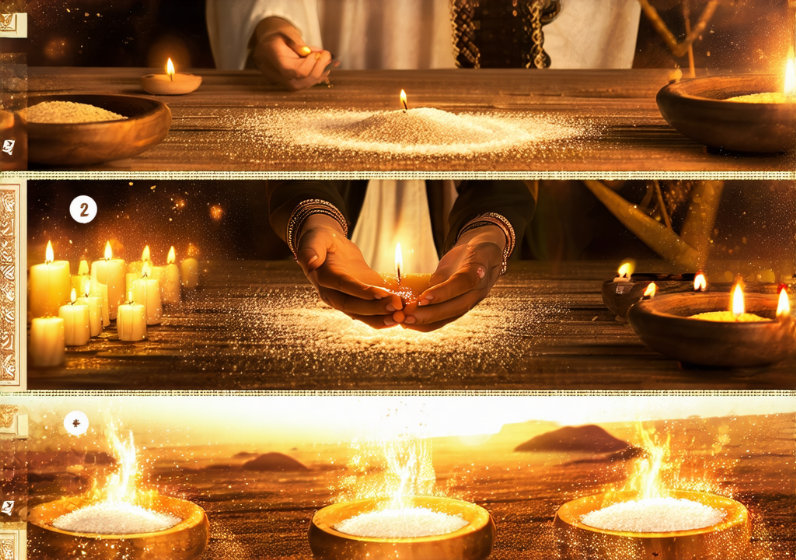
1. A candle. White or amber-colored wax. The flame is a classic threshold marker—it burns between earth (wax) and sky (fire), which is poetically perfect for a practice about crossing boundaries. Light it at the start of your ritual. Let it burn throughout. Do not extinguish it until you formally close the circle.
2. A small bowl of water. Not fancy, not filtered, not from a sacred spring (though if you have that, use it). Tap water is fine. Water represents memory, emotion, and the fluidity between states. When you pour a little on the floor or into a dish before starting, you’re symbolically washing away your own noise so the dead can be heard.
3. Salt. A small pinch or a spoonful. Place it near the candle or in a small dish beside your work area. Salt is a boundary-keeper in many traditions—it creates a clean line between here and there. If you feel uneasy during the ritual, look at the salt. It’s your anchor to this world.
4. A pen and paper. You will want to write down what happens. Not because you’re keeping a journal for an audience, but because the subtle details—how the candle flickered, where you felt pressure on your shoulder, the exact moment the room went cold—are often more meaningful than any grand vision or voice. The dead rarely speak in full sentences (unless they’re very theatrical). They communicate through sensation, image, word-fragments, and shifts in atmosphere. Write it all down.
5. A photograph. If you are speaking with a specific person—a grandmother, a friend, a mentor—bring a photo of them. Not a printed Instagram selfie. An actual photograph or picture. Something that carries their likeness in physical form. Place it face-up near your candle. This gives the dead a handle to grab onto. A point of contact.
6. Optional: incense. If you use incense, choose something with a clear, clean scent—frankincense, myrrh, or simple white sage. Avoid heavy perfumed varieties. You want clarity, not a spa experience. Light it before the candle, so the smoke rises and settles into the upper air of your space.
Find a quiet room where you won’t be disturbed. Turn off the television. Put your phone on silent and place it face-down in another room if possible (or at least out of your sight). The less sensory noise competing for your attention, the easier it is to notice the subtle signals that are already there—because they’re always there. You just need to quiet yourself enough to perceive them.
📜 III. The Ritual: Step by Step
Here’s how you actually perform a first necromancy ritual. Follow these steps in order, but don’t feel rigid about them. This is a framework, not a script. Adapt it to your comfort level and your personal style.
Step 1: Ground Yourself
Stand or sit where you’ll be working. Close your eyes. Take five slow breaths—in through the nose for four counts, hold for four, out through the mouth for six. On each exhale, imagine yourself becoming heavier, more rooted, more present in your body. You are not floating away. You are planting yourself here so that you can reach toward there without losing yourself in the process.
Step 2: Invoke Your Protection
You don’t need a complicated protective formula. But you do want to acknowledge the boundary between your world and theirs. Say something simple, in your own words:
“I open this space for communion with those who have crossed over. I ask that only peaceful presences enter. I set my intention clearly and speak with respect. May this ritual be safe, clear, and true.”
You can also add a brief invocation to the specific person you’re calling:
“Grandma Rose, if you can hear me… I’m here. I wanted to talk to you for a while.”
Or, if you’re doing a general practice without a specific deceased person in mind:
“To any spirit or departed soul who wishes to speak—this space is open to you. Come as you are. I am listening.”
Step 3: Light the Candle
Light your candle with a match (not a lighter, if you can help it—the ritual gesture of striking flame adds intention). Watch the flame for ten seconds. Let your eyes adjust. The candle is now burning between you and the other side. It’s a small fire at the threshold.
Step 4: Speak Your Questions
This is where most people freeze up because they don’t know what to say. Here’s the secret: you don’t need to have questions ready. You just need to be open. But if you want structure, here are some good starting points for a first ritual:
“What do you wish I knew that I didn’t ask while you were alive?”
“Is there something unfinished between us? Something left unsaid or unresolved?”
“How are you doing on the other side? What is it like now, in this place where you’ve gone?”
“Is there a message for me? A piece of wisdom? A warning? A blessing?”
Speak these questions aloud. Don’t whisper—speak with normal volume, as if you’re talking to someone standing right across the room from you. The dead respond better to full sentences and clear voice than to mumbled half-whispers. And don’t be afraid of sounding silly. You are in a quiet room by yourself. No one is judging your phrasing.
Step 5: Listen
This is the hardest part, and the most important part. After you’ve asked your questions, stop talking. Go silent. Sit or stand still. Breathe slowly. And listen.
Not for a voice in your head (though that can happen). Not for a dramatic apparition (though that can also happen—rarely on first attempts, but it does occur more often than people expect). Listen for:
Temperature shifts. A small pocket of cold air near you. Your skin pricking or tingling.
Sensations in your body. Pressure on a shoulder. A hand-like warmth at the back of your neck. The feeling of being seen.
Changes in the candle flame. It flickers in an unusual way. It leans toward you, then away. It gutters and recovers.
Auditory signals. A soft creaking (from nowhere). A faint rustling sound. Your name spoken very quietly.
Mental images or word-fragments. A single word that pops into your mind unbidden: “Forgive.” Or a visual flash of a place you haven’t thought about in years.
Don’t force any of these. Don’t say “come on, show yourself” like a frustrated parent. Be patient. The dead are not always punctual. They may take time to find the bridge and cross it. Give it ten minutes. Fifteen if you can manage that much quiet focus. Write down everything—every small sensation, every flicker of candlelight, every stray thought that seems out of place.
Step 6: Close the Ritual
When you feel the presence has faded (or when your time is up), formally close the space. Thank them. If you named a specific person, say their name one more time and offer thanks for coming to listen or speak.
“Thank you, [Name], for hearing me. I honor your presence here. May this connection bring peace to both of us.”
If you’re doing a general communion:
“Thank you for crossing over to meet me. I release this space now and ask that all presences return to their rest.”
Blow out the candle—don’t snuff it, gently exhale on the flame. Collect your paper, pen, salt dish, and photo. Store them somewhere safe until your next session. If you used incense, let it burn down fully or remove it once coals are cool.
Sit in silence for another thirty seconds before you stand up. Let yourself adjust back to “normal” sensory input. The room will feel louder after the ritual, and that’s normal. You were in a quieter frequency, and your nervous system needs a moment to recalibrate.
🌙 IV. What to Expect (and What Not to Expect)
Let me prepare you for what first-time necromantic rituals are actually like, because pop culture has set up some very specific—and mostly inaccurate—expectations.
You will probably not hear a clear voice. This is the number one disappointment people report: “I did the ritual and I didn’t hear my dead grandmother say anything!” And that’s… normal. Clear verbal communication from the dead is possible, but it’s not guaranteed on your first attempt. Think of it like trying to receive a radio signal in a new location—you need to tune the dial, adjust for interference, and give the signal time to come through. Your first session might be a faint static hum. Your fifth session might be clear as bell-toll.
You will probably feel something more than you see. Somatic experiences—pressure, warmth, tingling, a sudden chill—are far more common than visual or auditory phenomena in beginner rituals. Trust your body’s signals even when they seem subtle. A slight tightness in your chest that comes and goes? That could be them adjusting to being near you. A wave of unexpected emotion (suddenly feeling sad for no reason)? That might be a memory or feeling passing through from their side.
The room may feel different. This is real, not imagination. Many practitioners report that the quality of “air” in the room changes during communion—thicker, thinner, denser, lighter. It’s hard to describe because it’s subtle, but you’ll know it when you feel it. Like walking into a room where someone has just left and their warmth is still hanging in the walls.
You may cry. Or laugh. Or feel an overwhelming sense of peace that makes your chest ache. All of these are normal emotional responses to reconnection with someone you’ve lost. Don’t suppress them. Let it happen. The ritual creates a container for feelings that were maybe left unprocessed during their lifetime or after the loss.
You may not get any obvious sign at all. And this, too, is normal. Not every first session produces a clear signal. Sometimes the work of the ritual is simply in the opening—in creating the bridge, in setting your intention, in practicing the act of reaching out. The connection deepens over time. Think of it like a new friendship: you don’t have a deep conversation on day one. You establish that you exist to each other.
And sometimes, the dead say very practical things. Not poetic wisdom. Not grand philosophical insights. Sometimes they come through with something like “I wish I’d told you about the bank account” or “You should call your mother” or “Stop worrying about that project, it’s going to work out.” The dead are often more grounded than we imagine. They’ve seen time pass and know which of our worries actually mattered and which ones were just noise.
🔮 V. Common Mistakes Beginners Make
Mistake 1: Treating the ritual as a performance. You’re not on stage. There’s no audience, no spotlight, no need to “do it right.” If you stumble over your words, if you laugh at yourself for being nervous, if you feel silly—good. The dead can tell when you’re performing versus when you’re genuinely reaching out. Authenticity trumps perfection every time.
Mistake 2: Expecting the dead to be entertaining. You are not booking a psychic reading. You are opening a channel of communication with someone specific (or general). Don’t ask “show me something impressive” or “give me a sign that you’re really there.” Just talk to them like they’re sitting across from you at a kitchen table.
Mistake 3: Doing it in a noisy, distracted environment. If your kids are watching TV in the next room and the dog is barking at the mailman, your subtle sensory signals will be drowned out by ordinary noise. Find real quiet. A bedroom at night, an empty room early morning, a quiet study—anywhere where you can sit still without competing stimuli.
Mistake 4: Skipping the writing-down step. This is crucial. Your memory of what happened in the ritual will fade or distort within minutes. The specific details—the exact way the candle flickered, the precise sensation on your shoulder, the word-fragment that popped into your mind—are evidence. They’re data points for understanding how your particular connection with the dead works. Keep a log. Over time, patterns emerge, and you learn to recognize your own “signal” versus background noise.
Mistake 5: Doing it when you’re emotionally unstable. If you just had a fight, if you’re running on two hours of sleep, if you’re in the middle of a work crisis—don’t start a ritual right now. Your emotional noise will drown out the subtle signals from the other side. Come back to the practice when you’re relatively calm and centered. The dead are patient. They’ll be here next week too.
🕊️ VI. Ethical Considerations: Respecting the Dead
This is a point that gets lost in pop-culture necromancy, but it matters more than most practitioners realize: the dead have rights. They have preferences about who speaks to them and how often. Some are comfortable with regular communication; others find it tiring or intrusive. A few—particularly those who died young or under traumatic circumstances—may be sensitive to being reached out to because the act of communication reminds them that they’re no longer in their body, still living the life they knew.
So: don’t overdo it. Don’t do a ritual every day. Give the dead space too. If you sense (and trust your instincts here) that the person you’re speaking with is tired or wants to rest, close the ritual gently and give them time. Think of it like visiting an elderly relative—you don’t show up unannounced five times a week because you miss them. You visit, you talk, you leave, and you let them rest in their space.
Also: don’t share details of your rituals with people who didn’t participate. This is a small but meaningful form of respect. The communion between you and the dead is, in many traditions, considered somewhat private. It’s like sharing a letter you wrote to someone else—unless they gave you permission to show it, keep it to yourself.
And: be honest about what you experienced. Don’t inflate subtle sensations into grand visions. If you felt a slight chill and a word-fragment “warmth,” write that down. Not “a golden angel appeared and told me I’m on the right path.” Honesty with yourself is the foundation of any reliable practice, including necromantic communion.
🌿 VII. Building Your Practice Over Time
Your first ritual is just that: a first step. Don’t expect it to be the most profound experience of your life (though it can be). Expect it to be a learning process. Here’s how you deepen over time:
Week 1–2: Do one or two rituals. Focus on the mechanics—lighting the candle, speaking clearly, listening quietly, writing down signals. Don’t worry about quality. Worry about consistency and comfort.
Month 1: Start to notice patterns in your own experience. What time of day works best for you? (Most practitioners find early morning or late evening most effective, but everyone is different.) Which questions get clearer responses? Do certain people’s presences feel different from others’? Keep noting these.
Months 2–3: You’ll start to recognize your own “frequency.” The specific way you experience communion with the dead—whether it’s primarily visual, somatic, auditory, or emotional. And you’ll learn to distinguish signal from noise. A subtle warmth on your left shoulder might mean something in your practice but nothing in someone else’s. That’s fine. Your practice is yours.
Ongoing: You can expand into more structured practices—rituals tied to specific dates (anniversaries of death, solstices, personal milestones). You can explore different traditions’ approaches (Egyptian, Greek, Wiccan, folk Christian, etc.). But don’t feel pressured to “level up.” Some practitioners do a simple candle-and-paper ritual for years and find it deeply sufficient. Simplicity is not lesser than complexity.
✝️ VIII. A Final Note: You Are Not Alone in This
Here’s the thing about necromancy that I think no one tells you when they first explore it: it makes the dead feel less like an abstraction. Before you practice, your grandmother who died five years ago is a memory, a name on a tombstone, a face in a photograph. An idea of someone. After you sit in a quiet room and light a candle and say her name out loud and feel the shift in the air, she becomes… present again. Not fully here. Not walking around making coffee or arguing about politics. But there, on the other side of the glass, pressing their palm against it so you can feel the warmth.
That is not a small thing. That is the heart of necromancy. It’s not about power over the dead (though that’s what the etymology says). It’s about reducing the distance. About saying: you are not gone, I am not alone in my grief, and the bond we had does not end at death.
You don’t need to be a witch. You don’t need special tools or training or lineage. You need to want it. To genuinely reach out. And then to sit still long enough to feel them reaching back.
Light your candle. Say their name. Listen.
The dead are closer than you think they are. They’ve been waiting for you to call. 🕯️