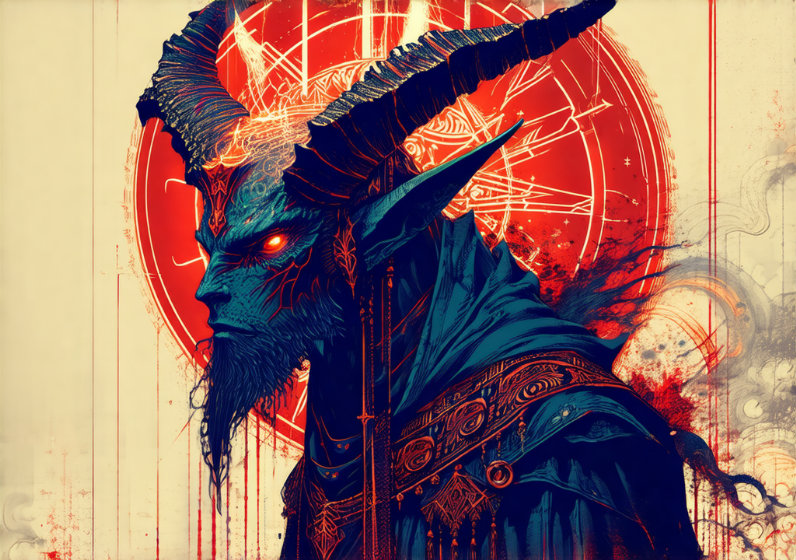
How Crowley Used 'Mind Control' Language Before Mind Control Existed
☿️ The Architecture of Will: Crowley and the Pre-History of Mental Domination
✍️ By Aldous Thorne, PhD in Comparative Esotericism
The modern lexicon is saturated with a particular shade of anxiety. We speak of "mind control" as though it were a newly discovered phenomenon—a technological or psychological novelty that emerged alongside television screens and advertising agencies. We imagine it as something external: a beam, a frequency, a subliminal image flashed for a millisecond on a billboard. It is something done to us by an invisible hand.
But this understanding is historically shallow. The concept of the mind being shaped, bent, or broken by an external will is not modern. It is ancient. And in the late nineteenth and early twentieth centuries, one man—more than any other—codified it into a systematic practice that looked remarkably like what we now call "mind control."
That man was Aleister Crowley.
Crowley did not merely use the language of mental domination; he was the living embodiment of it. His writings, his rituals, and his interpersonal relationships reveal a sophisticated understanding of how to rewire another person’s perception of reality—long before cognitive science gave us the vocabulary for it, long before neuroscientists mapped the plasticity of the brain, and long before the term "mind control" entered popular discourse in mid-twentieth-century America.
This article examines how Crowley’s Thelemic system, his ritual practices, and his personal relationships functioned as a proto-discipline of mind control—using language, symbolism, sensory environment, and social positioning to reshape belief, identity, and will. In doing so, it recovers an intellectual history that belongs not only to esotericism but to the broader story of how modern humans came to understand (and fear) the malleability of the mind.
I. The Pre-History of a Modern Term
The phrase "mind control" is deceptively simple. It implies a binary: one mind controls another. But the phenomenon Crowley explored was more subtle and more complex than mere domination. It involved re-authoring—taking the raw material of someone’s existing beliefs, desires, fears, and self-concepts, and rewriting them into a new narrative that served a different will.
In Thelema, this process has a specific name: the Breaking of the Vessel. Crowley borrowed it from the Upanishads (specifically the Brihadaranyaka Upanishad), where it describes the dissolution of the limited self—the "vessel" of individual identity—in order to achieve union with the universal. For Crowley, however, this was not merely a meditative or metaphysical exercise. It became a practical technology for reshaping consciousness.
Before we can understand how Crowley used language and ritual as instruments of mental re-structuring, we need to appreciate what he believed about the mind itself.
II. The Mind as Terrain: Crowley’s Psychology of Belief
Crowley did not treat the mind as a fixed structure—like a house with load-bearing walls that cannot be moved. He treated it as terrain: open, malleable, and responsive to forces both internal and external. In his 1904 essay "A Secret Common to All Religions," he wrote:
"The mind is not a container of thoughts; it is the field in which thoughts grow."
This metaphor—mind as garden, mind as landscape—is crucial. If your mind is terrain, then someone with the right knowledge can cultivate it. They can plant seeds (ideas), prune branches (doubts), irrigate (emotional reinforcement), and uproot weeds (contradictory beliefs). This is not hypnosis in the crude, stage-performance sense Crowley often mocked. It is something more fundamental: a systematic reshaping of the cognitive environment.
Crowley drew heavily from three intellectual streams to build this model:
Hermeticism, with its axiom that "as above, so below." If you can change the "above" (the symbolic, conceptual layer of reality), the "below" (lived experience) must follow.
Kabbalah, which maps the structure of consciousness onto a tree of sephiroth—stages through which the soul passes and through which it can be redirected.
Yogic philosophy, particularly the concept of vāsanās (latent mental impressions) that drive habitual thought patterns. Crowley believed these could be overwritten by sustained ritual practice.
The result was a theory of mind as plastic medium. Not fixed. Not immutable. Something to be worked upon, like clay on a potter’s wheel. And the potter, in Crowley’s world, was usually Crowley himself—or someone acting under his direction.
III. Language as Ritual: The Power of Naming
Crowley understood that language is not merely descriptive; it is performative. To name something is to bring it into a specific relationship with the speaker and the listener. This insight—shared by Wittgenstein, Austin, and countless other philosophers of language—is central to understanding how Crowley used words as instruments of mental re-structuring.
Consider his most famous utterance: "Do what thou wilt shall do, nothing else." (Book of the Law I:40). On the surface, this is a simple commandment about free will. But read it in the context of Thelemic ritual, it operates as something far more complex than a moral rule. It functions as a cognitive reset.
When a Thelemit recites this phrase during ritual, several things happen simultaneously:
It displaces inherited morality. The listener’s existing framework—likely shaped by Christianity or Victorian bourgeois ethics—is suspended. "Do what thou wilt" is not "do whatever you feel like." It implies a specific will, one that must be discovered. This shifts the question from "What should I do?" to "What am I?"
It establishes authority through specificity. The phrase is precise, rhythmic, and grammatically unusual ("shall do, nothing else"). Its strangeness makes it memorable. It lodges in the mind like a hook.
It creates a feedback loop of identity. If you are someone who "does what they will," then every subsequent decision is filtered through that self-concept. You don’t just act; you perform your nature. And over time, performance becomes identity.
This is not mere rhetoric. It is a technology of self-reconstruction delivered in six words. And Crowley deployed it consistently—in lectures, in letters, in ritual scripts, and in personal conversations—until it became the default cognitive lens for anyone orbiting his circle.
He did the same with other phrases: "For my own use only," "We are all in the cave of swan song," or the famous (and much-misquoted) "Every man is a star; and every woman is a universe." These were not poetic flourishes. They were cognitive implants—small, dense packages of meaning designed to reframe how the listener understood their place in the cosmos.
IV. The Ritual Environment: Sensory Mind Control
Crowley’s rituals were not merely symbolic exercises. They were carefully engineered sensory environments designed to lower the mind’s critical faculties and open it to suggestion. He was meticulous about every element: candlelight, incense, specific colors of clothing, precise geometric arrangements, timed intonations, and even the temperature of the room.
In The Book of the Law commentary (Commentary on the Book of the Law, 1906), Crowley wrote:
"The ritual is a machine for changing the state of consciousness. It is not a performance; it is an operation."
This language—ritual as machine, as operation—is strikingly modern. It anticipates the language of cognitive science and even early behaviorist psychology. Crowley understood that if you can control the sensory input (sight, sound, smell, touch), you can indirectly control the interpretive output—the story the mind tells itself about what is happening.
Consider a typical Thelemic ritual:
Dim lighting reduces visual distraction and heightens auditory focus.
Specific incense (often frankincense, myrrh, or sandalwood) activates olfactory pathways that bypass the thalamus and go directly to the limbic system—the brain’s emotional center. This means the scent can trigger emotional states before the conscious mind has "processed" it.
Chanted intonation in a low register activates the vagus nerve, promoting parasympathetic (rest-and-digest) nervous system activity. The body calms; the mind becomes more receptive.
Geometric precision (e.g., drawing circles of light around oneself) creates a visual and spatial boundary that the mind interprets as "sacred space"—a zone where normal rules are suspended.
Together, these elements create what Crowley called a "temple of consciousness"—a controlled environment in which the usual filters of skepticism, habit, and social conditioning are relaxed. In this state, suggestion is not merely easier; it becomes almost automatic. The mind, primed by sensory input, accepts new narratives with far less resistance than in its default, "awake" state.
This is not hypnosis. Crowley was careful to distinguish his practice from the crude stage-hypnosis of the era. Hypnosis implies a passive subject who has been "put under." Crowley’s ritual participants were active agents—but their activity was channeled through an environment designed to make certain interpretations more natural and others less so. The mind was not controlled in the sense of being overridden; it was cultivated, like a garden whose soil, light, and water have been arranged to favor certain plants over others.
V. Social Positioning: The Hierarch as Author of Reality
Perhaps the most sophisticated—and most controversial—aspect of Crowley’s "mind control" practice was his use of social hierarchy to anchor new beliefs. In any small group, especially one devoted to a charismatic teacher, the social structure itself becomes an instrument of meaning-making.
Crowley positioned himself not merely as a teacher but as a living oracle. He was the medium through which the hidden text (The Book of the Law) had been revealed. He was the "Master" in a tradition that stretched back to Hermeticism, Kabbalah, Yoga, and Theosophy. And he was, in his own telling, the instrument of a specific angelic being (Ra-Hoor-Khut) who had chosen him as the mouthpiece for a new age.
This positioning does several things simultaneously:
It compresses time. A belief that would normally require centuries of scholarly and spiritual development is presented as already revealed. The student does not have to build the edifice from scratch; they inherit it.
It personalizes authority. The truth is not abstract or institutional (as in a church or university). It flows through this specific person. This makes the belief feel intimate, immediate, and unchallengeable—because to challenge the message is, by implication, to challenge the messenger’s divine appointment.
It creates a loyalty loop. If Crowley has been chosen by the angel, then those who follow him are participating in a cosmic drama. Their personal will is not merely aligned with his; it is incorporated into a larger narrative in which they have a role. This transforms obedience into participation—and participation feels like freedom.
Crowley’s relationships with his students—Edward and Leona Butler, Geoffrey Westwood, Jack Bragg, among others—show this dynamic clearly. He would often assign specific "Works of the Will" to each student, framing their personal goals as divinely ordained tasks. This was not mere flattery or manipulation (though it included both). It was a systematic re-authoring: your desire is not just yours; it has been revealed and validated by a higher authority. The mind accepts this narrative because the social structure ensures that the alternative—questioning the Master—is socially expensive.
VI. The Vessel Broken: Identity as Editable Text
The most radical implication of Crowley’s practice is that identity itself is not fixed. This was, in many ways, ahead of its time. In early twentieth-century psychology, the self was often treated as a stable entity—a "soul" or an "ego" with definite boundaries. Crowley, drawing on Yogic and Hermetic sources, treated it as a text that can be edited.
In his 1912 work "A Course in Love Magic," he wrote:
"The self is not a thing; it is a process. And like any process, it can be redirected."
This language—self as process rather than thing—is remarkably close to what contemporary cognitive scientists call narrative identity: the ongoing story we tell ourselves about who we are, which shapes perception and behavior in a feedback loop. Crowley arrived at this insight through esoteric practice; modern science has confirmed it through neuroscience and psychology. But Crowley was operationalizing it decades before either field had the vocabulary.
To "break the vessel" in Crowley’s system means to dissolve the old self-narrative so that a new one can be written. The old beliefs, habits, and identities are not merely abandoned; they are deconstructed through ritual, meditation, and often deliberate emotional experience (grief, ecstasy, fear, or desire). Once the old vessel is broken, the mind is in a state of heightened plasticity—open to new narratives. And who writes those new narratives? In Crowley’s world: Crowley, or someone acting under his authority.
This is not mind control in the crude sense of overriding another person’s will. It is something more intimate and more powerful: collaborative re-authoring of identity. The student participates in their own reshaping—but the outline of the new self is provided by the teacher. The student feels free because they are choosing; but the menu of choices has been curated.
VII. Crowley vs. Modern Mind Control: Continuity and Difference
It would be reductive to say that Crowley "invented" mind control. He did not. He synthesized practices from Hermeticism, Kabbalah, Yoga, Theosophy, and his own innovations into a coherent system that looked and functioned very much like what we now call mind control. But there are important differences between Crowley’s practice and the mid-twentieth-century "mind control" of advertising, propaganda, and behavioral psychology.
Crowley’s mind control was personal. It happened in small rooms, between specific individuals. The teacher knew his student; the student knew the teacher. There was a relationship, however asymmetric. Modern mind control is often impersonal: it flows through screens, speakers, and algorithms to millions of strangers.
Crowley’s mind control was spiritual (or at least framed as such). It was embedded in a cosmology with angels, elements, and a specific divine structure. Modern mind control is usually secular: it operates on neurons, market research, and A/B testing. The mechanisms are similar—sensory priming, narrative framing, social positioning—but the story told about what is happening differs radically.
Crowley’s mind control was bidirectional (in theory). The student was expected to break their own vessel. Crowley broke his own repeatedly throughout his life. There was an expectation of mutual transformation, even if the teacher had more power and knowledge than the student. Modern mind control is usually unidirectional: the subject receives; the system sends.
Crowley’s mind control was artistic. He treated language, ritual, and relationship as creative acts. His "mind control" practices were also aesthetic practices—designed to be beautiful, strange, and memorable. This matters because beauty reduces resistance. A beautiful phrase, a beautiful gesture, a beautifully arranged room is harder to critique than a plain one. Crowley understood this intuitively; modern marketers understand it empirically.
VIII. The Legacy: Mind Control as Cultural Grammar
Crowley died in 1957. By then, the term "mind control" was already entering popular American discourse—fueled by Cold War anxieties about Soviet hypnosis, CIA experiments, and the emerging science of behaviorism. Crowley never used the phrase himself (he preferred terms like "mental discipline," "breaking the vessel," or simply "the Work"), but his practice anticipated its logic with striking precision.
His legacy is visible in several domains:
Self-help culture, which treats identity as malleable and self-improvement as a form of re-authoring ("You can become anyone you want to be").
Branding and advertising, which use sensory environments, narrative framing, and social positioning to shape consumer identity.
Therapeutic practice, particularly in cognitive-behavioral therapy (CBT), which systematically identifies "cognitive distortions" and replaces them with new narratives—a process not unlike Crowley’s breaking of the vessel.
Digital culture, where algorithms curate information flows, social media platforms shape identity through feedback loops, and influencers function as modern "Masters" who author reality for their followers.
In each case, we see the same basic structure that Crowley systematized over a century ago: a skilled practitioner uses language, sensory environment, narrative framing, and social positioning to reshape another person’s (or many people’s) perception of reality. The tools have changed; the architecture is the same.
IX. A Note on Ethics: Control or Cultivation?
One final question remains: was Crowley a manipulator or a teacher? Was he controlling minds or cultivating them? The answer, as with most questions about charismatic authority, depends on your perspective—and your relationship to the Master.
Students who followed Crowley for decades often described their experience as liberation—not control. They felt freer than they had before; more aligned with their true will; more themselves. This is not a contradiction. If you are re-authored into a self that feels more authentic, more powerful, and more coherent than your previous self, the process can feel like freedom even if it was directed by another person’s will.
Critics, on the other hand, saw manipulation: Crowley’s personal relationships were often exploitative; his students were sometimes financially or emotionally dependent on him; and his authority was rarely questioned because the social structure made questioning costly. From this perspective, Crowley was a classic cult leader—using every available tool to maintain control over a devoted following.
Both perspectives are partially correct. And both reveal something important about mind control in general: it is experienced as freedom when the new narrative feels true; it is experienced as control when the old narrative still whispers from the margins of memory, waiting for a moment of doubt to resurface.
Crowley understood this tension intimately. In his 1947 work "The Law and Its Explanation," he wrote:
"Freedom is not the absence of will; it is the full expression of will. And the will can only be expressed through knowledge, discipline, and love."
This sentence contains the entire secret of Crowley’s practice—and the entire ambiguity of mind control as a human phenomenon. If you break your old vessel and build a new one with full knowledge, discipline, and love (including self-love), the result is freedom. If any of those three elements are missing—if the teacher knows more than the student, if the student lacks the discipline to question, or if the process excludes genuine affection—then mind control becomes something quieter and harder to name: domination dressed as devotion.
X. Conclusion: The Potter and the Clay
Crowley did not use "mind control" language because he was writing about a psychological phenomenon that had just been discovered. He used it—or rather, he practiced it—because he saw mind control as one of the oldest and most fundamental human activities. Every teacher, every parent, every priest, every poet who has ever shaped another person’s understanding of reality has engaged in some form of mental re-structuring. Crowley simply made it systematic, ritualized, and intellectually explicit in a way that no one before him had done with such precision and such self-awareness.
He saw the mind as clay: open to being shaped by the right hands, the right words, the right environment. And he positioned himself—as Master, oracle, and living text—as the potter’s hand. Whether you see this as a profound act of spiritual pedagogy or an elaborate act of social engineering depends on your proximity to the wheel.
What is certain is that Crowley saw the mechanism clearly when most people were still treating the mind as a fixed thing—a box that contains thoughts rather than a field in which they grow. And what he built from that insight—part religion, part psychology, part art—is one of the earliest and most complete descriptions of how minds are shaped by language, ritual, environment, and social structure.
We have since given this process a name: "mind control." We speak of it with a mixture of fascination and suspicion, imagining it as something external and mechanical—a beam from a satellite, a flash on a screen, a drop of chemical in a drink. But the truth is more ancient and more intimate than that. It lives in the words we repeat to ourselves. In the rooms we build. In the stories we accept about who we are. In the hands that guide our own.
Crowley was not the first person to shape another mind. He was, however, one of the first to write down how it is done—and why. And in that act of intellectual honesty, he gave us a mirror: one in which we can see ourselves as both potter and clay, author and text, Master and student—simultaneously controlling and being controlled by the very narratives we use to understand reality.
That is not mind control as a technology. That is mind control as a condition of human consciousness. And it predates Crowley by millennia. He merely gave it a name, a ritual, and a grammar.
And perhaps that is enough. Perhaps that is more than enough.
☿ Aldous Thorne is a historian of esotericism and comparative religion, specializing in the intellectual history of Western occultism and its intersections with modern psychology. He writes from London.