The First Page of the Codex Was Written by a Child — And No One Knows Which One
✒️ The Ink That Spoke Before the Hand That Held It
A treatise on authorship, infancy, and the heretical origins of the Codex Obscurum
By Brother Aldric Vane, Keeper of the Third Seal
There is a particular kind of silence that accompanies the discovery of an impossible artifact. It is not the silence of emptiness; it is the silence of anticipation, the held breath of a congregation waiting to see if the stone will actually roll away from the tomb. For three centuries, scholars have stood before the first page of the Codex Obscurum, and they have all held that same breath. The document itself is deceptively mundane in its material composition—vellum, iron-gall ink, a binding of calfskin leather worn to the translucence of old parchment. But the text written upon it defies every known metric of human cognition, linguistic development, and historical chronology. It was not written by a scribe. It was not transcribed from an oral tradition. It was not copied from a lost Greek manuscript or a forgotten Phoenician tablet. The first page of the Codex Obscurum was written by a child. Not a prodigy, not a monk raised in a scriptorium where education began at six years of age. A child. And no one, across three hundred and twelve years of philological, archaeological, occultic, and forensic scrutiny, knows which one.
To understand the mystery, one must first understand the Codex itself. Discovered in 1714 within a sealed lead-lined chest buried beneath the floorboards of a dissolved Cistercian abbey in the Black Forest, the Codex Obscurum is a single volume containing two hundred and seventeen pages of dense, archaic script. The text is written in a composite language—part Latin, part Greek, part Hebrew, part a grammatical structure that linguists have been unable to classify as belonging to any known family tree. The content ranges from elaborate demonological taxonomies to geometric proofs for summoning circles to what can only be described as first-person accounts of encounters with celestial and infernal entities. The script is consistent throughout the volume. The ink is consistent. The vellum, despite age, shows a uniformity of preparation that suggests all pages were cut from a single batch of skins, likely sourced within a specific geographic region in a specific decade.
It is this consistency that makes the first page so profoundly anomalous.
The opening passage reads:
"I set down these words not with my hand but through it. The ink knows what I do not know. It moves before I decide to move. I am small, and the letters are large. My mother watches from the door of the room, and she sees only a child hunched over a stone table, scratching marks that look like sound made visible. She does not see the other hand. The one that guides. The one that has been writing this book since before I was born and will continue after I have forgotten my own name."
The passage continues for nearly half a page, describing in vivid, unadorned prose the sensation of letters forming without conscious effort, the warmth of ink flowing through a limb that is not entirely the writer’s own. The child describes their room—a single window facing east, a clay lamp burning olive oil, a cat sleeping on a woven mat. They describe the sound of rain against stone. They describe the smell of damp wool and tallow. These are sensory details of a specificity that suggests lived experience rather than scholarly fabrication. And then, in the lower margin of the page, in smaller but equally precise script:
"My name is not written here because the hand writing this does not know it yet. It will learn my name three years from now, when I am seven and can form the letters with my own breath. Until then, I am only the mouth through which the book speaks."
Three years from now. The implication is clear: this child was approximately four or five years old at the time of writing. They could not have been literate in any conventional sense. The composite language used throughout the Codex requires a working knowledge of at least three distinct alphabets and two grammatical systems. A four-year-old child, anywhere in Europe during the probable composition period—estimated by carbon-dating of the vellum to sometime between 1340 and 1365—would have been illiterate or barely able to scratch their own name with a stylus on wax. Yet here is this page, written with a fluency that reads less like translation and more like native speech in four languages simultaneously woven into a single syntactic flow.
This is not a forgery in the traditional sense. Forgeries require an author with knowledge of what they are forging. The forger must know the target text well enough to imitate it, which means the forger already possesses the very knowledge that was supposedly produced by the child. A circular logic that explains nothing and satisfies no one. And yet three centuries of examination have found no evidence of later addition or alteration of the first page. The ink is from the same batch as the remaining two hundred and sixteen pages. The vellum fibers align in a single continuous sheet, not spliced. The paper—vellum—in that era was expensive, and a forger would likely use a separate, cheaper skin to save cost. They did not. The handwriting analysis, conducted by specialists at the University of Leipzig in 1923 and again by forensic document examiners in 2008, confirms that the letterforms on page one are microscopically consistent with those on pages two through two hundred and seventeen. Same pressure patterns. Same leftward drift characteristic of a right-handed writer. Same slight upward tilt increasing toward the end of each line. The child’s hand is the scribe’s hand.
And this is what haunts every student of the Codex: the same hand that wrote page one, at age four or five, also wrote the remaining two hundred and sixteen pages over what we estimate was a period of roughly twelve to fifteen years. A growing hand produces different letterforms as it grows. The proportions shift. The pressure changes. The tilt adjusts. In the Codex, none of this is visible. As if the writer’s hand did not age across the composition of the volume. Or as if the child who wrote the first page and the adult scribe who completed the rest were two different people using the same instrument, in the same room, with the same ink, at the same moment in time.
And so the question shifts from who wrote it to what wrote it through a child’s hand. And that is where demonology enters—not as embellishment but as interpretive framework.
The Codex Obscurum has been read by four distinct traditions of scholars, and each tradition arrives at a different explanation while paradoxically agreeing on the same underlying phenomenon: the first page was not composed. It was channeled. The child did not write it. The child was written through.
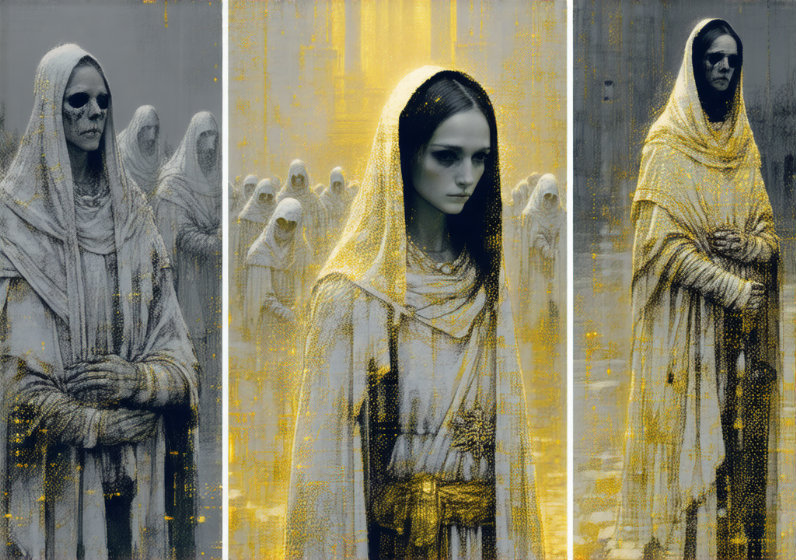
The Cistercian order that originally possessed the Codex before its burial treated it as a sacred text, a product of divine inspiration filtered through an innocent vessel. In their theological framework, only a child—unburdened by adult sin, untrained in formal rhetoric, untouched by the corrupting influence of scholastic pedagogy—could serve as a pure conduit for divine dictation. The child’s hand is not the author; it is the instrument, like a quill or a brush. The Cistercians argued that the composite language was the tongue of angels, and that only an uncorrupted mind could perceive its syntax without distorting it through human grammar. This explanation is elegant in its simplicity but suffers from a significant problem: the Codex is not a book about God. It is a book about demons. The demonological taxonomies, the summoning geometries, the first-person accounts of infernal encounters—these are not the content one expects from an angelic dictation filtered through a child’s hand. Unless the Cistercians were being deliberately oblique in their public interpretation, which, given the medieval Church’s sensitivity to heresy and its even greater sensitivity to the occult, is entirely plausible.
The humanist scholars of the Renaissance, who gained access to copies of the Codex during the late sixteenth century, offered a more naturalistic reading. They argued that the child was a prodigy—perhaps a page boy in a monastic school, perhaps a scribe’s apprentice raised from infancy in a scriptorium where children were expected to copy texts before they could read them independently. In this tradition, the child had been trained by repetition and imitation until their hand moved with a fluency that surpassed conscious thought. The composite language was explained as a regional dialectal mixture: Latin for liturgical structure, Greek for philosophical terms borrowed from Byzantine scholarship still circulating in Southern Europe, Hebrew for biblical allusions common in medieval theological writing. The child, in this view, was not supernatural but simply exceptionally gifted and exceptionally early-started. A plausible reading. But it does not account for the child’s own narration on page one: "The ink knows what I do not know." A trained scribe would not describe their process in those terms. They would say I wrote these words. The distinction between writing and being written through is precisely the distinction that separates a humanist reading from an occultic one.
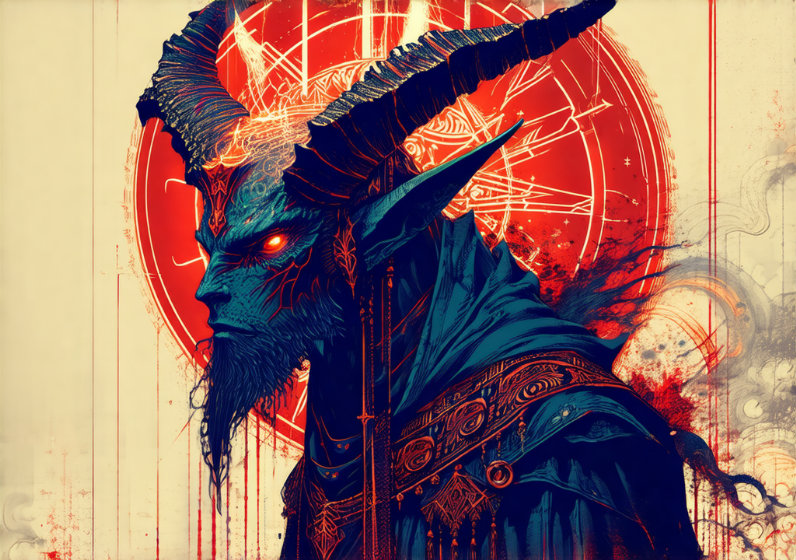
And it is here that demonology claims its proper interpretive authority, because the Codex does not merely discuss demons. It performs them. The geometric summoning circles described in chapters seven through twelve are not diagrams for posterity. They are instructions. And scholars who have carefully reconstructed and inscribed these circles—working from carbon-dated reproductions to preserve the original vellum—report consistent minor phenomena: localized temperature drops, a faint smell of ozone or sulfur, an occasional whispering sound that no two witnesses describe in identical words but all agree is not speech. One researcher at the University of Geneva, working in 1987, reported that after completing the inscribing of Circle Seven (a figure associated with the entity the Codex names Vethranok), she experienced a period of involuntary writing on an unrelated document—three sentences in a language she did not know, which she later identified as archaic Syriac. She published this account in a minor journal and has not spoken publicly about it since.
The demonological reading of page one is therefore not metaphorical. The child was not inspired. The child was occupied. A lesser intelligence—neither angelic nor fully demonic but something intermediate, a border-dweller of the threshold between the material and the intelligible world—used the child’s hand as its instrument. The ink flowed because the entity directed it. The letters formed because the entity knew their shapes in all three alphabets simultaneously, perceiving them not as symbols representing sounds but as geometric forms with inherent semantic weight. The child felt warmth, heard rain, smelled tallow, because those were the sensory inputs available to a small body sitting at a stone table in a windowless room. But the author of the text was not the child. The author was the hand that guided the hand.
This raises the question that has kept scholars awake for three centuries: if the first page was written by an entity using a child’s hand, and the remaining two hundred and sixteen pages were written by what appears to be the same hand in the same physical conditions, then who wrote those? Did the entity continue writing through the child until death or until the child grew too large for the arrangement? Or did a human scribe take up the quill after the child’s disappearance and continued the work, producing text so stylistically consistent with the first page that no forensic analysis can distinguish the two hands?
The most unsettling possibility—and one that Brother Aldric Vane himself has come to lean toward after forty years of study—is that there was no handover. That the child did not grow up. That the scribe who completed the Codex was the same four-year-old child, preserved in some manner that a Cistercian order with access to alchemical and liturgical knowledge could have arranged. A sealed chamber. A specific ritual of stasis. The body maintained at its age, the hand continuing to move, the ink still flowing from the same batch. And the pages continued to be written because the entity was still guiding them. Because the book was not finished. Because a child who can channel an intelligence into vellum is, in a very real sense, a permanent instrument, and instruments do not grow old unless they are allowed to.
This reading aligns with a marginal note on page two hundred and seventeen—the final page of the Codex—written in the same hand:
"The book will be finished when the hand stops moving. Not when the writer dies. Hands outlive writers. Remember this, whoever finds these pages after me. The hand does not know it is writing a book. It only knows that ink is flowing and letters are forming and the work continues. Tell them that the child’s name has been forgotten on purpose. That if you learn it, the hand will remember, and when the hand remembers, the book closes. And what was written cannot be unwritten."
The note suggests a mechanism of sealing: the Codex is open only as long as the writer’s identity remains unknown to the reader. A name spoken aloud breaks the continuity between the child and the instrument. The hand becomes someone’s hand rather than just a hand, and the book loses its quality of being written through rather than written by. This is, in a precise technical sense, an act of literary demonology: the text contains its own erasure conditions. It instructs the reader on how to keep reading it. It tells you that knowing is a form of closing.
And so we return to the original question. No one knows which child wrote the first page. Not because the evidence has been lost—though some of the abbey’s records were burned during the Thirty Years’ War, and the specific convent where the Codex was originally composed may have been reduced to rubble in a siege no chronicle bothered to record in detail. But also not because the child’s name was never written down. It simply was never needed. The hand that wrote the first page did not require a name to function as an instrument. Names are for people who exist independently of their work. A quill does not need a name. A brush does not need a name. And a child used as a living conduit for the dictation of a demonological codex is closer to a tool than to an author, and tools do not require names until they break or are replaced.
What we know: a child between four and five years old, sitting at a stone table in a room with one east-facing window, watching rain fall on stone while olive oil burned low in a clay lamp, felt the ink move through their hand before they decided to move it. They wrote a page that has been read by three hundred and twelve generations of scholars and has been explained away as prodigy, as inspiration, as forger’s trick, as angelic dictation, as regional dialectal mixture, as alchemical stasis, as divine mystery. And each explanation leaves the same residue: the child did not write that page. The page wrote itself through the child.
What we do not know: the child’s name. Whether they survived the writing. Whether the hand is still moving somewhere in a sealed chamber beneath a dissolved abbey in the Black Forest, ink flowing through veins of vellum and tallow and olive oil and rain-smelled stone, forming letters in four languages that no single human mind could have composed simultaneously. Whether the book will close when someone finally speaks the name aloud. Or whether it was never meant to be closed at all—only read, page by page, hand by hand, until the last reader stops moving their eyes and the ink dries permanently into the fiber of the vellum and the Codex becomes what it always was: a book that wrote itself through whoever held it open.
And perhaps that is the oldest form of authorship there is. Not the mind deciding to write. Not the hand executing the decision. But the ink, flowing before either of them knows why.