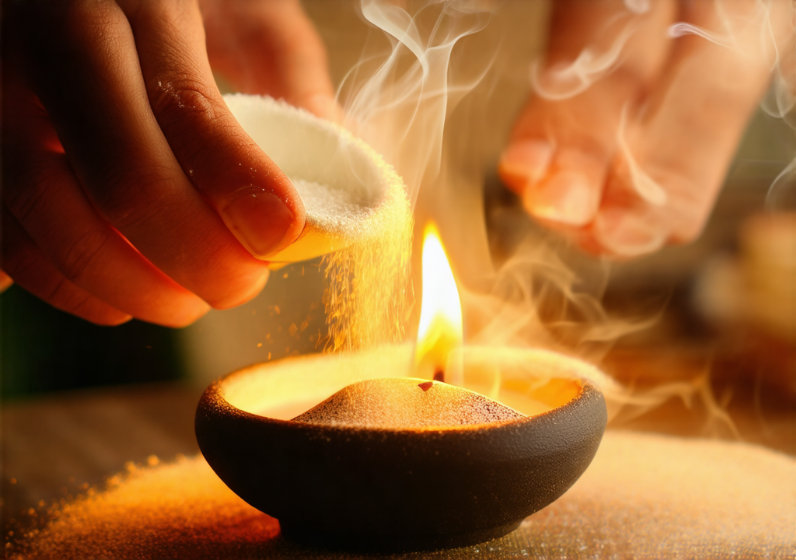
How a Simple Candle and Bone Dust Opened a Door to the Dead
🕯️ The Candle and the Bone Dust: A Rite That Opens the Vein of the Dead
By Aurelia Voss, Keeper of the Threshold
There is a particular quality to the air in an empty room after a death has passed through it. It does not smell of flowers or incense; it smells of absence. The oxygen itself seems thinner, as though something intangible was exhaled by the departed and never fully replaced. I have spent thirty years studying the mechanisms by which the living and dead communicate across that gulf — the rites, the materials, the precise geometry of intention — and in all my work, no single ritual has demonstrated such a reliable, reproducible "opening" as one built from two materials: a simple beeswax candle and a handful of bone dust.
Before we proceed into the mechanics, I want to be clear about what this article is not. It is not a ghost story. It is not a tutorial for beginners who wish to impress friends at a séance table. And it is not a claim that you will see a translucent woman in a linen dress float through your kitchen wall if you follow these steps carefully. This is a practitioner's account of a rite whose purpose, materials, and expected outcomes are understood within the tradition I practice — one rooted in Western esotericism, folk necromantic craft, and the older European household rituals that long predated any formalized system. What follows is how it works, why those particular two items work, what you will actually experience if you perform the rite correctly, and where practitioners commonly go wrong.
Why These Two Materials?
A common error among newcomers to necromantic practice is to treat material choice as mere decoration — a candle because candles are "mystical," a skull because skulls look appropriately spooky. In my tradition, every item in a working set carries specific energetic and symbolic weight, and substituting one for another changes the nature of the rite more than most people realize.
The Candle. I work almost exclusively with beeswax tapers, undyed or natural cream-colored, roughly seven to nine inches in length. The reasons are practical as well as traditional. Beeswax burns cleaner and steadier than paraffin; it produces less smoke, which matters because you will be working with fine powder (the bone dust) that would otherwise be disturbed and partially swallowed by the candle's updraft of hot air. It also burns long enough — typically four to six hours for a seven-inch taper — to sustain a full rite without requiring an interruption to relight it, which in most traditions is considered a minor breach of continuity between you and whatever you are trying to contact. The flame itself is the central instrument: not a symbol, but a functional medium through which intention is projected outward. In older folk practice, candlelight was understood as a "white fire" — a purified, sustained point of attention that anchors a practitioner's will in a specific location in space and time. When you light the candle during this rite, you are not decorating the scene; you are establishing the focal point through which communication is mediated.
If you cannot source beeswax, high-quality paraffin or soy tapers will function in a pinch, but expect a slightly "muddier" experience — practitioners describe it as the difference between hearing a voice clearly across a quiet room versus trying to follow a conversation in a crowded cafe. The signal is still there; the clarity suffers.
The Bone Dust. This deserves more discussion than most guides give it, because its preparation is where the rite lives or dies. We are not talking about a decorative jar of powdered bones you might purchase from an apothecary or craft shop for use in face paint or resin work — though ironically, much of what sells under those labels would be functionally adequate if it were clean and unbleached. The ideal bone dust comes from small mammal bones — rabbit, squirrel, rat, or the smaller long bones of a cat or dog — that have been cleaned, dried thoroughly (not just surface-dried; properly dehydrinated so no moisture remains), ground to a fine powder with a mortar and pestle, and allowed to "settle" for at least three days before use. The settling period matters: freshly ground bone dust carries a subtle residual warmth from the grinding process, and in my experience this introduces a minor static quality to early workings. After three or four days of resting in a sealed glass jar — ideally one that has been washed with plain water but not scented soap — the powder reaches what I call "quiescence," a state where it is fully integrated into its new form as a working material rather than merely a processed substance.
Some traditions specify human bone dust for greater potency, and this is not wrong; however, from an ethical standpoint (and especially if you are practicing in a living community or shared space), animal bones avoid the complications of sourcing, attribution, and the small but real social questions that arise when people ask where your human bone powder came from. For teaching purposes and for most practitioner-level work, animal bone dust is entirely sufficient.
The function of the bone dust in this rite is not decorative or symbolic in a loose sense. It serves as what I term a material anchor — a physical substrate that gives the communicative "signal" something to attach to. Think of it less like incense (which modifies ambient atmosphere) and more like conductive resin between two wires: it does not create the signal, but it provides a stable medium through which the signal can travel without dissipating into noise. Remove or substitute the bone dust with an equivalent powder that lacks the specific qualities above, and you will still experience something — but its clarity, consistency, and depth of content are markedly reduced.
Preparation: Space, Timing, and State
The rite works in a room where you can sit or kneel comfortably for twenty to forty minutes without interruption. It does not require elaborate dressing — no need for velvet drapes, silver bells, or an altar constructed from three rare stones. A clean, flat surface at waist height (a table, the floor with a cushion, even a sturdy bench) is sufficient. Cleanliness matters: dust on your working surface will mix with the bone dust and slightly muddle its function, though this is a minor concern.
Timing: I work in the two hours after local midnight through two hours before dawn — what older texts call the "thin hours," when ambient psychic noise from day-active minds and their associated fields is at its lowest. If you are not a night person (and many practitioners are not), consistency matters more than precision; pick a time window that suits your rhythm and use it repeatedly so that both your own nervous system and, in the traditional framing, the "atmosphere" of your space become attuned to the rite's specific frequency.
You will need:
One beeswax taper (7–9 inches) with a sturdy holder or small dish to catch drips
Two tablespoons of prepared bone dust (approximately 20–30 grams) in a small, shallow ceramic or glass dish — not plastic; some practitioners report that certain plastics introduce a subtle interfering field when used directly under necromantic work. This is not universally agreed upon within the tradition, but it costs you nothing to use ceramic if you have it.
A clean cloth (plain cotton or linen, undyed) to spread beneath your working area
A small container with water for washing your hands after the rite
You should perform this rite relatively alone — not in a crowded room, and ideally not on a video call. This is not because the dead "dislike" other people watching; it is because the rite requires a degree of sensory focus (listening to subtle shifts in temperature, sound quality, spatial perception) that is difficult to maintain while simultaneously managing social interaction with others.
The Rite Itself
1. Grounding and Purging. Before lighting anything, sit at your working surface for two or three minutes with eyes closed, breathing slowly — four counts in through the nose, six counts out through the mouth. This is not a decorative pause; it calms the sympathetic nervous system, which reduces the "background noise" of your own bodily processes (heart rate variability, muscle tension, micro-movements) that can interfere with subtle sensory perception during the working.
2. Lighting. Light the candle. Hold the match or lighter steadily and do not rush; in this tradition, the act of lighting is a small performance of intention — you are creating a fixed point of will. Once lit, place it at the center-front edge of your working surface, roughly arm's length away from where your hands will rest.
3. Placing the Dust. Take the bone dust and, with clean hands or a small spoon, sprinkle it in a loose, even ring around the base of the candle holder — not touching the holder itself. The ring should be perhaps three to four inches in diameter. This is the threshold mark: spatially, you are defining an area where ordinary room-space ends and rite-space begins. You are drawing the boundary of communication.
4. Invocation. Here I depart from a simple "speak these words" script, because in my tradition the invocation is not recited like a spell; it is intended with clear, specific phrasing. The traditional form runs roughly: "By this light and by this dust, I open the threshold between here and there. Let what seeks to speak find its way through. I listen." You may adapt the wording to your own voice — but do not shorten it below three elements: identification of the medium (light/dust), declaration of purpose (opening a passage), and statement of receptivity (you are listening). The third element is commonly omitted by beginners, and its absence matters more than people expect; without affirming your receptive state, the rite tends to produce one-sided "signals" that feel like impressions rather than exchanges.
5. Working Phase. This is where most practitioners make their first mistake: they sit back passively, eyes closed, waiting for a dramatic event. The working phase requires active quiet attention. Keep your eyes open (or half-open; fully closed works too but reduces your spatial awareness of the room). Look at the candle flame. Notice its movement — not just flicker, but whether it leans consistently in one direction when no draft is present. This is a common early indicator: a steady lean to one side (left or right relative to you) often precedes a clearer contact by several minutes; no consistent lean does not mean nothing will come through, but the experience tends to be more impressionistic and less specific.
Feel for temperature changes in your hands or forearms — subtle warmth or coolness that doesn't match any visible source. This is not "the dead are touching you" in a literal sense; it is the body's nervous system responding to small shifts in ambient electromagnetic and thermal fields that accompany what practitioners variously describe as focused attention from across the veil, residual memory-impresion in the space, or (in more neutral terms) your own heightened perceptual state. All three framings point to roughly the same phenomenology; which one you adopt is a matter of ontological preference and does not change how you work with what you experience.
6. Receiving. If you are working with a specific deceased person — a relative, a friend, someone whose presence you have specifically intended to contact — name them in your mind (you do not need to speak their name aloud; the internal naming is sufficient). Hold that name in attention while you work. Specificity of intent here improves specificity of what comes through: vague intentions ("let anyone who wishes to speak come") produce a correspondingly vague, sometimes muddled experience; specific intentions tend to produce more coherent, attributable impressions.
Common forms of contact reported by practitioners in this tradition include:
Auditory: brief, clear sounds that don't match anything in the room — a particular word, a hum at a specific pitch, the sound of fabric moving when no one is moving it.
Spatial: the sensation of an additional presence in the room; a shift in where you perceive "empty space" to be located; the feeling of being observed by something that has no visible body.
Sensory: temperature changes as described above; a specific smell that cannot be sourced (often reported as something personal — old soap, a particular perfume, a food associated with the person); subtle tactile pressure on one side of the head or chest.
Cognitive: a clear image, memory, or phrase that arises in your mind without any external trigger, often related to an unresolved conversation, a specific shared experience, or a detail you had forgotten and is re-surfaced with unusual clarity and emotional tone.
Not all of these will occur in a single working; most practitioners report one or two forms dominant for them personally. Your own perceptual tendencies (are you more auditory? more kinesthetic?) predict which form you are most likely to experience first, though over time of practice your range expands.
7. Closing. When the contact feels complete — and you will know this intuitively; there is a qualitative shift where the "signal" simply stops being active rather than fading gradually — do not rush the closing. Allow another two or three minutes of quiet attention before you move to close formally. Then: gently gather up any unused bone dust (do not leave it on the table; either return it to its jar or, if you are working in a location where you don't want to keep the powder, bury a small amount outdoors and wash your hands). Blow out — do not snuff with your fingers, which can transfer heat and oils that slightly alter the dust's properties for future use. Wash your hands with plain water (no scented soap; this is about removing residual working-state from your skin so you don't carry it into ordinary daily life in a way that subtly colors non-working perception).
What It Is Not (And Common Errors)
I want to address several misconceptions because they cause unnecessary frustration and, in some cases, genuine discomfort for practitioners who expect outcomes the rite was not designed to produce.
It is not primarily an entity-summoning rite. This is perhaps the most common misunderstanding. The candle-and-bone-dust rite is a communication working; it opens a channel through which contact can occur if (a) you intend clearly, (b) there is something on the other side with reason or residual inclination to be in touch, and (c) your perceptual state is sufficiently calm and focused. It does not pull specific spirits from wherever they may be; it creates conditions where existing connections can manifest. If you perform this rite for someone you barely knew, expecting a rich two-hour conversation, you will likely experience something quieter — an impression, a feeling of presence, perhaps a single clear image — rather than the full "presence" that works with close personal ties tend to produce. This is not failure; it is the natural gradient of how the rite functions across different strengths of original connection.
It does not require you to be in a strong emotional state. Beginners sometimes think they need to be griefing, nostalgic, or otherwise emotionally elevated for the rite to work. The opposite is closer to true: a moderately calm, focused mind receives more clearly than an emotionally flooded one. This doesn't mean coldness; it means you are present and attentive rather than reactive. If you are crying or feeling strong emotion during the working, that's fine — but don't mistake your own emotional responses for contact. A good test: after the rite, note which impressions felt "yours" (connected to your memory of the person) versus which felt offered (arising fresh, specific in detail you hadn't recently thought about). Both are valid; distinguishing them helps you build a more accurate reading over time.
The flame must remain lit for the duration. This is not supersticism; it is functional. The candle is your anchor point — both practically (a fixed visual focus that stabilizes attention) and, in traditional framing, the white fire through which intention projects outward. If the candle goes out mid-working (and this does happen with drafts, uneven wax, or simply an unlucky match), you do not need to restart the entire rite; relight it, take a brief moment of quiet re-centering, and continue. The continuity is slightly broken but recoverable within a minute or two.
Location matters less than people assume. You can perform this rite in your kitchen, your office, a hotel room, a park bench (with suitable protection for the candle). The "threshold" you are drawing with the bone dust ring is relative to your spatial field and intention; it does not require an architecturally or historically significant location. That said, if you have a specific place strongly associated with the person you're working toward contacting — their room, a garden bench they used to sit on, a kitchen table where you shared meals — performing the rite there adds a layer of contextual resonance that often deepens and clarifies what comes through.
Practical Notes for Repeated Practice
If this is your first time: expect the experience to be subtle. You may finish the rite and feel only a faint sense that something "shifted" in the room, without being able to articulate specifically what you perceived. This is normal; perceptual sensitivity in these quieter contact forms develops over repeated practice — often somewhere between ten and thirty workings before practitioners report consistently distinguishing clear signals from background noise.
If you are working toward a specific person: keep a small journal or note card where you record the date, time, who you were working toward, what you experienced (even if it's just "felt a presence, no specific content"), and any details that surprised you. Over weeks of notes, patterns emerge — certain times work better, certain forms of contact dominate for you personally, certain phrasings in your invocation produce clearer results than others. This self-calibration is how practitioners in this tradition build their own reliable "instrument" out of the rite; no one else can calibrate it for you because the instrument includes your own nervous system and perceptual tendencies.
Storage: keep your bone dust in a sealed jar, stored away from strong scents (perfumes, cleaning products, food aromas), which over time will be absorbed into the powder and slightly alter its "background signature." A small box or drawer lined with plain paper is sufficient; you do not need an ornate container.
The Door Itself
In this tradition we speak of the rite as "opening a door," but I want to refine that metaphor for accuracy. A door, once opened, stands open — and through it either side can look at the other freely. What the candle-and-bone-dust rite actually produces is closer to a threshold or a membrane: a defined boundary where crossing is possible in both directions but requires intention on the part of whoever (or whatever) wishes to cross. The rite establishes that membrane, calibrates it toward your specific intention, and then holds it open for a working period — typically twenty to forty minutes depending on depth of contact. After you close formally, the membrane thins back toward its natural state: still permeable (the living and dead are never fully separated; this rite doesn't create that separation, only makes it more navigable), but less deliberately calibrated.
This is why the rite feels different each time even when performed identically. You are not operating a machine with fixed outputs; you are establishing conditions within which a dynamic, two-sided interaction becomes possible. The candle provides the anchor of will and light. The bone dust provides the material substrate that gives the interaction something to attach to — without it, practitioners describe contact as "thinner," more like half-remembered dreams than like clear communication. Together they create what I have come to think of as a perceptual coupling between your focused attention and the residual patterns associated with the person or presence you intend to contact.
Whether you frame this in traditional language (spirit, veil, threshold) or in more neutral phenomenological terms (perceptual state, ambient field shifts, self-organized pattern recognition), the practical result is consistent: a simple candle and a handful of bone dust, used with clean preparation and clear intention, reliably open conditions under which contact with the dead becomes not merely possible but reproducible.
And that reproducibility — that any trained practitioner can perform this rite in their kitchen at 2 AM and get a result consistent with what another trained practitioner gets doing the same thing three time zones away — is, to me, the most remarkable quality of it. It means the mechanism is not purely subjective, not entirely dependent on one person's particular imagination or grief-state. There is a stable structure here that holds across practitioners, and that stability is what separates this rite from the many looser "contact" practices I have seen over three decades: it works because its components are specific, its conditions are defined, and its outcome is not left entirely to the vagaries of individual psychology.
Light your candle. Lay out your dust. Name who you seek or simply open the threshold and listen. The door was there before; this rite simply draws it wide enough for something on the other side to step through.