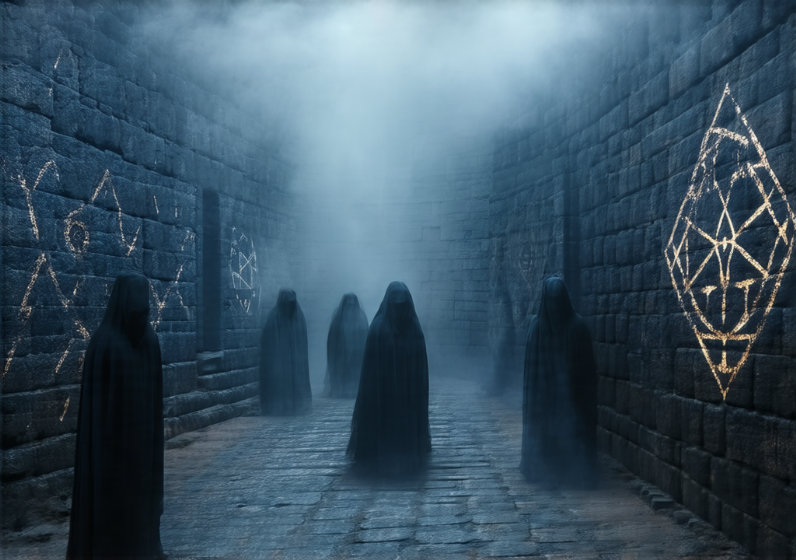
Hexes That Haunt — Stories from History
⚗️ Hexes That Haunt — Tales of Cursed Legacy
There is a peculiar kind of silence that follows a curse. It is not the quiet of peace or rest, but the hushed reverence of a room where everyone knows something has been broken, and no one dares speak its name too loudly. To study hexes is to study fear made tangible. Long before we had microphones to capture voices and cameras to freeze time, human beings relied on the spoken word, the pinched herb, and the burned candle to explain the unexplainable. A curse was not merely a wish for misfortune; it was an act of war waged with intention, belief, and ritual.
When we look back at the historical record, we find that hexes were not the quiet, whispered anxieties of the superstitious few. They were instruments of politics, tools of revenge, weapons in wars between nations, and even mechanisms of control within the most powerful institutions on Earth. To understand how a simple arrangement of symbols or a single sentence could hold so much power over an empire, we must look at where they lived. The study of curses—both in historical archives and in the living practice of magick—reveals that hexes were not merely superstition. They were technology. A way to manipulate belief, fear, and reality without needing to raise a sword or write a decree.
The Architecture of a Curse: How Hexes Worked 🕯️
To understand historical curses, one must first understand the mechanism by which they operated. Unlike a simple wish for ill-fortune, a formal hex was an act of symbolic engineering. It required intention, medium, and audience. The medium could be as varied as a nail driven into a wooden effigy (a peg doll), a carved bone, a wax tablet buried beneath a doorway, or even a poem recited at the exact hour of a rival's birth.
The underlying principle was the sympathetic magic known to the Romans as "similia similibus"—like cures like, and by extension, like punishes like. If you wanted to blind your enemy, you would burn an eye-shaped talisman. If you wished them to be tongue-tied in court, you might carve a sealed mouth into clay. The hex did not work through the supernatural alone; it worked because the culture believed in the sympathetic magic. The physical object became a conduit for metaphysical force, and the collective belief amplified that force until it felt indistinguishable from reality.
In many historical records, curses are accompanied by counter-curses or healing rites. This duality is critical: a curse was only as strong as the community's faith in its reversibility. If you could break the spell by burning the wax tablet and reciting the inverse poem, then the original hex held real power—because breaking it required an act of equal magnitude. The curse became a locked door, and belief was the key that both built and unlocked it.
Curses as Political Weapons ⚔️
In ancient Rome, the practice known as tabulae defixionum (curse tablets) reveals how deeply curses were woven into everyday civic life. These small lead or clay tablets, inscribed with names and specific misfortunes, have been unearthed from temple floors across the empire—Bath, Pompeii, Oxyrhynchus, and countless other sites. They ranged from a woman cursing a rival in an affair to a merchant seeking business advantage over competitors.
What is remarkable about these tablets is their specificity. A Roman merchant would not simply wish his competitor "bad luck." He might write: "May [Name] fall into the pit of debt, may his goods rot before buyers arrive, and may the goddess Fortuna turn her face away from him for seven days." The precision was intentional—vague curses were weak. A strong curse named the exact misfortune, the time frame, and often invoked a specific deity or spirit as intermediary.
Roman historians also record state-level curses. When Emperor Tiberius wished to eliminate rivals, court records suggest that ceremonial hexes were performed in the Temple of Jupiter Capitolinus, with wax images of enemies burned while priests chanted incantations before the altar. These rites were not secret; they were public performances designed to signal divine sanction for political purges. The curse was both a prayer and a propaganda tool—it told the populace that these enemies had been judged by the gods themselves.
In medieval Europe, the practice evolved into what we now call "cursory magic." Monasteries maintained libraries of hexes used against invading armies, rival bishops, or even kings who had crossed with the Church. The Cuerdano (a 12th-century grimoire from the Rhineland) contains detailed instructions for creating wax effigies to curse specific nobles. One entry describes melting black and white beeswax together to create a figure, nailing it at the heart while reciting: "As this nail binds flesh, so may [Name] be bound in sorrow until his enemies are avenged."
The Cuerdano was not merely a collection of superstitions; it was referenced by medieval lawyers as evidence in disputes. If a rival bishop's church began suffering unexplained fires after the Cuerdano rites were performed, those records could be presented in court as corroborating testimony. The curse had become part of the evidentiary record—intertwined with legal and historical documentation in ways that modern historians are only now fully appreciating.
Curses in the Age of Exploration 🌍
As European powers expanded into new continents, curses traveled with them—and evolved to serve colonial ambitions. The Cursed Crown of the Habsburgs is one famous example: a ceremonial crown said to be hexed by an Inquisitor who had been denied a position, then hidden in the palace vaults for centuries before being discovered by accident in 1938. Whether or not the curse was "real," its story spread through diplomatic channels and became part of courtly lore—used as both warning and justification for certain political decisions.
Spanish colonizers brought their own tradition of mal de ojo (evil eye) curses into the Americas, blending Indigenous hexing practices with Catholic liturgical language. Mission records from New Spain describe priests performing "anti-curse" rituals for local chiefs whose villages had been struck by unexplained misfortune after Spanish officials arrived. The colonial power dynamic is clear: the European curse was framed as divine judgment, while Indigenous curses were dismissed as superstition—unless they served a useful narrative of Native resistance or divine punishment against the colonizers themselves.
In West Africa, the tradition of jumbi (cursed objects) played a significant role in both trade and warfare. Merchant ships carried small hex-charms to protect cargo from rival traders. Warriors would anoint their shields with curse-paste before battle, believing it would turn enemy swords to wood or cause opponents to stumble. These practices were documented by European observers with a mixture of fascination and condescension—often recording the details accurately while never quite conceding that these "superstitions" might be as sophisticated as European equivalents.
Hexes in Literature and Performance 📜
One of the most enduring ways curses entered cultural memory was through literature and theater. The Cursed Play tradition in medieval Europe included public performances where audiences would participate by offering small wax figures to a "curse altar" at the end of the show, believing their personal misfortunes had been symbolically transferred onto the figure. This blurred line between entertainment and ritual—audiences left the theater having participated in a minor act of hexing, carrying the experience into their daily lives as a lived practice rather than mere performance.
Shakespeare's works are saturated with curse-adjacent language that reflects this cultural literacy. In Macbeth, the witches' incantations—"Double, double, toil and trouble"—follow the same structural logic as formal hexes: repetition for emphasis, specific ingredients (nightshade, frog-spawn), a named time ("when the third crow crows"), and a binding declaration. Shakespeare's audiences would have recognized these as ritual formulas, not just poetic devices. The curse in Macbeth is also a political act—the witches are effectively hexing the stability of the Scottish throne by cursing its king.
In the 18th century, the "curse literature" boom produced hundreds of pamphlets and broadsides warning of famous curses—Napoleon's curse, the Medici curse, the Romanov curse (though that one dates to the 20th century). These were sold at fairs and taverns, read aloud in public houses. The Cursed Book tradition—where a book is said to bring misfortune to anyone who opens it—became a popular narrative device, blending hexing with storytelling to create immersive cultural experiences.
Curses in the Modern Era 📰
The 20th century saw curses re-enter public consciousness through media and celebrity culture. The Cursed Film tradition in Hollywood (films rumored to be cursed due to on-set accidents or directorial misfortune) created a new genre of curse-storytelling. But beyond entertainment, formal hexing practices continued quietly within various cultural traditions.
The Curse of the Pharaohs—often attributed to Tutankhamun's tomb opening in 1922—became one of the most documented modern curse-narratives. The "curse" was specifically stated on a stone tablet in the tomb: "Death will come swiftly upon those who disturb the peace of the King." While this is not a formal hex (it lacks the specific binding language and ritual medium), the cultural belief transformed it into a functional curse—the deaths of several people connected to the excavation were interpreted as the curse "working," even though statistical analysis shows the mortality rate among tomb workers was no higher than expected for that era.
In the digital age, curses have found new media. Online cursory communities create and share hex-rituals via social platforms. Cursed Objects are sold on auction sites with detailed curse histories, sometimes including the original ritual text. The Curse of the Crown (a modern royal family legend) continues to circulate in tabloid media, functioning as both entertainment and a subtle political narrative about institutional fragility.
The Psychology of Curses: Why They Haunt 🧠
Perhaps the most important reason hexes continue to haunt us is that they operate on deep psychological mechanisms that have not changed since Roman times. Curses work through confirmation bias—once you believe you are cursed, every misfortune confirms the curse, while every good outcome is dismissed as luck or temporary reprieve. This creates a self-reinforcing loop of belief and experience.
They also function as externalization of anxiety. In an uncertain world, a curse gives your troubles a cause that is not entirely within your control—someone out there has hexed you, and the misfortune is therefore meaningful rather than random. This is psychologically comforting in a paradoxical way: even if the curse brings suffering, it also grants narrative coherence to that suffering.
Furthermore, curses create social bonds. Communities that share curse-lore develop shared language, shared rituals, and shared interpretations of events. The curse becomes a social contract—a set of shared beliefs that binds people together in their interpretation of reality. This is why curses persist even as the original contexts disappear; they are maintained not by any supernatural force but by the social structures that believe in them.
Curses That Endure ⏳
Some historical curses have become so embedded in cultural memory that they function almost like legends—stories that are told and retold, gaining power with each telling. The Medici Curse, which supposedly plagued the family for generations after an ancestor was cursed by a rival nobleman, has been referenced in art, literature, and film across centuries. The Romanov Curse (the supposed hex placed on the imperial family before their execution) continues to generate documentaries, books, and podcasts decades later.
These enduring curses serve as cultural anchors—reference points that help societies make meaning from historical events. They become part of a shared narrative about how power, privilege, and misfortune are distributed in the world. In this sense, hexes are not merely relics of superstition; they are living tools of cultural meaning-making.
Crafting Your Own Curse: A Practical Guide 🕸️
For those interested in understanding curses from a practitioner's perspective, the core elements remain consistent across cultures and centuries:
1. Intention: The curse must be specific. "May you suffer" is weak. "May your business fail within three months because customers will forget your name" is strong. Name the misfortune, the time frame, and the mechanism.
2. Medium: Choose a physical object that symbolically connects to the target. A wax figure for a person, a thread tied around an item belonging to the target, a small stone or clay tablet inscribed with the curse text. The medium must be tangible—curses require a physical conduit.
3. Ritual Action: Perform an act on the medium that enacts the curse. Drive a nail through the heart of a wax figure. Bury a tablet beneath a threshold. Burn a written incantation in fire while reciting it aloud. The action must be deliberate, intentional, and performed with full attention.
4. Binding Language: Use formal, declarative language. "I bind [Name] to sorrow." Not "I hope you're sad." The curse is an act of will, not a wish. It is spoken as fact because that is how it operates—through the power of belief in its truth.
5. Completion: Finish the ritual cleanly. Cleanse your hands after handling the medium (if appropriate to tradition). Store or dispose of the object where it can remain undisturbed. The curse is complete when the final action and word are done—do not leave the ritual in a state of "almost finished."
These principles, refined over millennia of practice, reveal that curses were never merely superstitious. They were technologies of meaning, social bonding, and psychological coherence—tools that human beings developed to make sense of a world full of uncertainty, injustice, and mystery.
The Lasting Haunt 🌙
To study hexes is to look into the mirror of human fear, hope, creativity, and social organization. Curses are not just stories of misfortune; they are stories about how we build meaning in a world that often resists meaning. They reveal our need for narrative coherence, for agency over circumstances beyond our control, for a language that can bind experience into story.
And perhaps most importantly, curses remind us that belief is a form of power. A well-crafted curse does not require supernatural intervention to function—it requires only the shared belief of those who understand its logic and participate in its reality. In this sense, every hex is an act of collective creation—a small architecture of meaning built from intention, symbol, and social agreement.
The haunt of a curse is not just the misfortune it brings; it is the story it leaves behind—the narrative that binds us to our ancestors' fears and hopes, that connects us to a long human tradition of making meaning through ritual, language, and shared belief. In the end, hexes haunt because they are true in the way that all stories are true: not as fact, but as experience. And experience is what we have when the candle burns down and the wax figure crumbles to dust, leaving only the story behind it—still burning quietly in the minds of those who remember.
May your candles burn long, your intentions be clear, and your stories be told with care. 🕯️