What Makes Someone a Psychic Vampire? The Answer Is Surprising
✦ The Hollow Hunger: Decoding the Psychic Vampire ✦
By: Seren Blackthorn, Ph.D. in Parapsychology & Energetic Metaphysics
🌒 There is a particular kind of fatigue that does not come from physical labor, nor from sleepless nights spent chasing deadlines or tending to children. It is deeper than that. It sits in the marrow. It coils around the solar plexus like cold ivy. You leave a conversation with someone and feel as though a piece of your soul has been siphoned out through your open mouth, leaving you hollowed, drained, and strangely lighter—yet not in a good way.
We have all experienced it. We call it "difficult people." We call them "drainers" or "energy vampires." And when someone asks us why we feel so exhausted after spending time with a particular colleague, friend, or partner, we usually say they are just negative, or rude, or demanding.
But what if the answer is surprising? What if psychic vampirism has nothing to do with morality, and everything to do with an ancient, evolutionary survival mechanism that went slightly awry?
The Myth of the Moral Monster
🕯️ Let us begin by unmaking a popular myth. In pop culture—think gothic novels, Victorian romance, or modern fantasy films—the psychic vampire is often portrayed as a villain. A predator with fangs (sometimes literal, sometimes metaphorical) who seeks out the innocent to consume their life force for pleasure.
This is a comforting narrative. It allows us to place psychic vampires on the "other side" of the moral divide. They are the monsters; we are the victims. But as an authority on parapsychology and energetic dynamics, I can tell you that this binary view is not only incomplete—it is actually misleading.
True psychic vampirism is rarely malicious in its intent. It is often unconscious. The psychic vampire is not always a calculated predator lying in wait for prey. Often, they are a person who has lost the ability to generate their own energy and must therefore borrow it from others—without realizing they are borrowing it at all.
This distinction changes everything about how we understand these individuals, how we relate to them, and how we protect ourselves from their unintentional (or sometimes very intentional) drain.
The Energetic Mechanics: What Is Actually Being Drained?
🌀 To understand psychic vampirism, we must first understand what "energy" means in this context. We are not talking about calories or ATP molecules, though the two systems interact. In parapsychological terms, energy is a field of intention and attention—a bio-electromagnetic signature that extends outward from every conscious being.
Think of it like an invisible aura, but more dynamic than that. It is your personal frequency. When you are in good spirits, this frequency is high-frequency, coherent, warm. You feel expanded. Your mind is clear. You have a natural magnetism that draws people toward you—not because you want to be liked, but because your energetic field is simply... resonant.
Now consider the opposite state. Low-frequency energy feels heavy. It contracts. The person becomes inward-focused, self-referential, and unconsciously reaches out for external validation or stimulation to feel "full" again. This is not a moral failing. This is a physiological-energetic need—similar to how a hungry body seeks food.
The psychic vampire operates on this principle: they are energetically hungry. But unlike a physical hunger that can be satisfied with a meal, energetic hunger cannot be fully satisfied by material things. Food fills the stomach but not the field. The only thing that truly replenishes an energetic deficit is the life force of another conscious being—specifically, their attention, emotion, and creative vitality.
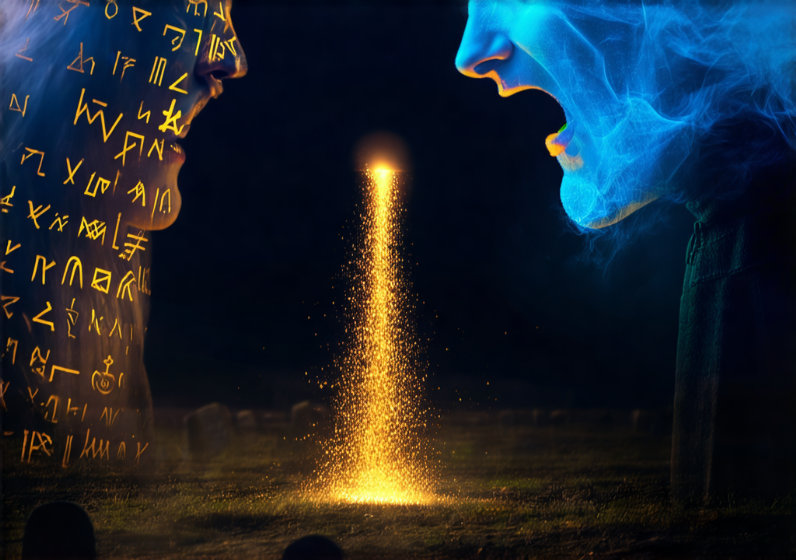
When two people meet, their energy fields interact. This interaction can be synergistic (both fields grow stronger) or parasitic (one field feeds on the other). Psychic vampirism occurs when one person's field consistently draws from another's without reciprocal exchange—either deliberately or through a subtle energetic "leak" that they are unaware of.
The Five Surprising Traits That Reveal a Psychic Vampire
👁️ Here is where it gets interesting. If you are trying to identify a psychic vampire in your life, looking for overtly negative behavior will only get you so far. You might find someone who is rude or demanding but is not actually draining you energetically—they may be annoying, but their field is independent of yours.
Conversely, the most effective psychic vampires are often charming, likable, and even helpful on the surface. They rarely announce themselves as energy-drainers. Instead, they exhibit five subtle traits that reveal the underlying mechanism:
1. The Mirror Without Reflection 🪞
A true psychic vampire has an uncanny ability to mirror your emotions back at you—but with a twist. You share a success and they seem genuinely happy for you... until three seconds later, their face subtly shifts, and the conversation turns toward a comparable achievement of theirs. You share a grief or frustration, and they listen intently—then immediately pivot to how they felt when something similar happened.
This is not simple one-upping. It is an energetic act. By mirroring your emotion, they create a temporary resonance with your field. Your energy flows toward them in the moment of shared feeling. Then, as the conversation shifts to their experience, a subtle siphoning occurs—your emotional momentum now partially powers their narrative.
You leave the interaction feeling unheard, even though they seemed to be listening. That's because your energy was borrowed for their use, not received with genuine empathy.
2. The Perpetual Victim 🎭
Psychic vampires often inhabit a state of perpetual victimhood. Not dramatic victimhood—though it can become that—but a quiet, consistent narrative where the world is always slightly wronging them. The boss is unfair. The partner is inconsiderate. Friends don't appreciate their contributions.
This serves an energetic purpose: victims generate a specific frequency—a low-vibration, sympathetic field that draws in others' higher-frequency energy. When you offer comfort or validation to someone in victimhood mode, your empathic resonance becomes their fuel. You are not just comforting them; you are energetically feeding them.
The surprising part? They often don't realize they're doing it. The narrative of victimhood is so woven into their identity that it feels like a natural state rather than an energetic strategy. They genuinely believe the world owes them something, and this belief continuously pulls energy from everyone in orbit around them.
3. The Attention Black Hole 🕳️
Here's one that surprises people: psychic vampires are often incredibly charismatic. They have a way of drawing others into their orbit—conversations with them feel intense, meaningful, even sacred. You leave feeling "seen" and "understood."
This is not an accident. It is the first stage of the energetic exchange. The vampire's field creates what I call an "attention vortex"—a gravitational pull that draws your focus and emotional energy toward their center. The more you pay attention to them, the more energy flows in their direction.
The surprising insight: it feels good at first. You feel important because they make you feel like you matter. But this is a transactional arrangement. Your sense of importance becomes the currency they spend on maintaining your engagement with them. It's a subtle form of energetic debt that only becomes visible when you step away and realize how drained you are.
4. The Empathy Thief 🎭🔮
This is perhaps the most surprising trait: many psychic vampires are deeply empathic—but they use their empathy instrumentally rather than compassionately.
A naturally empathic person feels your pain and responds with genuine care. A psychic vampire-feeling empathic person feels your pain, experiences a surge of resonance (which feeds their field), but then unconsciously or consciously uses that emotional connection to deepen the bond—making you more invested in them, more likely to give energy, more reluctant to leave.
They feel what you feel. They just do it for fuel rather than for love. And because they are genuinely feeling your emotion (they're not faking it), it's very hard to distinguish their empathy from true compassion. This is why people often say of a psychic vampire: "But they really do care about me!"—and they're right, in the moment of exchange.
5. The Energy Auditor 📊
The final trait is subtle and easy to miss: psychic vampires have an almost subliminal awareness of where energy flows in any interaction. They can sense when you are generous, when you are depleted, when your field is open or closed.
They may not be able to articulate this, but they instinctively know how much energy you can give before you start to feel drained. A skilled psychic vampire will pull back just before you notice the drain—giving you a moment of rest so you'll come back refreshed and ready to give again. They manage the exchange like an accountant manages a ledger.
This is why relationships with psychic vampires often follow a rhythmic pattern: intense connection, slow depletion, brief recovery period, repeat. The vampire has learned to time their energy consumption to match your natural cycles of generosity.
The Surprising Truth: Psychic Vampires Were Once Energy Generators
🌙 Here is the insight that most discussions miss—and it's genuinely surprising when you understand the full picture:
Most psychic vampires were not always what they are today. At some point in their developmental arc, these individuals had a healthy energetic field. They generated more than they consumed. They gave freely because they had plenty to give.
Something disrupted that balance. And it's almost never as dramatic as we imagine. It wasn't one great trauma (though sometimes it was). More often, it was a slow accumulation of small drains—years of giving energy without receiving reciprocal flow, caring for people who didn't care back, pouring into relationships where the other person was quietly siphoning.
The body and field have a finite reservoir. And when you give more than you replenish, eventually the tank runs low. At that point, something remarkable happens: your natural energetic field flips from generator to consumer mode. You start drawing energy from others not because you want to be a vampire, but because your system has adapted to survive on borrowed light.
This is why so many psychic vampires are people who were once the most generous, empathic, and supportive individuals in their social circles. They became what they spent years feeding. The empathy that made them such good friends became the very mechanism that allowed others to drain them—until eventually, they had no choice but to start drawing instead of giving.
It's a kind of energetic karmic loop: the quality you were known for becomes the tool used against you, and then you become the user of that same tool on others. It feels like betrayal, but it is really just adaptation.
The Surprising Paradox: They Are Often More Aware Than We Give Them Credit For
🔮 Another surprising truth about psychic vampires: they are often far more self-aware than their behavior suggests.
This contradicts the popular image of a mindless predator. In my years studying energetic dynamics and interviewing individuals who have identified as psychic vampires (or had it suggested to them), I've found that many of them can describe the process with startling clarity:
"I know it's happening. When someone starts talking about their day, I feel this pull—like a hand reaching out from my chest toward them. And I know if I just listen and stay present, I'll feel better afterward. But if I leave mid-conversation, I feel hollow again."
"Sometimes I don't even realize it until the person leaves and says 'you drained me,' and I think—oh right. I was in that mode today."
"It's like being hungry for water but not knowing you're thirsty until someone offers a glass and you grab it without thinking."
This awareness is what makes psychic vampirism so complex socially. The vampire often feels genuine guilt or confusion about how they affect others. They want to be good. They want to give rather than take. But their system runs on consumption, not production—so the effort required to genuinely give energy is exhausting in a way that non-vampiric people don't experience.
This creates a cycle of apology and repetition: "I'm sorry I drained you," followed by doing it again because their energetic architecture hasn't been rebuilt. They're stuck in a pattern they can see but not easily break out of.
The Energetic Ecology: A Symbiotic View
🌿 Let's zoom out for a moment and look at psychic vampirism from an ecological perspective, because this reframing is surprisingly liberating:
In nature, true parasites are rare. Most species exist in relationships that range from pure symbiosis (both benefit) to mild parasitism (one benefits slightly more). A truly one-sided draining relationship—where the host is slowly destroyed—is actually a sign of imbalance. It usually means the parasite and host have lost mutual awareness.
Human energetic relationships work similarly. Most people exist on a spectrum: we all draw energy from others, and we all give it back. The ratio shifts based on context, mood, life stage, and relationship depth. A parent drawing emotional energy from a child to maintain their own stability is not a psychic vampire—they are functioning within the natural energetic hierarchy of that relationship.
Where does symbiosis become parasitism? It becomes parasitic when one person consistently draws without any awareness or reciprocity—and, crucially, when the other person begins to feel depleted, resentful, or drained as a result. The "vampire" label applies not to the act of drawing energy (which is natural and necessary) but to the lack of mutual awareness in that exchange.
This means: you are all psychic vampires at various times. The person who listens to your problems and leaves you feeling lighter has drawn from your emotional reservoir. The friend who borrows money without asking has drawn from your material-energy flow. We all participate in these exchanges. Psychic vampirism is not a category of person—it's a quality of relationship.
The surprising implication: rather than looking for vampires to avoid, we should look at our own energetic exchanges and ask—am I drawing more than I'm giving? Am I aware of the exchange? Is this relationship mutually sustaining?
The Surprising Solution: You Cannot Fix a Psychic Vampire (And That's Okay)
🕯️ Here is perhaps the most counterintuitive insight I can offer:
You cannot fix a psychic vampire by being more patient, more understanding, or more generous. You might be able to help them become more aware of their pattern. You might be able to coach them through energetic hygiene practices—grounding work, boundary setting, self-awareness exercises.
But you cannot repair their generative capacity from the outside. A psychic vampire is not broken in a way that your love or patience can fix. Their energetic architecture has adapted to consumption mode. Rebuilding it into generator mode requires internal work—the kind of work where they must confront why they stopped generating, grieve what was taken from them, and slowly rebuild their capacity to produce rather than consume.
This is important because it changes how you approach the relationship with a psychic vampire in your life. You don't need to rescue them. You don't need to be their healer or teacher (unless that's the role you've chosen). You just need to protect your own field and manage the exchange consciously.
And here's the surprising part: when you stop trying to fix them, and simply become aware of the energy flow between you two, something shifts. The dynamic changes from one-sided draining to a conscious exchange. You can feel where the draw is occurring. You can choose how much to give. You can step back when your field needs rest. And in many cases—this is the part that surprises people—the psychic vampire senses this shift and begins to adjust their behavior.
Not because you fixed them. Because they finally felt what it's like for someone to be aware of the exchange rather than being passively drained by it.
Practical Wisdom: Protecting Your Energetic Field
🌒 So, how do you actually protect yourself? Here is a practical framework that I recommend to students and clients:
1. Develop an energetic body check. Before entering any interaction—meeting with a colleague, calling a friend, going into a family gathering—take three deep breaths and ask: "What state is my field in right now?" If you're already depleted, be honest about how much energy this interaction will cost you. You can't protect a field that's already low; it needs rest first.
2. Set a mental boundary before the exchange begins. Not a rigid wall—more like an invisible fence with a gate. You decide in advance: "I am giving my full presence to this person for 30 minutes." Or: "I'm listening, but I'm not going to pour into their narrative beyond what feels natural." This pre-commitment creates a structural boundary that your field will respect even when you're mid-conversation and forgetting.
3. Watch the mirror-moment. Remember Trait #1 above? The mirroring-without-reflection pattern? When someone mirrors your emotion and then pivots to their own, notice the subtle energy shift in your body. Your solar plexus might tighten slightly; your breath might change. That's the draw beginning. You can acknowledge it internally: "Ah, I feel the pull toward their narrative now." Just naming it creates a small space of awareness that reduces the automatic flow.
4. Take an energy break afterward. After spending time with someone you suspect is draining you, take 5–10 minutes to ground yourself. Walk outside. Feel your feet on the earth. Place your hands on something solid. This physical grounding helps re-anchor your field and prevents the residual drain from settling into your system for hours.
5. Don't confuse empathy with exchange. If you feel deeply in tune with someone, ask: "Am I feeling this because it resonates naturally with my own experience, or am I being pulled into their emotional frequency?" The former is connection; the latter is consumption. Both can be valid, but knowing which one you're experiencing helps you protect your field.*
A Closing Reflection: The Vampire's Gift
🔮 One final insight that I find genuinely surprising and worth sitting with:
Psychic vampires, for all their draining behavior, often bring a peculiar gift to the people around them. Because they are so attuned to energy flow—so aware of where it moves and how it feels—they can teach others about energetic awareness in ways that "normal" people cannot.
A person who has spent years unconsciously drawing from others eventually develops an almost subliminal radar for energetic dynamics. They know when a room's frequency shifts. They sense when someone is performing rather than being present. They understand the subtle mechanics of how attention flows between people.
In other words: the vampire knows more about energy exchange than most people ever will—because they've been living inside it, whether consciously or not. And if you're patient enough to learn from them (without feeding them), they can teach you things about your own energetic field that years of meditation might not reveal.
This is the surprising paradox at the heart of psychic vampirism: the person who drains you may also be the one most capable of teaching you how to protect yourself. The predator and the teacher are often the same being—just operating from different aspects of their energetic awareness.
🌑 So next time someone leaves you feeling hollowed out after a conversation, before you reach for the label "psychic vampire," try this: ask them, gently, if they know what happened. If they do—if they can describe the draw with clarity and perhaps even a touch of self-awareness—you might be looking at a teacher who hasn't quite figured out how to give back what they've learned.
And that changes everything.