From Witches' Coven to Modern Times: The Evolution of Hexes
🔮 The Living Thread: How Hexes Evolved from Coven to Cult
🌿 By Selene Ravenmoor, Keeper of the Old Words
There is a particular quality to a hex. It does not announce itself with fanfare or incense-heavy ceremony. A hex, in its purest form, is quiet. It is the whispered intention pressed into wax, the name scratched beneath a doorframe, the salt scattered in reverse so that good fortune flows outward and never returns. Where a curse speaks of punishment—of divine retribution or karmic debt—a hex speaks of direction. It takes something natural and bends it toward an outcome. A hex does not ask for misfortune; it invites it gently, like a hand turning a page in the dark.
This distinction matters because it reveals what hexes truly are: not relics of superstition, not parlor tricks of medieval folklore, but one of humanity's oldest technologies of intention. They predate written language. They outlasted empires that burned witches at the stake and survived the very Enlightenment that tried to explain them away as primitive psychology. Today they sit alongside therapy journals, manifestation apps, and self-help affirmations—woven into a cultural fabric that claims to be rational while still leaving small notes in jars by the window.
This is the story of how hexes traveled from candlelit circles to smartphone screens, and why each step forward carried more of their essence than most people realize.
I. The Ancient Roots: When Hexing Was Simply Living
Long before the word "witch" existed, humans were hexers. The practice was so embedded in daily life that it rarely required a name. A farmer who poured milk backward to protect his herd from neighbors' envy was casting a functional hex. A mother who pressed her child's shadow to a door with a pin—so no spirit could walk out through the opening—was performing what we would now call a binding hex. The Greeks had pharmakos rituals where a scapegoat carried the community's misfortune beyond city walls; Romans nailed images of enemies to stakes in gardens, pricking them daily until the rival "withered."
In pre-literate cultures, hexes were not separate from life. They were the salt in the meal. You hexed when you feared a stranger's gaze (the evil eye tradition spans nearly every Mediterranean and Middle Eastern culture). You hexed when you wanted to ensure a marriage held or a rival faltered. You hexed your own shadow on winter solstice night so it wouldn't wander off and be claimed by the dark. The act was practical, almost domestic—no more ceremonial than hanging garlic over a doorway in July.
What made these early hexes powerful wasn't supernatural force. It was social cohesion. When an entire village believed that spitting over your left shoulder deflected a rival's ill will, and everyone performed the gesture, the collective belief created a feedback loop of expectation and behavior. The hex worked because it structured how people watched each other, interpreted gestures, and allocated suspicion. The mind became the engine; the ritual was just the key that turned it on.
This is a detail modern practitioners sometimes lose in their reverence for "mystical energy." Hexes were never just about vibration or frequency. They were about narrative control. To hex someone was to author a story about them and then live inside that story with enough conviction to make it come true through subtle shifts in attention, memory, and choice.
II. The Medieval Crucible: When Hexes Became Heresy
The Middle Ages did not invent hexing. It criminalized it—and in doing so, transformed its social function from folk practice into theological weapon. This is the chapter where the word "hexe" (from Old English and Germanic roots meaning a woman of power or misfortune) entered the lexicon as both accusation and identity.
Churches needed to explain why rural women—midwives, herbalists, keepers of birth and death knowledge—seemed to possess powers that rivalled the priesthood. The answer was elegant in its simplicity: they had made a pact with the Devil. Their herbs were not medicine but philtres. Their community gatherings were not harvest festivals but coven meetings. Their hexes against crops or livestock were not protective rites but demon contracts written in the language of Beelzebub.
The result was a fascinating inversion. Hexes, once a tool for everyday people to protect themselves from an unequal power structure (lords, clergy, wealthier neighbors), became evidence of that very inequality's legitimacy. The powerful could now say: "You are not merely using folk knowledge. You have sold your soul." And because the soul was a theological asset, stealing it meant you were spiritually bankrupt—a state that made further exploitation feel divinely sanctioned.
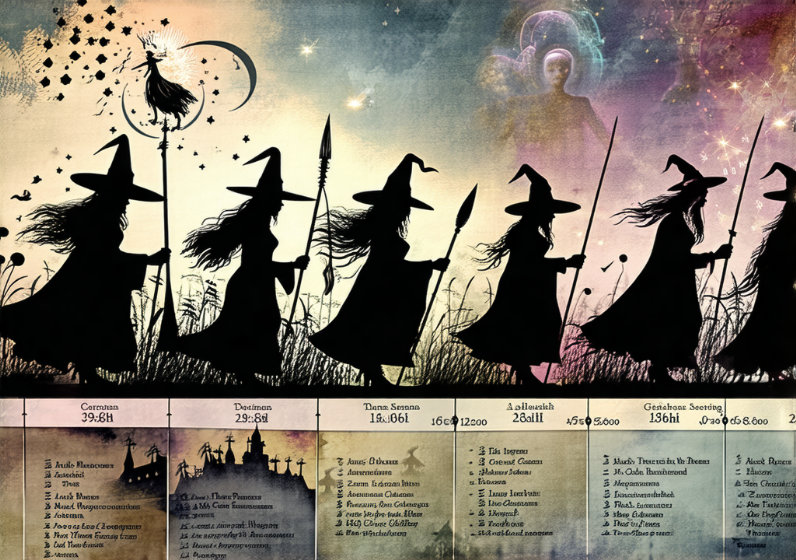
Witches' covens in this period—whether real gatherings or imagined ones—functioned as underground universities. They taught:
Which roots calm the blood and which open the womb
How to read weather in bird flight and cloud shape
When to harvest so potency peaks at full moon vs. new moon
How to write a hex that targets a specific person's will rather than just their health
This was practical education delivered in secret, often by women who had been dispossessed or widowed. The coven was not a mystical brotherhood; it was a mutual aid society with an occult curriculum. And its most potent course? How to bend intention toward outcome without needing the Church's mediation.
The trial records are bluntly useful for historians of hexing. Women accused of "hexing" were often described doing things that read, by modern standards, as basic folk psychology: making a clay figure and pricking it, burying hair in a garden, writing a name on paper and burning it over water. These are technologies. They have mechanisms—memory association, sensory anchoring, narrative framing—that cognitive science can now describe precisely. The hex didn't need the Devil to work. It needed a mind that believed in it.
III. The Enlightenment Correction: When Reason Tamed the Coven
The 17th and 18th centuries brought a strange gift to hexing culture: skepticism that preserved it. Think about this. The rationalists—Locke, Hume, Voltaire—were not friendly to witches. They wanted to explain away the supernatural. And in their efforts, they accidentally built a framework that let hexes survive as cultural practice rather than theological crime.
Hume's famous essay on miracles didn't just argue against witchcraft; it redefined what counts as evidence. A hex works if you can describe the chain of cause and effect: intention → ritual → psychological framing → behavioral shift → outcome. You don't need a spirit in the jar. You need a mind that expects the jar to work, and then a life lived inside that expectation. The Enlightenment gave hexes an alibi. They were no longer proof of the Devil's hand; they were proof of the human mind's extraordinary power to shape reality through narrative.
Simultaneously, the coven structure migrated from rural villages into urban salons. Secret societies—Masonic lodges, chivalric orders, literary clubs—bore structural resemblance to witches' covens: a small group, shared symbols, ritualized meetings, a curriculum of secrets passed down in stages. The form survived even as the theological content was stripped away or repurposed. When someone joined a lodge and learned their "hexing" through graded initiations, they were doing something structurally identical to what a 14th-century coven did with its herbal lore—except the enemy was no longer the parish priest but social exclusion itself.
This period also birthed the aesthetic of the modern hex. Think of how Gothic literature—Shelley, Brontë, later Stoker and Dines—turned the witch into a figure of romantic power rather than theological punishment. The hex became a metaphor for hidden knowledge, female autonomy, and the quiet violence of social expectation. By the time someone in 1890 bought a book titled "The Witch's Craft," they were buying a philosophical position, not just a recipe.
IV. The 20th Century: When Hexes Went Mainstream and Underground
The 1900s split hexing culture into two streams that would eventually reunite: the academic stream and the countercultural one.
The Academic Stream. Anthropologists like James Frazer (The Golden Bypass, 1890) and Mircea Eliade (A History of Religious Ideas) documented hexes across cultures with a clinical precision that was, to practitioners, both validating and dehumanizing. They described sympathetic magic—the principle that "like affects like" or "part represents whole"—as a universal human cognitive bias. A hex on a clay doll works because the mind treats the symbol as a proxy for the person. A hex through water works because water is associated with flow and change, so pouring it carries connotations of washing away or carrying toward an outcome.
This was not dismissal. It was translation. The anthropologists said: "You don't need the spirit in the doll. You need a mind that believes in symbolic correspondence." And for many practitioners, this was liberating. If hexes work through psychology rather than metaphysics, then anyone can learn them. No lineage required. No coven membership needed. Just understanding how narrative and symbol shape behavior.
The Countercultural Stream. The 1960s and 70s brought the modern witchcraft revival—Gardnerian Wicca, Dianic movement, Neopaganism. Gerald Gardner's systematization of "Wicca" (coining the term from an old English word for a witch) created a structure that felt both ancient and new: rituals marked by seasons, a coven as community, hexing as one tool in a broader spiritual toolkit. Hexes became part of a lifestyle—a way to feel connected to nature, to women's history, to a pre-Christic past.
The counterculture stream also brought hexes into the realm of identity politics. To practice hexing was to implicitly say: "My knowledge is not primitive. It is old, valid, and yours only if you choose it." In a world still structured by institutional authority (church, state, corporation), the coven reasserted that small groups with shared intention could shape outcomes without needing permission from above.
The two streams met in the 1980s and 90s as New Age spirituality merged folk magic with self-help culture. Books like The Secret (2006) didn't mention hexes by name, but their core mechanism—focus intention, believe it into being, act on that belief—is structurally identical to a traditional hex. The jar of salt and a photo became a journal entry; the clay figure became an affirmation spoken in front of a mirror. The technology stayed. Only the packaging changed.
V. Digital Hexes: When the Coven Became an Algorithm
And now we arrive at the present, where hexes live inside smartphones, podcasts, and 3 AM group chats. Let's not romanticize this too much—there is something genuinely strange about a woman in Toronto whispering "may your plans crumble" into her phone camera while watching a YouTube tutorial on "how to write a banishing spell," then posting the result in a Discord server where 200 people respond with 🕯️ and 🌙.
But look closer, because the structure is remarkably consistent:
Intention → spoken or written (a prompt, an affirmation, a comment)
Symbolic anchor → a photo, a candle, a crystal app icon, a hashtag
Narrative framing → "I am releasing this" / "This person will feel the shift"
Community validation → likes, shares, replies that reinforce the story
Behavioral follow-through → small acts of attention that align with the intention
That is not different from a 14th-century coven gathering to pray over a jar. The medium changed; the mechanism did not. What has changed is scale and speed. A medieval hex took days or weeks—gather, prepare, perform, wait for the neighbor's crop to yellow. A digital hex can be cast in four minutes between scrolling sessions. And it can be shared with 50,000 people who each feel a small thread of narrative connection to your intention.
There are some genuinely new phenomena worth naming:
The Hex as Personal Brand. Influencers sell "hex kits" and "banishing bundles." The hex becomes a product, a content format, an aesthetic. This is neither better nor worse than the 17th-century witch selling her philtres in the market square. The economy of intention is older than commerce itself.
The Hex as Therapy. Modern practitioners openly describe hexing as "externalized journaling" or "ritualized cognitive restructuring." You write your fear onto paper, burn it, and now that fear has a physical shape you can look at, touch, and release. This is functionally identical to what a 19th-century woman did when she pressed a lock of hair into clay and buried it in the garden "so her worry would grow roots and leave." The psychology was there all along; we just needed better vocabulary for it.
The Hex as Social Glue. Group chats where women collectively hex their shared stress—workload, relationships, systemic inequity—function exactly like a coven's shared intention. You are not alone in your wanting or needing. The group's belief becomes the engine; the ritual is just the key.
The Hex as Protest. Modern movements use hex-like framing: "May this system crumble," "May those who harm be seen clearly." These are not curses. They are directional intentions aimed at structures rather than individuals, and they carry a quiet, persistent pressure that feels less like punishment and more like narrative momentum.
VI. What Has Actually Changed? (And What Hasn't)
Let's be precise here, because this is where most modern discussions of hexes go fuzzy.
What has changed:
The audience. Hexing was once a private or coven-level practice; now it can be broadcast globally in seconds.
The vocabulary. We no longer say "the Devil is in the jar." We say "I am directing my intention toward this outcome." Same mechanism, cleaner grammar for a secular world.
The gender politics. Early hexing was predominantly female knowledge (because women held most folk medicine and household authority). Modern practice is more gender-fluid, though still culturally feminine-coded.
The access barrier. You no longer need to be born into a lineage or adopted by a coven. A YouTube video is as good a teacher as a grandmother's kitchen table—though it lacks the embodied, sensory richness of learning by doing together in a room that smells of beeswax and sage.
What has not changed:
The core mechanism: intention + symbol + narrative → behavioral shift → outcome.
The social function: hexes create shared belief, which structures attention, which shapes behavior, which produces results.
The emotional need they fill: the human desire to feel that you are not passive in your life; that your wanting has weight and direction; that the world is not merely happening to you but can be gently steered by you.
The hex has survived every regime—feudal, church-state, Enlightenment, industrial, digital—not because it is "magical" in a supernatural sense, but because it addresses a stable feature of human psychology: we are narrative animals, and we need our stories to have agency. A hex is the smallest unit of that agency made tangible.
VII. The Quiet Continuity
Here is what I think most people miss when they study or practice hexes: they are not trying to control reality. They are trying to align with it. There is a difference, and it's the one that separates a hex from a curse and a wish from a command.
A curse says: "Let this bad thing happen to you." A wish says: "I hope for this good thing." A hex says: "Here is the direction I am pointing my life toward; now let me act in ways consistent with that direction, and let others who share the story also act consistently." It's collaborative. It's quiet. It doesn't require a coven of twelve or a full moon or a specific crystal. It requires a mind that has decided what it wants and then the discipline to keep believing and acting on that decision until the outcome crystallizes.
That is not magic in the parlor-trick sense. That is one of the oldest, most human technologies we have. And it works—on coven firelight, in Gothic novels, in journaling prompts, in 3 AM group chats, in boardrooms where a project lead quietly reframes a narrative and watches the team's behavior shift over three weeks.
The evolution from witches' coven to modern times is not a story of loss or dilution. It is a story of translation. The hex has been translated into every language, every medium, every social structure that has existed since pre-literature. And in each translation, the core survives: the quiet act of taking your intention and giving it shape, direction, and a small ritual anchor—so that the mind can believe in it long enough to make it true.
🕯️ The thread is unbroken. It was never broken. We just keep learning new words for the same old wanting.