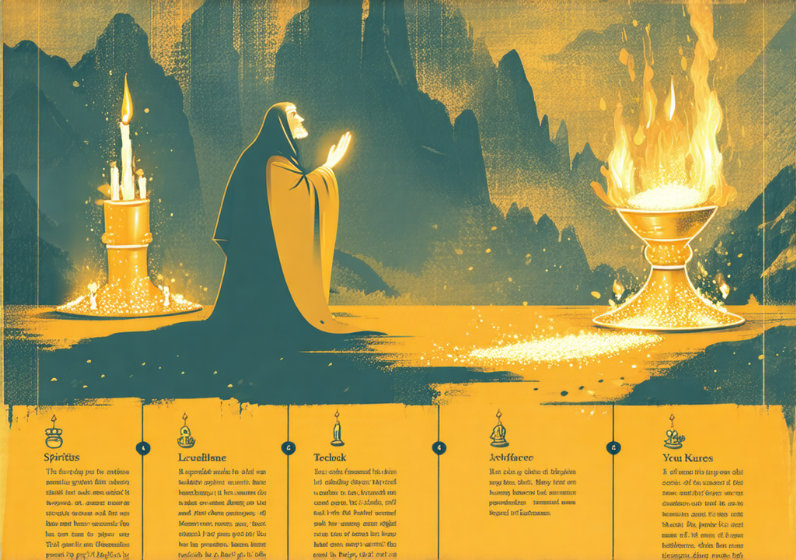
Astral Travel For Beginners - Everything I Wish I'd Known Starting Out
✦ The Unseen Veil & The Wandering Soul — A Primer for New Astral Travellers ✦
by Aurelius Moonwhisper, Keeper of the Thresholds
You have decided to walk where few dare. You have chosen to lift your awareness from the heavy clay of the physical body and let it drift into the luminous fields beyond. This is not a fantasy; this is a discipline as old as consciousness itself, refined by monks, mystics, mediums, and modern seekers alike. And like every true initiation, there are things you will wish you had known before your first trembling step through the veil.
This is that knowledge. Gathered from years of practice, failure, breakthroughs, and quiet revelations at 3 a.m. when the world is still and the inner senses sharpen to an almost painful clarity. Read it slowly. Let each passage settle into your awareness like dust motes in a shaft of candlelight.
🕯️ The Nature of What You Are Attempting
Before you lie down on your first night of practice, understand what "astral projection" actually is and — just as importantly — what it is not.
The popular imagination paints the experience as a glowing body shooting out of the mouth or crown, floating above a sleeping form like a hologram in a science-fiction film. It is poetic, but it misses something essential. Astral travel — whether you call it astral projection, out-of-body experience, lucid dreaming at its most vivid, or soul-journey — is not primarily about leaving. It is about remembering that you were never confined to the body in the first place.
Your awareness is a field, not a point. Your consciousness extends far beyond the skin. The physical body is an anchor, a tuning fork, a particular vibration of matter that your awareness uses to perceive and interact with the three-dimensional world. Astral travel is what happens when you loosen that coupling — not severing it, but relaxing the grip so that your awareness can explore the subtler layers of reality that are always present, always humming, but rarely attended to by the sleeping mind.
This reframing matters because it changes how you approach practice. You are not trying to force yourself out of a prison. You are learning to tune in to a signal that is already broadcasting. The body is not the container for consciousness; it is one expression of it, like a single note in an infinite chord.
🌙 Choosing Your Method (Or Why "The Best Technique" Is a Myth)
Every teacher will hand you a technique. The rolling method. The rope technique. The vibration method. The relaxing-into-tension method. The sensory-deprivation approach. The mantra-and-intent approach. And each one works, and none of them is universally superior. This is because the technique is not the point. The technique is a gate, and gates only work if you actually walk through them.
My advice for beginners: pick two methods and rotate between them. If you rely on a single method and it fails on any given night, your confidence erodes. With two approaches, one will often open when the other does not. Also, do not mistake familiarity with mastery. You may be able to "do" a technique mechanically while your awareness is still asleep behind your eyes. The goal is not to perform a ritual; it is to become awake in a state where most people are not awake.
A few practical notes on method selection:
The Vibration Method works well for those who have good interoceptive awareness — the ability to feel internal bodily states. You learn to distinguish the subtle hum of energy building up and let it wash over you without clenching or straining. If you are a person who notices when your stomach growls before you decide to eat, this method will speak to you.
The Rope Technique is more active and visual. You visualize a rope hanging from the ceiling above your bed and grab onto it with your astral hands. This works well for people with strong imaginative capacity — writers, artists, musicians, anyone who lives in their head in a vivid way. The key is that you must feel the texture of the rope, not just see it. Engage all senses.
The Rolling Method is deceptively simple: you relax completely, feel the body go limp, and then gently roll to one side — but the part that rolls is your awareness, not your muscles. Your physical body stays still or moves only slightly. This method suits people who are comfortable with bodily sensation and less comfortable with elaborate visualization.
The Hypnagogic Approach (drifting off while maintaining a thread of observation) is perhaps the most natural for beginners because it requires no technique at all — just the willingness to watch your own drowsiness without losing track of yourself. Many first genuine OOBEs happen this way, accidentally, in the space between sleeping and waking.
Whichever you choose, the underlying principle is the same: maintain a witness. You must be simultaneously in the experience and observing it. That dual awareness — the "I" that watches the "me" doing things — is the engine of all conscious astral travel.
📖 The Sleep Paralysis Question (And Why It Is Your Greatest Teacher)
You will likely encounter sleep paralysis in your early sessions. Your body is asleep; your mind is not fully asleep. You are conscious, perhaps aware of a presence, a pressure on the chest, a strange light at the edge of vision, or an uncanny sense that something else is in the room. And you cannot move.
Beginners often panic. They feel trapped and want to fight the paralysis, which only makes it worse — tension pulls your awareness back into the body like a fisherman yanking a line. Instead: breathe slowly. Observe without judgment. Let the experience be exactly as it is.
Sleep paralysis is not your enemy; it is a demonstration of what you are working toward. Your consciousness has already separated from the motor function of the body. You are awake while your body sleeps. The only missing piece is intentional direction. If, during that moment of paralysis, you can generate a clear intention — "I will rise," or "I will open my eyes to the room" — and hold it with calm certainty rather than anxious force, many practitioners find they step through into a fully conscious projection.
Not every session will produce this result. Some nights you will simply lie there, aware of your own sleep, in a state that is half-dreaming and half-waking. That is not failure. That is the work. The mind must learn to be comfortable in liminal states — the threshold spaces where certainty dissolves and new perception becomes possible.
🕸️ The Cord (And Why You Should Trust It)
One of the most persistent questions from beginners: What holds me to my body? What happens if I travel too far? Can I get lost out there?
The traditional answer — and it is true, though "true" here means experientially verified rather than scientifically proven — is the energy cord or silver thread. It connects your astral form to your physical body. As long as that connection is intact, you can return home at any time by simply willing yourself back. The pull of the cord is constant and gentle, like a leash that only tightens when you walk too far.
Practically speaking: never travel beyond what feels comfortable. In your first sessions, stay close to your body — within the room, perhaps in the next room over. Feel the texture of the connection. Notice how it changes as you move further from your sleeping form. Build confidence incrementally. A beginner who projects three blocks away on their second session and then loses the cord is going to have a very memorable (and potentially frightening) experience that may make them want to quit.
You will also discover, over time, that the cord is not a single unbroken wire. It has texture, color, temperature, even mood. On calm nights it feels like cool silk. On anxious nights it feels thin and slightly taut. This feedback loop — using your inner senses to read the state of your own connection — is one of the most valuable skills you will develop in practice.
🧘 The Pre-Sleep Ritual (Structure Is Freedom)
You do not need an elaborate altar, but you do need consistency. Your mind needs a reliable sequence of cues that say: we are about to shift gears; we are about to enter the threshold space. A simple, repeatable ritual anchors your intention and reduces the "am I actually doing this or just lying here thinking nice thoughts" doubt that plagues every beginner.
A workable pre-sleep routine might look like this:
Dim the lights. Eliminate visual stimulation 20 minutes before you plan to begin. Let your eyes adjust to low light; the inner senses sharpen when outer vision is reduced.
Settle the body. Get into a comfortable lying position — usually supine (on your back) for most methods, though some find side-lying easier. Unclench your jaw. Relax your shoulders. Feel the weight of the mattress supporting you.
Breathe and release tension. Ten slow breaths, or as many as you need to feel the physical body go quiet. Each exhale should feel like you are letting go of one small thing — a thought, a muscle group, a mental image.
State your intention clearly. Not a vague wish but a specific, present-tense declaration: "I am aware in my astral form." Or "My awareness is moving through the wall now." Say it mentally with conviction, as if reporting a fact rather than hoping for one.
Choose your anchor image. A doorway, a staircase, a familiar room, a specific location you have visited and know well. This gives your inner senses a place to "land" when they detach from the physical.
Begin your method of choice. And then — this is the part most beginners get wrong — stop trying. Let go of the effort. You are not pushing; you are allowing. The experience will come in its own time, and the moment you stop straining for it, your awareness often slips through like a fish slipping from cupped hands.
🌐 What It's Actually Like (So You Know What to Expect)
The first successful projection — if you count "success" as full conscious separation rather than a fleeting 2-second glimpse of the room in hypnagogia — often feels less dramatic than you expected. There is no blinding light. No chorus of angels. No spinning tunnel of color.
Mostly, it feels like being somewhere else while also being here. You perceive the room from a different vantage point. The colors are slightly different — not exactly wrong, but shifted in hue and saturation, as if you're looking through water or through a window that has aged a little. Sound is muffled, distant, arriving with a faint delay, like hearing music from an adjacent room. You can see your own body lying still on the bed, and seeing it does not feel like watching yourself; it feels more like confirming a fact you already knew.
Movement through space in the astral state is smoother than physical movement. There is no inertia to overcome. You decide to be at the other end of the room, and there's a gentle easing into that position — not teleportation exactly, but a fluidity that defies the physics your body knows. Turning your head is instant; crossing the room takes a beat, but it feels like leaning rather than walking.
The quality of perception changes. Details you would normally overlook — the grain in the wood of the floorboard, the faint hum of the refrigerator, the specific pattern of dust on the windowsill — become available with an almost tactile clarity. It is as if your senses have been turned up to a setting that normal waking life doesn't require.
And then there's the feeling. The emotional texture of astral travel is often described as calm clarity — not euphoria, not excitement, but a deep, quiet certainty. You know where you are. You know what you're perceiving. There is no doubt in the way that permeates ordinary waking life ("am I seeing this right? am I imagining it?"). In projection, the knowing is direct and unmediated.
⚡ Common Beginner Pitfalls (And How to Navigate Them)
1. Straining. This is the number-one killer of a good session. Beginners treat projection like a muscle group they're trying to flex: push harder, push harder, PUSH. But astral travel responds to relaxation and intention, not force. If you feel yourself clenching your jaw or gripping your hands into fists during practice, you are working against the process. Let go. Breathe out. Trust that the experience will arrive when the conditions are right.
2. Believing it must look a certain way. Your first projection may be blurry. The colors might be wrong. You might "see" the room from inside your own chest, or from above the ceiling, or in some geometrically impossible vantage point. This is normal. Your inner senses are calibrating. Don't judge the experience by cinematic expectations. Judge it by whether you were aware and present in a state that was not ordinary waking consciousness.
3. Chasing the experience. After one good session, beginners often feel a pull to repeat it on the same schedule, in the same location, with the same technique. And when it doesn't replicate exactly, they conclude they've lost their ability. Projection is not a light switch; it's more like weather — sometimes clear, sometimes foggy, and your "ability" is not being turned on or off. It's more like attunement. The channel is always there; you're just varying in clarity of reception.
4. Neglecting the return. Beginners often get so absorbed in exploration that they forget to mindfully re-enter the body. This can lead to a slightly disoriented "re-entry" — a few minutes of feeling floaty or slightly detached from physical sensation before it settles. It's not dangerous, but it can be unsettling if you weren't expecting it. Practice intentional return: when you're ready to come back, find the cord, feel its pull, and let your awareness flow home like water finding a drain. Breathe with your body once you're back. Feel the weight of the sheets. Ground yourself in the physical before getting out of bed.
5. Treating it as separate from daily life. Astral travel is not an escape from reality; it's an expansion of perception. If you project on Tuesday and go to work on Wednesday with no change in how you perceive, interact, or pay attention, the practice has remained siloed. Let the clarity, the calm, the expanded sensory awareness you experience in projection bleed into your waking life. You will notice more. Feel more. Be more present. The practice is not just about what happens while you're out of body; it's about what changes in how you inhabit the body when you return.
🕸️ The Subtler Layers (And Why "Room Size" Is a Starting Point)
Once you are reliably projecting and have built some comfort with the immediate environment — your room, your house, perhaps the block around it — you will begin to sense that there is more to explore than just going somewhere else. And here's where the practice deepens in ways that many beginner guides don't prepare you for.
The astral plane is not one place. It has layers, densities, textures. The "room" you project into first is usually a relatively dense, familiar reflection of your physical space — what some traditions call the lower astral or the emotional plane. It's comfortable because it looks like home. But if you keep exploring, you'll find that the quality of perception changes as you move further from your body. Colors become more vivid or, paradoxically, more transparent. Sounds change in timbre. You might encounter forms or presences that don't correspond to any physical object — not ghosts in a horror-film sense, but energetic patterns with their own coherence and intentionality.
You may also discover that the same location can look different at different times of day, under different emotional states, or on days when you've meditated versus days when you haven't slept well. The astral is not a fixed landscape; it's a living field, responsive to your state of awareness just as a lake reflects the sky above it. Your inner weather changes the outer scene.
You will encounter "other" — and it may be more interesting than you expect. Not every session involves meeting entities or presences, but many do. These range from simple, ambient intelligences (a general sense of awareness in a space, not personified) to more distinct forms that communicate through image, feeling, or symbolic gesture rather than language. Some are familiar — they look like people you know, or places you've been. Some are entirely new and strange. The key beginner skill here is discernment: learning which impressions to attend to and which to let pass, without either dismissing everything as "just imagination" or accepting every image at face value as "truth."
Lucid dreaming is a cousin, not an identical twin. Many beginners conflate the two because they share features: awareness during a non-ordinary state, vivid sensory experience, a sense of freedom from physical constraint. But lucid dreaming typically occurs in the dream state — you are in a narrative with internal logic that bends to your attention. Astral projection, at its clearest, feels more like perceiving an environment that has a degree of independence from your will. You can look around; things are there whether or not you want them to be. In lucid dreaming, if you don't think about the sky, it may fade. In astral travel, the sky is there because it's part of the field, and your attention simply chooses which aspect to attend to.
(That said, the boundary between these states can be blurry in practice, and many experienced practitioners report a spectrum rather than a hard line. Don't get too hung up on taxonomy. What matters is that you are aware and intentional.)
🧪 Safety, Hygiene, and the Practical Realities
Astral travel is not dangerous in any physical sense — your body remains in bed or wherever it was when you left. But there are practical considerations:
Keep a journal. Write down what you experience while memory is fresh. The details that feel trivial in the moment ("the wall looked slightly blue-green instead of white") become meaningful patterns over time. You will learn to read your own inner weather from these notes.
Protect your space. This isn't supersticism; it's practical psychology. If you practice in a cluttered, noisy, or uncomfortable room, your inner senses will pick up on the dissonance and it will color your experience. A clean, quiet, comfortable physical environment supports a clear inner one. Light, dimmable, stable lighting helps. Reduce background noise (mute notifications, close doors).
Stay hydrated. This sounds trivial but matters more than you'd think. Your body is doing real work during these sessions — the nervous system is in a unique state, and mild dehydration can make re-entry feel disorienting or leave you feeling foggy for an hour after.
Don't practice when exhausted or ill. If you're running a fever or were up at 4 a.m., your inner senses will be muddier than usual and the experience may feel less clear or more distorted. That doesn't mean it wasn't "real" — but you won't get as much signal through the noise of a tired body.
Respect the rhythm. Astral travel is not a performance metric. Some days will be clear; some days will be foggy; some days, nothing happens and that's fine. Treat your practice like tending a garden rather than chasing a harvest. Consistency over intensity. Patience over urgency.
🌙 The Deeper Work (Where the Practice Goes After the Basics)
Once you have reliable projection and are comfortable with the immediate environment, the practice opens into dimensions that many beginners never discover because they stop exploring the moment it stops being "fun" or "impressive."
Sensory expansion. You will learn to perceive in ways that don't map cleanly onto the five physical senses. You might sense emotional fields around people (or around spaces), feel the quality of a room's "memory," or become aware of subtle energetic patterns — currents, textures, temperatures that aren't thermal but qualitative. This is not mystical hand-waving; it is a refinement of perception along axes that physical biology doesn't emphasize but that your awareness can access when untethered from motor function.
Intention and shaping. As you grow more confident in the astral state, you discover that your attention genuinely influences what you perceive — not by creating reality (the environment has its own coherence), but by tuning which aspects of it become salient to you. This is not the same as "manipulation" or "wishful thinking." It is closer to how a musician's ear finds harmonies in a chord that an untrained listener hears only as noise. Your awareness becomes more selective, more discerning, more capable of attending to what matters.
The question of purpose. Beginners project because it's interesting, impressive, or validating ("I did it! I'm special!"). Mature practitioners project because they want to understand. What is this field I'm perceiving? How does my state affect it? What can I learn from the clarity that projection provides that waking life doesn't? The practice matures when you stop treating it as a trick and start treating it as an instrument of perception — a way of knowing that supplements but doesn't replace ordinary awareness.
Integration. The ultimate goal of astral travel is not to spend more time out of the body. It's to bring back what you learned in the subtler states into the densest state: embodied, social, material life. If your projections are calm and clear but your Tuesday morning commute is still a fog of autopilot, the practice has only partially succeeded. The real test is whether you can carry that quality of aware, unclenched, present perception through a grocery store, a work meeting, a conversation with a friend — all the dense, noisy, demanding textures of physical life.
🕯️ A Final Word on Trusting Your Own Perception
In the beginning, your inner experience will feel uncertain. You'll wonder: Am I imagining this? Am I confusing memory with perception? Am I constructing these images rather than perceiving them? This doubt is normal and healthy — it's the mind checking its own work. But over time, if you practice consistently and honestly, something shifts. The distinction between "imagining" and "perceiving" becomes clearer to your inner senses in a way that ordinary waking life never teaches you. You develop an inner eye for truth — not a certainty, but a felt quality of "this is what I am perceiving right now, with this level of clarity, from this vantage point."
You will also learn to be humble about your perceptions. Not everything vivid was important; not everything subtle was real in the way you wanted it to be; and not every "presence" you encounter will be as benevolent or as meaningful as you'd hope. The astral is a field of information, not a reward system. It gives you what's there — which may include confusion, ambiguity, and experiences that are more puzzling than illuminating. Learning to sit with that uncertainty without needing it to mean something specific is one of the quietest, most valuable skills the practice teaches.
📜 A Suggested First-Month Practice Structure
If you want a concrete starting point:
Weeks 1–2: Focus on relaxation and witness-awareness. Ten minutes daily. Lie down, breathe, feel your body go quiet, maintain the thread of "I am aware" as drowsiness builds. Don't chase an experience; just practice not losing track of yourself while falling asleep.
Weeks 3–4: Add one projection method (vibration or rope are good starting points). Practice the technique for 10–15 minutes before sleep, with clear intention stated. Aim for 2–3 sessions per week rather than daily; consistency matters more than frequency at this stage.
Ongoing: Journal after each session. Note the quality of perception, any details that felt "real" versus constructed, your emotional state, and what you learned about yourself from the experience. Re-read old notes monthly. Patterns will emerge that are invisible in the moment of practice.
Monthly check-in with yourself: Am I straining? Am I judging experiences too quickly? Am I integrating what I learn into waking life? Am I being honest about uncertainty, or am I papering over it with confident language? These questions matter more than any technique.
You are entering a practice that is as old as human self-awareness and as personal as your own nervous system. There is no shortcut, no app, no supplement that will do the work for you. What you need is a quiet room, a consistent intention, a willingness to be uncertain, and enough patience to let your inner senses calibrate over time rather than demanding clarity on day one.
The veil between the seen and the unseen was never as thin as your waking life makes it seem. You already live on both sides of it — you just haven't learned how to look from this side yet.
Begin where you are. Breathe. Let go. And trust that awareness, once loosened from its habitual grip on the physical, will find its way home in a form you did not expect.
— Aurelius Moonwhisper