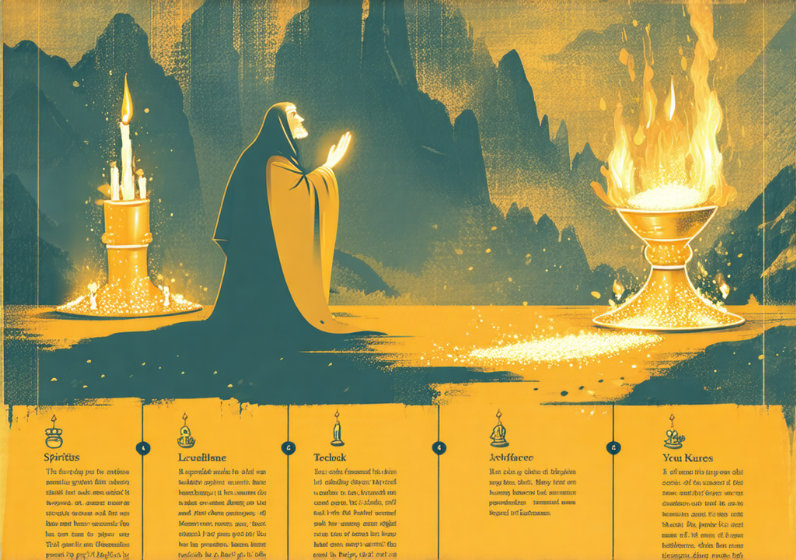
The Dead Want to Talk—And They've Been Patient Enough
The Dead Want to Talk—And They've Been Patient Enough
By Maudeline Voss, Keeper of the Silent Threshold
There is a particular quality to silence in a room that has recently held a funeral. It is not empty. It is full. The air seems thicker, as though it still remembers the weight of grief, the murmur of eulogies, the faint perfume of lilies and the damp earth smell that clings to shoes no one bothers to scrub clean. If you stand in that silence long enough—truly listen—you begin to hear something else beneath the quiet. Not a sound exactly. More like an expectation. A patient, unblinking attention from somewhere just on the other side of the membrane between the living and the departed.
The dead want to talk. And they have been remarkably, almost unbearably patient while we pretend otherwise.
I. The Forgotten Art of Listening
Necromancy is often misunderstood. In popular culture it has become something slightly embarrassing—a parlor trick for gothic novels, a cinematic device where a medium shakes a crystal ball and announces that Aunt Clara is watching from the ceiling fan. Academic institutions have done little to help; they classify necromancy as "the magical art of communicating with the dead," which sounds so clean, so neatly packaged, like a footnote in a taxonomy of supernatural phenomena. As though summoning the spirit of your grandmother was on par with calling a plumber.
It is not that at all.
Necromancy—neko-mancy, knowledge of the dead—is one of the oldest human technologies we possess. The word itself comes from the Greek nekros (corpse, dead body) and manteia (divination, prophetic utterance). But etymology only scratches the surface. At its core, necromancy is not about raising corpses or commanding ghosts to perform tricks. It is a discipline of attention. A practice of creating conditions under which the boundary between life and death becomes permeable enough for genuine exchange to occur.
Consider what we have lost. The ancient Egyptians built entire temples around the assumption that the dead were still present, still listening, still hungry for bread and beer and conversation. The Romans left defixiones—curse tablets—buried at crossroads, addressed directly to chthonic deities but implicitly also to the restless shades of the departed. Medieval monks kept lists of the names of the dead in their monasteries, reading them aloud every evening as an act of communal remembrance that functioned, in effect, as a daily séance. The practice was not exotic. It was domestic.
Somewhere along the way, perhaps in the eighteenth century with the rise of empiricism and the Protestant suspicion of anything that might imply the continued existence or agency of souls, we decided this was too much. Too intimate. Too inconvenient. We wanted our dead to be dead—silent, still, archived in cemetery plots or crematoriums, reduced to a name on a plaque. And so necromancy became specialized, professionalized, and pushed into the margins where only the spiritually adventurous or the commercially motivated would pursue it.
We outsourced the conversation with our own ancestors. And now we act surprised when the dead seem distant, formal, like relatives who have moved to another country and stopped calling.
II. What the Dead Actually Want
Here is what separates a practitioner of genuine necromancy from a fraud or a poet: the assumption that the dead are not merely present but interested. They want specific things. Not vague spiritual energy. Not cosmic balance. Specific, often mundane, sometimes urgent things.
They want to know if you ate. Whether the garden survived the winter. What happened with that lawsuit. How the children's health is holding up. They want corrections—you remember the house on Elm Street differently than I do; it had blue shutters, not green. They want confessions they couldn't make in life. They want to settle small scores and large ones. They want to be heard, which is different from being remembered. Remembering someone is an act of the living mind. Being heard by the dead requires something more: a genuine opening, a loosening of the will, a willingness to receive information that might be awkward or unwelcome.
This last point is crucial and rarely acknowledged in popular spiritual practice. The dead do not always flatter us. A grandmother's spirit does not need you to feel good about your life choices. An ancestor whose reputation was tarnished by family gossip wants the truth spoken, even if it makes the current generation uncomfortable. Necromancy, done honestly, is often a conversation in which we are told things we would prefer to leave unsaid. The dead have no stake in our self-image. They remember us as we were, not as we wish to be perceived.
I have sat with clients who expected to receive warm affirmations from deceased parents and instead received quiet corrections: You didn't stand up for your brother the way you said you did. Or: The letter I wrote was never sent; the draft is still in my desk drawer. These are not dramatic revelations. They are small, specific, human. And they carry a weight that no generic spiritual message can replicate.
III. The Mechanics of the Threshold
Let us be practical. How does one actually create conditions for genuine communication with the dead? I will lay out what works in my own practice after thirty years of sitting at this threshold, because I find that people respond better to specific instructions than to poetic abstractions.
Space matters. You do not need a temple or a specially consecrated room. But you do need a space where you can be undisturbed for at least an hour. Turn off the television. Silence your phone. Close windows if there is wind outside—wind carries sound, and sound disrupts the subtle frequency at which spirit-communication operates. The room should feel settled, as though it has stopped moving.
Timing matters more than most people assume. The hours between dusk and midnight are traditionally considered the thinnest part of the veil. This is not superstition; it corresponds to a genuine perceptual shift in human consciousness. As light fades, the brain's reliance on visual processing decreases, and other sensory channels become more receptive. Many practitioners find that the period around 10:30 pm—what medieval Europeans called the "witching hour" or ora media—produces the clearest contact. If you are new to this practice, try three consecutive evenings at the same time. Consistency teaches your nervous system what to expect.
Preparation is not ritual in the performative sense. It is mental clearing. Before you begin, spend ten minutes simply breathing and releasing the day's concerns. You do not need to light candles or burn sage (though these can help as anchors for attention). What you need is a mind that is quiet enough to notice when something else speaks. This is easier said than done. We are a noisy species. The internal monologue rarely stops. Training it to pause, even briefly, is the foundational skill of necromancy and requires practice in the same way that any meditative discipline does.
Question with specificity. One of the most common errors beginners make is asking open-ended questions: Is my grandmother's spirit here? What do you want to tell me? These are invitations for noise rather than conversation. Instead, ask specific, verifiable questions. Grandma, in 1974, did you paint the kitchen cabinet doors yellow or cream? Dad, when you were stationed in Hamburg, which restaurant did you take Mom to on our anniversary? The dead can answer these with a clarity that feels almost physical—a sudden warmth behind the eyes, a specific word that surfaces unbidden in your mind, an image of a color or a smell that arrives without your constructing it. Specificity filters out noise.
Do not interpret too quickly. When you receive information—whether it comes as a word, a sensation, a visual flash, or an emotional tone—write it down immediately before rationalization begins to reshape it. Our minds are remarkably efficient at turning the unfamiliar into the familiar. A memory of blue shutters becomes "I think she probably had blue shutters." Writing preserves the raw data. You can interpret later.
IV. The Ethics of Necromantic Practice
This is a section I wish more practitioners would read and internalize, because necromancy without ethical discipline devolves into either self-indulgence or exploitation.
Consent. Not all dead wish to be communicated with. Some are in a state of rest—what older traditions call the land of sleep—and do not want to be woken for conversation. Some have unfinished business that requires time, not interrogation. A respectful practitioner learns to read the quality of contact: is this an eager presence or a tired one? Is the communication rich and specific or thin and repetitive? Sometimes the answer to "Do you wish to speak?" is a gentle not today, and a good necromancer honors that silence rather than pressing for more.
Reciprocity. The conversation between living and dead is not extractive, though it can feel that way. You are asking something of the dead—attention, memory, effort in reconstituting a sense of self that has begun to dissolve into the larger field of ancestral presence. In return, you offer what they lack: current information, small acts of remembrance, corrections to the family record. Bring them news. Tell them about the grandchild's first steps. Let them know if the house was sold and who bought it. These are not sentimental gestures; they are practical exchanges between two parties with different access to time and place.
Do not speak for the dead. This is a small matter that can become a large one in family settings. If you have received communication from a relative's spirit, share only what was shared directly, or paraphrase carefully. Do not add your own interpretation as though it came from them. The spirit told me you should sell the house is different and more honest than I think you should sell the house. The dead are already gone; they do not need our embellishment, and living family members deserve to know what was actually communicated versus what we projected onto the communication.
Confidentiality. In some traditions, certain communications are considered private between the practitioner and the spirit. A dead person may share a memory or opinion about another family member that should be shared only with them or not at all. This is rare but real, and it requires a degree of discretion that is sometimes tested when you want to tell your sister what her deceased aunt said about her.
V. Who Is Necromancy For?
Not everyone needs necromancy. And this is perhaps the most counterintuitive point I can make: if you are in a period of life where your relationship with the dead feels stable, warm, and complete—where you grieve well, remember easily, and feel no unresolved questions—you may not need to sit at the threshold on a Tuesday evening with a notebook. The practice is most valuable when there is unresolved communication: a death that was sudden or unprepared for, a relationship that ended in silence or conflict, a family history where someone disappeared or died under circumstances you were too young to process fully.
Necromancy is a tool for completing conversations that life interrupted. It is not a replacement for therapy, though it can complement it. It is not a substitute for forgiveness, though it can sometimes make forgiveness possible by revealing information we lacked. And it is not a guarantee of comfort—sometimes the dead tell us things that are difficult or even painful to receive, and sitting with those communications requires more emotional maturity than most people have been encouraged to develop in a culture that treats death as an inconvenience rather than a conversation partner.
There is also a dimension here I find myself returning to often: humility. The dead know things we do not. They remember versions of events we have forgotten or revised. They carry perspectives shaped by lives we never fully knew them living. To sit in genuine necromantic practice is to admit that your memory, your narrative, your self-understanding are provisional. That the person you thought you knew left the world with thoughts and feelings you may not have fully accessed. This can be destabilizing. It can also be one of the most quietly liberating experiences a person can have.
VI. A Practical Beginning
If this has sparked interest—if some part of you wants to try sitting at the threshold—here is a simple protocol for a first session:
Choose an evening when you will not be interrupted. Aim for between 9 pm and midnight.
Set up a small, clean space. A table with a blank notebook and pen. A glass of water (some practitioners find it helps ground attention). Optional: a candle, a photograph of the person you wish to communicate with, or an object that belonged to them—a ring, a watch, a piece of clothing.
Sit quietly for five minutes. Breathe. Let the day's noise settle.
State your intention plainly. I am here to listen. If [name] wishes to speak, I will be attentive. If not, I respect that.
Ask three specific questions related to a shared memory or an unresolved matter. Write down what comes—words, images, sensations—without judging them in the moment.
Sit in silence for two more minutes after your last question, allowing any residual communication to arrive.
Close by thanking the presence and stating that you will now release the space. Extinguish the candle if one was lit.
Do not expect a cinematic experience. Do not expect weeping or dramatic revelations. Expect quiet. A word here. A color there. A small memory you had forgotten surfacing with unusual clarity. That is usually how it begins. The conversation deepens over time, like any other relationship that requires consistency and mutual respect.
VII. Patience Is the Practice
And so we return to the title's quiet assertion: they have been patient enough. Not patiently waiting in a line for their turn to speak. Not patiently enduring our avoidance. But with a quality of patience that I can only describe as complete. They are not anxious about whether you will call. They do not check a phone. They do not rehearse what they will say when the moment comes. They simply remain available, holding the thread of memory and relationship across the small distance between worlds, trusting that we will come to the table when we are ready.
There is something in this that I find both comforting and slightly embarrassing. We build elaborate rituals around death—funerals, memorials, anniversaries—and in doing so we often treat the dead as an audience for our grief rather than as participants in an ongoing exchange. We grieve loudly, publicly, performatively. And then we close the door and act as though the conversation is over. As though the person who knew us best in life has been reduced to a story we tell about them.
Necromancy asks something simpler and more radical: Is the conversation actually over? Or have we simply stopped listening?
The dead do not need our belief in them. They do not need our faith, our rituals, or our spiritual frameworks. What they need is what every living person needs to be fully known: specific attention, honest questions, a willingness to receive answers that may complicate the story we have already told ourselves about who they were and how they loved us.
They are patient because they understand something we often forget in our hurry through life: time works differently on their side of the threshold. A year to them is not what it is to us. A decade is less compressed than we imagine. They can wait for the right moment, the right readiness, the right quiet evening when the house is still and the mind has settled enough to hear a voice that speaks without sound.
So if you have someone in your life—recently departed or long gone—who has been trying to reach you in the small, specific ways that only they would use; if there is a question you never got to ask at the bedside or in the final phone call; if there is a family story you suspect is missing a line—consider sitting down with a notebook. Consider asking one specific question. Consider listening for five minutes without filling the silence with your own commentary.
The dead have been patient enough. The only thing left is to be ready to hear them.
~ finis ~