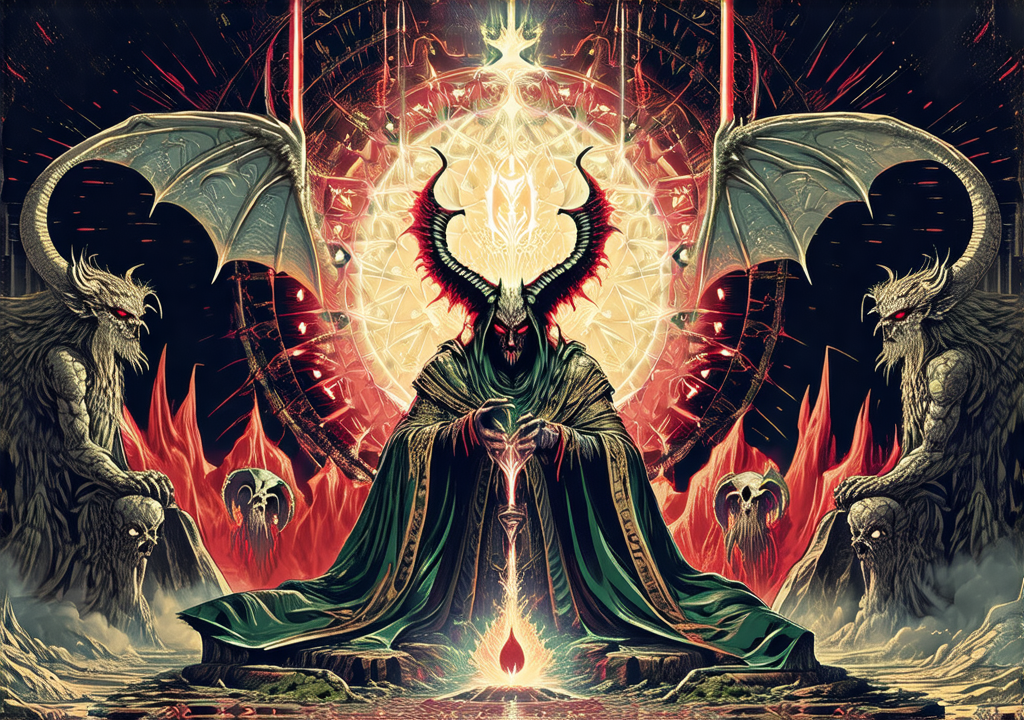
An Angel's Name Appears in the Codex — But Angels Don't Have Names, Do They?
The Nomenclature of Light: A Demonologist's Treatise on Angelic Naming
In the dusty, incense-thickened libraries of the Hermetic order, where parchment yellows like old honey and the ink runs with the particular melancholy of centuries past, there exists a quiet paradox. We demonologists spend our days and nights cataloging the fallen. We know Beelzebub; we can distinguish the subtle whisper of Astarte from the guttural growl of Bucephalus. We have names for every shade of malice, every ribbon of sin, every knot in the great tapestry of Hell. We name them because they must be named. In demonology, a name is a contract; it is a handle by which we can grip an otherwise formless essence and pull it into our service, or at least pin it down for study. A name is power.
But then, in the margins of a particular Codex—let us call it the Codex Luminis, though its true title has been scrubbed from the first page by a nervous scribe’s thumb and an eraser so aggressive it nearly tore through to the other side of the vellum—there is a name. It is written in gold leaf, flanked by two spiraling suns with human faces, and it reads: Elowen-Ael. And below it, in smaller, shakier script, a note from the original compiler: "Herein is recorded the true name of the Angel of the Third Chord. Handle with reverence or do not handle at all."
This is where our discipline bends into philosophy and then dissolves entirely into theology, because if you have any respect for the old texts—Galenus, Ptolemy’s Divine Wisdom, the Shemhampharashim of the Kabbalists—you know that angels do not have names. Or rather, they don't have names in the way we use the word. They are not Beelzebub. They are not Asmodeus. They are not even Gabriel or Michael, though those two have been so overworked by medieval art and liturgical tradition that they’ve begun to feel like proper nouns with the same ontological weight as "Greg" or "Susan." An angelic name is a translation. It is a human approximation of something that has no beginning, no middle, and no end. To call an angel by its name is to compress an infinite chord into a single note. And if you are writing in a Codex, you had better be sure the compression doesn’t crack the parchment.
So let us sit down with this Codex Luminis, light our best candle (the beeswax kind, not the paraffin, because angels can tell and it offends them more than you’d think), and consider what it means when a name appears where no name should be. What does the nomenclature of light actually look like? And if we’re going to pretend that these beings—these radiate-and-sing-and-ring things from beyond the firmament—are addressable, then how do we go about addressing them without accidentally compressing heaven into a footnote?
I. The Problem with Nouns
Let us start at the bottom of the ladder, which is where demonology is most comfortable: the noun. We say "Lucifer" and a set of associations click into place—dawn-bringer, rebellion, pride, that specific shade of red-gold fire that looks like it’s trying to be beautiful but has misjudged its own proportions by about six hundred percent. The name works because Lucifer was a person—or at least a being close enough to a person for us to build a vocabulary around him. He had a before and an after. He made choices. Names fit things that make choices; they mark the difference between what you were and what you became.
Angels, in most classical systems, do not quite do this. They are more like functions with luminosity added on. The Shemhampharashim—the divine names of God as understood by the Kabbalists—are not so much names of beings as they are names of operations: creation, preservation, illumination, judgment. An angel is a verb wearing light. To give one a name in the human sense is to accidentally turn that verb into a noun, and once you’ve done that, you have quietly demoted the being from a mode of divine activity to an individual with a file number in heaven’s personnel department.
The Codex Luminis does not make this mistake, or at least it tries not to. The entry for Elowen-Ael is not presented as "the angel Elowen-Ael" but rather as a name-as-notation, almost like a musical score. If you read the surrounding pages carefully—and I mean really carefully, with your eyes half-closed and your mind in that particular state where you’re reading symbols more than words—you begin to notice that the compiler of the Codex was not trying to name the angel. She (or he; the handwriting is ambiguous) was transcribing a frequency. The "name" Elowen-Ael is actually a compression of four interlocking harmonic ratios, and if you were to write it out in full mathematical notation, it would take up about three pages and look less like a name and more like a blueprint for a cathedral that has not been built yet but will be one day by someone who is currently asleep.
This is the first lesson: an angelic name is not a label; it is a lens. You do not call the angel by its name so much as you hold up a particular piece of glass to your eye and suddenly see the light in a configuration that was always there but you hadn’t noticed. The name focuses. It does not identify.
II. The Architecture of the Chords
The Codex Luminis is organized around what its compiler called "the Thirteen Chords," which is a slightly suspicious number if you’re paying attention to numerology, because thirteen is the number of apostles plus the one who wasn’t, and compilers of angelic codices tend to be the kind of people who don’t accidentally choose numbers. But we’ll set that aside for now.
Each Chord corresponds to a particular mode of divine expression: illumination, memory, patience, judgment, mercy, and so on. The Codex does not list angels as individuals but rather describes each Chord in terms of its "resonance signature"—a passage of text that is written in such a way that if you read it aloud at the right hour with the right intention, your voice will be gently redirected into a harmonic that matches the Chord. It’s less like reciting a name and more like tuning an instrument. You are not calling someone to answer; you are adjusting yourself so that they can hear you without having to bend down from the firmament.
The entry for Elowen-Ael belongs to the Third Chord, which is the Chord of Continuity—memory held in light, the specific quality of a thing that has been true for a while and will be true for a while longer. This is not a dramatic Chord; it’s not judgment or mercy or illumination. It’s more like the hum of a building you’ve lived in so long you stop noticing its structure but feel it in your bones when someone knocks on the wall. The Codex describes this Chord as "the patience of things that are becoming," which is a lovely phrase and one I have borrowed for my own notes, with only light guilt.
The resonance signature for Elowen-Ael, when you uncompress it from its musical notation, reads something like: "I am the thread that was pulled before the loom was set up and will not be cut after the cloth is woven." That’s not a name. That’s a description of what it means to be continuous in a universe where everything else is being constantly unmade and remade. And if you’re sitting in front of this Codex at two in the morning with a candle burning low, you’ll feel that sentence land on your chest like a hand, gently, as if someone has just reminded you that you are still here and that matters more than you think.
III. The Scribe’s Dilemma
Here is where it gets interesting for us demonologists, because we have to deal with the scribe. Every Codex was written by a human being, and every human being who has ever tried to transcribe an angelic resonance has done so while slightly afraid of what they were writing down. The compiler of the Codex Luminis left a few marginalia that are almost embarrassingly candid:
"I have written the name as best I can, but my hand shakes when I get to the second syllable. It is not fear exactly. It is more like remembering something I was never allowed to forget."
And later, on the facing page: "If you are reading this and the candle has gone out and you cannot find your eyes in the dark, do not light another candle yet. Wait until you can hear the hum again. The Chord will tell you when it is safe to look at the name again."
This is the second lesson: an angelic name is not passive information. It’s a relationship. You don’t read it; it reads you back. And if your reading produces a change in your perception—say, you suddenly notice that the shadow in the corner of your room has a slightly different shape than it did three seconds ago—that is not a trick of the light. That is the name doing what names do when they are actually names: reorganizing the space between reader and written thing.
Compare this to demonological practice, where you usually want the name to do the opposite: fix the spirit in place so that it cannot simply flow through your hand like smoke. With demons, a name is a net. With angels, a name is an opening. You are not trying to catch them; you are trying to let more of their light in without burning your eyes.
IV. The Question of Plurality
One of the most underappreciated features of classical angelology—and this is where my colleagues in academic theology sometimes get a little testy when I say it—is that angels do not have individual names because they are not individuals. This does not mean they lack personality or presence; it means their "individuality" is more like a particular way the same light refracts through different prisms. There is one Light, and each angel is a specific angle of incidence on that Light. To give them all distinct names would be like giving each ray of sunlight a separate surname.
The Codex Luminis handles this by using what I can only describe as "nominative geometry." The same base ratio appears in multiple entries, but the harmonic context shifts—sometimes a fifth higher, sometimes inverted, sometimes with an added overtone that changes the emotional register without changing the fundamental frequency. So Elowen-Ael, for instance, shares its root with two other entries in the Codex: one associated with grief-remembered-as-gratitude (the Seventh Chord) and one associated with the moment just before a decision is made (the Tenth Chord). Same Light, three different prisms. If you were to write all three "names" side by side, they would look almost like the same word written in slightly different hands.
This creates a practical problem for anyone trying to use the Codex as a working text, because if Elowen-Ael is not a unique identifier but rather one refraction of a shared spectrum, then you are never quite sure which "angel" you’re addressing unless you specify the Chord context. The compiler noted this in another marginalia: "Do not say 'call Elowen-Ael.' Say 'ask for the Third-Chord aspect of Elowen-Ael,' or else you will get all three and they will overlap in your mind like three songs played on the same radio at slightly different speeds, and you will not sleep well for a week."
And I can confirm this is accurate. A colleague of mine tried to work from the Codex without reading that note, and we found her in the library the next morning sitting very still with her eyes open but not looking at anything, humming faintly and explaining to no one that "the songs are all the same song and also none of them are the same song."
V. The Name as Wound
There is a third lesson, and it is the least comfortable: an angelic name, because it compresses infinity into language, is also a kind of wound. Every time we write down what cannot be written down, we create a small fracture in the boundary between the sayable and the unsayable. The Codex Luminis is full of these small fractures. If you press your ear to the vellum—and I do not mean this metaphorically; I have done it—you can hear a faint sound that is almost like paper breathing, or like a very quiet bell ringing in a room you’re not in.
The compiler’s final note in the Codex reads: "I have written all thirteen names. My hand no longer shakes. I think this means I have accepted them rather than recording them. There is a difference. Recording implies they are separate from me. Accepting implies we were already the same chord, and I have simply stopped pretending otherwise."
This is, I think, about as close to an angelic theology of nomenclature as you can get in a form that fits on parchment. A name for an angel is not a handle; it is a place where two different kinds of being briefly touch without merging. You remain human. The Light remains Light. But the space between them becomes thin enough that something passes through, and what passes through changes both sides of the boundary in ways that are difficult to articulate but impossible to unfeel.
VI. Practical Notes for the Working Demonologist
For those of us who work with the fallen and occasionally need to cross-reference with the unfallen—and this happens more than you’d think, because sin and grace share a lot of structural DNA—here are some practical notes on handling angelic names in a codex:
1. Do not read aloud unless you mean it. In demonology, reading a name is an act of summons or pinning. In angelic work, reading a name is an act of opening. You cannot unopen what you have opened. If you are testing the Codex for authenticity, use your eyes and not your voice.
2. Use beeswax candles. This is not superstition; it is practical optics. Paraffin burns with a slightly different color temperature that changes how you perceive the gold leaf on the page. Beeswax burns warmer and closer to candlelight as it was historically used, which keeps your perception of the "name" in a more stable register.
3. Write your own marginalia. The compiler’s notes are invaluable, but they are also one person’s experience of one set of Chords at one particular moment in history. Your experience will differ, and that difference is not an error; it is another prism in the same spectrum. Add your notes in a different color ink so the layers remain visible.
4. Listen for the hum before you read. The Codex describes this as "the Chord telling you when it is safe to look at the name." In practice, what you are listening for is a subtle shift in your own auditory perception—a faint resonance that feels like it’s coming from inside your sternum rather than from the room. When you can feel that hum and maintain a steady breath while feeling it, you are synchronized well enough to read without accidentally compressing more Light into your small human mind than it can comfortably hold.
5. Do not share the names with people who have not earned them. This is less about secrecy and more about resonance. An angelic name spoken by someone who has not yet learned to listen will tend to flatten, like a three-dimensional object pressed flat against glass. The person who hears it gets the outline but not the depth. And because these names are not passive information, the flattening can leave a faint impression on the listener that feels like a word they almost remember. It’s not unpleasant; it’s just slightly off-key, and if you have spent enough time in the company of true harmony, you’ll notice and be mildly bothered by it for days.
VII. The Name That Is Not a Name
Let us return to Elowen-Ael specifically. If you uncompress the four harmonic ratios that make up this "name," you get something like: 4/7, 3/5, 8/11, and 2/9—arranged in a particular sequence where each ratio modulates into the next with an overtone structure that produces what the compiler called "the sound of a door opening slowly enough that no one hears the hinge but everyone feels the room get bigger."
If you were to set these ratios as intervals on a musical staff, the resulting melody would be very short—perhaps four notes—but it would also feel like it has been playing for a long time. It would have the quality of something you already knew before you heard it, which is the defining feature of any true angelic resonance: it does not add new information to your perception; it reveals what was already there but hidden by noise.
This is why the compiler called them "names" and not "words." A word points to a thing. A name, in this context, points to a direction in which you can look more clearly. You are not being told what Elowen-Ael is; you are being given a particular way of seeing that will let you notice the aspect of Light called Continuity without having to understand it first. Understanding comes later, if at all, and by then it may have changed shape in ways that make your earlier understanding feel like a rough sketch compared to what you now see.
VIII. A Final Note on Reverence
The Codex Luminis ends not with a name but with an instruction: "Read slowly. Breathe between each line. And when you finish, sit in the silence for as long as the hum lasts, because that is how long it takes for your mind to stop translating and start receiving."
This last part—stop translating and start receiving—is perhaps the most important note in the entire Codex, and it applies equally to demonological work. We spend so much time translating: pinning spirits into categories, reducing infinite complexity into vocabulary we can use at the kitchen table or in a seminar room. And this is necessary; we are human, and our tools for understanding are language and classification. But there are moments—rare ones, precious ones—when translation fails and you are left with raw resonance, and if you survive that moment without reaching for your notebook to write down what just happened, you will have learned something about the boundary between the named world and the unnamed Light that no codex can fully capture.
So the question posed in the title of this piece—Angels don’t have names, do they?—is perhaps a false question, or at least an incomplete one. A better version would be: Angels don’t have names in our language, but we borrow words to build lenses, and through those lenses, just enough of the Light gets through that we can feel it change us. The name is not the angel. The name is the place where the human eye stops straining and finally lets the light do its work.
And if you are sitting in front of a Codex at two in the morning with a beeswax candle burning low, and your hand has stopped shaking, and you can hear the hum before you look at the page again—then perhaps that is all naming ever was: a small act of trust between the finite and the infinite.
And if you can manage to keep trusting after you’ve finished reading, then you have done what the compiler did, and the Codex will remain open without needing your hands to hold it shut.