Lost Knowledge: How To Astral Project Like The Ancients
⚔️ THE UNSEEN WALKER — A Study in Ancient Astral Practice by Vespera Nightquill ⚙
There is a silence that lives just beyond the threshold of sleep. Not the silence of a room, but the silence between two worlds — the one you see and the one that sees you back. The ancients did not treat this threshold as mystery or metaphor. They treated it as a corridor, well-worn, familiar, and open to any who knew how to walk it. To project the astral body was not, for them, an experiment. It was a discipline, a craft, a spiritual technology refined over centuries of patient practice.
And yet here we are in our own age, surrounded by books and podcasts that reduce this ancient science to a few breath exercises and a visualization trick. We have lost something essential — not just technique, but the entire framework of understanding that made the old methods work so reliably. This article is an attempt to recover that framework. Not as folklore, not as mysticism for the faint of heart, but as what it was: a precise, reproducible, and deeply practical art.
Let us begin where the ancients began — with the body itself.
I. The Body Is the First Temple
Modern astral projection instruction tends to treat the physical body as an obstacle. You must "get out of your body," they say, as if it were a prison you need to escape from. The ancients understood something more subtle and far more important: the physical body is not the cage. It is the anchor. And the quality of that anchor determines everything about the projection.
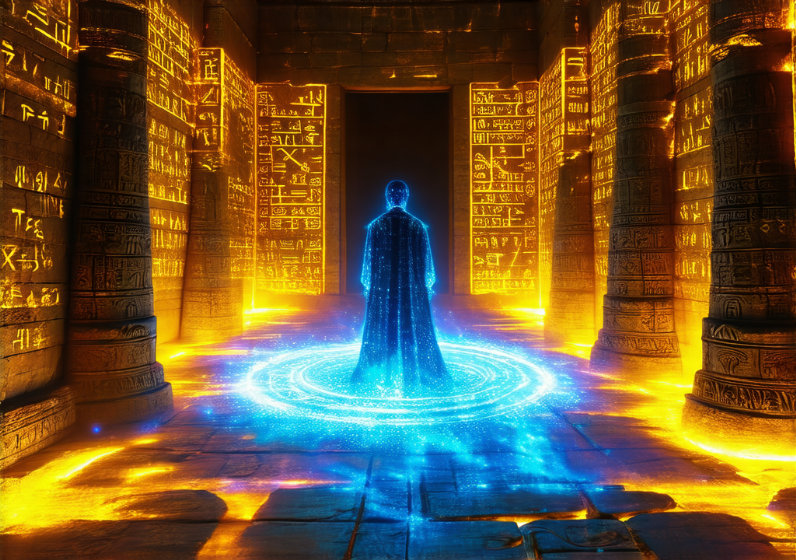
In Egyptian temple traditions, priests underwent weeks of preparation before any work with the ba — the spiritual double they believed could leave the body to travel through other realms. They fasted at specific intervals. They washed in water drawn from particular sources at particular hours. They burned specific resins that were understood to thin the membrane between worlds. None of this was decorative. Each element served a functional purpose: to reduce sensory noise, to stabilize the subtle energy fields surrounding the body, and to create a state where the mind could perceive and direct non-physical substance with clarity.
The Greek tradition carried this further. The Pythagoreans spoke of the somatos — the "body" in its fuller sense, not just flesh but the layered energetic envelope that extends beyond skin. They trained students to feel the boundary between self and environment. Not by imagining a glow or a light (though some did), but by attending to the actual sensation where one's awareness stops and the world begins. This is deceptively simple and extraordinarily difficult. Most people cannot find their own energetic boundary if asked. They can describe it intellectually, feel it in imagination — yes. But felt as an actual sensory impression? Rarely.
The practice is this: sit or lie down quietly. Breathe slowly for several minutes until the mind settles and the body relaxes. Then direct your attention outward from the surface of your skin. Not to what's beyond your skin, but to the skin itself — that thin boundary where you end and the room begins. In a darkened room this is easier; in silence it becomes clearer still. What you are looking for is not an image. It is a sense of thickness, of presence, of a subtle "here" that separates you from the air around you. Some practitioners describe it as feeling like warm static. Others say it feels like the edge of a field. The quality varies by individual and by state of preparation, but the sensation is real, not imagined.
Once you can find this boundary consistently, you have done something most modern students never achieve: you have located the first layer of your subtle body. And from there, projection becomes a matter of navigation rather than imagination.
II. The State Between States
Every serious tradition in astral practice identifies a particular state of consciousness as the gateway to projection. In Hindu yoga this is called dhyana — not deep meditation in the modern wellness sense, but a state where thought has thinned to near-transparency and the observer can watch mental activity without being carried by it. The Tibetan traditions call something very similar lhakam-supa, the "clear light" state that appears just before sleep fully takes hold.
The Egyptian texts from the Ptolemaic period describe a state called "the first darkening." Not darkness in the sense of absence, but a softening — the point where sensory input has faded enough for non-physical perception to become possible. The mind is still active. You can think if you choose. But thinking has lost its urgency. It becomes optional rather than compulsory.
This state is sometimes called hypnagogia in modern literature, and that term captures part of it but misses the essential quality. Hypnagogic experiences are often visual — floating images, strange scenes, a kind of dream-like theater. The ancients were less interested in the visuals and far more interested in the underlying condition: a stable, alert stillness where the inner eye is open but the outer senses have quieted.
Practically speaking, this state is most reliably reached during the transition between waking and sleep — not after you're fully asleep (that's dream work), but in the narrow window just before consciousness slips into unconsciousness. Lie down comfortably. Let the body relax completely. Keep a gentle awareness on your breathing. As the mind starts to drift toward images or narratives, do not follow them. Simply note that thoughts are arising and let them pass. The goal is not to eliminate thought but to reduce its volume until you can hear the quieter perception beneath it.
In this state, the boundary you located in the earlier practice becomes visible — not visually, but as a sense of layered depth. You can feel where your physical body ends, then where the subtle layer begins, and beyond that, a kind of open field where nothing is fixed or solid. This open field is what the ancients meant by "the other side."
III. The Craft of Leaving
Here is where most modern instruction falls apart. We are told to "want" to leave our body. To visualize ourselves floating up, out through a window, drifting like a leaf on wind. It reads beautifully in books. And it works sometimes — which is why the advice persists. But if you've tried it and found that your astral self simply refuses to separate from the physical one no matter how vividly you imagine it, you're not doing anything wrong. You're using a method suited for beginners with no other options.
The ancients had better tools.
In the Egyptian tradition, the separation was achieved through what I would call energetic unfastening. The subtle body is held to the physical one by a series of connections — what modern energy work calls the navel cord or silver cord, though the ancients simply understood it as the bond between the two forms. To project, you do not need to push yourself out. You need to gently loosen that bond.
The technique works in layers. Once you are in the stable state described above — alert but quiet, aware of your subtle boundary — direct your attention to the center of your chest or the navel region (the specific point varies by tradition). Feel for a sense of connection there: a line, a thread, a gentle tether linking your inner self to your physical form. You do not need to see it. You need to feel its presence as a subtle tension.
Then — and this is the part that distinguishes ancient craft from modern instruction — you do not pull or push. You breathe through the connection. Let the breath move along the tether, loosening it gradually. Imagine the thread becoming slightly longer with each exhalation. Not stretched taut, just a little more slack. Repeat this over several minutes. The tether is not being broken; it is being relaxed. And when it has loosened enough, the separation happens almost on its own. Your awareness drifts outward, and you find yourself perceiving from a vantage point that is clearly outside your physical form.
Some traditions add a vocal element here — a low hum or a specific tonal phrase that vibrates through the chest and helps maintain focus during the transition. The Romans used a soft "murmur" of mantras. The Greeks, in certain Orphic rites, chanted in a particular register said to match the frequency of the subtle body. These were not decorative. Sound in these contexts was understood as a tool for stabilizing attention at the exact moment when consciousness is most vulnerable to being pulled back into the physical senses.
IV. Navigation and Orientation
Once you are outside the body, a new set of challenges emerges that most modern literature barely addresses: how do you know where you are? How do you move with purpose rather than drifting like a leaf in wind? How do you distinguish between genuine perception within the projection and mental construct — the mind's tendency to fabricate scenes because it doesn't know what else to do?
The ancients had answers, and they were practical.
First: orientation is not visual. In the physical world, you navigate by sight — landmarks, direction, distance. In the subtle realm, these cues are unreliable or absent. The ancient method was to anchor perception in sensation rather than image. You feel your position relative to familiar places. If you have a home, a room, a garden, a body of water that holds strong personal resonance, you can use it as an orienting point. Not by seeing it, but by feeling the quality of its field — the specific energetic signature that makes this place this place and not another.
Second: movement in projection is directed by intention held with sensory clarity. This is not "willing" yourself to go somewhere. It is forming a clear, felt sense of where you want to be — the temperature, the quality of light, the texture of the air, the specific character of the place — and letting that full sensory image pull your awareness toward it. The more concrete and multi-sensory your intention, the more reliably your projection follows it. Vague intentions produce vague travel. Specific, felt intentions produce precise navigation.
Third: distinguishing real perception from mental fabrication is a skill, not an insight. In early practice, nearly everything you "see" or "experience" in projection is partly constructed by the mind filling in gaps. This is normal and expected. The ancients did not require clarity on day one. They trained students to maintain a steady awareness of what was being perceived versus what was being generated. Over time, as the subtle senses matured, the distinction sharpened. Experiences became less dreamlike and more textured — with depth, consistency, and a quality of "being there" that mental imagery cannot fully replicate.
The Egyptian priests are said to have tested their projections by returning to physical landmarks. They would project to a specific location, note details only visible from that vantage point, and verify them upon returning to the body. This was not superstition. It was quality control. A practical verification method for an experience that no one else can witness.
V. The Return
Leaving is the easier half of the craft. Coming back — or rather, allowing yourself to come back with full integration of what you have seen and felt — is where most practitioners stumble.
The silver cord (or tether) connects your projected awareness to your physical body. As long as that connection holds, you can return at any time by simply turning your attention back toward the body and following the thread inward. The ancients emphasized that this thread should not be cut or severed during routine practice. You are not dying when you project. You are walking in a second skin. And like all walks, it requires knowing how to come home.
The return process mirrors the departure. You feel the tether reconnecting — a gentle tightening of the bond between your awareness and your physical form. Sensations flood back: weight, temperature, sound, the texture of the surface beneath you. These are not intrusions. They are the world reasserting itself. The key is to receive them without resistance or alarm. Let the body's sensations wash over your attention gradually. Do not rush. A sudden jolt back into full bodily awareness can be disorienting and, in early practice, sometimes causes a brief period of confusion or fatigue that lasts for hours.
The ancients also emphasized integration after projection. Not just resting — though rest is important — but processing. In the Egyptian tradition, priests would spend time in quiet reflection after each session, reviewing what they had perceived without trying to force interpretation. The Greek Orphics wrote down their experiences immediately upon waking, capturing impressions while they were still fresh and unfiltered by the mind's tendency to reshape memory.
This is a practice worth recovering: write or speak your experience aloud within minutes of returning to full bodily awareness. Not as narrative — not "I felt like I was floating over a lake." But as raw sensory record: "warm amber light, low hum in the air, texture of water surface slightly granular, sense of depth beyond visible edge." This kind of recording preserves the quality of perception that memory will inevitably smooth out and reshape.
VI. The Lost Framework
Here is what we have lost that cannot be recovered from any single book or course: context. The ancients did not practice astral projection in isolation. It was embedded within a full spiritual technology — specific preparations, environmental conditions, social structures of support, lineages of teachers who had done the work for decades and could correct a student's subtle errors by feel alone.
A student in an Egyptian temple knew what to eat, when to fast, which incense to burn, how long to sit before beginning, and what to do if the projection felt unstable or too intense. A student in a Greek mystery school had elders who could sense when a young practitioner was pushing too hard or losing proper grounding. The knowledge was not just procedural. It was relational. It lived in the relationship between teacher and student, in the accumulated corrections and adjustments passed down through generations.
We have fragmented that framework. We've extracted the techniques from their context and sold them as standalone products: a YouTube video, an app, a book. And they work — partially. The raw mechanics of projection are not lost. A sincere practitioner can learn them from text alone. What is harder to recover is the surrounding wisdom: how to know when your practice is progressing correctly, how to distinguish genuine subtle perception from elaborate mental theater, how to maintain stability over years of practice without burning out or becoming confused by your own experiences.
That knowledge lives in community, in lineage, in the patient correction of someone who has done this work for decades and can feel where you are straying. It is not reproducible from a PDF. And that loss — of relational wisdom, of embodied teaching, of the slow accumulation of corrections over years — is perhaps what "lost knowledge" really means. Not that the techniques have vanished. They haven't. But the living context that made them reliable and safe has thinned to a whisper in an age of digital abundance.
VII. A Practice for Now
So how does one actually begin? Not as a project or an experiment, but as the ancients understood it: a discipline with a beginning, a middle, and a gradual deepening that unfolds over months and years rather than days or weeks.
Start with the body work. Two to three minutes of slow breathing until the mind settles. Then ten to fifteen minutes of boundary sensing — finding where you end and the room begins. Do this daily. Not because each session will produce dramatic results, but because you are training a sense that most people have never used consistently. It is as basic as learning to balance on one foot: simple in description, slow to integrate into stable skill.
Add the state work next. The hypnagogic transition — the alert stillness just before sleep. Practice reaching it without chasing images or experiences. Just find the quiet and hold it gently for a few minutes. This is the gateway state. Mastering it is more valuable than any visualization trick.
Then, when you can reliably reach that stable state and feel your subtle boundary clearly, attempt the unfastening. The breathing-through-the-tether technique described above. Be patient with it. Some days the separation happens within two minutes. Other days you'll spend twenty minutes loosening the bond and not quite drift free. Both are progress.
Record what you experience. Note the quality of perception — is it sensory or imagistic? Is there depth, texture, consistency? Are you in a place or in a scene? The difference matters more than the content. You are building an inner instrument for distinguishing real subtle perception from mental construction. That instrument takes time to calibrate.
And if you can find teachers, practitioners, communities — do so. Not because the knowledge is secret or gated, but because relational correction accelerates learning in ways that no text can replicate. Someone who has projected hundreds of times can tell by your description whether you're in genuine perception or elaborate fantasy. That kind of feedback is worth more than any technique chart.
VIII. What the Ancients Knew That We Keep Forgetting
There is one final quality to ancient astral practice that deserves naming, because it is so absent from modern discourse: humility about the experience itself.
The ancients did not treat projection as a spectacle or an achievement. It was not something you "do." You do not project astrally the way you run a marathon or solve an equation. You prepare yourself, you enter the state, you loosen the bond — and then the projection happens. Your role is to create the conditions and maintain stability. The actual movement of awareness through non-physical space is, in a real sense, something that occurs within you rather than by your direct effort.
This matters because it changes how you relate to the experience. You are not performing for an audience — not even yourself. You are walking in a second skin and seeing what is there with quiet attention. The purpose of ancient practice was not to prove anything or achieve a state of consciousness that others might envy. It was to know. To perceive clearly across the boundary between physical and subtle. To understand, through direct experience rather than intellectual argument, how layers of reality interpenetrate one another.
In an age that treats spiritual experience as content — something to be produced, optimized, shared, and validated — this quality of quiet knowing stands out like a still pool in a rushing stream. The ancients did not need to post their projections. They did not rate them or compare notes on which realm was more impressive. They walked the corridor between worlds because it was there, because walking it changed how they moved through the world that is visible and solid and shared by all of us.
And perhaps that is the deepest lesson in all this: astral projection, practiced as the ancients understood it, is not about leaving your body. It is about learning to inhabit more fully the body you already have — a body made not just of flesh but of layers, fields, and connections that extend further than skin. The projection is the training ground. The return is where the knowledge settles into how you live, perceive, and move through the world that all of us share.
The corridor has not closed. It is as open now as it was in the temple halls of Memphis or the quiet rooms of a Greek philosopher's school. What has changed is our willingness to approach it with the patience, the precision, and the relational wisdom that made it reliable for those who came before.
Walk it carefully. Walk it often. And when you return — carry something back that did not exist in your perception before. That is how you will know the corridor was real.