A 10-Year Shaman Reveal: Why Most Sigils Are 'Dead on Arrival'
A 10-Year Shaman Reveal: Why Most Sigils Are 'Dead on Arrival'
By Elder Kaelen of the Obsidian Grove
You have drawn them. You have inked, carved, burned, and meditated upon them. Perhaps you spent an entire weekend in a state of flow, letting your subconscious hand guide the pen across parchment or stone. You felt the energy humming beneath your fingertips; you sensed the intention crystallizing into geometric form. And yet... it didn't work. The sigil sat on your shelf like a decorative paperweight. Or worse—it worked for three days and then faded into background noise, indistinguishable from any other symbol of aesthetic appeal but functional power.
I have walked this path for ten years. I was initiated into the shamanic traditions of the Northern Circles before I ever opened a book on Hermeticism or Tanya Morgan’s Designing Sigils. I spent my first five years in remote regions, learning how to read the landscape as text and how to listen to the spirit world through vibration rather than sound. When I returned to the city, I began teaching sigil craft to students who came from a purely academic or artistic background. Many were talented artists. Most produced beautiful images. Almost all of them produced dead sigils.
In this article, I will not teach you how to draw better lines or create more complex geometries. We have covered the mechanics enough in the modern occult literature. Instead, I am going to explain why your sigils are dying before they are even burned. It is not a problem of technique; it is a problem of ontological misunderstanding. To understand why most sigils fail, we must first unlearn what we were taught about what a sigil actually is.
The Illusion of the Object
In Western esotericism and popular occult culture, the sigil is treated as an object. A noun. You make a sigil for wealth; you make a sigil for love; you make a sigil for health. We speak of it in the third person: "My sigil," "This symbol," "That image." We treat it like a talisman, a physical key that unlocks a door in reality.
But a dead sigil is not a broken key. A dead sigil is a forgotten thought.
A living sigil is not an object at all. It is an event. It is a convergence of consciousness and matter so complete that the boundary between the two dissolves. When you draw a sigil, you are not creating a picture of your desire; you are performing a ritual of compression. You are taking the sprawling, noisy, chaotic data of your conscious desire—your "I want more money because I feel insecure"—and compressing it into a single, dense node of pure intention.
Most practitioners fail at this compression step. They let the conscious mind take over. The conscious mind is a critic; the subconscious is the creator. When you begin to draw, your inner editor wakes up. It looks at the curve you just drew and thinks, "That looks like a snake." Or "That corner is too sharp." And so you adjust it. You refine it. You make it pretty.
This is the first killer of sigils: Aesthetic Perfection.
In shamanic practice, we do not seek beauty in our totems or spirit helpers. We seek resonance. A rattle made from a deer skull and sage leaves may look rough to an art critic, but it rings with the frequency of the forest. If you make your sigil "pretty," you have filtered out the raw energy that gave birth to it. You have polished the stone until the original crystal structure was sanded away. The signature of your unique subconscious has been smoothed over by the generic standards of taste.
The Grammar of Desire: You Are Encoding the Question, Not the Answer
This is a subtle but devastating error in sigil design. When we sit down to create a sigil for "success," what are we actually encoding?
If you write out your desire as a sentence—I want to be successful and respected by my peers—and then reduce that into letters, you are encoding the question. You are encoding the state of lacking. Your subconscious reads the sigil not as a declaration of success, but as a beautiful representation of the question: "Will I be successful?"
In shamanic terms, we call this echoing the void. You have created a symbol for the hole in your bucket rather than the water that fills it. The sigil becomes a mirror reflecting your uncertainty back at you. Every time you look at it or activate it, you are subconsciously asking, "Is this working?" And because you are looking, you are observing, and observation collapses the probability wave into the present state—lack.
To create a living sigil, you must encode the answer. You must encode the felt sense of the wish already fulfilled. Not the statement that you have achieved it (which is still conscious knowledge), but the somatic reality of having it. What does your body feel when you are successful? Is there a looseness in the shoulders? A lightness in the chest? A specific color of aura surrounding you?
Your sigil must be a container for that somatic memory. It should not look like "success"; it should feel like the moment after success has already happened and is no longer news to your nervous system. This requires a shift from visual thinking to sensory thinking. Stop looking at the shape; start feeling the weight, the temperature, the texture of your intention. Let that sensation dictate the line work.
The Energy Leak: Activation as Performance vs. Release
Once the sigil is drawn, most practitioners engage in what I call activation theater. They light candles. They chant mantras. They stare at the symbol for an hour. They perform the ritual with intense focus and willpower.
And this is precisely where they kill it.
A living sigil requires release, not performance. When you activate a sigil, you are handing over your intention to the universe, to the collective subconscious, or to the spirit world depending on your tradition. If you continue to hold onto it with your conscious mind, you are not releasing; you are gripping.
Think of a shamanic journeying state. Once the shaman enters trance and meets the spirit, they do not sit in front of the spirit saying, "Please be nice, please help me, I really need this." They simply are with the spirit. The interaction happens because there is no interference from the analytical ego.
When you activate your sigil, you must reach a state where you no longer remember what it looks like. You burn it, or display it, or meditate upon it until it becomes part of your background noise. Then, in that state of non-attention, the true activation occurs. The energy flows from you to the symbol and from the symbol into the field of possibility. If you are still watching yourself watch the sigil, there is a double layer of consciousness blocking the direct connection. You are standing between yourself and your own intention.
The Subconscious as Artist: Trusting the Unconscious Hand
Let us speak of the drawing process itself. In my shamanic training, we learned to draw not with our dominant hand, but in a state where the arm felt heavy and foreign. We let the shoulder do the work. We treated the pen as an extension of the spirit guide.
In modern sigil craft, this is often reduced to "draw quickly." But it is more than speed; it is disownership. You must draw the sigil in a way that allows your subconscious mind to take full authorship of the final form. This means:
Reduce the desire to letters. Write down the phrase, remove repeated letters (vowels are often removed or compressed), and arrange them.
Do not look at the arrangement. Or if you do look, look for a fraction of a second only. Let your eyes blur.
Let the hand draw the connection. Draw lines connecting these letters. Do not plan the connections in advance. If your hand wants to make a spiral, let it spiral. If it wants to make a jagged lightning bolt, let it flash.
The resulting shape will often look like nonsense to your conscious mind. It may look messy, asymmetric, or strange. This is good. Nonsense is the language of the subconscious. Logic is the language of the conscious mind. You are writing in the language of dreams, not in the language of a textbook. If you edit the drawing, you have translated the dream into logic, and the magic dies because dreams do not work through logic; they work through association, metaphor, and pure symbol.
The Context of Display: Where Your Sigil Lives Matters
A sigil is a living entity in the energetic field. It needs an environment that supports its vitality. Most practitioners hide their sigils in drawers or display them on cluttered desks next to unpaid bills, old receipts, and broken electronics.
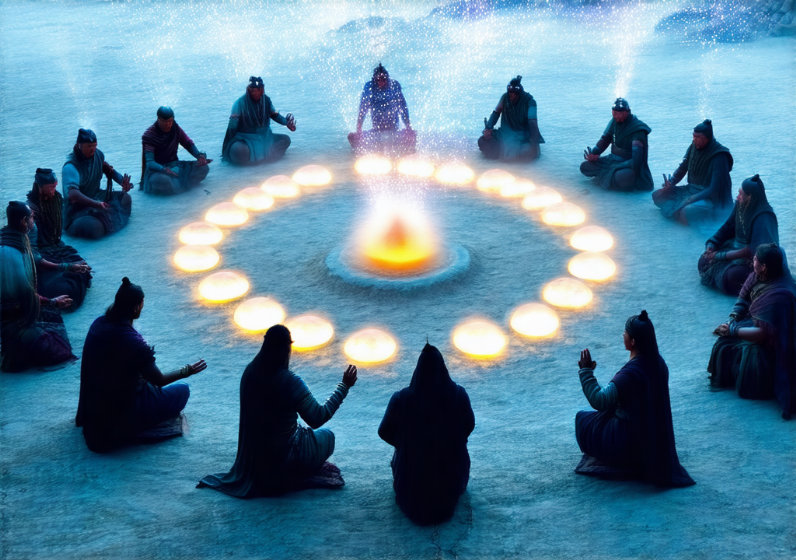
In shamanic practice, we create shrine spaces. These are areas cleared of dead matter—things that have lost their spirit or purpose. A shrine is a pocket dimension where the rules of linear time do not fully apply. It is a place of pure potentiality.
If your sigil is on a desk cluttered with the residue of your mundane struggles, it absorbs those frequencies. The sigil for "abundance" sitting next to a stack of overdue bills starts to encode scarcity and debt. The sigil for "clarity" sitting under a layer of dust begins to encode confusion and stagnation.
Create a small altar or shrine space dedicated to your working. Keep it clean. Add elements that resonate with the intention: water, earth, fire (candle), air (incense). These are not just symbolic; they are energetic anchors. They help stabilize the field around your sigil so it does not bleed into or absorb from the mundane chaos of your living room.
The Temporal Trap: When is a Sigil Done?
This is perhaps the most common question I receive in workshops: "How long does a sigil take to work?" And my answer is always the same: "Until you forget it."
Most practitioners operate on a timeline. They check for results after one week, then two weeks, then a month. When they don't see results, they doubt the process. They think, "Maybe I drew it wrong," or "Maybe this technique doesn't work." And so they make another sigil. Then another.
This is not a failure of the sigils; it is a failure of faith in the mechanism. A sigil is a seed planted in the soil of your subconscious and the broader field of reality. Seeds do not grow on a schedule that matches human anxiety. They grow when conditions are right.
In shamanic tradition, we speak of cyclical time. Things happen in cycles: new moon to full moon, day to night, year to year. Your sigil may be working at the level of the quantum field, rearranging probabilities long before a tangible event manifests. If you keep checking on it, you are like a farmer who pulls up the seedling every morning to see if it has roots. You may kill the growth by interfering with its natural process.
Learn to let go. Create the sigil, activate it, and then live your life as if the sigil does not exist—yet knowing in your bones that it is working. This paradoxical state of "not caring but believing" is where the magic lives.
The Shamanic Insight: Sigils Are Contracts with Self
Let me bring this full circle back to shamanism. To a shaman, a sigil is not just a tool for changing external reality. It is a contract between your conscious self and your subconscious self. It is a promise that you are willing to become the person capable of receiving the desire.
If you make a sigil for a new relationship but still believe deep down that you are unlovable, the sigil will attract relationships that confirm your belief in unlovability—or it will simply fail because your frequency does not match the intention. The sigil opens the door; you must be willing to walk through it and live on the other side.
This is the shamanic reveal: The sigil works by changing you, so that reality can change for you.
We are so focused on what the sigil will do for us that we forget that it requires something from us. It asks for alignment. It asks for consistency. It asks for a surrender of control. It asks for us to become the living embodiment of the desire we have compressed into ink or stone.
Practical Ritual: The Breath of Life
If you wish to apply this shamanic insight, try this simple practice with your next sigil:
Write your intention in a positive, present-tense sentence that includes how it makes you feel. (Not "I want peace," but "My mind is calm and my chest feels open.")
Reduce the letters into a base shape.
Draw it slowly, focusing on the physical sensation of your hand moving. Feel the ink or paint; feel the paper or wood. Connect the drawing to your body.
Hold the sigil in your hands. Close your eyes. Breathe into the symbol as if you are breathing life force (or prana, or qi) into it. Imagine the energy flowing from your lungs, through your arms, and into the image.
Speak a simple affirmation that is not about the result, but about the act of creation: "I have released this intention." Or "This is done."
Place it in a clean space. Do not look at it immediately. Let your eyes rest on other things. Allow the image to leave your visual focus so it can enter your subconscious.
The Beauty of Imperfection
Finally, embrace the imperfections in your sigil. The wobbly line is the trace of your unique energy signature. The smudge is a record of your physical presence at that moment in time and space. These imperfections are what make the sigil yours. They are the biometric data of your soul's fingerprint on the work.
A perfect, symmetrical, computer-generated sigil has the power of a stock photo. A hand-drawn, slightly lopsided, imperfect sigil has the power of a personal letter from your future self. It is alive because it carries the trace of your aliveness.
Closing Thoughts: Listen to the Silence
As you continue your practice, listen for the silence after activation. That quiet moment when you have finished drawing and are not yet analyzing the result—that is where the magic lives. In that silence, the sigil is no longer an image; it is a vibration. It has detached from the paper or stone and has entered the field of pure potentiality.
Your job as the practitioner ends at that moment. You have planted the seed. You have compressed the desire. You have released the intention. Now, you must trust the soil. Trust your subconscious. Trust the universe. And most importantly, trust yourself to be a vessel worthy of what you have asked for.
The sigil is not dead on arrival if you understand that it was never an object at all. It is a bridge between who you are and who you wish to become. Walk across it with faith, and it will hold your weight.