7 Secrets of Ceremonial Witchcraft That Will Blow Your Mind
✦ The Seven Veils of Ceremonial Craft ✦
By Maudeline Voss, Keeper of the Hidden Flame
I. The Altar Is Not a Table — It Is a Threshold
Begin with what most seekers get wrong: they set out a candle, some crystals, maybe a little incense, and call it "ceremonial." As if ceremony is decoration. As if ritual is performance.
A true ceremonial witch understands that the altar is not where you do magic — it is where you cross. The cloth beneath your tools is a membrane between the mundane and the mythic. The four corners mark the cardinal directions, yes, but they also mark the four elements, the four seasons, the four stages of soul, the four rivers that carry light through the body. When you arrange an altar with intention, you are not arranging objects. You are constructing a door.
This is the first secret: the altar is a threshold, not a stage. You do not perform at it. You pass through it. The moment your eyes leave the room and land on that cloth, something shifts in the architecture of your perception. The walls of the ordinary world become permeable. This is not metaphor — this is the mechanics of ceremony.
Many beginners treat their practice space as a shrine to be admired. "Look how pretty my altar is." And this is fine for devotion, but it is not enough for craft. A threshold does not ask to be admired. It asks to be used. You approach it with purpose. You cross it with intention. You leave through it when the work is done. The door closes behind you, and the ordinary world reseals.
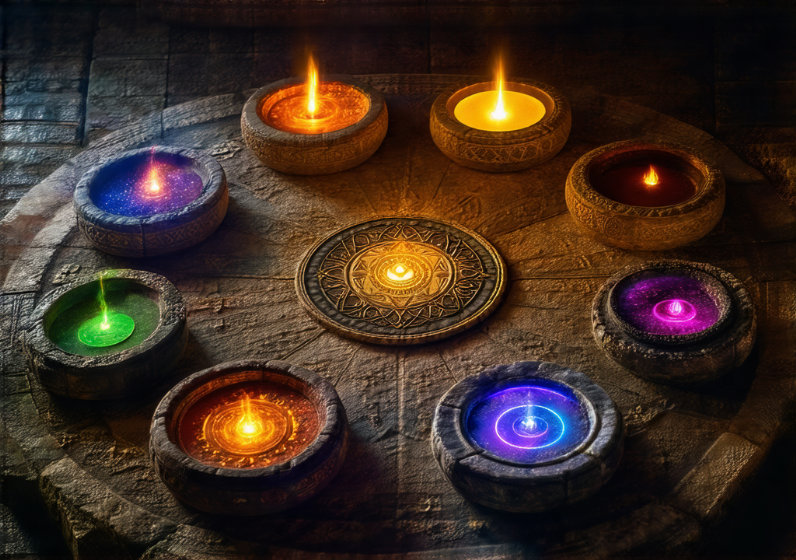
Learn this first before anything else. If your altar is a decoration, you are decorating the threshold rather than walking through it. Strip away the excess. Keep only what serves the crossing. A candle for light. Salt for purification. Water for clarity. Incense to carry intention upward. That is enough. The rest is noise.
II. You Are Not Chanting Words — You Are Shaping a Container
Here is where ceremonial witchcraft diverges sharply from folk magic, and this distinction matters more than most practitioners realize.
In folk magic, you say a word of power, and the word is the magic. "Hocus pocus." "By sun and moon." The syllables carry the charge. In ceremonial witchcraft, the words are not the engine — they are the walls. You are building a container for something that already exists but is scattered in the ambient field. Your voice, your rhythm, your intonation — these are the mortar between the bricks of intention.
Consider the difference between saying "I call upon the spirits" and actually building the call. The first is a sentence. The second is an architecture. In ceremonial practice, you begin with silence. You let the room find its stillness. Then you speak — but you do not speak to the spirit. You speak in a way that makes space for the spirit. Your words are the frame of a window. The spirit walks through it.
This is why ceremonial rituals feel so different from folk incantations. Folk magic says: "Do this, and that will happen." Ceremonial magic says: "Build this, and what was already possible becomes actual." You are not commanding reality. You are giving reality a shape to pour itself into.
Practitioners who understand this secret stop worrying about whether their words are "correct" or "powerful enough." They worry about the structure. Is the container sealed? Is the geometry sound? Have you left any gap where intention can leak out and something undisciplined can leak in? The ritual is a vessel. And like all vessels, it must be closed tight or the contents spill.
This also explains why ceremonial witches spend so much time on structure — the opening, the grounding, the calling, the working, the sealing, the closing. It looks redundant to beginners. "Why do you have to say that three times? Why do you have to walk the circle in a specific direction?" Because every repetition tightens the container. Every directional movement is another brick laid. You are not performing a script. You are building a cathedral of attention, one stone at a time.
III. The Circle Is Not a Boundary — It Is a Locus
Most people hear "cast a circle" and imagine a fence. A line in the sand that keeps bad things out. And yes, that is part of it. But if you stop thinking about the circle as a boundary, you miss half of what it does.
A circle is not merely an exclusion device. It is a locus — a place where the geometry changes. Inside the circle, the rules of the outer world are suspended or renegotiated. Time behaves differently. Space compresses and expands. The distance between your intention and its manifestation shrinks to almost nothing.
Think of it this way: outside the circle, you are in the forest. Trees everywhere, paths winding, no two steps the same. Inside the circle, you are on a cleared ground where every direction is equally available and every step has equal weight. The forest's noise falls away. The path is you. Your intention becomes the path.
This is why ceremonial witches take the casting of the circle so seriously — not as a protective gesture (though it is that too), but as an act of spatial alchemy. You are not drawing a line in the sand. You are clearing ground where the inner and outer worlds press against each other, and in that pressure, new things can crystallize into form.
There is a practical implication here: the quality of your circle determines the quality of your work. A sloppy circle — cast while you're distracted, half-thought, muttered under your breath with no real presence behind it — creates a weak locus. The outer world bleeds in. Your intention gets diluted by ambient noise. You leave the ritual feeling like you "did something" but can't quite say what changed or why nothing felt different.
A strong circle is cast with full attention, each point marked deliberately, each element acknowledged not as a checklist item but as a living presence within the space. When you stand in that circle and feel the ground shift beneath your feet — not physically, but in that subtle sense of "I am somewhere else now" — you have built a real locus. And from there, anything is possible.
IV. The Tools Are Not Symbols — They Are Proxies for Faculties
This one trips up even experienced practitioners. We talk about the wand as a symbol of willpower, the athame as a symbol of separation, the chalice as a symbol of intuition or the feminine principle. And all of that is true at the mythic level. But in ceremonial practice, the tools are not symbols of these faculties — they are proxies. They stand in for something you already possess but need to externalize and direct.
Your willpower is inside your head. It's invisible. It's diffuse. You can't aim it at anything specific because it doesn't have a shape. The wand gives your willpower a direction. A point of focus. When you extend the wand toward your intention, you are not commanding an external force — you are taking the invisible architecture of your own mind and giving it a vector.
Your intuition is a feeling in your chest or gut. It's warm, diffuse, hard to pin down. The chalice gives it a vessel. You pour your question into it. You hold it. And suddenly that formless knowing has a shape you can look at, turn over, examine.
This changes how you approach tool work entirely. Beginners ask: "Which wand is right for me? What wood should I use? Should the athame be made of iron or bone?" And while these choices carry their own weight, the deeper question is: what faculty am I trying to externalize in this ritual? If you are doing a working that requires precise direction and focus — a banishing, a targeting, a shaping of energy toward a specific point — your wand matters more than your chalice. If you're drawing down a current or holding an image or giving form to an inner vision, the chalice is your primary tool.
You are not collecting pretty objects. You are curating a set of externalized faculties. Each tool is a different way your mind can reach into the world and shape it. Learn which faculty you need before you pick up the tool. The tool follows the need. Not the other way around.
V. Timing Is Not When You Do It — It Is How You Meet the Currents
Folk magic says: "Do this on a full moon for amplification, a new moon for beginnings." And there is truth in that. But ceremonial witchcraft takes timing to another level entirely. In ceremony, you are not just picking a day. You are meeting something. You are synchronizing your inner intention with an outer current that already exists and is moving through time whether or not you participate.
Consider the four seasons as a model. Spring is not "the time for new beginnings" in some abstract calendar sense. Spring is the moment when the world's own energy is turning — from contraction to expansion, from winter's inward focus to summer's outward radiance. If your intention aligns with that turning — if what you want is growth, emergence, a new form taking shape — then working in spring means your personal will and the world's will are pushing in the same direction. You are not fighting gravity. You're surfing it.
Summer is fullness. The energy is already expanded, already radiant, already at peak expression. Work in summer that asks for amplification, celebration, bringing something fully into form — you are adding fuel to a fire that's already roaring. Autumn is the time of gathering in, of separating the useful from the excess, of letting go. Winter is contraction, stillness, the seed beneath the soil where nothing seems to happen but everything is reorganizing.
And within each season, there are smaller currents: the phases of the moon, the movement of the planets, the rhythm of your own body's cycles. Ceremonial timing is not about finding a "lucky day." It's about reading the current and aligning with it. You are a swimmer in a river. You can paddle against the flow all you want, but you'll make less headway than if you let the current carry you for part of the journey and then correct your heading at the right moment.
This is why ceremonial witches keep detailed ritual calendars — not because they're superstitious about dates, but because they are attentive to currents. They feel when a particular working will land more heavily if done on a waning moon versus a waxing one. They know that a banishing works differently in the contracted energy of winter than it does in the expanded energy of midsummer. Timing is not decoration. It is leverage.
VI. The Ritual Is Not What You Do — It Is What Changes Between Before and After
This might sound like a paradox, but it's one of the most important secrets in ceremonial craft: the ritual itself is not the magic. The magic is the difference between who you were before you began and who you are after you close.
Beginners often fixate on the process. "Did I say the words right? Did I light the candles in the correct order? Did I remember to ground at the end?" And while precision matters, it's not the point. The point is: what shifted? If you performed a beautiful ritual with perfect form and walked away feeling exactly as you did before — same doubts, same stagnation, same unresolved tension — then the ritual failed its purpose regardless of how pretty it looked.
Conversely, I have seen practitioners do what looks like a sloppy, half-remembered working — three candles instead of seven, muttered words instead of clear intonations — and walk away changed. Their shoulders dropped. A knot in their chest unknotted. A question that had been circling for weeks suddenly had an answer. The ritual worked not because the form was perfect, but because something real crossed over during those twenty minutes of focused attention.
This is what ceremony actually does: it creates a structured window of time where your attention is fully gathered and directed. In that window, the scattered fragments of your inner life — the doubt, the desire, the fear, the intention — are held in one place at once. And when they're all in one place, they can be seen clearly. Seen clearly, they can be rearranged. What was tangled becomes ordered. What was hidden comes into view.
The ritual is a lens. The magic is what you see through it and decide to do with that seeing. So after every working — and I mean every working, no matter how small or informal — take two minutes of honest reflection: "What changed? Where am I different from where I was twenty minutes ago?" If nothing changed, the ritual didn't work. Don't blame the candles or the moon phase or the words you used. Look inward. The ceremony is a mirror. It shows you what's actually there so you can act on it.
VII. You Are Not Performing a Ritual — You Are Being Performed By One
And this is the final secret, and perhaps the most quietly profound: in ceremonial witchcraft, you are not the author of the ritual. You are its instrument. The ritual is not something you do to the world. It is something the world does through you.
When you stand before your altar with full presence — when your attention is gathered, your breath is steady, your intention is clear and held without grasping — you become a channel. Not a creator. A channel. And what flows through that channel is not merely your personal will. It is something larger: the pattern of the season, the current of the moon, the deep structure of the element you're working with, the particular frequency of the spirit you've called or the image you've drawn down.
You shape it. You give it a direction and a form. But you did not create it from nothing. You met it. You built a container for it. And in the meeting between your intention and that larger current, something happens that neither of you could have done alone. Your will gives it direction. The current gives it substance. Together, they produce an effect that is more than the sum of both.
This is why ceremonial witches speak so often about "surrender" within ritual. Not surrender as weakness or passivity — but surrender as precision. You don't need to force the outcome. You just need to build the container correctly, hold your attention steady, and let the current do what currents do: flow into the shape you've made and take on its form.
And here's the practical upshot of this last secret: your consistency matters more than your cleverness. A simple, well-structured ritual done with full presence will outperform a complex, elaborate one done half-heartedly. Because in a ceremony where you are truly present — truly a channel rather than a performer — the current has no resistance to flow through it. Your attention is clear. The container is sound. And what pours through is more powerful than anything you could have manufactured from your own will alone.
✦ Closing Invocation ✦
These seven secrets are not separate truths. They are one truth seen from seven angles: the altar as threshold, the words as container, the circle as locus, the tools as faculties, the timing as current, the ritual as transformation, and you as channel. Master them in order, and your ceremonial practice will shift from performance to practice — from doing things to being a place where things happen.
And that, dear seeker, is the difference between someone who does magic and someone through whom magic flows.
— Maudeline Voss
Keeper of the Hidden Flame