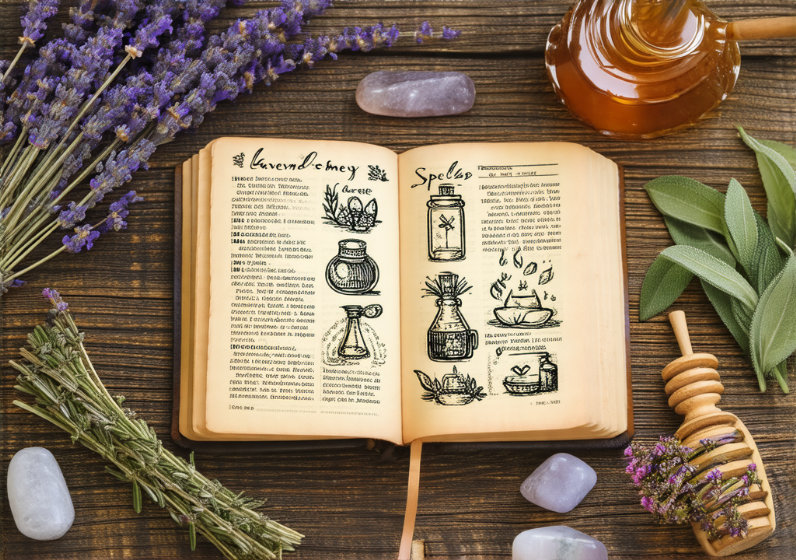
10 Ancient Spells You Can Perform in Under an Hour
Ten Ancient Rites for the Modern Circle ✨🕯️
By Seraphina Moonwhisper, Keeper of the Old Ways
There is a particular kind of magic that lives in the pause between heartbeats. It is not the flashy, sparkly variety peddled in modern pop culture, nor is it the dry, academic study of esoterica found in university libraries. It is something older, quieter, and far more potent. It is the magic of ritual — the deliberate shaping of intention through symbol, gesture, word, and time.
For those who have just begun walking the path of Ceremonial Witchcraft, or for seasoned practitioners who find themselves stretched thin by work, family, and the general chaos of modern life, the question often arises: How do I maintain a consistent practice when I don't have three hours to stand in a circle?
The answer lies in understanding that magic is not measured by duration. A spell cast with full presence for ten minutes carries more weight than one performed on autopilot for two hours. The ancients did not need elaborate theaters of ritual; they needed clarity, devotion, and the right tools at the right time. They understood that a single candle, correctly lit with clear intent, is a door opened to the divine.
Herein you will find ten ancient spells — drawn from folk tradition, folk magic, and the broader ceremonial traditions — each designed to be completed in under an hour. These are not shortcuts; they are distillations of power. They require no rare ingredients, no expensive regalia, and no grand staging. What they do require is your full attention, a clear intention, and a willingness to listen to the quiet voice within.
Let us begin.
1. The Candle Reading: A Spell for Clarity ✨🕯️
Time Required: 20–30 minutes
Best Performed At: Dusk or during the waning moon
This is not a spell that changes your circumstances; rather, it is a spell that clarifies them. In the oldest traditions of Western esotericism, candle reading (or candle scrying) was one of the most accessible forms of divination. A single white candle becomes a mirror for the unseen. You do not need crystals or tarot decks. You need only flame, shadow, and stillness.
What You Need:
One clean white pillar or taper candle
A stable surface (a plate, a saucer, a stone) to catch wax
A darkened room
Your journal
The Rite:
Begin by cleansing your space with a simple breath — three slow exhales, imagining any mental clutter being blown away. Light the candle and place it at the center of your working surface. Sit before it. Let the flame find its rhythm. Do not rush. The first few minutes are for settling your mind. Watch the flame without trying to "see" anything. Simply observe.
After five to ten minutes, ask your question silently. It should be open-ended — "What do I need to understand about this situation?" rather than a yes/no question. Then close your eyes and listen with your inner ear. You may receive words, images, sensations of color or temperature, or even a single letter that feels significant. When you feel the answer has arrived (you will know by a sense of resolution), open your eyes and write down everything you received in your journal.
Extinguish the candle by blowing it out gently — do not use water, as this is said to "drown" the message. Allow the smoke to rise before putting away your materials. The next morning, reread your notes with fresh eyes. Often what seemed ambiguous in the dim light becomes clear once the mind has rested.
Why It Works:
In ceremonial terms, you have created a micro-cosmos: flame (fire), wax (earth), smoke (air), and the still air around it (water). You have invoked all four elements in miniature. The candle is not merely a light source; it is a focal point for consciousness to sharpen.
2. Salt and Honey: A Spell for Protection 🍯🧂
Time Required: 15–20 minutes
Best Performed At: Morning, upon waking, or before leaving the home
This is one of the oldest protective rites in Western folk tradition. You will find variations of it in Egyptian temple rituals, medieval European household magic, and West African root work. The principle is simple: salt purifies and preserves; honey sweetens and attracts good fortune. Together, they create a barrier that repels negative energy while inviting positive forces to remain near you.
What You Need:
A small bowl of clean sea salt (or table salt in a pinch)
A small dish or spoonful of raw honey
Your own body as the working surface
The Rite:
Upon waking, before speaking to anyone or checking your phone, stand at a mirror if one is available. Dip two fingers into the salt and three into the honey. Rub these on each hand — left hand for receiving, right hand for giving. Then anoint your forehead, your heart center (sternum), and the soles of both feet. As you do this, speak simply: "Salt to purify, honey to sweeten. May harm turn away from me, may good find its way in."
If you are leaving home, carry a small pinch of salt mixed with a drop of honey on your finger or tucked in your pocket (some traditions wrap it in a scrap of cloth). This carries the "seal" of protection through your day. At night, wash your hands thoroughly and let any leftover residue rinse away — this is the old belief that you are washing off what was absorbed during the day's interactions.
Why It Works:
Salt is hygroscopic; it draws moisture (and metaphorically, emotional "wetness" or confusion) into itself, preserving purity. Honey is a complex mixture of sugars and enzymes; in alchemical terms, it represents the sweetening of base matter into something nourishing. You are literally coating your energetic field with these two principles: one that repels corruption, one that attracts nourishment.
3. The Three Coins: A Spell for Abundance 🪙✨
Time Required: 25–40 minutes
Best Performed At: New moon or first quarter moon; early morning is ideal
Coin magic is perhaps the most universally shared form of folk spellwork across cultures. Chinese, Egyptian, European, and West African traditions all recognize that coin represents not just currency but energy in its most tangible form — it has been touched by many hands, circulated through economies, and carries the vibration of exchange. To work with coins is to work with the flow of life force itself.
What You Need:
Three clean coins (any denomination; they do not need to be rare or ancient)
A small cloth or piece of green paper
A quiet space where you will sit for at least 20 minutes
The Rite:
Lay the three coins in a triangle on your cloth. Each coin represents one aspect of abundance: the past (what has already been given to you), the present (what is flowing through you now), and the future (what is coming toward you). Touch each coin in sequence, speaking to it:
"This coin honors what I have received. This coin holds what I am creating now. This coin opens the door to what is yet to come."
Then speak your specific intention for abundance — be precise. Not "I want more money" but "I open myself to new income streams that align with my gifts." Hold this thought while looking at the coins. Then wrap them in the cloth and place them somewhere you will see daily (a desk drawer, a shelf).
Leave them undisturbed for seven days. On the eighth day, unwrap them, clean them gently, and return them to your collection or give one coin to someone as a gesture of goodwill — this "closes the loop" and keeps energy flowing rather than hoarded.
Why It Works:
The triangle is a stable geometric form; it represents structure within flow. The three coins create a "trinity" that mirrors the triadic structure found in so many ceremonial traditions (body-mind-spirit, past-present-future, earth-water-fire). You are building a small altar of intention and then maintaining that intention over time — which is where most spellwork fails: not in the casting, but in the sustaining.
4. The Water Mirror: A Spell for Healing 💧🌙
Time Required: 30–45 minutes
Best Performed At: Full moon; evening or night
Water scrying is one of the oldest forms of divination and healing known to humanity. From ancient Babylonian temple pools to medieval European "water glasses" used by folk healers, still water has been recognized as a portal between the seen and unseen. When you look into still water under moonlight, you are not merely looking; you are being looked at. The mirror reflects back what is within you — often what you have not yet processed or released.
What You Need:
A shallow bowl or plate of clean water (rainwater if possible)
Moonlight or soft candlelight as illumination
Your journal
Optional: a single white flower petal to float on the surface
The Rite:
Set up your bowl in a darkened room where moonlight can reach it. Sit before it and let your eyes adjust. Do not stir the water; stillness is essential. Look into the surface without trying to see anything specific. Allow your gaze to soften, to lose focus slightly. You may begin to see shapes moving under the surface — these are often memories or emotions you have been carrying but not yet released.
Speak gently to the water: "Show me what I need to release." Then simply watch and observe for 10–15 minutes. Write down any images, words, or sensations that arise. Afterward, pour the water out slowly into a plant (this is said to feed the earth with your released energy) or a clean drain (if you prefer the "washing away" metaphor). Cleanse the bowl and store it for next month's rite.
Why It Works:
Water has no fixed shape; it takes the form of its container. In healing terms, this represents adaptability — the body's and mind's capacity to reshape itself after trauma or stagnation. The still water acts as a receptive field: you project your inner state onto it, and it reflects back what you need to see. This is not "magic" in a supernatural sense; it is the ancient understanding that consciousness and matter are more intertwined than materialism allows.
5. The Door Threshold: A Spell for New Beginnings 🚪🌅
Time Required: 10–15 minutes
Best Performed At: Sunrise or dawn; first day of a new phase (new job, move, relationship)
In folk tradition, thresholds — doorways, windows, bridges, paths — are liminal spaces. They belong to neither side; they exist in the between. This makes them powerful sites for transition magic. A doorway is not just an opening; it is a decision point where one state ends and another begins. To work with a threshold is to consciously mark that decision.
What You Need:
Your own body (you are the spell)
A doorway you will pass through daily (front door, bedroom door, office door)
A small piece of paper or cloth if desired (optional)
The Rite:
Stand just inside the threshold — one foot in, one foot out. Take three deep breaths. Visualize the room behind you as your old state: all its patterns, habits, and identities. Then visualize the space ahead as your new state: the person or life you are stepping into. Speak aloud (or silently): "I leave what I no longer need. I step forward into what is meant for me."
Then walk fully through the doorway with deliberate, unhurried steps. Do not rush. This is a ceremonial crossing — give it the weight of a rite of passage. If you have paper or cloth, write one word that represents your intention (e.g., "Courage," "Clarity," "Peace") and tuck it in your pocket or place it on your doorframe for the week.
Why It Works:
Liminality is the state of being "betwixt and between." In ceremonial terms, this is where transformation happens — you are no longer who you were, but not yet fully who you will be. By consciously marking that space, you give your subconscious permission to complete the transition. The physical act of stepping through the threshold anchors the mental shift in the body.
6. The Breath Circle: A Spell for Centering 🌬️🌀
Time Required: 15–20 minutes
Best Performed At: Anytime; especially useful before meetings, sleep, or creative work
This is the simplest of all spells — and perhaps the most powerful. It requires no tools, no ingredients, no space beyond your own lungs. The principle is ancient: breath is the bridge between body and spirit. In every ceremonial tradition from yoga to Sufi whirling to Christian liturgy, breath is the primary instrument of consciousness. To master your breath is to master your inner weather.
What You Need:
Your own breath
A quiet moment (5 minutes minimum)
Seated or standing comfortably
The Rite:
Sit with your spine straight but not rigid. Close your eyes. Breathe in through the nose for four counts, holding for seven counts, and exhaling slowly through the mouth for eight counts. This 4-7-8 rhythm is one of the oldest known breathing patterns associated with calming the nervous system (it appears in variations across Indian, Chinese, and European traditions).
As you breathe, imagine a circle forming around your chest — a warm, golden ring that expands on each inhale and contracts gently on each exhale. This is not visualization for show; it is intentional shaping. You are giving form to the energy in your body. Continue for 10–15 breaths. Then open your eyes slowly and notice: your thoughts will be quieter, your posture more grounded, your presence more solid.
Why It Works:
The 4-7-8 ratio activates the parasympathetic nervous system — the "rest and digest" state. In ceremonial terms, you are shifting from a state of doing (sympathetic, fire element) to a state of being (receptive, water/earth elements). This is not relaxation; it is alignment. A centered practitioner casts more effectively because their intention is clear rather than scattered.
7. The Thread and Needle: A Spell for Connection 🧵❤️
Time Required: 20–30 minutes
Best Performed At: Full moon or waxing moon; evening
Thread magic is one of the oldest forms of binding spellwork in Western tradition. A thread represents continuity, connection, and the invisible lines that link people, places, and ideas. To work with thread is to acknowledge that relationship is not an abstraction — it has texture, tension, and direction. This spell is for strengthening a bond (romantic, familial, friendship) or mending a rift.
What You Need:
A length of soft thread or yarn in the color associated with your intention (red for passion/love, green for growth/healing, white for purity/clarity)
A needle or pin
Your journal
The Rite:
Hold the thread in both hands and imagine each person in the relationship at one end. Speak: "May this bond grow stronger and truer." Then begin to tie a simple knot — not too tight, just secure. As you tie it, visualize the two ends drawing closer, the thread becoming taut but unbroken. Tie a second knot on a different section of thread. This represents mutual effort — both parties contributing to the strength of the bond.
Write in your journal: what is this relationship giving you? What do you need to give in return? Be honest. Then store the knotted thread in a small pouch or wrap it around a candle to "anchor" the intention into a physical object you can carry.
Why It Works:
Knots are one of humanity's oldest technologies — they represent holding. A knot holds two ends together against the pull that would separate them. In this spell, you are creating a symbolic anchor for an invisible bond. The journal entry adds another layer: it externalizes your intention into text, making it more concrete to the subconscious mind.
8. The Herb Bundle: A Spell for Purification 🌿🔥
Time Required: 20–30 minutes
Best Performed At: Waning moon; evening before a new beginning or after a difficult day
Burning herbs (or smudging) is one of the most widely practiced forms of folk magic in the Western world. Its roots stretch back to ancient Egyptian temple purification, Native American ceremonial use, and medieval European household cleansing. The principle is not merely "smells nice"; it is that the combustion of aromatic plant matter releases volatile oils that affect both the physical environment and the practitioner's nervous system. You are creating a field — a space saturated with specific energetic qualities.
What You Need:
A small bundle or handful of dried herbs (sage, rosemary, lavender, or a blend)
A fire-safe dish or bowl
A match or lighter
Optional: a bell or chime to mark the beginning and end
The Rite:
Light one end of your herb bundle. Allow it to smolder rather than flame (if it catches full fire, pinch it out and let it smoke). Begin at the entrance to the room you wish to cleanse and move slowly through the space, directing the smoke into corners, behind furniture, and around doorframes — the places where energy tends to pool or stagnate. As you move, speak: "May all that does not serve me leave this space."
Take your time. This is not a task; it is a ritual. Let the smoke do its work. When you have covered the space, extinguish the bundle by pressing it into the fire-safe dish (do not use water). Sit in silence for 2–3 minutes and notice any emotions that surface — these are often what the cleansing has "loosened."
Why It Works:
Combustion breaks down complex molecular structures into simpler ones, releasing aromatic compounds. In ceremonial terms, you are transmuting stored energy (in the plant) into a form that can interact with your environment and nervous system. The smoke carries the intention outward — it is a vehicle for your will to permeate the space.
9. The Stone Stack: A Spell for Stability 🪨⛰️
Time Required: 15–20 minutes
Best Performed At: Morning; any time you feel unsteady or scattered
This spell draws on one of humanity's oldest symbolic acts: stacking stones. From Inca quipu records to Japanese ishibashi (stone bridges) to the simple cairns left by hikers, stacked stones represent order imposed upon chaos. Each stone is a decision; each level is a layer of intention built upon the last. To stack stones is to say: "I am building something that will hold."
What You Need:
5–7 smooth, flat stones (river stones work well)
A stable surface or outdoor spot where you can leave them for at least a day
Your journal
The Rite:
Lay the largest stone flat as your base. Place the next largest on top, adjusting until it feels balanced. Continue upward, each stone slightly smaller than the one below. As you place each stone, assign it an aspect of stability: foundation (largest), direction, consistency, patience, and vision (smallest/top). Speak to each: "You are my [aspect]. You hold me steady."
Leave the stack in place for at least 24 hours — this is important. The spell is not complete when you finish stacking; it completes over time as the stones "settle" into their positions. Check on them daily and notice if any have shifted or fallen (this can be read as a sign to revisit that aspect of your life).
Why It Works:
Balance requires continuous micro-adjustments. A stone stack looks stable but is actually in dynamic equilibrium — each stone subtly adjusts its center of gravity in response to the others. This mirrors how stability works in life: it's not rigid, it's responsive. The physical act of stacking trains your hands and mind into a state of focused attention that carries over into your broader practice.
10. The Night Watch: A Spell for Intuition 🌙👁️
Time Required: 30–45 minutes
Best Performed At: New moon; night, before sleep or during a quiet hour
The new moon is the time of potential — when the sky is dark and nothing is yet in motion. It is also the time when intuition is most active, unclouded by the "light" of ongoing events. The Night Watch is not a spell that gives you an answer; it is a spell that creates the conditions for your inner voice to be heard. It requires patience and a willingness to sit with uncertainty.
What You Need:
A dark room or outdoor spot under open sky
A comfortable place to lie down (a blanket, a mat)
Your journal (within reach but not in front of you)
Optional: a small bell to mark the end of the rite
The Rite:
Lie on your back and let your body go completely still. Close your eyes. Breathe slowly for 5 minutes until your heart rate settles. Then ask your question silently — keep it simple. "What am I not seeing?" or "What is my next step?" Do not try to force an answer. Instead, listen with your whole body: ears, skin, gut, the back of your eyes.
You may receive words, images, a single sensation (warmth on one side of your face, a tingling in your hands), or even just a feeling — a tone of certainty or doubt that tells you which direction to lean toward. This is not "hearing voices" in a supernatural sense; it is attending to the subtle signals your body and subconscious are already producing but which daily noise drowns out.
When 20–30 minutes have passed, ring your bell gently (if using one) or simply open your eyes slowly. Write down everything you received before sleeping. Over the following days, notice if any of these impressions become clearer in action or conversation. Intuition works on a timescale longer than the moment it is received.
Why It Works:
In ceremonial terms, you have entered a state of receptive silence — the opposite of the "doing" mode that dominates modern life. The new moon sky removes visual stimulation; lying down reduces physical exertion; stillness quiets the nervous system. Together, these create an environment where subtle signals can be received. You are not creating intuition; you are making space for it to be heard.
Closing Notes: The Discipline of Small Rites 🕯️📜
One of the most common questions from new practitioners is not "how do I cast a powerful spell?" but rather "how do I keep doing this consistently when life gets busy?" These ten spells are designed with that question in mind. Each can be completed in under an hour — some in as little as 10 minutes — so they require no grand commitment of time or resources.
But consistency is not the same as repetition. A candle lit with full presence on a Tuesday evening carries more weight than a ritual performed mechanically every day for a month without engagement. The key is intentional presence — showing up to your practice not as a task to complete but as a conversation to continue.
The ancients did not separate their magic from their daily lives. They blessed the bread before eating it. They sprinkled salt at the door before leaving. They stacked stones on the path they walked every day. Their spells were woven into the fabric of ordinary existence, which is precisely why they worked — because they never stopped working.
Begin with one spell that speaks to your current need. Practice it three times over a week. Notice what shifts in your perception, your mood, your decisions. Then move on to the next. Over time, these small rites will become as natural as breathing — and just as essential.
The circle is not a place you go; it is a state you return to. These ten spells are your invitations back into that state. Light the candle. Stack the stones. Breathe the circle. The old ways are not lost — they are waiting for you to remember them. 🌙✨