


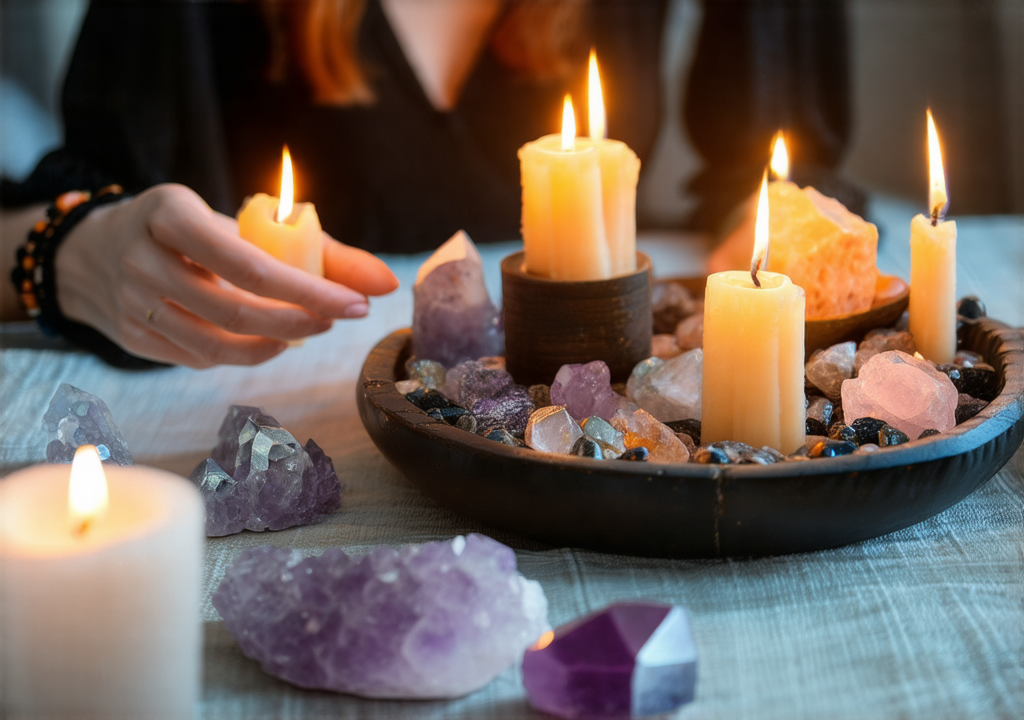
What if you were standing on a threshold right now? Between the mundane and the wondrous, between ordinary time and sacred time? This is precisely where ceremonial magic begins—not in distant grimoires or exotic lands, but here, in your own hands.
What Is Ceremonial Magic?
Ceremonial magic is a structured form of ritual practice that uses precise words, symbols, gestures, and materials to channel intention into reality. Unlike everyday magic—the casual kind we perform when lighting candles for a romantic dinner or drawing chalk circles on the beach—ceremonial magic demands exactitude. Every element serves a purpose; every gesture carries meaning. It is the art of making deliberate use of symbolic action in order to produce specific results, whether those results be external (bringing rain, healing illness) or internal (shifting consciousness, gaining insight).
The word “ceremony” itself derives from Latin caerimonia, denoting a sacred rite performed with prescribed form and sequence. When we speak of ceremonial magic, we refer not to spectacle but to substance—rituals conducted with precision according to established tradition, whether that tradition be Hermetic, Kabbalistic, Enochian, or another lineage entirely.
The Historical Landscape: From Ancient Rituals to Golden Dawn
The roots of ceremonial magic extend back through the ages. In ancient Egypt, priests performed elaborate rites within temple precinctures with precise offerings and incantations. Greek magicians invoked divine names using complex symbols and mathematical relationships between them. But it was the Hermetic tradition—particularly as expressed in texts like the Corpus Hermeticum and later codified by medieval and Renaissance practitioners—that established many of the principles still employed today.
The major milestone came with the publication of Athanasius Kircher’s Arca Noë, Heinrich Cornelius Agrippa’s De Occulta Philosophia, and John Dee’s Enochian invocations, all of which provided frameworks for systematic magical practice. But perhaps no figure better embodies the spirit of ceremonial magic than Aleister Crowley, whose Magick in Theory and Practice crystallized centuries of accumulated knowledge into a coherent system accessible to modern practitioners.
The Elements That Define Ceremonial Magic
At heart, ceremonial magic revolves around four fundamental principles:
- Precise Intention: Every ritual must have an objective that is clearly defined before beginning. Whether calling forth a particular spiritual entity or manifesting some external effect, the magician specifies exactly what she intends.
- Correspondences: The system recognizes relationships between symbols, colors, sounds, numbers, and material substances. Silver corresponds to the moon; incense to spirit; circles to wholeness. Knowledge of these correspondences allows the magician to construct rituals that resonate across different levels of reality simultaneously.
- The Circle of Art: This refers to the practitioner’s skill in constructing and executing ceremonies with precision—knowing when to invoke, when to banish, how to arrange tools, and which words to speak aloud versus silently.
- Time and Direction: The timing of a ritual (whether according to planetary hours or lunar phases) significantly affects its potency, as does the direction in which it faces.
Tools of the Trade: Rods, Candles, Sigils, and Beyond
Ceremonial magicians employ various instruments in their practice. The wand represents active force; the sword, passive power. Candles correspond to elemental qualities (candle flames symbolize fire’s purification; white candles evoke purity). The pentacle—often a disc of metal or painted on parchment—symbolizes earth and material abundance.
But perhaps most important is the sigil: a graphic representation of intention, which can be drawn in one moment and carried forward as a talisman. Sigils work because they operate on the subconscious level—the image itself carries meaning even when the practitioner forgets its specific purpose.
Getting Started: Where to Begin Your Ceremonial Journey
You needn’t wait for perfect conditions or elaborate equipment before beginning your journey into ceremonial magic. Start simply:
- Learn one ritual system (Crowley’s Liber A, The Golden Dawn, or another tradition you find compelling)
- Practice regularly: Consistency matters more than complexity
- Keep a journal of what works and what doesn’t
- Begin with basic invocations, then gradually incorporate more complex ceremonies as your confidence grows
The beauty of ceremonial magic is that it welcomes both scholars and beginners alike. Whether you’re approaching the practice through scholarly study or intuitive discovery, you’ll find that each ritual deepens your understanding and enriches your life in ways that persist long after the candlelight fades.
Final Thoughts: A Path Worth Pursuing
What makes ceremonial magic truly remarkable is its accessibility. You don’t need wealth or special bloodline to enter this world of symbols and incantations; you simply need willingness to engage deliberately with reality itself. And once you’ve learned the basics, every ordinary moment becomes an opportunity for subtle magic: lighting a candle while thinking clearly, tracing a sigil in air before speaking important words, observing planetary hours as you work.
Your first step into ceremonial magic really is closer than you think—and it’s happening right now, as you read these words and consider whether perhaps the threshold between worlds stands just slightly to your left.














No Comments