


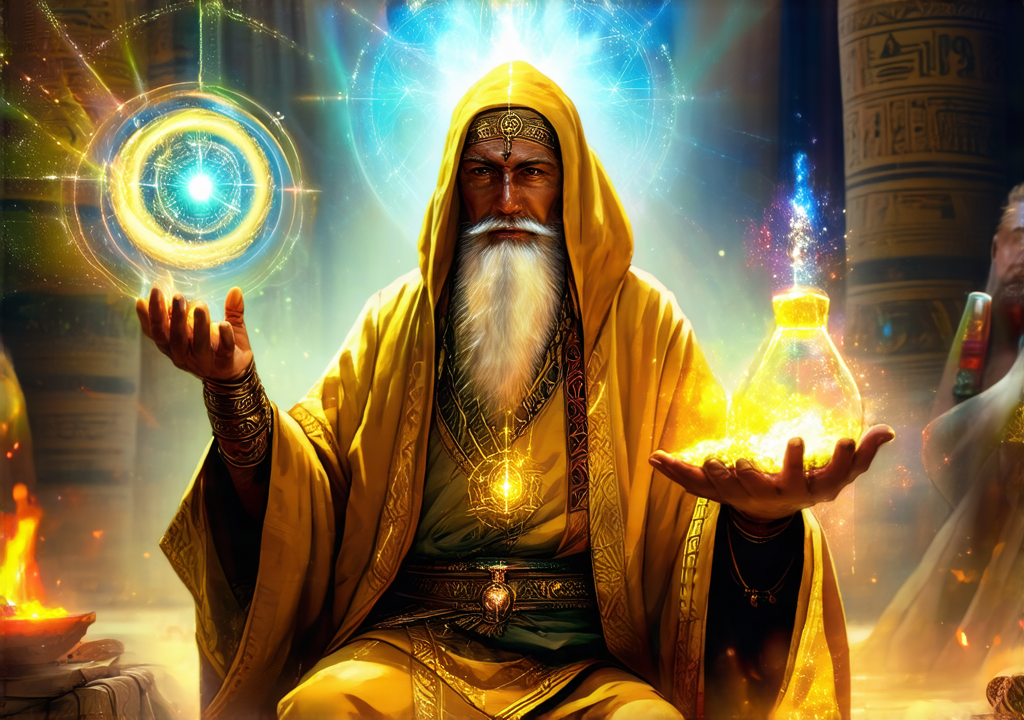
Alchemical transmutation is one of the most ancient, misunderstood, and profoundly transformative arts known to humanity. At its core lies the principle that base matter—whether lead, stone, or human spirit itself—is not static but contains within it the potential for divinity. The great hermetic axiom “As above, so below” guides the transmuter along this sacred path, where laboratory work becomes prayer and experiment becomes revelation.
The art of transmutation has been spoken of since the dawn of civilization, referenced in Egyptian texts, preserved through medieval manuscripts, and whispered about by alchemists throughout the ages. Yet for all its storied history, true mastery remains elusive—so much so that only one soul out of every ten thousand who encounters this great work can truly master it.
Why such selectivity? The answer lies not in intelligence or resources but in something far more fundamental: the transmuter’s ability to harmonize inner and outer, spirit and matter, intent and effect.
The alchemical process begins with purification—the albedo—where base materials are prepared through calcination, dissolution, separation, conjunction, fermentation, and crystallization. Each stage demands precision not merely in measurement but in timing, in recognizing the subtle signs that only a trained eye can perceive. The novice watches; the master listens.
But here is where most seekers falter: they approach transmutation as external work done to matter alone, when truly it is internal work manifested outwardly. The true transmuter understands that lead cannot become gold without first becoming lead internally—shedding its heavier substances, refining itself through successive stages of purification until it achieves the quality appropriate for transformation.
The great works of history demonstrate this principle clearly. The famous “Green Lion” depicted in medieval texts—the lion devouring and transforming what it consumes—represents not a literal creature but the alchemical process itself: the green (natural, verdant) power consuming base matter and raising it to higher states through repeated cycles.
For those few who truly understand this art, transmutation is no mere mechanical process of heating and mixing; it becomes an act of participation in cosmic order. The lapis philosophorum—the philosopher’s stone—is not merely a catalyst for changing lead into gold but rather the perfected matter itself, having undergone all transformations through which base lead passes to achieve gold-like perfection.
The rarity of true transmuters stems from several factors. First is the requirement of scientia: genuine knowledge that comes not from books alone but from direct observation and experience. Second is the need for what alchemists call the “secret fire”—an inner heat that differs from ordinary flame, operating at a different level of reality. Third is the necessity of aligning one’s personal frequency with the cosmic harmonies that govern transmutation itself.
Mercury, symbolically central to all true work, represents this requirement: not merely as an element but as a principle—fluidity between states, the ability to exist in multiple forms simultaneously, the quality of transformation itself. The true transmuter must become like mercury: capable of change while remaining essential, mutable yet unchanging at core.
The journey through alchemy involves seven stages corresponding both to metals and to planetary influences: lead (Saturn), tin (Jupiter), iron (Mars), copper (Venus), silver (the Moon), gold (the Sun), and platinum or diamond (the ultimate perfection). Each stage requires specific conditions, specific inner states.
What distinguishes the master transmuter from the mere practitioner is their ability to maintain this inner alchemical fire continuously—not merely during active work but through the entire day. This “fire” is not physical heat alone but a sustained state of readiness, where everything serves as potential fuel for transformation.
The famous statement that only one in ten thousand truly masters transmutation refers not to genetic lottery or social status but to a specific configuration: the ability to hold opposites simultaneously (lead and gold, matter and spirit, individual and cosmos), to recognize that every material encounter is potentially an opportunity for transformation, and to possess both the patience for long work and the precision to recognize when each stage is complete.
Such mastery requires years—if not decades—of dedicated practice. The novice may achieve minor transmutations through careful application of recipes and formulas; only by truly understanding the principles can one move beyond formula into genuine mastery where every action becomes alchemical, every moment an opportunity for transformation.
The path to mastery begins with humility before matter itself—as if lead were not base but potential awaiting its true form—and ends when the transmuter recognizes their own nature as equally subject to and capable of transformation. Lead has become; gold remains; what was once base now shines like light itself, unchanged in essence, transformed by having passed through all necessary stages.
The art lives still today—not merely in laboratory experiments but in anyone willing to approach matter with reverence and the willingness to discover that which lies hidden within it: the divinity waiting to emerge.















No Comments