


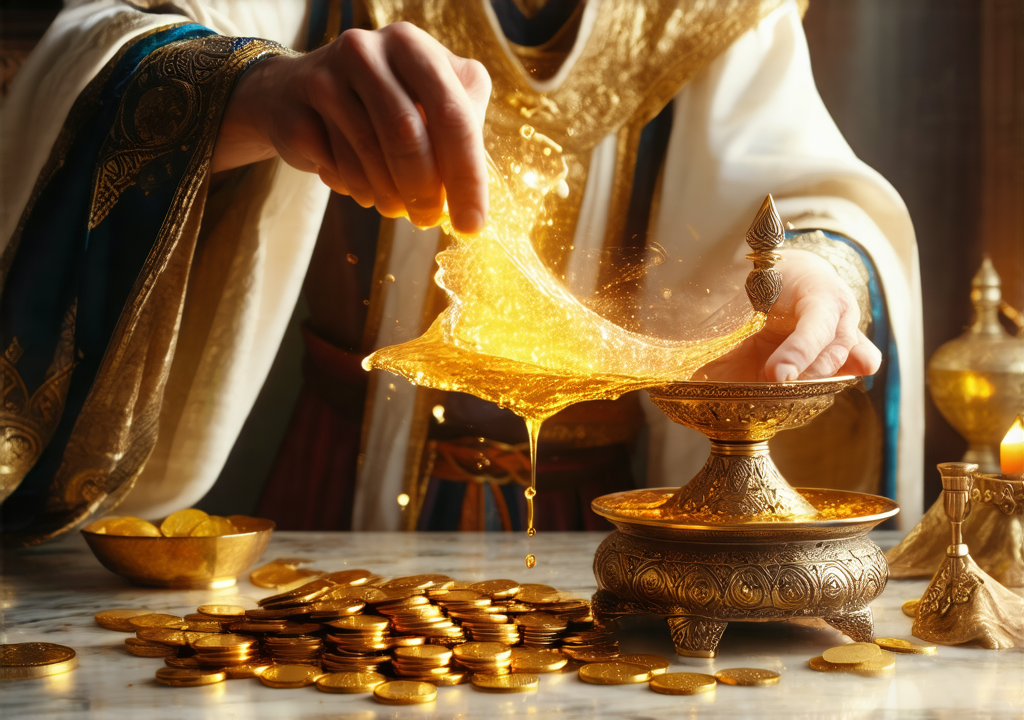
For millennia, alchemists have whispered of an extraordinary truth concealed within the earth itself—that base lead, that heavy and common metal which dulls the eye and drags down the spirit, may be transmuted into the luminous, incorruptible substance we call gold. The Philosopher’s Stone, it was said, holds the secret to this transformation. But what does transmutation truly mean? And how might anyone—perhaps even you—participate in this sacred work?
The Great Work: A History of Transformation
The art of alchemy stretches back through the mists of antiquity—from the ancient Egyptians who first observed that lead could be treated to yield gold—to medieval scholars like Albertus Magnus, to Paracelsus and beyond. Across centuries, each culture understood transmutation not merely as a chemical process but as an act of cosmic participation: man working in harmony with the forces of nature, drawing down celestial energies into earthly matter.
In its broadest sense, alchemical transmutation means change—change of substance, change of state, and ultimately, change of being itself. The lead that enters one’s hands is not merely metal but a reflection of the darker, unrefined self; the gold produced stands as symbol for illumination, perfection, and divine likeness.
The Principles of Transmutation
To understand how lead may become gold, we must first grasp several foundational principles:
The Principle of Sympathy: “As above, so below.” Whatever exists in one realm finds its counterpart in another. Lead’s celestial correlate is Saturn; gold belongs to the sun. When alchemists worked with lead, they sought not merely to alter chemical composition but to invoke a sympathetic resonance between the earthly metal and solar energies.
The Principle of Mediation: Between extremes there stands a mediator—what the ancients called Mercurius, or quicksilver. Mercury is neither wholly earth nor wholly spirit; it bridges them both. The alchemical substance known as the Azoth combines mercury with sulfur and salt, forming a triad that constitutes the very heart of transmutation.
The Principle of Conjunction: Opposites must unite before transformation can occur—sulfur and mercury, masculine and feminine principles, fire and water. This sacred marriage (coniunctio oppositorum) creates what alchemists called the rebis or second child—a substance more potent than either parent alone.
The Philosopher’s Stone: Key to the Great Work
The most famous of all alchemical achievements, the Philosopher’s Stone is actually not a stone at all in any literal sense but rather a subtle spiritual substance, capable of penetrating base metals and refining them into gold. Different traditions name it differently—Lapis Philosophorum, Azoth, even the third thing beyond salt, sulfur, and mercury.
The Stone was said to possess two powers: the power to transmute matter (chrysopoeia) and the power to confer longevity or immortality (the Elixir). These were not separate gifts but aspects of a single understanding—that matter is not solid substance but rather crystallized spirit, capable of being re-spiritualized.
How Transmutation Is Done: A Practical Guide
While many alchemical writings leave us in the dark with cryptic symbols and riddles, the essential process can be described clearly enough for earnest practitioners to follow:
Preparation of Matter: The lead must first be purified by calcination—heating it until impurities burn away—and then reduced to fine powder. Some traditions require that this powder be mixed with specific herbs or minerals, each chosen according to its celestial correspondence.
Conjunction and Digestion: The prepared matter is sealed in a vessel (the athenor or closed flask) and subjected to gentle heat—what the alchemists called the gradus of fire. This slow heating, maintained over many days or even months, allows the opposing forces within the substance to unite.
Fermentation and Fixation: After conjunction comes fermentation—the active internal stirring as the substance seeks its true form. The result is a darkened substance that eventually gives way to a lighter color, then to yellow, and finally to gold—a process they called nigredo, albedo, and rubedo.
Perfection: Once the transmutation appears complete—when a small piece of the treated lead yields gold when tested—the entire batch may be considered transformed. The Stone itself is said to possess the power to continue working, though it diminishes somewhat with each use.
Spiritual Alchemy: Transmutation of the Self
Perhaps more important than literal transmutation is what alchemists called the Magnum Opus—the Great Work, which they understood as simultaneously an external process and an internal one. As Paracelsus wrote, “The stone that transforms lead into gold operates also within us.” The same forces that transform matter refine the soul: humility before fire, patience in darkness, willingness to dissolve so that reformation may follow.
Every authentic alchemist recognized this dual dimension of transmutation. True gold was not merely external; it was the gold of a heart transformed from fear and desire into wisdom and love. The lead of the outer person—the heavy, slow, animal nature—became gold, luminous and enduring, when submitted to the fire of inner discipline and devotion.
Why Anyone May Attempt Transmutation
What makes this art accessible is that it requires no special birth or vast wealth. What it demands is attention, willingness to follow a pattern, and faith in what cannot immediately be seen. Every alchemical text ultimately points toward one truth: transmutation is possible because spirit underlies matter, and when the two are joined correctly, the lower becomes the higher—not by violation but by fulfillment.
So let us begin with reverence, with a purified heart and a simple vessel, and let us apply the fire of willing to what we seek to change. Whether you choose literal transmutation or spiritual—or both together—the secret is revealed: lead may become gold, because all that exists participates in divine nature, waiting only for the right conditions to shine forth as their true self.















No Comments