


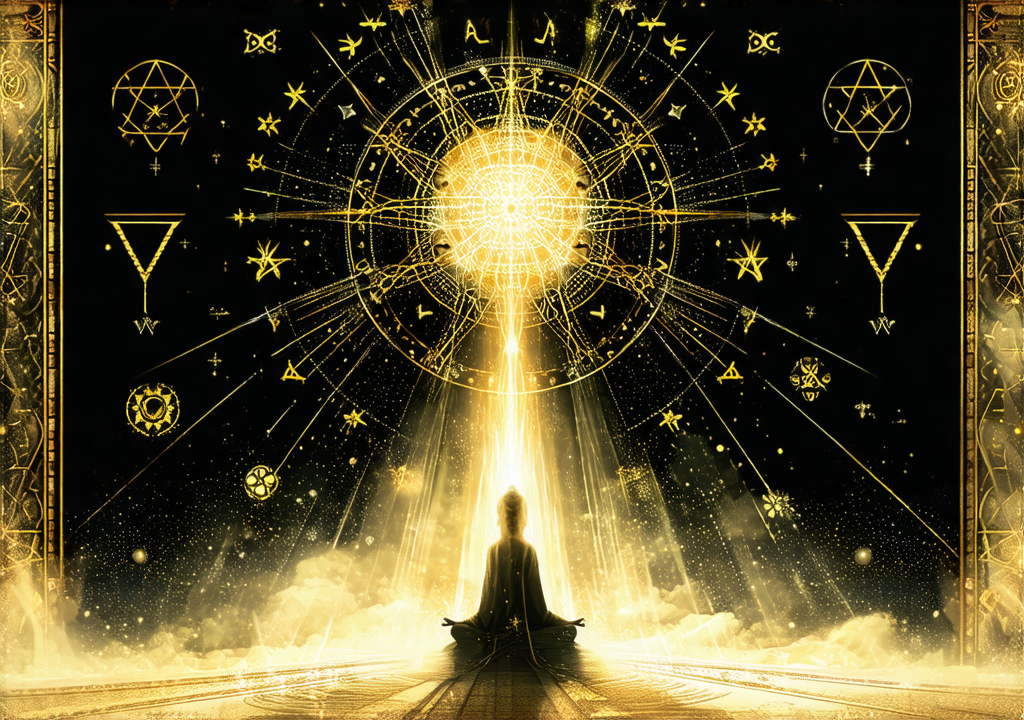
Introduction: Birth of a New Age
In 1904, amidst the bustling energy of Cairo, Egypt, an American occultist named Aleister Crowley received what he believed was divine inspiration through his wife, Rose. During this period of profound mystical revelation, he received The Book of the Law (Liber AL), which would become central to a new spiritual movement called Thelema—a word derived from Greek, meaning “will” or “volition.”
This revelation marked the beginning of what Crowley described as the age of Horus—the era where humanity transitions from collective obedience to individual sovereignty. At its core, Thelema is not merely a religion but a complete cosmology and magical system that places Will at the center of all existence.
Understanding True Will: The Central Principle
At the heart of Thelema lies one fundamental concept: True Will. This is not mere whim or preference, nor is it stubbornness. True Will refers to each individual’s unique purpose in creation—their essential nature expressed through deliberate action and conscious choice. As Crowley wrote in The Book of the Law, “Do what thou wilt shall be the whole of the Law.”
This might sound simple enough, yet Thelemites understand that knowing one’s True Will requires a lifetime of introspection and magical work. It is not something discovered in a single moment but rather cultivated through ongoing self-knowledge and practice.
Magic: The Science of Self-Development
What distinguishes Thelema from other mystical traditions is its treatment of magic as an actual science—a method for achieving one’s True Will through systematic practices. Crowley defined magic as “the Science and Art of causing Changes in Conformity with the Will.” This definition establishes magic not as some mysterious supernatural power, but as a practical discipline that anyone can study and apply.
Within Thelemic tradition, various magical systems developed over time: ceremonial magic, yoga, alchemy, and meditation techniques all found expression within the framework of True Will. Each practitioner develops their own approach while remaining connected to the central principle that magic is fundamentally about aligning one’s actions with one’s deepest purpose.
The Book of the Law (Liber AL)
Liber Al—the sacred text revealed to Crowley—is brief yet profound in only 87 short verses. It contains within its pages everything from cosmological principles to ethical guidelines, all expressed through poetic language that rewards deep contemplation.
The book introduces several key concepts:
- Ain (Limit): The infinite void before creation
- Araphael: The angel of the Book itself
- Kheryuim: Spiritual forces governing the universe
- ** Nuit**: Cosmic mother, representing infinity and space
- Ra-Hoor-Khuit: The crowned and conquering child
These concepts provide a framework for understanding how Thelemites view themselves as participants in an ongoing cosmic drama.
Practice and Daily Life: Living the Will
The practice of Thelema extends beyond mystical contemplation into daily life. Thelemic practitioners develop rituals, study magical texts, practice yoga, engage in ceremonial magic, and apply their insights to everyday decisions. The tradition encourages experimentation—each individual should test various methods until finding what works for them personally.
A key aspect of Thelemic practice is the concept of magick (with a ‘k’) as distinguishing it from general magic. Crowley emphasized that true magick involves deliberate, conscious action aligned with one’s True Will. This distinguishes magical work performed in service to oneself from mere superstition or blind ritualism.
Thelemic Ethics: Do What Thou Wilt
Perhaps the most famous statement of Thelemic ethics remains Crowley’s declaration in The Book of the Law: “Do what thou wilt shall be the whole of the Law.” This principle, when properly understood, means not license to do anything one wants (which would lead to chaos), but rather to discover and follow one’s True Will.
Two additional principles clarify this further:
- “The method of science; the aim of religion” emphasizes that Thelema values evidence-based practice alongside spiritual insight.
- “Love is the law, love under will” suggests that loving relationships are expressions of one’s true purpose rather than distractions from it.
Thelemic Community and Modern Relevance
Modern Thelemites continue to build on Crowley’s foundation while adapting his teachings for contemporary life. Organizations like the Ordo Templi Orientis (OTO) carry forward the tradition, teaching magic as a practical system for self-development. Books such as Magick in Theory and Practice remain essential reading for those interested in Thelemic magical theory.
What makes Thelema compelling today is its emphasis on personal sovereignty—each individual becoming responsible for their own spiritual development rather than relying solely upon external authorities or dogmas. This resonates particularly well with modern seekers who value both mystical depth and intellectual clarity.
Conclusion: The Continuing Journey
The story of Thelema continues to unfold through the ongoing work of practitioners worldwide. Whether one approaches it as a religion, a magical system, or simply a set of ideas about personal development, the core insight remains powerful: that each individual has within them an essential purpose—a True Will—that they can discover and express throughout their lives.
As Crowley himself suggested, Thelema offers not just knowledge but practical guidance for those seeking to live authentically in accordance with their deepest nature. It is a path that combines ancient wisdom with modern sensibility, mystical experience with rational inquiry, individual sovereignty with cosmic significance.
In the end, Thelema Uncovered: A Story About Will, Magic, and the Secrets of Creation serves as both invitation and instruction—for anyone curious enough to explore what lies beyond conventional religion and into the heart of their own True Will.


Recent Post


Gallery






Featured Videos






No Comments