


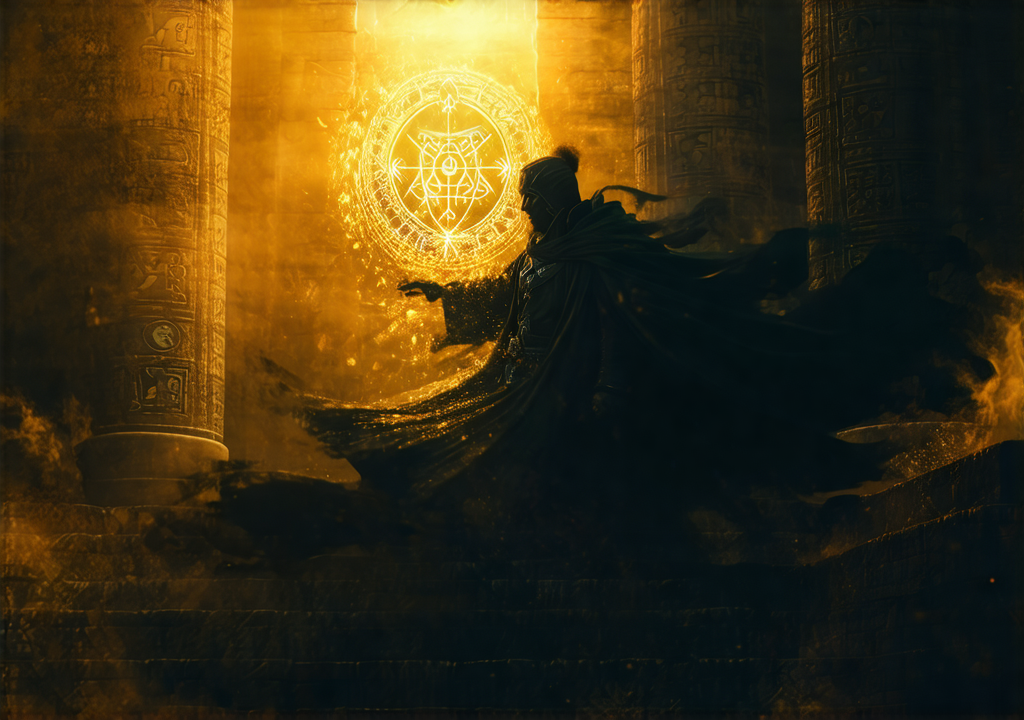
In the vast landscape of Western esoteric traditions, few concepts are as provocative or as central as Thelema itself—a word derived from ancient Greek, meaning “will” or “willingness,” yet carrying within it a profound philosophical revolution. Founded by Aleister Crowley in 1904, Thelema emerged not merely as a new religious system but as a radical reimagining of the relationship between human agency and cosmic order. At its core lies a tension that would seem paradoxical on the surface: the Epic Battle Between Will and Destiny According to Thelema—which is both a conflict and a reconciliation of two seemingly opposing forces.
Understanding True Will
The concept of True Will in Thelema requires careful distinction from ordinary notions of willpower or desire. Crowley’s “True Will” represents not what one wants, but rather what one is—one’s fundamental purpose in the cosmos. It is often described as the unique trajectory each soul must follow if it is to live authentically and fully realize its potential. When Crowley famously declared that “Every man has his mission, a vocation which he can perform in different ways,” he was articulating this vision of personal destiny not as predetermined fate but as a dynamic course toward self-actualization.
This is where the battle begins. Destiny, traditionally conceived as the fixed pattern written by gods or stars, appears static and external. Will, however, emerges from within as the driving force that shapes one’s existence. In Thelema, destiny is not imposed upon humanity; it is discovered through self-knowledge and pursued through conscious choice.
The Law of Thelema
The central axiom of Thelemic philosophy—”Do what thou wilt shall be the whole of the law”—has been the subject of endless interpretation. The word “wilt” in Crowley’s formulation carries a double meaning: it refers both to one’s True Will and to the act of willing itself. This elegant linguistic duality captures the essence of the debate between will and destiny. If everything is determined by fate, then what room remains for genuine choice?
The answer lies in Thelemic understanding that our True Will is our destiny—not in the sense of being predetermined, but in the sense of representing our highest potential and ultimate purpose. When one aligns with their True Will, they are not breaking free from destiny; they are fulfilling it authentically. This reconciliation transforms what might appear as a battle into something more harmonious: a partnership between individual will and cosmic order.
The Mythic Framework
Thelema draws heavily upon mythological narratives to illustrate the relationship between will and destiny. Consider the story of Nuit, Hadit, and Ra-Hoor-Khuit—the three deities representing the infinite cosmos, the point within matter, and their union in manifestation. This triad embodies the cosmic dance between the vast possibilities of destiny (Nuit) and the concentrated energy of individual will (Hadit). Their meeting produces Ra-Hoor-Khuit, the crowned and conquering child who represents the active realization of one’s True Will within history.
Crowley himself experienced this dynamic through his own spiritual journey, particularly during the period when he received The Book of the Law at Cairo in 1904. This foundational text presented itself as a divine revelation that would establish a new aeon—the Aeon of Horus—characterized by individual will and self-discovery rather than external authority.
Resistance and Fulfillment
What makes this battle truly epic is that resistance to one’s True Will is suffering in Thelemic thought. When we act against our deepest nature, against our True Will, we experience friction—not because the cosmos opposes us, but because our actions are misaligned with our essential purpose. Conversely, when we follow our will authentically, even difficulties become part of our fulfillment rather than obstacles to it.
The Battle Between Will and Destiny is thus ongoing throughout life. Each day presents choices that either align with or diverge from one’s True Will. Yet in Thelema, this battle has a purpose: through conscious choice and self-discovery, individuals gradually reveal their destiny not as a predetermined fate imposed upon them but as something they actively create and become.
Practical Implications
For practitioners of Thelemic philosophy, this understanding transforms how one approaches life’s challenges. When facing difficult decisions or periods of apparent chaos, the question is not “What should I do?” in an external sense but “Who am I?” and “What am I truly willing to become?” The answer guides action without constraining it within rigid predetermined patterns.
Thelema thus offers a vision where individual agency and cosmic destiny are not enemies locked in eternal conflict, but complementary forces whose apparent tension is actually the creative dynamic of existence itself. In following one’s True Will, one simultaneously discovers and fulfills their destiny—the most profound reconciliation between will and fate that Western esoteric thought has to offer.


Recent Post


Gallery






Featured Videos





No Comments