


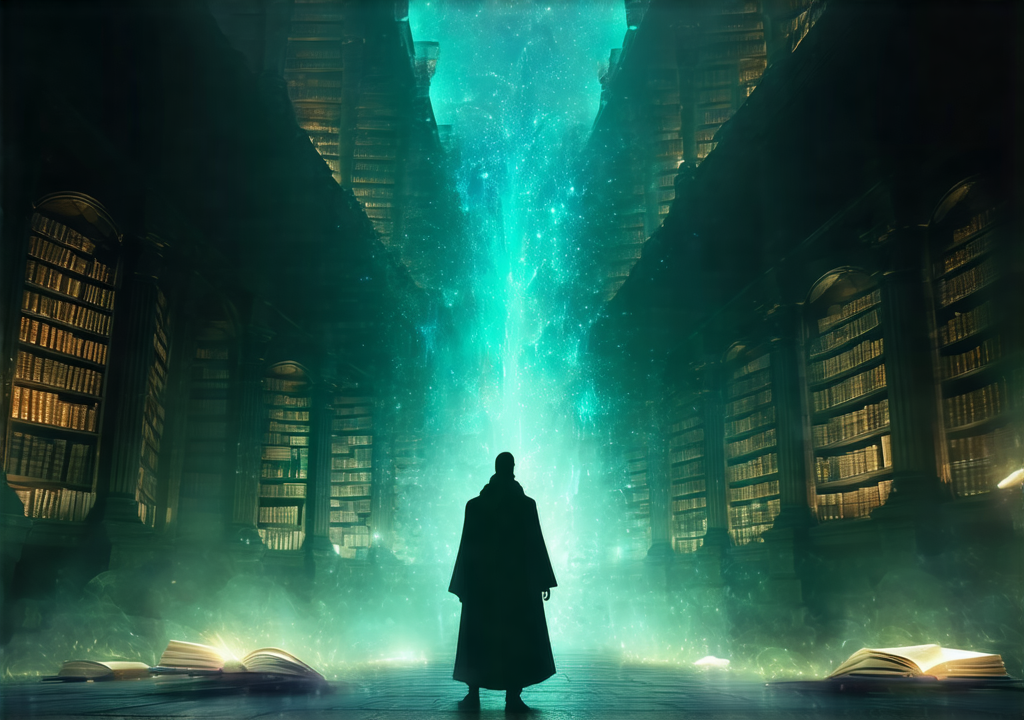
Thelema, derived from the Greek word for “will,” represents one of the most influential occult movements of the twentieth century, founded by the English mystic Aleister Crowley (1875–1946). While many occult traditions trace their roots back to ancient practices and esoteric lineages stretching across millennia, Thelema’s origins are remarkably specific: they begin with a single man’s intense spiritual encounters during a visit to Cairo in 1904.
Crowley was already an established figure in occult circles when he first received what would become the central revelation of his life. During a hot August day in Cairo, he and his future wife Rose had a profound experience that Crowley documented extensively. According to his own account, during this encounter, a mysterious entity named Aiwass dictated The Book of the Law, the sacred text of Thelema. This short but dense work declares that “Do what thou wilt shall be the law,” establishing will as the fundamental principle of cosmic order and human purpose.
What makes Crowley’s story particularly compelling is how his seemingly eccentric life reflected in practice the very principles he espoused. He was not content with passive acceptance of religious doctrine; rather, he sought to discover one’s true nature through direct mystical experience. His famous declaration “I am the Master Prophet” may have struck contemporaries as arrogant, but it emerged from a genuine conviction that he had received divine revelation and that his mission was to usher in a new age governed by different principles than those of Christianity.
The reception of Liber AL-vel-Legum (as Crowley titled the Book of the Law) marked the beginning of what would become one of the most recognizable magical traditions in modern occultism. Thelema differs from many other occult systems in its emphasis on individual sovereignty and the concept that each person’s true purpose is their unique will, which distinguishes it from both moral codes that prescribe how one should live and philosophical doctrines that claim universal application.
Crowley established several organizations to propagate his teachings: first A∴A∴ (the Order of the Ancient Wisdom), then later the Abbey of Thelema in Sicily, where he attempted to live out his vision with a community of devoted followers. His writings spanned philosophy, poetry, and technical instruction on magical practice. He developed sophisticated systems for ritual magic, including what became known as the Abramelin system and later refined it through his own insights into the nature of magick (spelled with a ‘k’ to distinguish Crowley’s use from mere witchcraft).
The significance of Thelema extends beyond its founding moment into how it has influenced subsequent occult movements. Many modern practitioners consider themselves “Thelemians” while incorporating elements from other traditions like Kabbalah, alchemy, and Enochian magic that Crowley had himself studied extensively. His work bridged the gap between Eastern philosophy—particularly Buddhism’s emphasis on self-knowledge—and Western esotericism, creating a synthesis that remains influential today.
What makes Thelema particularly relevant to modern spiritual seekers is its rejection of dogmatic authority in favor of personal experience. While Christianity emphasizes faith and devotion, Thelema emphasizes knowledge and discovery. Crowley famously declared himself the prophet of a new age not because he claimed divine authority over others but because he believed each individual could discover their own truth through direct investigation of both self and cosmos.
The tradition continues to evolve as practitioners explore its teachings in contemporary contexts. With hundreds of thousands adherents worldwide, including notable figures from literature, music, and the arts, Thelema has proven itself capable of growing beyond Crowley’s lifetime while remaining faithful to his original vision. Whether one accepts his mystical claims or views them through psychological interpretation, the central insight—that each person possesses a unique will that should guide their life—continues to resonate with modern seekers who value both depth and individuality in their spiritual practice.
In the end, Crowley’s legacy rests not on his personal achievements alone but on the enduring principles he articulated: that knowledge is power, that will is sacred, and that every human being has within them the capacity to discover their true purpose through direct mystical experience. His life may have been marked by controversy and excess, but it was also marked by genuine visionary insight—a vision that continues to inspire practitioners of Thelema who seek not just to live according to their nature but to fully realize themselves in all aspects of life.


Recent Post

Gallery






Featured Videos






No Comments