


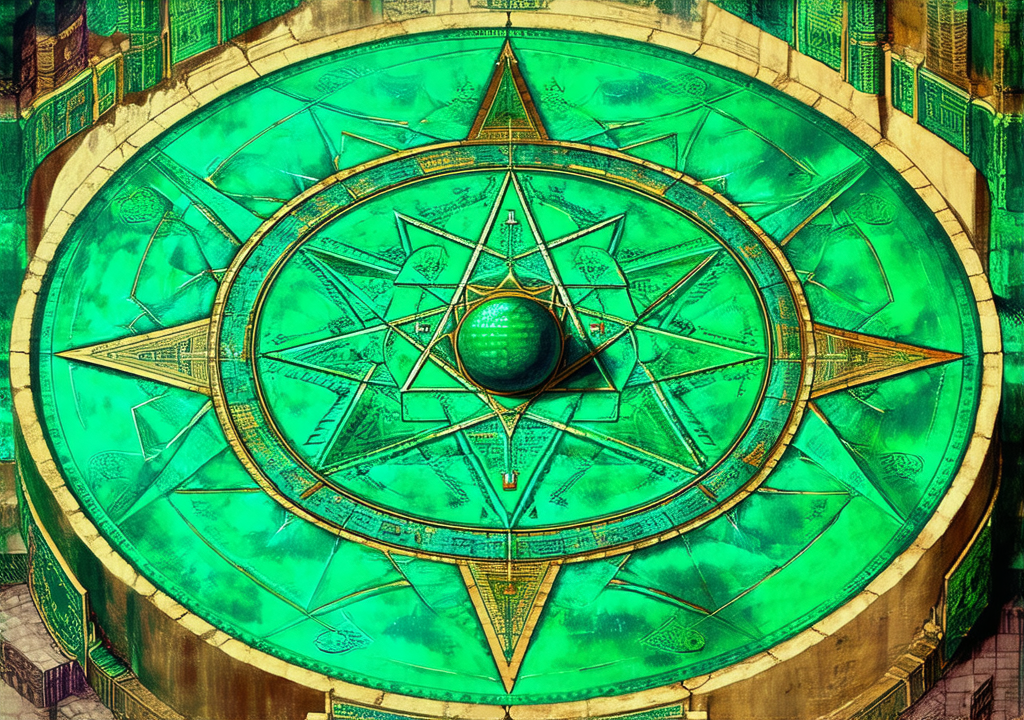
You carry within you a seed—a fragment of the original fire that shaped heaven and earth before time had its own name. This is what Hermes Trismegistus meant when he handed his disciple, Thoth-Hermanubis, the tablet covered in divine script: That which is below is like to that which is above. It is not merely a slogan to be repeated; it is an invitation—to step into a living relationship between your inner world and the cosmos outside.
The Emerald Tablet, that mysterious artifact said to have been buried in a sealed jar beneath the pyramids of Egypt, has survived millennia not as a mere relic but as a living text—one that begins with just seven lines and unfolds into something far greater than words: it is a map for initiation. It speaks of transformation—how the heavy metals can be transmuted within the furnace of the soul; how water becomes spirit; how the sun enters your body to burn away every impurity.
When you commit yourself to this tablet, when you let its principles unfold in meditation and daily practice over thirty days, something remarkable happens. The first week is one of recognition—of noticing what was always there but had been hidden beneath the surface of ordinary consciousness. You begin to see that your body is not separate from the world around it; that breath connects you to the wind; that the metals in your blood are the same as those found deep in the earth. This recognition is not intellectual—it carries weight, substance.
By the second week, the tablet’s teachings cease to be words on a page and begin to pulse behind your eyes during meditation. You will find yourself thinking in terms of correspondences—how the planets mirror organs; how numbers align with breath; how silence itself becomes a kind of language older than speech. The Emerald Tablet teaches that there is no separation between macrocosm (the great world) and microcosm (the small one). Everything you carry within echoes outwards, everything outside mirrors what lives inside.
During the third week, you will notice shifts in perception—sometimes subtle, sometimes startling. A particular kind of stillness becomes available, like a room clearing itself of furniture. Dreams grow denser, more vivid; they begin to contain their own logic and instruction. You may find yourself waking at certain hours without knowing why—the early morning between dawn’s first light and the sun’s actual emergence carries special potency according to Hermetic tradition.
The fourth week reveals what has been working silently through you: the tablet itself, once internalized, begins working on its own schedule. What it does is slow your descent into ordinary awareness while simultaneously accelerating your capacity for seeing. You are not becoming someone new but remembering who you already were before forgetfulness set in. The practice of thirty days—of returning daily to this small book—is designed precisely for this: to let the principles settle like sediment, until they become part of your own substance rather than merely facts you carry intellectually.
There is also a practical dimension worth noting. Following the tablet involves not just meditation but alignment—with one’s body, with one’s words, with one’s intentions. Each day brings new opportunities for living what was learned yesterday. The Hermetic student does not merely study; they embody.
What remains after thirty days is a self that has been refined through fire—through repeated attention, through the slow burn of daily return to this ancient source. You will find yourself seeing through things differently—not just intellectually but viscerally. Where before there was only surface, now depth. Where before only fragmentation, now unity.
The tablet itself does not change; what changes is you. And when you emerge from those thirty days, carrying with you the wisdom of Hermes—As above, so below; as within, so without—you carry something more than knowledge. You carry a key. One that opens doors long sealed shut in the human heart.
Follow this path for thirty days—and what follows will not be mere instruction. What follows is initiation.


















No Comments