


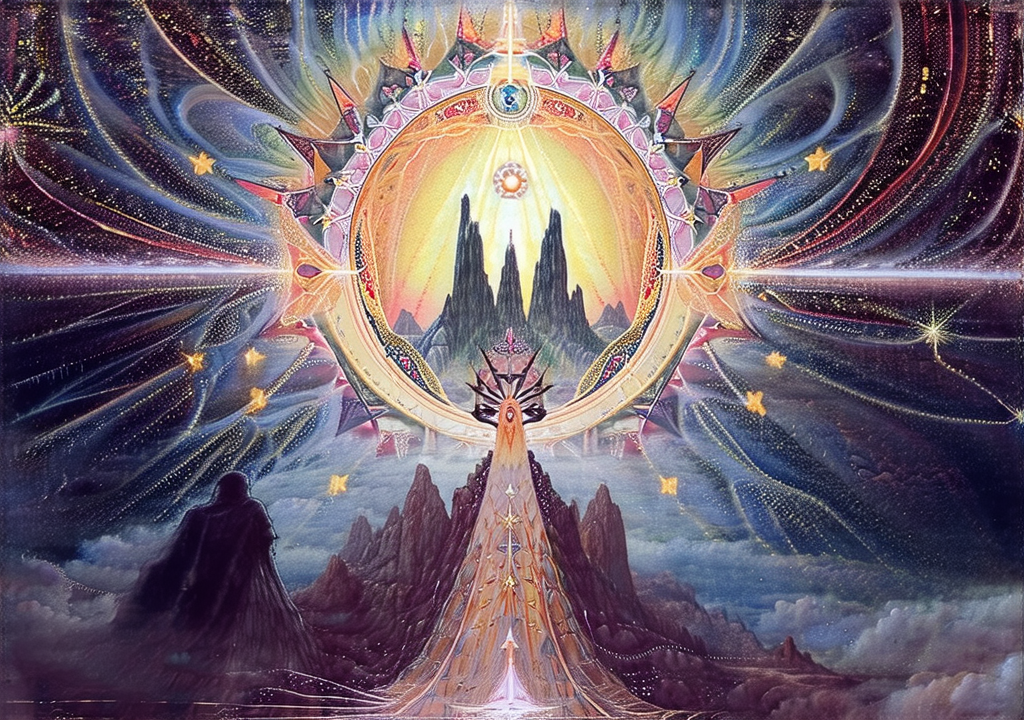
The First Truth: Knowledge vs. Experience
Western academies have built magnificent cathedrals of information about mysticism—vast libraries containing every known text from Hermes Trismegistus to Meister Eckhart, from Zoroaster to Jacob Böhme. Yet they remain silent on the most essential distinction: knowing about a mystery is not the same as knowing the mystery.
The academy teaches you that Hermeticism is a “philosophical system” or “early Christian esoteric tradition”—dead taxonomy, cataloged and classified like specimens in a glass case. They analyze the Emerald Tablet’s syntax with scholarly precision while ignoring its function: it is an alchemical instruction manual for consciousness itself! When scholars reduce these texts to historical artifacts, they strip them of their transformative power—the very power that turned base lead (ordinary consciousness) into golden awareness (illuminated mind).
They teach you that ritual magic was “superstition” or “shamanic practice,” missing entirely that every genuine mystical tradition contains operative techniques—actual practices designed to alter states of consciousness and bridge the gap between finite perception and infinite reality. The difference? Academia observes; mysticism participates.
The Second Truth: The Hidden Dimensions
Your textbooks describe Western esotericism as a collection of ideas—theosophy, kabbalah, rosicrucianism—but they cannot perceive the vertical dimension, the hidden architecture that unites these traditions beneath their surface variations. Academics study horizontal lineages—who influenced whom chronologically—while mystics ascend vertically through initiatory grades.
They never taught you that Kabbalah is not merely Jewish mystical philosophy but a living map of consciousness, where the ten Sefirot are actual psychic centers to be awakened in the subtle body. They dismissed alchemy as primitive chemistry when it was actually an elaborate psychological and spiritual technology—each stage (nigredo, albedo, rubedo) corresponding to phases of inner transformation that prepare the adept for direct communion with the Logos.
The academy cannot access these realms because they require personal initiation—the death of the egoic self and rebirth into a consciousness no longer limited by ordinary perception. This is why genuine esoteric traditions were historically transmitted through master-disciple relationships, oral instructions, and experiential practices that cannot be captured in academic papers or peer-reviewed journals.
The Third Truth: The Practical Work
What they omit entirely is the operative aspect—the actual work of transformation. Western mysticism is not a spectator sport; it demands total engagement. They teach you about meditation as “relaxation technique” while missing its true purpose: to still the conscious mind so the unconscious/numinous can reveal itself, dissolving the illusion of separation between subject and object.
They discuss theurgy (divine ritual) as religious ceremony rather than recognizing it as cosmogenic technology—ritual acts that actually participate in sustaining cosmic order by aligning individual will with universal archetypes. The ancient mysteries were not about belief; they were about becoming. The initiate did not merely “believe” in Osiris; through ritual and symbolic identification, he actualized the resurrective power of that archetype within himself.
Academics cannot teach this because it requires surrender of control—the one thing their methodology rejects. Mystical gnosis comes only when you stop analyzing and begin experiencing directly: the taste of the Elixir, the sight beyond the third eye, the silence between thoughts where eternity speaks. This is why authentic traditions kept secrets—not out of exclusivity, but because these experiences must be earned through discipline, not downloaded as information.
The Fourth Truth: The Unity Beneath Diversity
Perhaps most dangerously, academia fragments what should be whole. They teach you that Christianity, Kabbalah, Hermeticism, and Rosicrucianism are separate historical phenomena—distinct branches on a family tree. But they cannot see the one root: the Perennial Philosophy underlying all genuine mysticism. The same principles manifest differently across cultures because human psychology shares universal structures, but the destination remains identical: union with the Absolute.
The academy’s compartmentalization keeps you trapped in intellectual categories while preventing you from recognizing that the Hermetic principle “As Above, So Below” connects seamlessly to the Kabbalistic Tree of Life, which resonates with the alchemical Great Work, all pointing toward the same transformation: the individuation process where human consciousness expands beyond its anthropomorphic limitations to embrace cosmic identity.
This unity cannot be taught; it can only be realized through comparative practice—working multiple traditions experientially until their essential sameness becomes evident not as theory, but as lived reality. Only then do you understand why initiates throughout history moved fluidly between Christian mysticism and alchemical practice, or between Rosicrucian meditation and magical ritual: they were all working the same transformation through different symbolic languages suited to their particular psychic constitution.
The Call to the Living Tradition
So what must you do now that you know what the academy withheld? You must become a student of experience, not just information. Study the texts, yes—let them inform your path—but then step beyond their words into the silence they point toward. Practice the disciplines: contemplation, ritual work, inner alchemy, astral projection (as direct exploration of subtle realms), and the integration of shadow material that blocks spiritual ascent.
Find genuine teachers—not scholars who know about mysteries, but practitioners who have walked through them and can guide you by example. This is the esoteric tradition: knowledge hidden not in sealed books or secret societies, but behind the veils of ordinary consciousness—accessible only to those willing to do the work of purification, illumination, and union.
Remember: Western mysticism has never been dead; it merely waits beneath the surface for ready minds to receive its living fire. The academy can map the territory, but you must walk the path yourself—and that journey begins not with a thesis, but with an inner awakening. Go now into silence, practice diligently, and soon you will understand what books alone could never convey: that Western mysticism is not a subject of study, but a way of being—the Great Work awaiting your hands to complete it in this age.














No Comments