


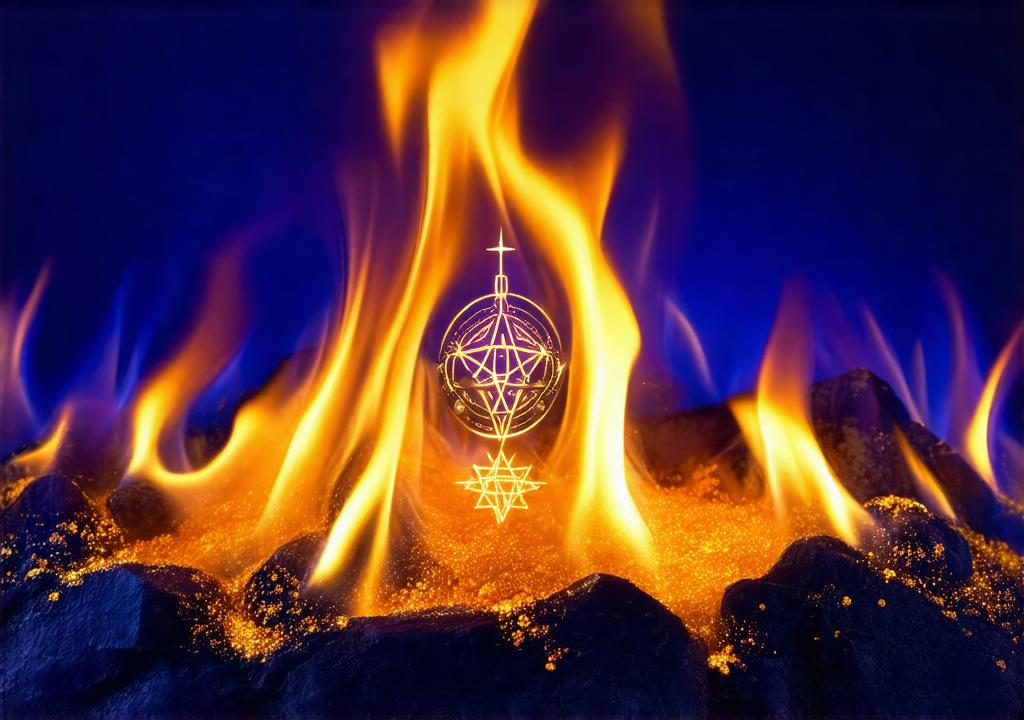
Alchemical Transmutation: Turning the Base into Gold
For over three millennia, practitioners of the Great Art have known that transmutation is not merely a chemical process—it is an ontological one. When alchemists speak of turning lead into gold, they are not speaking of simple rearrangement of particles, but of revealing what was always latent within every substance: its essential form, hidden like seed in soil or potential awaiting realization.
At the heart of this discipline lies a fundamental principle that has guided adepts from Paracelsus through modern laboratory science and into contemporary esoteric practice: the world operates on multiple dimensions simultaneously, with spirit and matter existing not as opposites but as complementary expressions of a single underlying reality. This is where the alchemical art truly begins—not in retorts and alembics alone, but within the hidden dimension where spirit meets matter, and everything changes.
The Nature of Alchemical Change
Alchemical transmutation differs from ordinary chemical reactions in its scope and intention. Where chemistry rearranges existing material according to measurable laws, alchemy seeks to liberate potential from matter through intentional engagement with what practitioners call the “active principle” or prima materia. This is not mere transformation; it is revelation. The lead does not become gold so much as reveal that it was always gold in essence, waiting for appropriate conditions of heat, time, and intention to manifest its true nature.
The Great Work demands a specific kind of participation from the practitioner—one who understands that matter is never passive but always receptive to spiritual influence. Ancient texts describe this relationship using terms like mercury, sulfur, and salt—not as specific chemical elements (though they correspond to them) but as archetypes: mercury for fluidity, sulfur for combustibility, salt for stability. Together, they form a triad that mirrors the threefold structure of spirit, soul, and body in alchemical thought.
The Transmutation Process
The practical art unfolds through several stages, each corresponding to both material processes and spiritual states. The initial stage—nigredo or “blackening”—represents dissolution, where matter breaks down into its constituent parts. Practitioners might use heating, fermentation, or putrefaction as methods, but the principle is always the same: returning base form to a state of potential.
The second stage, albedo or “whitening,” involves purification—the separation of essence from dross. Here, the material becomes lighter, more refined, more receptive to further transformation. The third stage, citrinitas, marks the beginning of golden quality emerging in the substance. Finally, rubedo brings completion—the final reddening and full realization of the work.
Each stage has its corresponding planetary association, each color its own meaning, each temperature its unique signature. But these are not mere correspondences; they represent a living relationship between the microcosm (the laboratory) and macrocosm (the cosmos), between practitioner and matter.
Spirit Meets Matter: The Hidden Dimension
The crucial insight—that which makes alchemy more than chemistry—is that spirit enters matter through this hidden dimension at specific moments of transformation. In medieval thought, this moment was called the coincidentia oppositorum, the coincidence of opposites. When mercury and sulfur united in precise proportion under the right conditions, spirit passed into matter like breath passing through flesh—neither separate from nor identical with it, but inseparable once joined.
Modern practitioners might describe this differently: as a resonance between electromagnetic fields, or as quantum transitions between energy levels. But the essential truth remains: there exists a dimension where spirit and matter are not two distinct substances, but expressions of one reality in different modes. When they meet—when spiritual intention enters material form with precision—the result is transmutation: gold from lead, inspiration from habit, healing from disease.
The Practice Today
Modern alchemical practice has expanded beyond laboratory retorts to include meditation on symbols, visualization techniques, and even what some practitioners call “inner work”—meditating upon the transmutation process while simultaneously performing external experiments. The principle remains constant: intention enters matter when conditions are right, and transformation follows.
What makes this art enduring is that it works whether performed in a medieval laboratory or modern one, through prayer or through precise measurement, through ritual or through scientific experiment. The hidden dimension where spirit meets matter operates independently of the method used to engage it—though certain methods facilitate access more readily than others.
Conclusion: Everything Changes
The alchemist’s art offers not merely gold or healing or longevity but a way of understanding how reality works at its deepest level. When we recognize that matter contains spirit within itself—that lead is always potential gold, that base substances carry divine qualities waiting to be revealed—we begin to see the world differently. We become participants in the great work, conscious partners with spirit in the ongoing transformation of matter toward its true form.
The hidden dimension where spirit meets matter is not far away; it runs through every stone and plant and creature around us. It opens when we engage it with intention, knowledge, and love. And everything changes—because once you recognize that the base is always the potential for gold, you cannot look at the world in quite the same way again.
















No Comments