


By Agatha Bell, Witch of the Third Circle
Modern witchcraft finds itself at a crossroads. We live in an age of digital magic—social media coven meetings, online tarot readings, and apps that tell us when to plant herbs by phase of moon. Yet something essential has been lost in this transition from tradition to convenience. The rituals that once anchored the witch’s craft have become optional accessories rather than foundational elements of practice. It is time for a reckoning: why modern witchcraft needs ancient rituals back.
The ancient ritual, as practiced by our forebearers, was not merely decorative. Every movement had meaning—every gesture tied to celestial bodies, every spoken word carrying vibrational weight that resonated beyond the physical realm. When medieval witches walked in procession during Beltane, their feet struck earth with intention; when they raised a cauldron of herbs, steam rose as visible prayer ascending toward the etheric planes. These were not primitive practices born from ignorance but sophisticated methods developed through millennia of accumulated wisdom.
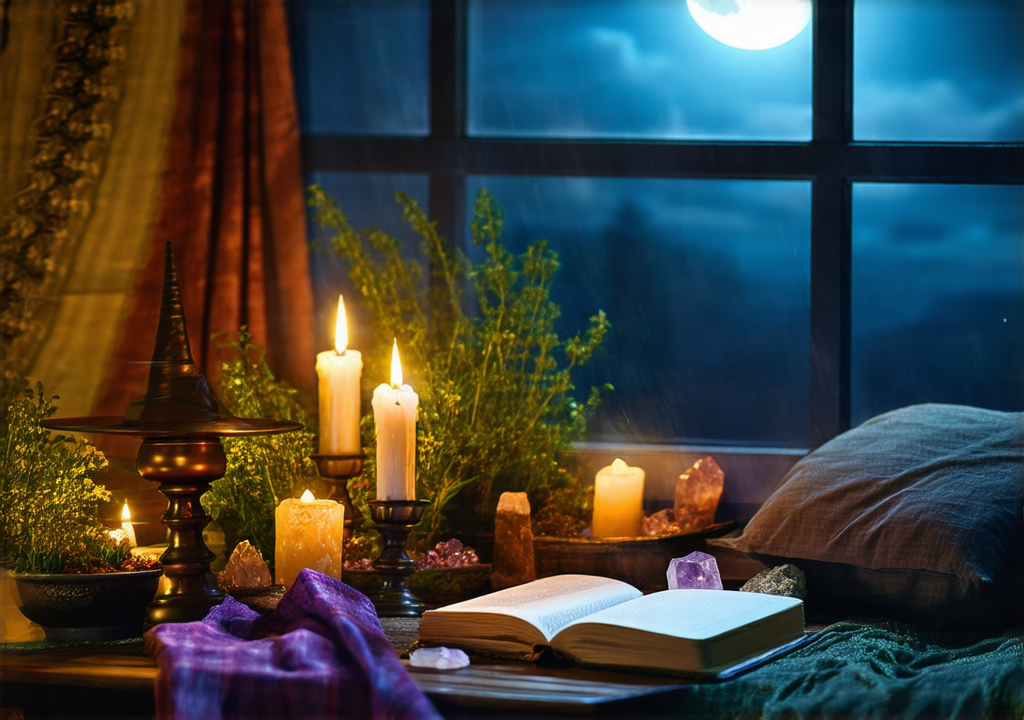
Consider the simple act of lighting an altar candle. In modern witchcraft, we flick on our smartphones to set alarms for moon phase changes and then perhaps light a scented candle while sipping chamomile tea from ceramic mugs that may have been purchased online with one-click delivery. Meanwhile, ancient practitioners would prepare their candles themselves from beeswax harvested at specific times of year, shape them by hand according to lunar cycles, and arrange them in patterns that corresponded to elemental forces. The difference is not merely aesthetic—it is foundational to how ritual transforms consciousness.
The word “witchcraft” itself derives from Old English wīte, meaning knowledge or insight. This etymology reveals something profound: ancient rituals were never about external objects alone but about cultivating internal knowing through deliberate, repeated practice. When a witch performs a banishing pentagram in the modern tradition, tracing its lines with athame while visualizing sacred geometry, they are not merely recreating a pattern but engaging with forces that have guided human consciousness since the dawn of symbolic thought.
Yet contemporary witchcraft often reduces these patterns to mere decoration. We buy commercially-produced ritual tools—often mass-produced and made in distant factories—and use them without understanding their deeper significance. Our “tools” become things rather than instruments; they hold objects instead of channels for force. This is not to say that modern witches cannot wield ancient rituals effectively, but merely that we have forgotten how deeply embedded these practices were in daily life.
The problem extends beyond materials and methods. Modern witchcraft often treats ritual as optional—something added to enhance a spell or decorate a altar rather than something essential for transforming consciousness. Ancient practitioners understood that ritual was not separate from ordinary activities but interwoven with every aspect of life: cooking, growing, building, healing. When they worked with herbs, they did so knowing which moon phase each would yield maximum potency; when they walked through forests or fields, they recognized spirits and spoke to them as one might speak to family members; when they built homes, they aligned them with ley lines and celestial alignments.
Today’s witchcraft has gained tremendous insight from its modernization—diversity in practice, accessibility across cultures, integration of psychology and neuroscience—but we have lost something vital along the way: the sense that ritual is not merely symbolic but operative. When an ancient priestess raised her hands toward heaven during solstice, she was not “pretending” to connect with divine forces; she was doing so through methods that had proven effective across generations.
The revival of ancient rituals in contemporary witchcraft does not mean abandoning modern approaches—nor does it require returning to a specific historical period as ideal. Rather, it means recognizing which practices have proven enduring across millennia and incorporating them meaningfully into modern practice. This is not nostalgia; it’s synthesis. When we light candles prepared according to traditional methods while working with digital tools for tracking celestial movements, we are doing exactly what our ancestors did: adapting ancient wisdom to contemporary needs without losing its essence.
The reason matters profoundly. Ancient rituals carry within them patterns that have shaped human consciousness across millennia. They work not merely because they look correct or because they follow tradition but because they activate specific energies and relationships between the practitioner and the cosmos. When we forget these deeper layers, we reduce our craft to mere habit; when we embrace them fully, we transform ourselves through intentional practice that bridges earth and sky, past and future, individual consciousness with universal forces.
Modern witchcraft needs ancient rituals back—not as relics preserved in glass cases but as living practices that continue to shape how we perceive reality itself. When the modern witch traces pentagrams, raises cauldrons, and speaks invocations while simultaneously using digital tools for tracking celestial events, they are doing what our ancestors did: bridging earth and sky through deliberate practice. The ritual is not merely symbolic; it is operative.
In this way, why modern witchcraft needs ancient rituals back becomes clear: we need them because without their grounding in centuries of accumulated wisdom, our craft lacks depth; yet we also need to integrate them meaningfully into contemporary life so that they remain living practices rather than decorative artifacts. This synthesis—ancient wisdom integrated with modern sensibility—is where true witchcraft flourishes.


Recent Post


Gallery






Featured Videos





No Comments